August 6, 2026
Regional Energy Security Architecture in South Asia
Energy diplomacy in South Asia has evolved from traditional bilateral trade frameworks into sophisticated crisis response mechanisms that reflect deeper geopolitical alignments. The region's interconnected energy vulnerabilities create cascading effects when global supply chains face disruption, forcing nations to activate emergency partnership protocols that extend far beyond commercial arrangements.
Understanding these dynamics requires examining how strategic energy partnerships function as both economic instruments and diplomatic tools, particularly when external conflicts threaten established supply routes. The March 2026 Middle East escalation demonstrated how quickly regional energy security can shift from routine commercial transactions to high-stakes diplomatic coordination, with the India petroleum shipment to Sri Lanka serving as a prime example of this evolution.
When big ASX news breaks, our subscribers know first
India's Neighbourhood First Energy Framework
The Architecture of Strategic Energy Partnerships
India's systematic approach to regional energy security extends beyond traditional commercial relationships to encompass comprehensive crisis response capabilities. This framework operates through multiple institutional channels, with Indian Oil Corporation's subsidiary Lanka IOC serving as the primary operational vehicle for emergency fuel supplies to Sri Lanka.
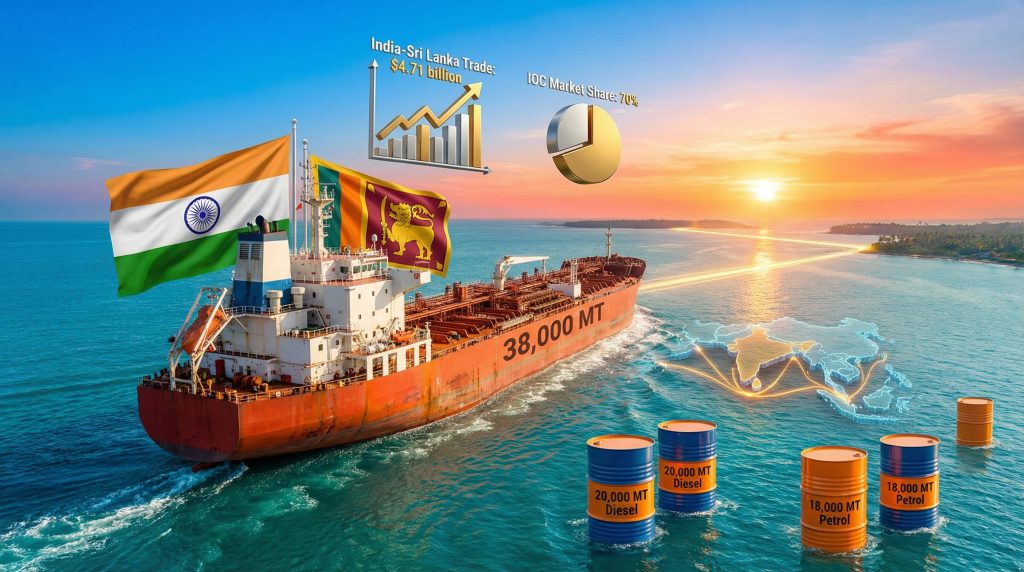
The scale of this partnership becomes evident through trade volume analysis: bilateral commerce between India and Sri Lanka reached $4.71 billion in 2024, with petroleum products comprising approximately 29% of total exports. This substantial energy trade dependency creates both vulnerability and opportunity for crisis management, particularly when considering the broader energy security transition affecting regional markets.
Key Components of India's Energy Partnership Model:
• Government-to-government coordination mechanisms for emergency response
• Commercial subsidiary operations (Lanka IOC) maintaining 70% market share in Sri Lankan fuel supplies
• Multi-level diplomatic engagement from ministerial to prime ministerial levels
• Alternative supplier activation protocols when primary sources fail
Historical Evolution of Crisis Response Mechanisms
The transformation from bilateral trade to crisis response architecture reflects India's broader Neighbourhood First policy implementation. This evolution accelerated following regional economic disruptions in the early 2020s, when traditional supply chain reliability faced increasing uncertainty.
Emergency Response Timeline Analysis (March 2026):
| Date | Action | Officials Involved |
|---|---|---|
| March 23 | Preliminary diplomatic coordination | External Affairs Minister S. Jaishankar, Foreign Minister Vijitha Herath |
| March 24 | High-level crisis consultation | PM Modi, President Anura Kumara Disanayaka |
| March 28 | Emergency shipment arrival | 38,000 MT petroleum delivery to Colombo |
This four-day response window demonstrates institutional capacity for rapid crisis intervention, moving from diplomatic identification of supply disruptions to physical delivery of emergency fuel supplies.
Middle East Conflict Impact on Regional Supply Chains
Force Majeure Declarations and Supply Disruptions
The March 2026 Middle East escalation created systemic disruptions across global energy supply chains, with particular impact on South Asian markets dependent on Gulf petroleum exports. The conflict escalated during the second week of March when attacks targeted energy infrastructure including oil tankers, refineries, and LNG facilities.
Furthermore, the crisis highlighted how OPEC market influence can rapidly shift during geopolitical tensions, affecting pricing mechanisms and supply allocation across regional markets.
Supply Chain Disruption Mechanisms:
• Vessel unavailability due to port congestion and route diversions
• Force majeure invocations by multiple contracted suppliers simultaneously
• Route disruptions affecting traditional energy transit corridors
• Insurance complications for petroleum cargo in conflict zones
Lanka IOC had secured March fuel supplies from Middle East and Singapore sources before suppliers expressed inability to fulfil delivery obligations. The simultaneous force majeure declarations by multiple contractors indicated systemic supply chain failure rather than isolated commercial disputes.
Sri Lanka's Energy Vulnerability Assessment
The island nation's energy crisis manifested through severe conservation measures implemented across government and private sectors. Fuel prices increased by 33% since the Middle East conflict escalation, creating substantial economic pressure on both institutional and individual consumers.
Moreover, the crisis demonstrated how oil price movements during conflict periods can severely impact small island economies with limited strategic reserves.
Conservation Strategy Implementation:
• Four-day working week for state sector institutions
• 25% electricity consumption reduction targets
• Street lamp shutdown protocols during peak hours
• Air conditioning restrictions in government buildings
• Electric vehicle charging limitations during grid peak periods
The government ordered citizens to avoid overnight EV charging, recommending daytime charging when excess solar power capacity becomes available. This reflects sophisticated grid management during energy shortages.
Fuel Reserve Analysis:
| Fuel Type | Reserve Duration | Strategic Implications |
|---|---|---|
| Diesel | Until mid-May 2026 | Critical for transportation and industrial operations |
| Petrol | Until late May 2026 | Essential for private vehicle mobility |
| Combined Impact | 6-8 weeks total | Requires emergency intervention for supply continuity |
Technology companies adapted through mandatory work-from-home arrangements, with WSO2 implementing remote work for 500 employees on Tuesdays and Thursdays as their contribution to national energy conservation efforts.
Geopolitical Sanctions and Alternative Energy Sources
US Sanctions Relaxation Framework
The Middle East crisis prompted US sanctions relaxation specifically targeting petroleum already loaded on vessels at sea. This policy adjustment aimed to address global supply disruptions without fully normalising Russian energy commerce with previously restricted countries.
However, these developments intersected with broader tariff policy implications affecting global trade relationships and energy commerce patterns.
Sanctions Architecture Changes:
• Pre-existing constraints: Comprehensive US sanctions prevented Russian petroleum transactions with Sri Lanka
• Emergency exemption: Specific allowance for already loaded petroleum cargo
• Policy rationale: Global supply crisis management without complete sanctions normalisation
• Scope limitation: Applies only to petroleum in transit, not future contracting
This created opportunities for Sri Lanka to access alternative energy sources previously unavailable due to sanctions compliance requirements.
Russia-Sri Lanka Energy Cooperation Development
Deputy Energy Minister Roman Marshavin's bilateral visit to Sri Lanka focused on establishing comprehensive energy cooperation frameworks extending beyond emergency supplies. The Russian Embassy emphasised potential partnerships in fuel supply, energy security, and long-term strategic cooperation.
Diplomatic Engagement Structure:
• Ministerial-level negotiations between Deputy Energy Minister Marshavin and Sri Lankan counterparts
• Ambassador-level coordination through Russian Ambassador Levan S. Dzhagaryan
• Parliamentary support from MP Nalinda Jayatissa advocating diversified supplier relationships
• Presidential endorsement for alternative procurement strategies
Iran as Alternative Crude Oil Source
Parliamentary discussions explored Iranian crude oil procurement as part of comprehensive supplier diversification strategy. This represents strategic energy security planning through non-Western aligned sources, reducing dependency on traditional Middle Eastern suppliers affected by regional conflicts.
In addition, these negotiations reflected broader regional dynamics, particularly considering Saudi energy dynamics and their impact on alternative supplier relationships.
The government's approach reflects deliberate risk management through multiple supplier engagement, simultaneously negotiating with Russia for refined products and Iran for crude oil feedstock.
Economic Mechanisms of Emergency Fuel Shipments
The 38,000 MT Petroleum Package Analysis
The emergency India petroleum shipment to Sri Lanka composition demonstrates sophisticated logistics coordination tailored to Sri Lankan consumption patterns and immediate needs. 20,000 MT diesel and 18,000 MT petrol allocation reflects transportation sector priorities and industrial requirements.
Shipment Composition and Strategic Rationale:
| Product | Volume | Strategic Purpose |
|---|---|---|
| Diesel | 20,000 MT | Transportation, industrial operations, power generation |
| Petrol | 18,000 MT | Private vehicle mobility, emergency services |
| Total | 38,000 MT | 4-6 week supply bridge during crisis resolution |
The High Commission of India in Colombo coordinated delivery logistics through Lanka IOC subsidiary operations, demonstrating institutional capacity for rapid emergency response outside normal commercial channels.
Financial Architecture of Crisis Assistance
Government-to-government arrangements bypass traditional commercial financing constraints, enabling rapid deployment of emergency supplies during crisis periods. This contrasts with standard petroleum trading requiring advance payment and credit facilities.
India-Sri Lanka Trade Relationship Context:
• Petroleum ether exports grew 196% year-over-year, reaching $1.06 billion (22% of bilateral trade)
• Total bilateral commerce of $4.71 billion provides foundation for emergency assistance
• Lanka IOC operations maintain consistent supply relationships independent of crisis periods
The financial structure demonstrates how strategic partnerships create resilience mechanisms that activate during supply chain disruptions affecting commercial suppliers.
Domestic Policy Reform and Energy Conservation
Implementation of Emergency Conservation Measures
Sri Lankan energy conservation strategies reflect comprehensive approach to demand management during supply constraints. The four-day working week for state institutions represents significant policy intervention affecting productivity patterns across government operations.
Sector-Specific Adaptation Strategies:
• Banking sector: Reduced operational hours to minimise electricity consumption
• Education system: Universities and schools shifted to abbreviated schedules
• Transportation: Rail and bus services adjusted to reduced demand patterns
• Private sector: Technology companies implemented mandatory remote work arrangements
Grid Management and Renewable Integration
Electric vehicle charging restrictions during peak hours demonstrate sophisticated grid management balancing supply constraints with renewable energy availability. The recommendation for daytime EV charging leverages excess solar power capacity during midday periods.
Grid Optimisation Measures:
• Peak hour demand reduction through EV charging restrictions
• Solar power utilisation for daytime energy-intensive activities
• Street lighting limitations reducing evening electricity consumption
• Air conditioning restrictions in government facilities
This approach reflects understanding of renewable energy generation patterns and their integration with crisis demand management.
The next major ASX story will hit our subscribers first
Regional Partnership Development and Future Energy Security
Parliamentary Recognition of Strategic Partnership Value
MP Namal Rajapaksa articulated the strategic importance of India's crisis response, emphasising the Neighbourhood First policy as foundational to regional energy security. His parliamentary statement highlighted India's role as Sri Lanka's first responder during critical supply disruptions.
Strategic Partnership Framework Elements:
• Crisis response protocols enabling rapid fuel supply deployment
• Economic assistance mechanisms extending beyond emergency interventions
• Regional cooperation models for comprehensive energy security
• Tax policy coordination learning from India's market stabilisation approaches
Rajapaksa noted India's fiscal policy approach: reducing excise duty not for immediate price decreases, but for market stabilisation preventing further increases during global oil price volatility.
Long-term Energy Infrastructure Investment Opportunities
The crisis response success creates foundation for expanded energy infrastructure development through Indo-Sri Lankan partnerships. Lankan IOC's operational effectiveness during supply disruptions demonstrates capacity for infrastructure expansion and modernisation.
Investment Development Areas:
• Refining capacity expansion reducing import dependency
• Storage infrastructure development for strategic petroleum reserves
• Renewable energy integration with grid modernisation
• Regional energy hub development through maritime logistics enhancement
Foreign Direct Investment Implications:
• Technology transfer opportunities in renewable energy sectors
• Infrastructure modernisation through strategic partnerships
• Regional energy independence reducing external vulnerability
• Economic development acceleration through energy security foundation
The March 2026 crisis response demonstrates how emergency energy diplomacy creates opportunities for long-term strategic partnership development. Consequently, the successful India petroleum shipment to Sri Lanka transforms crisis management into sustainable regional energy security architecture.
Furthermore, as reported by Business Today, the rapid response highlighted how relationships are tested during crisis periods. Additionally, The Hindu emphasised the strategic significance of this emergency fuel delivery within broader regional security frameworks.
Investment Considerations: Energy security partnerships involve geopolitical risks that can affect commercial returns and operational continuity. Investors should consider regulatory changes, sanctions evolution, and regional stability when evaluating energy infrastructure opportunities in South Asia.
Ready to Profit from Energy Sector Volatility?
Discovery Alert's proprietary Discovery IQ model delivers real-time alerts on significant ASX energy and critical minerals discoveries, instantly empowering subscribers to identify actionable opportunities ahead of the broader market. Begin your 14-day free trial today and secure your market-leading advantage in the rapidly evolving energy transition sector.