May 21, 2026
Understanding Regional Hydrocarbon Development Dynamics
Southern Africa's energy landscape undergoes fundamental transformation as nations transition from traditional commodity extraction toward integrated value-chain development. This shift reflects broader economic diversification strategies across post-colonial economies, where industrial expansion demands substantial energy infrastructure investment and technological partnerships with international stakeholders.
The regional approach to hydrocarbon development varies significantly across territories, with each nation pursuing distinct strategies based on geological advantages, regulatory frameworks, and capital market access. While some focus on export-oriented liquefied natural gas facilities, others emphasise domestic industrial transformation through gas-to-power and petrochemical manufacturing applications.
Zimbabwe oil and gas partnerships represent a strategic pivot toward beneficiation-focused development, distinguishing the country's approach from purely extractive models prevalent across the continent. Furthermore, this transformation occurs within broader Southern African hydrocarbon expansion, as multiple nations simultaneously develop exploration and production capabilities across diverse geological formations, influenced by oil price rally dynamics affecting regional investment decisions.
When big ASX news breaks, our subscribers know first
Strategic Positioning Within Southern African Energy Markets
Comparative Regional Approaches to Hydrocarbon Development:
| Territory | Primary Strategy | Development Stage | Key Focus Areas |
|---|---|---|---|
| Mozambique | LNG Export Hub | Advanced Production | Offshore gas, international markets |
| Namibia | Offshore Development | Early Production | Deep-water exploration, oil focus |
| Botswana | Coalbed Methane | Pilot Projects | Domestic power generation |
| Zimbabwe | Beneficiation Focus | Exploration-Production | Value addition, manufacturing |
The strategic differentiation lies in Zimbabwe's emphasis on downstream processing rather than raw hydrocarbon exports. This approach prioritises industrial transformation through energy-intensive manufacturing, chemical production, and fertiliser synthesis. Consequently, the model requires sophisticated technological partnerships and substantial capital investment in processing facilities, mirroring broader mining evolution trends across the region.
Regulatory Framework Advantages
Zimbabwe's investment attraction strategy centres on regulatory clarity and streamlined approval processes. The framework provides competitive advantages through:
• Expedited licensing procedures reducing exploration approval timelines
• Transparent fiscal regimes offering certainty for long-term capital deployment
• Community engagement protocols ensuring social licence for operations
• Technology transfer facilitation supporting knowledge acquisition from international partners
The regulatory approach emphasises investor confidence building through consistent policy implementation and transparent decision-making processes. This contrasts with complex approval mechanisms in neighbouring territories, creating competitive advantages for capital mobilisation.
International Partnership Architecture
Zimbabwe oil and gas partnerships leverage two primary investment corridors: Australian capital markets and West Asian technical expertise. These partnerships provide complementary capabilities essential for capital-intensive exploration and production operations.
Australian Capital Market Integration
Australian-listed companies utilise developed capital markets for international fundraising whilst expanding operations across Southern African territories. This structure provides several strategic advantages:
• Advanced regulatory compliance meeting international ESG standards
• Institutional investor access through established Australian Stock Exchange listings
• Technical expertise transfer leveraging Australian mining sector capabilities
• Risk management frameworks suitable for frontier market operations
The Australian partnership model demonstrates successful capital mobilisation through developed market exchanges, indicating institutional confidence in Zimbabwe's hydrocarbon potential among sophisticated investors. For instance, Invictus Energy exemplifies this Australian-listed approach to African hydrocarbon development.
West Asian Technology Transfer
West Asian partnerships bring proven hydrocarbon sector experience and technological capabilities essential for commercial development. These collaborations focus on:
• Advanced exploration technologies confirming commercial reserve viability
• Extraction methodology transfer from established regional operations
• Processing facility development for downstream value addition
• Operational expertise in gas-to-chemical manufacturing applications
The combination of Australian capital markets access and West Asian operational expertise creates a comprehensive partnership framework supporting integrated hydrocarbon development from exploration through commercial production.
Industrial Transformation Through Gas Utilisation
Confirmed gas discoveries drive Zimbabwe's industrial capacity expansion through multiple application channels. The strategic focus emphasises domestic value addition rather than raw export, aligning with broader economic diversification objectives, particularly as Australian market insights suggest growing investor appetite for value-added energy projects.
Power Generation Infrastructure
Gas-fired electricity generation addresses Zimbabwe's energy deficit whilst supporting industrial expansion. The development strategy encompasses:
• Base-load power capacity providing consistent electricity supply for manufacturing
• Industrial electricity provision supporting energy-intensive beneficiation operations
• Grid stability enhancement reducing dependence on regional power imports
• Mining operation support powering mineral processing facilities
Gas discoveries prove particularly attractive for their applications in power generation, fertiliser production, and chemical manufacturing, creating integrated industrial development opportunities.
The electricity generation component addresses fundamental infrastructure constraints limiting industrial expansion across Southern Africa's developing economies.
Chemical Manufacturing Development
Downstream chemical applications represent the core value-addition strategy, transforming raw gas into higher-value manufactured products:
Fertiliser Production Applications:
• Ammonia synthesis for agricultural fertiliser manufacturing
• Urea production supporting regional agricultural productivity
• Export potential to neighbouring agricultural markets
• Import substitution reducing foreign currency requirements
Petrochemical Manufacturing Opportunities:
• Methanol production for industrial chemical synthesis
• Plastic precursor manufacturing for regional markets
• Synthetic fuel production capabilities
• Advanced chemical synthesis applications
This approach creates integrated value chains from gas extraction through finished chemical products, maximising economic benefits whilst building regional industrial capacity.
Regional Energy Interconnectivity Strategy
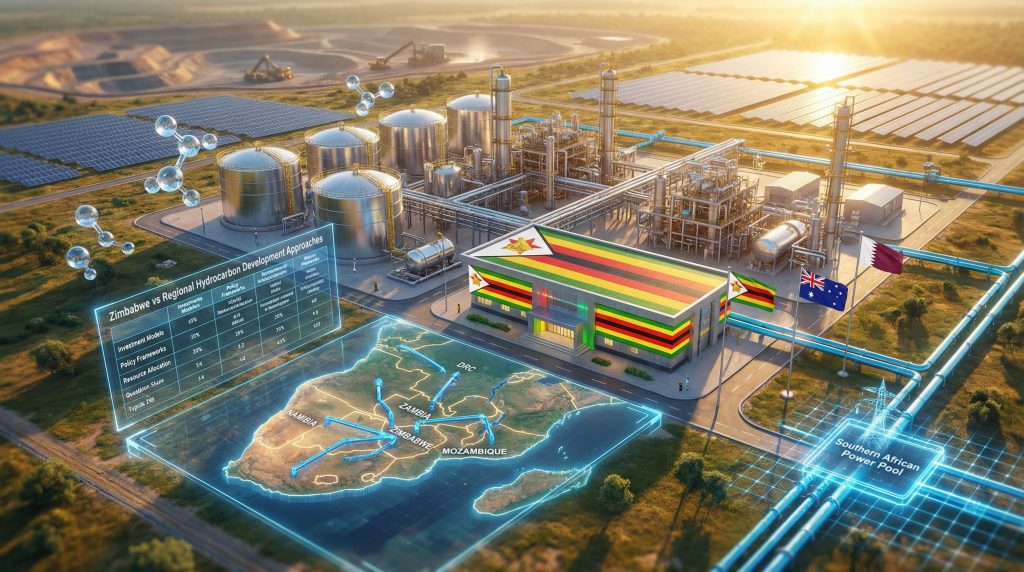
Zimbabwe's participation in Southern African Power Pool (SAPP) frameworks enables regional market expansion beyond domestic demand limitations. The interconnectivity strategy encompasses electricity trading and cross-border pipeline infrastructure development, influenced by global developments such as Saudi exploration licenses affecting regional investment flows.
Cross-Border Infrastructure Development
Proposed pipeline networks create regional energy distribution capabilities:
Priority Pipeline Connections:
- Mozambique Route – Linking to established LNG infrastructure and port facilities
- Namibia Connection – Supporting emerging offshore hydrocarbon developments
- Zambia Pipeline – Serving copper mining energy requirements
- Democratic Republic of Congo Access – Reaching high-demand mining operations
These connections enable Zimbabwe to serve as a regional energy hub, distributing domestically produced gas to high-demand industrial applications across Southern Africa's mining and manufacturing sectors.
Mining Sector Demand
Regional mining operations represent substantial energy demand centres, particularly copper processing facilities in Democratic Republic of Congo and Zambia. This demand provides:
• Consistent off-take agreements ensuring revenue stability
• Premium pricing opportunities for reliable energy supply
• Long-term contract potential supporting project financing
• Regional market expansion beyond domestic industrial applications
The mining sector focus aligns with Southern Africa's mineral processing expansion, creating synergistic development opportunities across energy and extractive industries.
Investment Framework Optimisation
Zimbabwe's competitive positioning relies on transparent regulatory frameworks and attractive fiscal terms designed to accelerate international capital attraction. The investment approach prioritises long-term partnership development over short-term revenue maximisation.
Fiscal Regime Competitiveness
The investment attraction strategy incorporates several competitive elements:
• Streamlined approval processes reducing bureaucratic delays
• Transparent licensing terms providing investment certainty
• Competitive fiscal arrangements balancing government revenues with investor returns
• Foreign currency access enabling dividend repatriation and equipment imports
This framework addresses primary investor concerns regarding regulatory stability and commercial viability in frontier market environments.
Community Stakeholder Integration
Successful project development requires comprehensive community engagement protocols ensuring social licence for operations. The approach includes:
• Local employment creation in exploration and production operations
• Business opportunity development for local service providers
• Infrastructure development benefiting surrounding communities
• Environmental compliance meeting international sustainability standards
The community engagement emphasis reflects lessons learned from regional hydrocarbon projects, where social acceptance proves critical for operational success.
The next major ASX story will hit our subscribers first
Economic Transformation Implications
Zimbabwe oil and gas partnerships drive fundamental economic restructuring through industrial diversification and export revenue generation. The transformation extends beyond energy sector development to encompass broader manufacturing capacity building.
GDP Diversification Impact
The energy transition creates multiple economic benefits:
Manufacturing Sector Expansion:
• Energy-intensive industry development through reliable gas supply
• Chemical processing facility construction creating skilled employment
• Technology transfer supporting industrial capability building
• Export manufacturing potential reducing import dependence
Balance of Payments Enhancement:
• Reduced energy import requirements preserving foreign currency
• Export revenue potential from surplus energy and chemical production
• International investment inflows supporting infrastructure development
• Regional service provision opportunities in technical sectors
Employment Creation Potential
The hydrocarbon sector development creates employment across multiple skill levels:
• Technical positions in exploration, production, and processing operations
• Engineering roles supporting facility design and construction
• Service sector opportunities in logistics, maintenance, and administration
• Indirect employment through supply chain and community development
This employment creation addresses structural unemployment challenges whilst building technical capabilities essential for industrial transformation.
Multi-Source Energy Integration Strategy
Zimbabwe's approach incorporates hydrocarbon development within broader energy portfolio expansion, avoiding binary choices between fossil fuels and renewable technologies. The strategy emphasises complementary energy source development, particularly as energy transition mining initiatives gain momentum across the region.
What Does Balanced Portfolio Development Look Like?
The energy strategy encompasses multiple generation sources:
Renewable Energy Expansion:
• Solar capacity development leveraging abundant sunshine resources
• Wind power installations in suitable geographic locations
• Hydroelectric rehabilitation and expansion programmes
• Grid integration systems optimising multiple energy sources
Hydrocarbon Integration:
• Gas-fired base-load generation providing grid stability
• Oil reserves development for transportation fuel production
• Petrochemical manufacturing using gas feedstock
• Regional energy export capabilities
This approach recognises that industrial transformation requires diverse energy sources, with gas providing essential base-load capacity complementing variable renewable generation.
Risk Assessment and Mitigation Strategies
Zimbabwe oil and gas partnerships face several operational and market risks requiring comprehensive management strategies. Understanding these challenges enables informed investment decision-making and appropriate risk mitigation planning.
Technical Development Risks
Hydrocarbon exploration and production involves inherent technical uncertainties:
• Geological complexity requiring advanced exploration technologies
• Infrastructure investment demanding substantial capital commitments
• Technical expertise requirements necessitating international partnerships
• Technology transfer challenges in specialised operational areas
These risks are mitigated through comprehensive geological analysis, phased development approaches, and strategic partnerships with experienced international operators.
Market and Regulatory Considerations
External factors may impact project commercial viability:
• Commodity price volatility affecting project economics
• Regional competition from alternative energy sources
• Regulatory evolution potentially modifying operational requirements
• Infrastructure development delays impacting timeline execution
Risk mitigation involves diversified market strategies, flexible development timelines, and comprehensive stakeholder engagement protocols. However, recent developments have shown partnership challenges highlighting the complexity of international hydrocarbon collaborations.
Future Development Scenarios
Zimbabwe's hydrocarbon sector evolution depends on successful partnership execution, infrastructure development, and regional market integration. Multiple scenarios exist for sector development over the next decade.
Short-Term Development Objectives (2025-2028)
Immediate priorities focus on exploration completion and initial production:
• Commercial viability confirmation through advanced exploration programmes
• First gas production from confirmed discoveries
• Initial infrastructure construction supporting production operations
• Regional partnership development for market access
Long-Term Strategic Vision (2029-2035)
Extended development encompasses comprehensive industrial transformation:
• Regional energy hub establishment serving Southern African markets
• Integrated chemical manufacturing creating value-added export products
• Cross-border infrastructure completion enabling regional energy trade
• Technology centre development supporting regional hydrocarbon sector
This vision positions Zimbabwe as a central player in Southern Africa's evolving energy landscape, balancing domestic industrial development with regional market opportunities.
Investment Considerations and Market Outlook
Zimbabwe oil and gas partnerships represent significant opportunities within Southern Africa's expanding hydrocarbon sector, though success depends on effective execution of complex technical and commercial requirements.
The strategic emphasis on beneficiation and value addition differentiates Zimbabwe's approach from purely extractive models, potentially creating higher returns through downstream processing applications. However, this strategy requires sophisticated technical partnerships and substantial capital investment in processing infrastructure.
Regional market integration through Southern African Power Pool participation and cross-border pipeline development provides market expansion opportunities beyond domestic demand limitations. The mining sector's energy requirements across Democratic Republic of Congo, Zambia, and other territories create substantial demand for reliable energy supply.
Disclaimer: This analysis involves forward-looking projections and industry forecasts that contain inherent uncertainties. Hydrocarbon exploration and development involves substantial technical and commercial risks, including geological uncertainty, commodity price volatility, and regulatory changes. Potential investors should conduct comprehensive due diligence and seek professional advice before making investment decisions.
The success of Zimbabwe oil and gas partnerships will ultimately depend on effective regulatory framework implementation, successful international partnership management, and efficient capital deployment across exploration, production, and processing applications within Southern Africa's evolving energy landscape.
Ready to Capitalise on Southern Africa's Energy Transformation?
Discovery Alert's proprietary Discovery IQ model delivers real-time alerts on significant ASX mineral discoveries, instantly empowering subscribers to identify actionable opportunities ahead of the broader market. Understand why major mineral discoveries can lead to significant market returns by exploring Discovery Alert's dedicated discoveries page, showcasing historic examples of exceptional outcomes, and begin your 30-day free trial today to position yourself ahead of the market.