August 14, 2026
Understanding Regional Infrastructure Vulnerabilities in Modern Warfare
The evolution of conflict strategies in the 21st century has fundamentally altered how nations approach regional security and economic warfare. When Iran vows to hit oil sites if US strikes power plants, it demonstrates how traditional military objectives have expanded to encompass critical infrastructure networks that form the backbone of global commerce. This shift represents a calculated approach to leverage economic dependencies rather than relying solely on conventional military superiority.
Contemporary geopolitical tensions demonstrate how energy systems become focal points for strategic pressure campaigns. The interdependence of modern economies creates vulnerabilities that extend far beyond immediate combat zones, with disruptions capable of cascading across multiple continents within hours.
Furthermore, when examining current Middle Eastern conflicts, the targeting of energy infrastructure reveals sophisticated understanding of global supply chain dependencies. Nations now recognise that controlling chokepoints can achieve strategic objectives without requiring extensive territorial occupation or prolonged conventional warfare.
When big ASX news breaks, our subscribers know first
Critical Chokepoints: Geographic Leverage in Global Energy Markets
The concentration of global energy flows through narrow geographic corridors creates systemic vulnerabilities that modern conflicts increasingly exploit. Understanding these chokepoints requires analysis of both their physical characteristics and their role in international commerce.
Strategic Waterway Dependencies
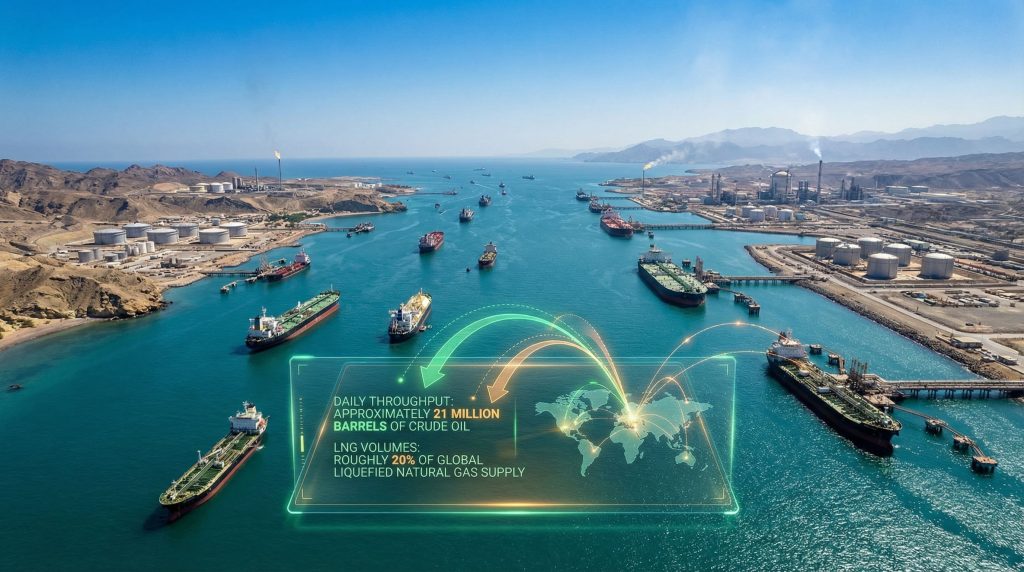
The Strait of Hormuz represents one of the most critical examples of geographic concentration in global energy trade. Current data indicates that approximately 25% of globally traded crude volumes and 20% of LNG supply transit through this narrow waterway, creating acute vulnerability for global energy security.
Recent events have demonstrated the immediate impact of disrupted transit through this chokepoint. Since late February 2026, traffic restrictions have limited vessel movements to only a handful of ships, representing a near-complete shutdown of normal commercial operations.
Physical Constraints and Operational Risks
- Width limitations: Only 21 miles at the narrowest navigable point
- Daily throughput capacity: Approximately 25 million barrels under normal conditions
- Alternative routing: Limited pipeline infrastructure to bypass maritime transit
- Security infrastructure: Concentrated refining and loading facilities within potential conflict zones
The geographic constraints create natural vulnerabilities that cannot be easily mitigated through technological solutions. Unlike pipeline networks that can incorporate multiple valve stations and rerouting options, maritime chokepoints present binary operational states with limited intermediate positions.
Regional Infrastructure Concentration
The Persian Gulf region's energy infrastructure exhibits significant geographic clustering that amplifies systemic risk. Major refineries, loading terminals, and processing facilities operate within relatively small areas, creating potential for cascading failures when individual facilities face disruption.
This concentration pattern evolved due to geological advantages and historical development patterns, but now represents a strategic vulnerability that conflicts increasingly target. However, the density of critical infrastructure means that limited precision strikes can achieve disproportionate economic impact.
Market Response Mechanisms and Price Volatility Patterns
Energy markets demonstrate predictable response patterns to infrastructure threats, with price movements often exceeding the magnitude of actual supply disruptions. Current market conditions illustrate how geopolitical tensions translate into immediate economic consequences across global trading systems.
Crude Oil Market Dynamics
Recent price data reveals the magnitude of market responses to infrastructure targeting. WTI crude futures for April delivery reached approximately $98 per barrel, compared to historical levels around $72 per barrel, representing a 36% price surge that aligns with historical patterns during major Middle Eastern conflicts.
| Market Segment | Immediate Impact | Extended Implications |
|---|---|---|
| Crude Oil Futures | 35-40% price increase | Sustained risk premiums |
| LNG Spot Markets | Regional price doubling | Contract renegotiation pressure |
| Refined Products | Transportation fuel shortages | Strategic reserve activation |
| Shipping Rates | War risk premium application | Insurance market restructuring |
The current market structure demonstrates backwardation conditions that enable strategic reserve releases to be financially viable. This technical market condition allows governments to implement emergency response measures while potentially recovering costs through future market positioning.
Additionally, understanding commodity market volatility helps investors navigate these turbulent conditions effectively.
Emergency Response Protocol Activation
The United States has initiated emergency crude releases from the Strategic Petroleum Reserve, with 172 million barrels scheduled for delivery between April and May 2026. This represents the U.S. component of a broader coordinated response involving multiple nations.
Exchange contracts awarded to companies including Shell, Marathon Petroleum, and BP require eventual return of 55 million barrels to the SPR, representing a 22% premium over the borrowed volumes. This structure ensures reserve replenishment while providing immediate market relief.
International Coordination Mechanisms
- IEA Emergency Response: Coordinated global release protocols
- Strategic Reserve Networks: Multi-country inventory deployment
- Alternative Supply Activation: Non-Gulf production increases
- Demand Management: Industrial consumption adjustments
The speed of response implementation, achieved within nine days of authorisation, demonstrates the evolution of emergency protocols since previous energy crises. This rapid deployment capability represents significant advancement in crisis management infrastructure.
Legal Frameworks and Maritime Security Protocols
International maritime law provides theoretical protections for commercial navigation, though enforcement mechanisms face practical limitations during active conflicts. Understanding these legal frameworks helps explain why infrastructure targeting represents significant escalation beyond conventional military operations.
Selective Transit Policies
Iran's approach to strait management illustrates how legal interpretations can create de facto two-tier systems for maritime access. Iranian officials have stated their willingness to facilitate passage for nations not involved in attacks against Iran while restricting access for hostile countries.
This selective approach challenges traditional interpretations of international maritime law, particularly UNCLOS provisions regarding freedom of navigation through international straits. The practical implementation creates complex diplomatic and legal precedents for future conflicts.
Furthermore, Iranian Foreign Minister Abbas Araqchi indicated readiness to discuss safe passage arrangements with specific countries, particularly Japan. According to CNN's latest reporting, coordination could enable secure transit arrangements. This demonstrates how diplomatic engagement might continue even during broader conflicts.
Sanctions and Emergency Exemptions
The Office of Foreign Assets Control (OFAC) issued temporary licences allowing Iranian crude transactions for cargoes loaded before March 20, 2026, demonstrating flexibility in sanctions enforcement during supply emergencies. These exemptions highlight the tension between economic warfare objectives and market stability requirements.
Such policy adjustments reveal how sanctions regimes must adapt to prevent unintended consequences that could destabilise global energy markets beyond acceptable thresholds.
Regional Producer Strategic Responses
Gulf state energy policies reflect sophisticated risk management approaches developed through decades of regional instability. These strategies balance immediate security concerns with long-term economic positioning in global energy markets.
Alternative Infrastructure Development
Regional producers have invested extensively in infrastructure diversification to reduce dependence on Strait of Hormuz transit. These investments include pipeline capacity enhancement, alternative port development, and strategic storage facility construction.
Saudi Arabia's Infrastructure Strategy:
- East-West Pipeline capacity enhancement for Red Sea access
- Yanbu terminal development for non-Gulf export routes
- Strategic storage expansion for supply security
UAE's Risk Mitigation Approach:
- Fujairah storage hub development outside the strait
- Alternative crude processing capabilities
- Regional refining capacity optimisation
In addition, these developments align with broader energy security trends that prioritise supply chain resilience.
Floating Storage as Interim Solution
Current disruptions have created significant floating storage accumulation, with Treasury Secretary Scott Bessent estimating 140 million barrels of crude oil at sea. This floating inventory includes production from Saudi Arabia, UAE, Kuwait, and Iraq, representing stuck exports rather than just Iranian crude.
Senior Gulf officials expressed concern that interim measures utilising floating storage risk creating uneven market dynamics. Consequently, Iranian crude continues flowing to China while allied producer exports remain constrained.
Escalation Dynamics and Infrastructure Targeting
The current conflict demonstrates how Iran vows to hit oil sites if US strikes power plants, creating escalation spirals that extend beyond immediate military objectives. Iranian parliamentary speaker Mohammad Bagher Ghalibaf indicated that power plant attacks would trigger responses against critical infrastructure and oil facilities throughout the region in what was described as an irreversible manner.
Tit-for-Tat Infrastructure Campaigns
Recent strikes on Iran's South Pars gas field caused substantial damage, illustrating how energy infrastructure has become a primary target rather than collateral damage. Revolutionary Guard Corps spokesmen warned that additional infrastructure attacks would draw increasingly severe responses.
This escalation pattern suggests that infrastructure targeting may become normalised in regional conflicts. For instance, this represents a fundamental shift from previous military doctrine that typically sought to minimise economic disruption.
Maritime Security Incidents
Commercial vessel attacks have expanded beyond the Strait of Hormuz, with explosions reported near bulk carriers off UAE's Sharjah coast. These incidents, occurring 15 nautical miles north of Sharjah, demonstrate how security risks are spreading across regional waters.
The expansion of maritime security incidents indicates that commercial shipping faces threats across broader geographic areas than initially anticipated. However, this complicates risk assessment and insurance calculations significantly.
The next major ASX story will hit our subscribers first
Global Supply Chain Adaptation Strategies
International energy companies and consuming nations are implementing rapid adaptation strategies to address ongoing supply disruptions. These responses include alternative sourcing arrangements, enhanced storage utilisation, and modified logistics networks.
Alternative Sourcing Mechanisms
Asian buyers are increasingly utilising sanctions waivers for Russian crude to compensate for reduced Gulf supplies. The first Russian cargo to the Philippines since 2021 departed Kozmino carrying Espo Blend crude, demonstrating how geopolitical tensions create opportunities for alternative suppliers.
Japanese shipowners, known for strict safety standards, were among the first to halt Gulf operations when conflicts began. This illustrates how commercial risk assessment drives market behaviour independent of government policies.
Moreover, these developments contribute to the complex oil price rally factors affecting global markets.
Strategic Partnership Adjustments
Senior Gulf officials expressed concerns about long-term strategic relationships, questioning whether current U.S. approaches adequately consider regional ally interests. One official emphasised that regional producers did not request the current conflict but expect resolution that protects their economic interests.
This sentiment reflects broader concerns about whether temporary market interventions adequately address structural vulnerabilities. Furthermore, these could persist beyond immediate military conflicts.
Long-term Implications for Energy Security Architecture
Current events are accelerating fundamental reassessments of global energy security frameworks. The demonstration that Iran vows to hit oil sites if US strikes power plants creates precedents that extend beyond immediate regional implications, affecting how nations approach infrastructure protection.
Investment Pattern Shifts
- Infrastructure hardening: Enhanced security systems for critical facilities
- Geographic diversification: Reduced concentration in vulnerable regions
- Storage expansion: Strategic reserve capacity increases globally
- Alternative energy acceleration: Renewable deployment to reduce import dependencies
The current crisis demonstrates how quickly energy security assumptions can be invalidated. Consequently, policy makers are reconsidering fundamental assumptions about supply reliability and infrastructure protection.
Market Structure Evolution
The ability to selectively restrict access to energy infrastructure creates new forms of economic leverage that may permanently alter international energy trade patterns. Countries may increasingly prioritise energy partnerships with suppliers less likely to weaponise infrastructure access.
This evolution could lead to more regionalised energy markets with reduced global integration. However, this potentially increases costs but improves supply security for major consuming regions.
Additionally, understanding the OPEC meeting impact becomes crucial for anticipating future market developments.
Risk Assessment and Crisis Management Frameworks
Modern energy security requires sophisticated risk assessment capabilities that account for both traditional supply disruption scenarios and emerging infrastructure targeting strategies. Current events provide real-time data on how quickly regional conflicts can create global economic consequences.
Multi-Domain Threat Analysis
Contemporary infrastructure protection must address physical security, cyber vulnerabilities, and economic warfare simultaneously. The integration of these threat vectors creates complex defensive requirements that traditional security approaches may not adequately address.
Physical Infrastructure Risks:
- Direct military targeting of processing facilities
- Maritime chokepoint closure or restriction
- Supply chain disruption through logistics targeting
- Maintenance and operations personnel security
Economic Warfare Mechanisms:
- Selective access policies for international shipping
- Financial system targeting through sanctions manipulation
- Insurance market disruption through elevated risk classifications
- Currency system impacts affecting energy trade settlement
Furthermore, examining trade war effects provides additional context for understanding these complex dynamics.
Emergency Response Capability Assessment
Current crisis response demonstrates both capabilities and limitations in existing emergency protocols. While strategic reserve releases can provide short-term supply replacement, longer-term disruptions may require more fundamental supply chain adjustments.
The coordination between international agencies and national governments shows improved crisis management compared to historical energy disruptions. However, effectiveness depends heavily on conflict duration and escalation patterns.
Understanding these crisis management capabilities helps inform policy development and private sector risk planning for future energy security challenges. In addition, these may exceed current disruption levels.
According to Reuters' analysis, the escalating trade threats over energy targets demonstrate the complex intersection of economic and military strategies in modern conflicts.
This analysis is based on current market conditions and geopolitical developments as of March 2026. Energy market conditions and conflict situations remain fluid and subject to rapid changes that may affect the relevance of specific data points and strategic assessments.
Exploring Opportunities in Energy Security and Crisis-Driven Markets?
Discovery Alert's proprietary Discovery IQ model delivers real-time alerts on significant resource discoveries that often emerge during global supply disruptions and infrastructure crises. When major energy chokepoints face threats, alternative resource discoveries on the ASX can provide actionable investment opportunities for those positioned ahead of the broader market. Begin your 14-day free trial today to secure your market-leading advantage during volatile periods.