
June 24, 2026
How Regional Mining Capital Transforms Economic Landscapes
Industrial economies worldwide rely heavily on resource extraction to drive regional development, but few examples demonstrate this principle as clearly as Australia's mining-dependent regions. These areas showcase how sustained capital investment in extractive industries creates cascading economic effects that extend far beyond the mine gates themselves.
The relationship between mining investment and regional prosperity operates through multiple interconnected channels. Direct employment in mining operations represents just the visible surface of a much deeper economic structure. When mining companies allocate capital across their operations, the spending patterns create ripple effects throughout local supply chains, service providers, and consumer markets.
Understanding these economic dynamics requires examining both the immediate financial flows and the longer-term structural changes that mining investment generates within regional economies. The Hunter Valley mining expenditure patterns provide a compelling case study of how resource sector capital allocation shapes entire regional economic ecosystems, reflecting broader industry evolution trends that are transforming mining regions globally.
When big ASX news breaks, our subscribers know first
How Does Mining Investment Drive Hunter Valley's Economic Engine?
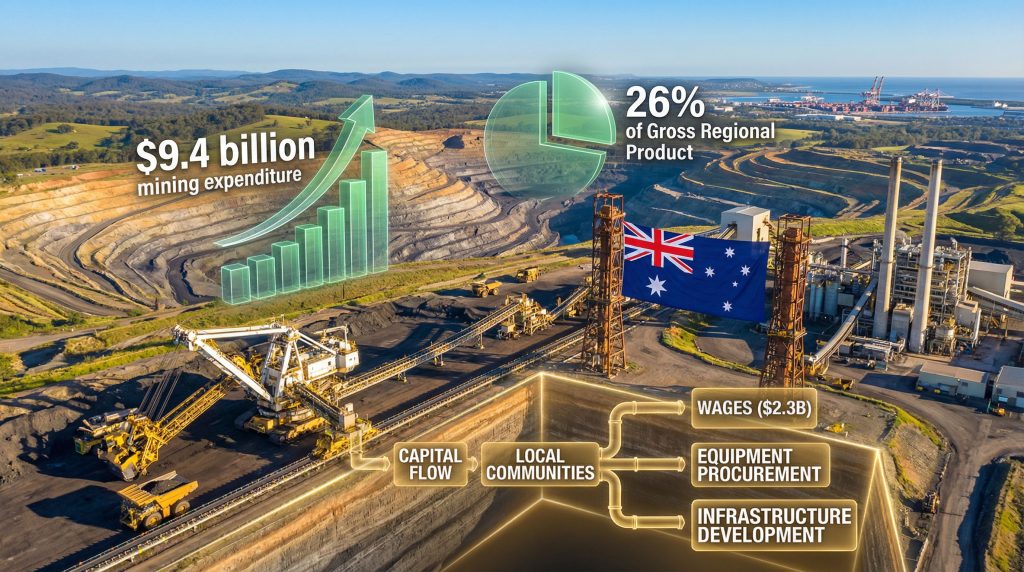
The Hunter Valley's economic transformation through mining investment demonstrates the power of concentrated industrial capital to reshape regional prosperity. Recent data from the NSW Minerals Council reveals that mining operations injected $9.4 billion in direct spending into the Hunter Valley economy during the latest financial year, representing a $600 million increase from the previous year and marking the highest result ever recorded.
Understanding the Regional Economic Multiplier Effect
The economic multiplier effect from Hunter Valley mining expenditure operates through several distinct channels that amplify the initial capital injection throughout the regional economy. Furthermore, this demonstrates the substantial regional economic impact that characterises successful mining regions across Australia.
Direct Employment Impact: Mining companies supported over 16,000 jobs in the Hunter region, maintaining near-record employment levels despite slight year-on-year decreases. This employment base represents approximately 5,000 more jobs than recorded in the initial survey conducted a decade ago, indicating sustained workforce expansion averaging 500 additional jobs annually over that period.
Supply Chain Integration: The mining sector purchased goods and services from 3,410 mining supplier businesses across the Hunter region, valued at over $7 billion. This supplier network represents the breadth of economic integration, with average annual revenue per supplier of approximately $2.06 million from mining expenditure alone.
Infrastructure Development Catalyst: Mining capital allocation has catalysed infrastructure development that benefits the broader regional economy beyond direct mining applications. Transportation networks, utility systems, and communications infrastructure developed for mining operations create spillover benefits for other industries and residential communities, including recent infrastructure safety updates implemented across the sector.
Wage Distribution and Local Purchasing Power Analysis
The wage component of Hunter Valley mining expenditure totals $2.3 billion annually, representing 24.5% of total direct mining expenditure. This translates to average annual compensation per worker of approximately $143,750, which includes on-costs such as payroll taxes, superannuation contributions, and insurance premiums.
These wage levels place mining employment in the upper quartile of regional employment opportunities, creating significant household income effects that drive consumer spending across non-mining sectors including:
- Retail and hospitality services
- Healthcare and professional services
- Housing and construction markets
- Educational and childcare services
- Recreation and entertainment sectors
Housing market dynamics reflect the stability of mining employment, with consistent wage flows supporting mortgage capacity and residential development. The concentration of higher-income households has attracted service businesses and amenities that enhance overall regional quality of life.
According to recent analysis from the NSW Mining Council, this level of investment has helped establish the Hunter Valley as one of Australia's most economically robust mining regions.
What Makes the Hunter Valley Australia's Premier Mining Investment Hub?
The Hunter Valley's position as a premier mining investment destination stems from a combination of geological advantages, infrastructure capabilities, and regulatory frameworks that create favourable conditions for sustained capital allocation.
Geographic and Geological Advantages
Coal Seam Accessibility: The region's geological structure provides relatively accessible coal seams that allow cost-effective extraction methods. This accessibility translates directly into lower operational costs per tonne compared to more challenging geological formations in other basins.
Transportation Infrastructure: Proximity to Newcastle Port provides critical export capabilities with established rail networks connecting mines directly to shipping terminals. This infrastructure advantage reduces transportation costs and provides reliable access to international markets.
Industrial Ecosystem: The concentration of mining operations has fostered development of specialised service industries, equipment suppliers, and technical expertise that create operational efficiencies for all regional mining companies.
Investment Climate Stability
The Hunter Valley's regulatory environment provides predictable frameworks for mining development, with streamlined approval processes that reflect the region's established mining status. However, recent studies by the Hunter Jobs Alliance indicate ongoing discussions about balancing mining investment with long-term regional diversification strategies. This regulatory clarity reduces investment uncertainty and enables long-term capital planning.
Policy Framework Benefits:
- Established mining tenure systems
- Predictable environmental assessment processes
- Coordinated infrastructure development planning
- Workforce development programs aligned with industry needs
How Do Mining Companies Allocate Capital Across Hunter Valley Operations?
Mining company capital allocation patterns across Hunter Valley operations reveal strategic priorities that balance immediate operational needs with long-term asset development and community sustainability requirements. In addition, these patterns reflect broader consolidation and joint ventures occurring throughout the Australian mining sector.
Operational Expenditure Breakdown Analysis
| Expenditure Category | Amount (AUD) | Percentage | Economic Impact Focus |
|---|---|---|---|
| Wages & Salaries | $2.3 billion | 24.5% | Household income injection |
| Goods & Services | $7.1 billion | 75.5% | Supply chain stimulus |
| Equipment & Machinery | $1.7-2.1 billion | 18-22% | Manufacturing sector support |
| Local Services | $3.3-3.8 billion | 35-40% | Business ecosystem development |
| Infrastructure Development | $750 million-1.1 billion | 8-12% | Regional capacity building |
| Community Investment | $190-280 million | 2-3% | Social licence maintenance |
Supply Chain Integration Patterns
The presence of 3,410 distinct supplier businesses indicates sophisticated supply chain specialisation across multiple categories:
Primary Supply Categories:
- Equipment maintenance and repair services
- Transportation and logistics providers
- Engineering and technical consulting
- Consumable materials and supplies
- Construction and infrastructure services
- Environmental and safety compliance services
Regional Economic Circulation: Approximately 75-80% of direct mining expenditure remains within the Hunter Valley region through local suppliers, wages, and service providers. This high retention rate creates significant economic multiplier effects as money circulates repeatedly through the local economy.
Supplier Development: Mining companies actively develop local supplier capabilities through training programs, equipment financing assistance, and long-term contract arrangements that enable smaller businesses to invest in specialised equipment and workforce development.
What Are the Long-term Economic Sustainability Indicators?
Long-term economic sustainability for Hunter Valley mining expenditure depends on managing the inherent volatility of commodity markets while building economic resilience through diversification and infrastructure legacy value. Furthermore, this requires alignment with broader sustainability transformation initiatives being implemented across the mining industry.
Diversification Metrics and Risk Assessment
Economic Dependency Analysis: Mining represents approximately 26% of the Hunter Valley's Gross Regional Product, indicating material but not overwhelming dependency. The remaining 74% of regional output from non-mining sectors suggests some economic diversification, though detailed sector-by-sector analysis reveals varying degrees of indirect mining dependency.
Resilience Planning Indicators:
- Alternative industry development initiatives
- Infrastructure assets with multi-industry utility value
- Educational institution partnerships for workforce transition
- Innovation hub development leveraging mining technology expertise
Infrastructure Legacy Value Creation
Mining investment has created infrastructure assets that provide long-term value beyond mining operations:
Transportation Networks: Rail lines, port facilities, and road infrastructure serve multiple industries and enable regional connectivity that attracts non-mining businesses.
Utility Infrastructure: Power generation, water management systems, and telecommunications networks developed for mining operations provide capacity for industrial diversification.
Educational Facilities: Partnerships between mining companies and educational institutions have created training facilities and research capabilities that support workforce development across multiple industries.
How Does Hunter Valley Mining Expenditure Compare Globally?
Hunter Valley's $9.4 billion annual mining expenditure positions the region among the world's most significant mining investment concentrations, comparable to major international mining regions on both absolute and per-capita bases.
International Mining Region Benchmarking
Australian Regional Comparisons:
- Western Australia's Pilbara region: Similar per-capita mining investment levels
- Queensland's Bowen Basin: Comparable coal-focused investment patterns
- Other NSW mining regions: Lower overall expenditure but similar economic multiplier patterns
Investment Intensity Metrics:
- Mining expenditure per employed person: $587,500 annually
- Regional economic contribution: 26% of total Gross Regional Product
- Supply chain integration: 3,410 local supplier businesses supported
Economic Density Analysis
The concentration of mining investment within the Hunter Valley creates economic density advantages that enhance operational efficiency and reduce costs across the industry cluster.
Competitive Advantages:
- Shared infrastructure utilisation
- Specialised service provider availability
- Concentrated technical expertise and workforce
- Regulatory efficiency through established processes
The next major ASX story will hit our subscribers first
What Economic Trends Shape Future Hunter Valley Investment Patterns?
Future Hunter Valley mining expenditure patterns face transformation pressures from technological advancement, market demand evolution, and regulatory changes that will reshape capital allocation priorities.
Technology-Driven Capital Allocation Shifts
Automation Investment Requirements: Advanced mining technologies require substantial upfront capital investment but promise reduced long-term operational costs. This shift toward capital intensity may alter employment patterns while maintaining or increasing total expenditure levels.
Digital Infrastructure Development: Remote operations capabilities, data analytics systems, and communications infrastructure represent growing capital allocation categories that support operational efficiency and safety improvements.
Market Demand Evolution Impact
Thermal Coal Demand Projections: Global energy transition policies create uncertainty around long-term thermal coal demand, potentially affecting investment planning horizons and capital allocation strategies.
Alternative Mineral Opportunities: The Hunter Valley's geological formations may contain critical minerals and rare earth deposits that could attract new investment categories as market demand for these materials increases.
Economic Transition Planning: Mining companies and regional authorities are developing strategies to leverage existing infrastructure and expertise for alternative mineral extraction and processing operations.
How Do Government Revenues from Mining Transform Regional Development?
Government revenue streams from Hunter Valley mining operations create additional economic development opportunities through strategic reinvestment in regional infrastructure and services.
Royalty Distribution and Regional Reinvestment
State Government Revenue Allocation: NSW government receives substantial royalty payments from Hunter Valley mining operations, with portions allocated back to regional development initiatives through various grant programmes and infrastructure projects.
Local Council Revenue Enhancement: Mining operations contribute significantly to local government rate bases while requiring minimal residential services, creating net positive revenue positions that enable enhanced public infrastructure investment.
Public-Private Partnership Outcomes
Collaborative partnerships between mining companies and government entities have delivered significant regional infrastructure improvements:
Joint Infrastructure Projects:
- Transportation network upgrades
- Healthcare facility expansion
- Educational institution development
- Environmental remediation programmes
Community Development Programmes: Mining companies invest 2-3% of total expenditure (approximately $190-280 million annually) in community development initiatives that build social licence while creating long-term regional benefits.
What Economic Challenges Require Strategic Management?
Hunter Valley mining expenditure sustainability faces several strategic challenges that require proactive management to maintain long-term regional economic health.
Boom-Bust Cycle Mitigation Strategies
Revenue Stabilisation Mechanisms: Developing financial reserves and diversified revenue streams helps buffer regional economies against commodity price volatility and production fluctuations.
Counter-Cyclical Investment Planning: Strategic infrastructure investment during commodity price downturns can maintain regional employment while building capacity for future growth cycles.
Environmental Cost Integration
Environmental compliance and remediation represent growing components of mining expenditure that require integration into long-term economic planning:
Rehabilitation Expenditure: Mine site restoration costs are increasingly factored into operational budgets, creating additional regional economic activity through specialised environmental services.
Water Management Infrastructure: Investments in water treatment and recycling systems serve both mining operations and regional water security needs.
Air Quality Improvement: Technology investments in dust suppression and emissions control create economic opportunities for environmental technology providers while addressing community health concerns.
Investment Outlook Disclaimer: Mining expenditure projections involve significant uncertainties related to commodity price volatility, regulatory changes, and technological disruptions. Regional economic planning should incorporate scenario analysis and risk mitigation strategies to address potential variations in mining investment levels.
The Hunter Valley mining expenditure patterns demonstrate how sustained resource sector investment can create robust regional economies through direct spending, supply chain development, and infrastructure legacy value. Consequently, success in maintaining these economic benefits requires strategic management of commodity cycle volatility while building economic diversification and resilience for long-term sustainability.
Understanding these economic dynamics provides valuable insights for other resource-dependent regions seeking to maximise the development benefits from mining sector investment while managing associated risks and challenges.
Ready to Discover Australia's Next Major Mining Success Story?
Discovery Alert's proprietary Discovery IQ model delivers instant alerts on significant ASX mineral discoveries, helping investors identify opportunities like those transforming regions such as the Hunter Valley before they become widely recognised. Begin your 14-day free trial today and position yourself ahead of the market with real-time insights into actionable mining investment opportunities.