May 17, 2026
Regional value chains represent a transformative approach to unlocking Africa's mineral wealth, addressing the fundamental mismatch between geological endowments that span borders and governance structures confined within national boundaries. The continent's critical minerals strategy requires coordinated development approaches that transcend political divisions to optimize value creation across integrated networks.
Continental Endowments Meet National Boundaries
Africa's mineral wealth exists as a geological reality that spans borders, yet policy frameworks remain stubbornly national in scope. This fundamental mismatch between resource distribution and governance structures creates systemic barriers to value creation across the continent. Understanding how to transform fragmented mineral corridors into integrated value networks requires examining both the physical geography of deposits and the economic architecture needed to optimise their development.
The continent holds approximately 30% of global reserves for future-facing minerals, including copper, cobalt, lithium, manganese, and platinum group metals. However, these endowments are dispersed across multiple jurisdictions: copper and cobalt concentrate in the Central African Copperbelt spanning the Democratic Republic of Congo and Zambia; lithium deposits stretch across Southern Africa; manganese and platinum group metals predominate in South Africa and Zimbabwe; while rare earth prospects emerge throughout Namibia and East Africa.
Furthermore, this geological reality creates natural processing corridors that transcend political boundaries. However, industrial policies remain confined within national frameworks, preventing the optimisation of value chain positioning across regional networks. The DRC cobalt export ban exemplifies how national policies can disrupt regional coordination efforts.
When big ASX news breaks, our subscribers know first
The Economics of Processing Stage Distribution
Mineral processing involves sequential value-added stages, each with distinct location requirements and cost structures. Raw material extraction occurs at mine sites, followed by crushing and concentration operations that reduce transport volumes. Primary processing through smelting requires substantial power and water resources, while refining and precursor production demand technical expertise and quality control systems.
Advanced manufacturing and component assembly benefit from proximity to skilled labour pools and market access. Consequently, this creates a natural geographic progression from resource extraction to final product assembly. This sequential structure suggests optimal value chain design should position activities according to comparative advantages rather than attempting to replicate all processing stages within individual countries.
Power-Intensive Processing Requirements
Different processing stages have dramatically different energy requirements. Copper smelting consumes approximately 13-15 MWh per ton of copper produced, while aluminium smelting requires 13-16 MWh per ton. These power demands often exceed individual country grid capacities, necessitating regional power pool coordination for economically viable large-scale processing operations.
In addition, regional power integration enables load balancing across multiple generation sources, reducing both costs and supply risks for energy-intensive mineral processing. The Southern African Power Pool demonstrates this principle, facilitating electricity trading across twelve member countries through interconnected grid infrastructure.
Policy Fragmentation and Investment Barriers
Current African mining policies create what economists term "destructive competition" through uncoordinated fiscal regimes and investment incentives. When neighbouring countries offer competing tax holidays and processing incentives, the result often reduces overall investment returns while failing to achieve optimal industrial development patterns. These challenges reflect broader mining industry trends towards regional coordination.
Single-sovereign risk exposure compounds these challenges by concentrating political and regulatory risk within individual country boundaries. International investors face elevated risk profiles when projects depend entirely on one jurisdiction's policy stability, fiscal predictability, and infrastructure capacity.
Scale Economics in Mineral Processing
Modern mineral processing requires minimum viable scales to achieve competitive unit costs. Copper smelting operations typically require 200,000-400,000 tons annual capacity to achieve optimal economies of scale, while cobalt refining plants operate most efficiently at 15,000-25,000 tons annual output. These scale requirements often exceed individual country mineral production, necessitating regional feedstock coordination.
Moreover, replicating processing facilities across multiple small-scale national operations increases capital costs per unit of output while reducing operational efficiency through suboptimal capacity utilisation.
The Lobito Corridor Transformation Model
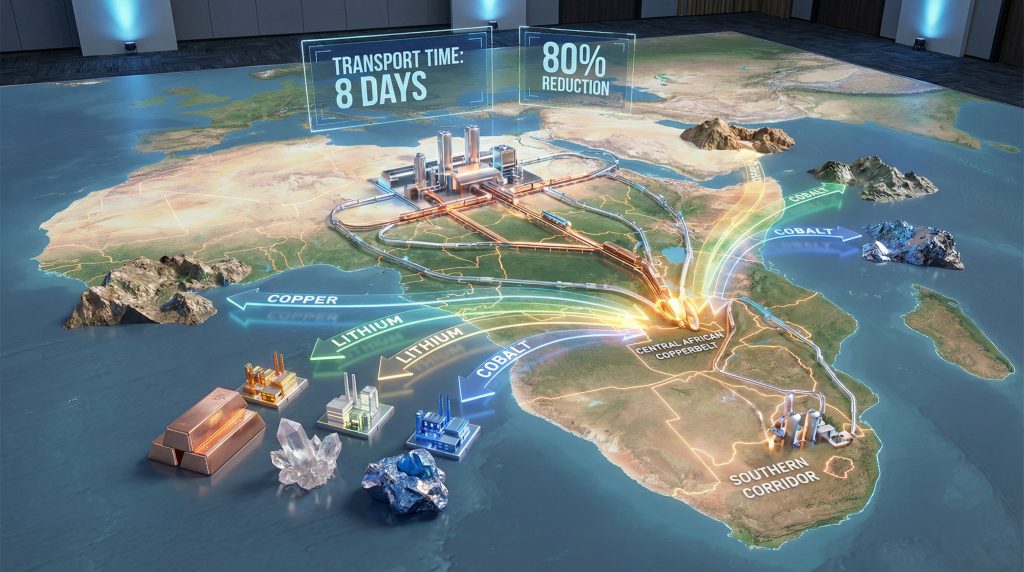
The Lobito Corridor project demonstrates practical regional value chains integration through coordinated infrastructure development spanning Angola, Zambia, and the Democratic Republic of Congo. Recent trial operations have reduced transport times from six weeks to eight days, representing an 80% reduction in logistics duration for mineral exports from Central African mining operations to Atlantic ports.
This transformation results from integrated rail-port coordination that treats the entire corridor as a single logistics system rather than connecting separate national infrastructure segments. The project coordinates customs procedures, regulatory standards, and operational protocols across three jurisdictions to create seamless mineral transport.
Multi-Jurisdictional Governance Framework
The Lobito Corridor operates through coordinated governance structures that align policy frameworks while maintaining national sovereignty over resource development. Participating countries have harmonised:
- Environmental and social standards for corridor operations
- Customs procedures and transit documentation
- Railway operational protocols and capacity allocation
- Port access and cargo handling procedures
- Dispute resolution mechanisms for cross-border issues
This governance approach provides a template for broader regional value chains coordination by demonstrating how multiple sovereigns can coordinate infrastructure and regulatory frameworks for mutual benefit.
Infrastructure Integration as Economic Architecture
Regional value chains development requires infrastructure systems that operate as integrated networks rather than national segments. Power generation and distribution must coordinate across borders to supply energy-intensive processing operations. Transport networks need standardised specifications and coordinated capacity planning to optimise logistics costs.
Digital connectivity becomes critical for supply chain visibility and traceability requirements, particularly as international buyers increasingly demand verified environmental and social governance compliance throughout mineral supply chains.
Regional Power Pool Coordination
Energy security for mineral processing depends on diversified generation sources and integrated transmission capacity. Regional power pools enable:
- Load balancing across multiple generation sources
- Seasonal demand coordination between countries
- Shared investment in large-scale generation projects
- Reduced power costs through competitive procurement
- Enhanced supply security through redundant transmission paths
The Southern African Power Pool serves twelve countries through interconnected transmission infrastructure, facilitating electricity trading that reduces both costs and supply risks for industrial operations.
Value Chain Positioning Strategy
Optimal regional value chains design positions processing activities according to location-specific advantages rather than political boundaries. Raw material extraction occurs at geologically determined mine sites, while crushing and concentration should locate near mines to minimise transport costs for high-volume, low-value materials.
Smelting operations require substantial power availability and environmental capacity, suggesting location near renewable energy resources or power pool interconnection points. Refining and precursor production benefit from technical expertise concentrations and quality control infrastructure.
Strategic Activity Placement Framework
| Processing Stage | Location Drivers | Regional Considerations |
|---|---|---|
| Crushing/Concentration | Mine proximity, water access | Transport cost minimisation |
| Smelting | Power availability, environmental capacity | Regional power pool access |
| Refining | Technical skills, quality control | Regulatory harmonisation |
| Precursor Production | Market access, logistics efficiency | Trade facilitation frameworks |
| Component Manufacturing | Labour costs, skills availability | Regional skills development |
This positioning framework suggests that regional specialisation creates efficiency gains compared to attempts to replicate all processing stages within individual countries.
The next major ASX story will hit our subscribers first
Investment Mobilisation Through Risk Distribution
Private sector investment in regional value chains requires risk mitigation mechanisms that address both political and commercial uncertainties. Regional projects can diversify risk exposure across multiple jurisdictions while creating revenue streams from broader geographic areas.
Corridor-wide revenue pooling reduces dependence on individual country fiscal positions, while standardised regulatory frameworks decrease compliance costs and operational uncertainty for multinational operations. However, government intervention policies must be carefully coordinated to avoid conflicting objectives.
Multi-Sovereign Investment Structures
Regional value chains projects benefit from investment structures that pool risk and return across multiple countries:
- Special purpose vehicles with multi-sovereign backing
- Regional development bank financing for corridor infrastructure
- Multilateral guarantee mechanisms through development finance institutions
- Public-private partnerships spanning multiple jurisdictions
- Revenue sharing agreements based on value-added contributions
These structures enable larger-scale investments while distributing political risk across multiple sovereign guarantees.
Continental Policy Framework Evolution
The African Union's Green Minerals Strategy represents a continental-level recognition that critical minerals offer regional industrialisation opportunities requiring coordinated development approaches. This framework positions mineral value chains as platforms for broader industrial development rather than simple commodity exports.
Regional economic communities provide implementation mechanisms for continental strategies through sub-regional coordination platforms. For instance, the Southern African Development Community, Economic Community of West African States, and Common Market for Eastern and Southern Africa offer established frameworks for policy harmonisation and infrastructure coordination.
AfCFTA Implementation Impact
The African Continental Free Trade Area creates trade facilitation mechanisms that support regional value chains development through:
- Reduced tariffs on intra-African mineral trade
- Harmonised customs procedures and documentation
- Standardised product standards and certifications
- Facilitated movement of technical personnel
- Enhanced dispute resolution mechanisms
These trade facilitation measures reduce transaction costs for regional value chains operations while creating larger integrated markets for processed mineral products.
Global Market Dynamics and Regional Strategy
International buyers increasingly prioritise supply chain resilience and diversification following recent geopolitical disruptions. This creates opportunities for African regional value chains that can offer stable, diversified supply sources with verified environmental and social governance standards. Understanding the global mining landscape helps contextualise these opportunities.
Critical minerals security has become a strategic priority for major economies, generating interest in long-term partnership agreements with stable regional suppliers. European Union critical raw materials partnerships and United States Minerals Security Partnership initiatives seek diversified supply relationships that regional African corridors can potentially supply.
ESG Compliance Requirements
Environmental, social, and governance requirements increasingly influence mineral supply chain decisions, creating advantages for regional systems that can implement consistent standards across processing stages:
- Carbon footprint reduction through renewable energy utilisation
- Water management coordination across watershed boundaries
- Community consultation and benefit-sharing mechanisms
- Conflict minerals prevention and traceability systems
- Worker safety and rights protection standards
Furthermore, regional coordination enables consistent ESG implementation while sharing compliance costs across larger operational scales. Academic research on regional value chain development supports these coordination benefits.
Implementation Pathways for Regional Development
Transforming fragmented mineral belts into integrated regional value chains requires sequential implementation beginning with pilot corridor development. Proof-of-concept projects can demonstrate coordination benefits while building institutional capacity for broader regional integration.
The Lobito Corridor serves as such a pilot, providing operational experience in multi-jurisdictional coordination while generating evidence of economic benefits from regional integration. Success factors from pilot implementations can inform scaling strategies for additional corridors and value chains.
Governance Model Development
Regional value chains governance requires new institutional frameworks that coordinate policy implementation while respecting national sovereignty:
- Corridor management authorities with multi-sovereign representation
- Technical working groups for sector-specific coordination
- Investment facilitation mechanisms for regional projects
- Performance monitoring and evaluation systems
- Stakeholder consultation processes including private sector participation
These governance innovations require experimentation and refinement through practical implementation experience.
Technical Infrastructure Standardisation
Regional value chains require compatible technical standards across transport, power, and digital infrastructure systems. Railway gauge differences between countries create operational inefficiencies that limit corridor effectiveness. Power system compatibility enables integrated grid operations, while digital connectivity standards facilitate supply chain integration.
Standardisation investments require coordinated planning and financing mechanisms that share costs according to expected benefits distribution across participating countries.
Skills Development Architecture
Regional value chains create opportunities for specialised skills development that serves broader geographic areas. Centres of excellence can provide training for specific processing technologies, while technology transfer mechanisms can accelerate capability development across corridors.
Consequently, coordinated skills development reduces duplication while building regional capacity that supports industrial development beyond individual countries' capabilities.
From Fragmentation to Integration
Africa's mineral endowments represent critical inputs for global energy transition and advanced manufacturing, but realising this potential requires moving beyond national boundaries toward regional coordination. The evidence demonstrates that geological realities, processing economics, and infrastructure requirements naturally create regional systems.
Success depends on aligning policy frameworks with these economic realities through coordinated governance structures, standardised regulatory approaches, and integrated infrastructure development. The Lobito Corridor provides a practical demonstration that multi-jurisdictional coordination can dramatically improve operational efficiency while creating larger-scale investment opportunities.
Regional integration offers African countries the opportunity to capture more value from mineral endowments while building industrial capacity and creating employment. For private sector investors, regional systems provide the scale, diversification, and regulatory predictability necessary for long-term processing investments.
The frameworks exist through continental and regional economic community platforms, while pilot projects like Lobito demonstrate implementation feasibility. The challenge lies in scaling successful models while building institutional capacity for broader regional value chains coordination that can transform Africa's mineral wealth into sustainable industrial development.
Want to Capitalise on Critical Minerals Investment Opportunities?
Discovery Alert's proprietary Discovery IQ model delivers instant notifications on significant ASX mineral discoveries, transforming complex geological data into actionable investment insights. As regional value chains reshape global minerals markets, subscribers gain immediate access to emerging opportunities that could mirror the substantial returns seen in historic discoveries. Begin your 30-day free trial today and position yourself ahead of the market with real-time alerts tailored for both short-term traders and long-term investors.