
June 21, 2026
When Mid-Tier Gold Producers Reach a Crossroads
The economics of gold mining have always punished the middle. Producers large enough to attract institutional attention but too small to command the operational leverage of global majors occupy an uncomfortable position in the capital markets hierarchy. This tension has defined the structural dynamics of the ASX gold sector for more than a decade, but the conditions accelerating in 2025 and into 2026 have intensified the pressure to a degree rarely seen in a single market cycle. Elevated bullion prices, central bank accumulation, and the persistent drag of per-ounce costs on smaller operations have collectively engineered an environment where consolidation is no longer a strategic option for mid-tier producers. It has become a competitive necessity.
Against this backdrop, the Regis Resources takeover of Vault Minerals represents something more than a corporate transaction. It is a structural response to forces reshaping the global gold investment thesis from the ground up.
When big ASX news breaks, our subscribers know first
The Strategic Logic Behind a $10.7 Billion Gold Consolidation
From Mid-Tier Competitors to Australia's Third-Largest Listed Gold Producer
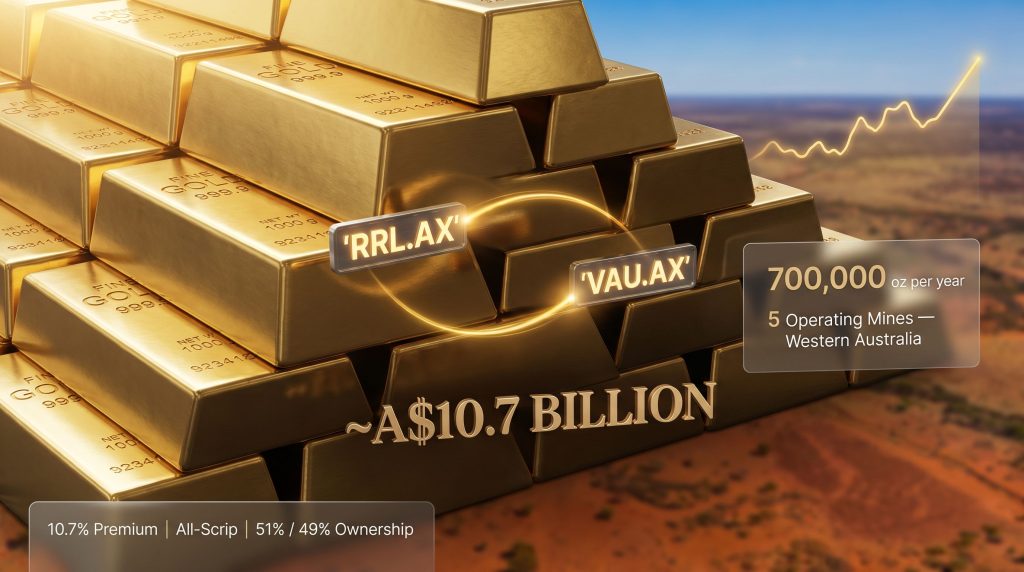
When two mid-tier producers combine, the arithmetic of scale rarely tells the full story. The Regis Resources takeover of Vault Minerals, announced on 5 May 2026, creates a combined entity valued at approximately A$10.7 billion (roughly USD $7.67 billion), positioning the merged group as Australia's third-largest ASX-listed gold producer by market capitalisation. That ranking matters not just for prestige but for institutional access. Larger entities attract index inclusion, ETF weighting, and the type of long-duration fund flows that mid-tier producers rarely access in isolation.
The five operating mines and two development-stage growth assets sitting inside the combined portfolio represent a production profile targeting approximately 700,000 ounces of gold per year. For context, that output level places the merged entity well above the threshold typically required for meaningful index representation and creates the kind of operational redundancy that makes investors more comfortable allocating to a single name across commodity price cycles.
How Scale Economics Are Driving M&A Activity Across the ASX Gold Sector
Scale in gold mining delivers compounding benefits that are difficult to replicate organically. Procurement of consumables such as reagents, fuel, equipment parts, and explosives occurs at materially lower per-unit costs when volume commitments are large enough to negotiate preferential supply terms. Sustaining capital expenditure, which represents one of the most persistent drags on free cash flow in operating mines, can be spread across a broader revenue base when multiple assets share engineering, maintenance, and technical teams.
The combined entity's executives cited both procurement efficiency and capital cost improvements as core rationale for the transaction. These are not aspirational synergies. They are structural outcomes that emerge reliably when two Western Australian operators, drawing from overlapping labour markets, contractor pools, and infrastructure corridors, integrate their operations under unified management. Furthermore, gold M&A activity across the ASX has accelerated notably as these structural pressures compound.
The Role of Elevated Bullion Prices in Accelerating Producer Consolidation
Gold price strength creates a paradox for M&A timing. When prices are high, targets become more expensive, but the same elevated prices generate sufficient free cash flow and balance sheet confidence to fund or structure deals that would not have been viable in a weaker price environment. The surge in bullion prices over the period leading into this announcement created exactly this dynamic across the ASX gold sector.
There is also a structural demand dimension worth understanding. Central bank gold demand has been growing with notable consistency, driven by the desire to diversify reserve holdings away from fiat currency concentration amid ongoing geopolitical fragmentation. This institutional bid beneath the gold market provides a demand floor that producers can incorporate into their planning assumptions, raising confidence in deal economics over multi-year integration timelines.
What Are the Structural Terms of the Regis Resources Takeover of Vault Minerals?
All-Scrip Exchange Ratio: What 0.6947 Shares Per Vault Share Actually Means
The decision to structure the Regis Resources takeover of Vault Minerals as an all-scrip transaction carries significant implications for both shareholder bases. Under the agreed terms, each Vault Minerals shareholder receives 0.6947 Regis Resources shares for every Vault share held. No cash consideration is offered. This means Vault shareholders are not receiving a liquidity event. They are exchanging their existing equity stake for exposure to a larger, more diversified combined entity.
The economic rationale for accepting scrip rather than cash rests on a specific thesis: that the combined entity will trade at a higher multiple, deliver stronger earnings growth, and generate greater long-term value than either standalone company could achieve independently. Whether that thesis proves correct depends entirely on integration execution, gold prices, and operational performance over the years following completion.
Breaking Down the A$5.15 Billion Implied Deal Value
The 0.6947 exchange ratio implies an acquisition value for Vault Minerals of approximately A$5.15 billion, based on Regis Resources' share price at the time of announcement. This figure will fluctuate with Regis's market price between announcement and scheme implementation, which is a characteristic feature of scrip deals that introduces pricing uncertainty for both sets of shareholders.
Key Deal Snapshot
| Metric | Detail |
|---|---|
| Combined Market Valuation | |
| Deal Structure | All-scrip (no cash component) |
| Exchange Ratio | 0.6947 Regis shares per Vault share |
| Implied Vault Acquisition Value | ~A$5.15 billion |
| Premium to Last Close | 10.7% above A$4.50 |
| Regis Shareholder Ownership Post-Merger | ~51% |
| Vault Shareholder Ownership Post-Merger | ~49% |
| Projected Annual Gold Output | ~700,000 oz per year |
| Tax Benefit Unlock | Over A$500 million |
| Operating Mines (Combined) | 5 across Western Australia |
| Growth Projects | 2 pipeline assets |
Ownership Split: Regis at 51% vs. Vault Shareholders at 49%
The post-merger ownership structure of approximately 51% for existing Regis shareholders and 49% for Vault shareholders reflects the relative market valuations of each company at the time of deal structuring. The near-equal split is unusual in a transaction where one party is designated the acquirer. It signals that this is as much a merger of equals in commercial terms as it is a formal takeover in legal and ASX regulatory terms.
This near-parity ownership structure also has governance implications. Vault shareholders retain meaningful economic weight in the combined entity, which may create expectations around board representation, asset management priorities, and capital allocation decisions that management will need to navigate carefully post-close.
Understanding the 10.7% Premium and Its Significance in Scrip-Based Deals
The 10.7% premium to Vault's last closing price of A$4.50 is on the lower end of what shareholders typically receive in contested cash acquisitions, where premia of 20–40% are more common in resources sector takeovers. However, in an all-scrip deal, the premium calculus operates differently. Vault shareholders are not being bought out. They are being invited into a larger entity that management and both boards believe will generate superior returns over time.
In this context, the 10.7% represents the day-one premium for accepting the structural uncertainty inherent in a scrip exchange, not a final monetisation price. The ultimate return for Vault shareholders will depend on how the merged entity's share price performs relative to what Vault would have traded at independently, a comparison that markets can only make in hindsight.
Who Are Regis Resources and Vault Minerals?
Regis Resources: An ASX-Listed Western Australian Gold Producer With Tropicana Exposure
Regis Resources has built its position in the ASX gold sector through a combination of organic development and strategic asset acquisition. Its most significant acquisition came in 2021 when it secured a 30% interest in the Tropicana gold mine for A$903 million, obtaining exposure to one of Western Australia's highest-quality producing gold assets, which it holds in joint venture with AngloGold Ashanti. Tropicana operates in the Albany-Fraser Orogen, a geological corridor known for its large, low-cost gold deposits, and the acquisition substantially upgraded the quality and scale of Regis's production portfolio.
That transaction also left Regis with a more leveraged balance sheet than it carried previously, making the case for a scrip-financed merger with a complementary operator particularly compelling as a way to build scale without adding further debt.
Vault Minerals: The Mid-2024 Merger Product of Silver Lake Resources and Red 5
Vault Minerals came into existence in mid-2024 through the combination of Silver Lake Resources and Red 5, two well-established ASX gold producers with overlapping geological footprints in Western Australia. The transaction created a mid-tier producer with a more diversified operational base than either predecessor company held independently, but it also left the entity in the early stages of its own integration journey.
This is an important contextual detail for understanding the risk profile of the Regis Resources takeover of Vault Minerals. By agreeing to merge with Regis, Vault's board is effectively layering a second integration onto an organisation still in the process of absorbing its first. The operational complexity of simultaneously running five mines across multiple geological and metallurgical settings while executing management restructuring should not be underestimated.
The Three Mining Hubs Vault Brought to the Table: Leonora, Deflector, and Mount Monger
Vault's inherited asset portfolio encompasses three distinct Western Australian mining hubs:
- Leonora in the northern Goldfields, a historically productive gold region with established processing infrastructure
- Deflector in the Murchison region, a polymetallic operation with copper and gold mineralisation that contributes both production diversity and commodity price exposure beyond pure gold
- Mount Monger near Kalgoorlie, one of Australia's most densely mineralised gold corridors
Each of these operations brings a distinct geological character, cost profile, and reserve life to the combined entity, creating operational diversity within the shared Western Australian context.
How Regis's Tropicana Stake Shapes the Combined Asset Base
Tropicana's contribution to the merged group extends beyond raw production ounces. As a large-scale, low-cost operation, Tropicana functions as a portfolio anchor, generating free cash flow that can be allocated across the broader asset base. Its low all-in sustaining costs help to offset higher-cost production from some of the smaller operations in the Vault portfolio, improving the blended per-ounce economics of the combined group. Consequently, the relationship between gold and mining equities becomes particularly important when assessing how this blended cost structure will translate into shareholder returns.
What Does the Combined Entity Look Like Operationally?
Five Operating Mines and Two Growth Projects: Mapping the Western Australian Footprint
The geographic concentration of all five operating mines within Western Australia creates both efficiency advantages and concentration risk. On the positive side, shared regulatory frameworks, established infrastructure networks, proximity to the same skilled labour pools, and access to common logistics corridors reduce the operational friction that typically characterises multi-jurisdictional mining companies.
On the risk side, all assets remain exposed to the same state-level regulatory environment, the same extreme weather events (cyclones, heat events affecting operational days), and the same regional labour market dynamics, which have periodically created cost inflation pressures in the Pilbara and Goldfields regions.
Annual Production Capacity of 700,000 Ounces: How This Ranks Against ASX Peers
A 700,000-ounce annual production target places the merged entity in the significant sub-major tier of global gold producers. For comparison, the two ASX producers likely ranked above it, Northern Star Resources and Evolution Mining, each produce in excess of one million ounces annually. The combined Regis-Vault entity sits meaningfully below those thresholds but comfortably above the mid-tier operators producing 200,000 to 400,000 ounces per year.
This positioning carries practical consequences for institutional investment:
- Index inclusion becomes more likely at higher production and market capitalisation thresholds
- Analyst coverage from major investment banks typically requires a minimum size threshold that the combined entity now approaches
- Debt capital market access improves when revenue diversification across multiple assets reduces single-mine operational risk
Leadership Continuity: Jim Beyer Confirmed as CEO of the Merged Group
The confirmation of Jim Beyer as the CEO leading the merged entity removes one variable from the integration uncertainty equation. In M&A transactions, leadership ambiguity during the period between announcement and completion often accelerates talent attrition at the target company, as key personnel begin evaluating their career options before formal decisions are made. The early naming of Beyer signals both boards' intention to resolve management structure quickly rather than allow uncertainty to linger.
Beyer has articulated the strategic case for the combination in terms that extend beyond production aggregation, emphasising that the merged company will carry a more resilient balance sheet and a more diversified operational profile. This framing is deliberate. It positions the deal as a risk-management exercise as much as a growth initiative, which is important for investor confidence during integration.
How Does This Deal Unlock Over A$500 Million in Tax Benefits?
Corporate Tax Losses and Offset Mechanisms in Australian Mining M&A
One of the most consequential but underappreciated dimensions of the Regis Resources takeover of Vault Minerals is its potential to crystallise over A$500 million in corporate tax benefits for the combined entity. In the Australian mining sector, tax loss positions can accumulate for multiple reasons: periods of suppressed gold prices that generate operating losses, large capital expenditure programs that accelerate depreciation deductions, and impairment charges on assets that have experienced value deterioration.
When profitable operations absorb entities with carried-forward losses, those losses can potentially be applied against future taxable income, reducing cash tax obligations over a multi-year period. The net present value of A$500 million in future tax offsets represents genuine economic value that would not have been accessible to either company operating independently at its current scale.
Why Scrip-Based Deals Often Preserve Tax Asset Utilisation Better Than Cash Transactions
The decision to structure this transaction as an all-scrip deal rather than a cash acquisition has meaningful implications for how tax assets flow through to the combined entity. Under Australian tax consolidation rules, certain tax benefits, particularly carried-forward losses, are subject to continuity of ownership and same business tests that determine whether a change of control event interrupts their utilisation. All-scrip structures can preserve continuity in ways that outright cash acquisitions sometimes cannot, because the original shareholders remain invested in the merged group rather than exiting entirely.
Tax efficiency is not a secondary consideration in large-scale mining M&A. In capital-intensive sectors where deferred tax positions can represent a meaningful fraction of total deal economics, the choice between cash and scrip structuring can determine whether hundreds of millions of dollars in latent value is preserved or forfeited. The A$500 million figure attached to this transaction illustrates why financial engineering and corporate strategy are inseparable in resource sector consolidation.
Estimating the Net Present Value of A$500 Million in Deferred Tax Benefits
The gross quantum of A$500 million in tax benefits will not be realised immediately. These offsets are typically applied progressively against future taxable income over a period of years, meaning that the actual net present value is lower than the face value figure, depending on the discount rate applied and the timeline over which the benefits are utilised. However, even discounted to present value, this quantum represents a substantial enhancement to the transaction's economics that goes beyond the headline production and market capitalisation metrics.
The next major ASX story will hit our subscribers first
Is the Regis-Vault Merger a Symptom of a Broader ASX Gold Consolidation Wave?
The Ramelius-Spartan Resources Precedent: A A$2.4 Billion Blueprint From 2024
The Regis Resources takeover of Vault Minerals did not emerge in a vacuum. The ASX gold sector has been experiencing an accelerating consolidation cycle, with the Ramelius-Spartan merger in a deal valued at approximately A$2.4 billion establishing a recent precedent. That transaction similarly used rising gold prices as a catalyst, with Ramelius leveraging elevated bullion to justify a premium that would have been difficult to fund in a weaker price environment.
Comparative M&A Table: Recent ASX Gold Sector Consolidation
| Deal | Acquirer | Target | Deal Value | Structure | Year |
|---|---|---|---|---|---|
| Regis / Vault | Regis Resources (RRL.AX) | Vault Minerals (VAU.AX) | ~A$10.7B combined | All-scrip | 2025/26 |
| Ramelius / Spartan | Ramelius Resources (RMS.AX) | Spartan Resources | ~A$2.4B | Scrip | 2024 |
How Rising Bullion Prices Create Consolidation Incentives for Mid-Tier Producers
The relationship between gold price cycles and M&A activity follows a distinctive pattern. When gold trades at elevated levels for an extended period, the market capitalisation gap between large and mid-tier producers widens, making mid-tier assets simultaneously more attractive as targets (because their in-ground reserves gain value) and more accessible (because acquiring companies can offer scrip with conviction about its underlying worth). This dual dynamic compresses the window in which mid-tier producers can remain independent without sacrificing shareholder value. The broader gold price outlook suggests this consolidation window may remain open for some time yet.
Central Bank Gold Accumulation as a Structural Demand Driver
The context behind both transactions is a sustained period of central bank gold purchasing that has provided structural support for bullion prices independent of speculative investment flows. Countries seeking to reduce their reliance on US dollar-denominated reserve assets have been systematically adding physical gold to their balance sheets, a trend that functions as a multi-year floor bid beneath the gold market. For gold producers, this represents a qualitative shift in the demand backdrop that influences both their operational planning and their willingness to commit to large-scale strategic transactions.
Why Mid-Tier Producers Are More Vulnerable to Takeover in High-Price Environments
Mid-tier operators face a specific vulnerability during gold price surges. Their share prices rise, but not proportionally to majors, because investors often anticipate that their per-ounce cost structures will absorb a disproportionate share of any price reversal. This creates a persistent valuation discount that makes them attractive to larger operators who can realise value through cost reduction, capital efficiency, and operational integration that the mid-tier company cannot achieve independently.
How Did Markets React to the Regis Takeover Announcement?
Vault Minerals Shares Surge Up to 6.4%: Interpreting Target-Side Price Action
Vault Minerals shares surged by as much as 6.4% on the announcement date, representing the largest single-session intraday move for the stock since early April. This reaction is consistent with standard market behaviour for acquisition targets, where the announced premium prompts immediate buying from arbitrage traders seeking to capture the spread between the current price and implied deal value.
However, the magnitude of the move, while positive, is notably smaller than the 10.7% premium announced, reflecting market scepticism about deal completion probability, the possibility that a competing bid could emerge, and the uncertainty inherent in scrip-based pricing between announcement and implementation. According to reporting from Mining Monthly, market observers described the deal as a surprise major merger that caught many analysts off guard.
Regis Stock Falls Up to 6.1% to a One-Month Low: Why Acquirers Often Dip on Deal Day
The 6.1% decline in Regis Resources shares on announcement day is a classic acquirer discount, a phenomenon well-documented in M&A literature where the market immediately reprices the acquiring entity to reflect several concerns:
- The dilution impact of issuing new shares to fund the all-scrip acquisition
- Uncertainty about whether stated synergies and tax benefits will be realised on the announced timeline
- Concern that management attention will be diverted from optimising existing operations during an extended integration period
- Scepticism about integration risk, particularly given that Vault itself is a recently formed entity still absorbing its own 2024 merger
Broker Ord Minnett's Assessment: A Positive Step Forward With M&A Optionality
Ord Minnett's characterisation of the deal as a positive development with a strong platform for further M&A activity is a notable broker signal. It indicates the broker views the transaction not as a destination but as an enabler. The scale achieved through this combination positions the merged entity as a potential consolidator of additional assets, meaning the market should factor in ongoing M&A optionality rather than treating this as a purely standalone event.
What the Divergent Share Price Movements Signal About Market Confidence
The divergence between target-side gains and acquirer-side losses is informative but should not be read as market rejection of the deal's strategic logic. It represents the normal short-term tension between two different shareholder bases with different immediate priorities. Over a medium-term horizon, the merged entity's performance will be judged on operational delivery rather than announcement-day price action. As noted by The Bull, the transaction formally creates Australia's third-largest gold producer, a structural milestone that carries long-term index and institutional implications regardless of short-term price movements.
What Are the Key Risk Factors and Conditions Attached to This Merger?
The No Superior Proposal Clause: How Competing Bids Could Disrupt the Timeline
Both boards have unanimously recommended the transaction subject to the standard condition that no superior proposal emerges from a third party. This fiduciary protection is a routine feature of ASX scheme-of-arrangement transactions but carries meaningful practical implications. A competing bid for Vault Minerals from a better-capitalised global gold major seeking Western Australian exposure could emerge during the regulatory approval window, potentially disrupting or repricing the transaction.
Understanding the Dual Integration Challenge
Vault Minerals was formed in mid-2024 through the combination of Silver Lake Resources and Red 5. That means the entity now being absorbed by Regis has been operating as a merged company for less than two years. The management teams, systems, culture, and operational processes from the Silver Lake and Red 5 merger are still being harmonised. Layering a second merger onto this foundation introduces execution risk that is qualitatively different from integrating a long-established standalone operator.
Regulatory Approval Pathways for Major ASX Mining Mergers
Large-scale ASX mining mergers of this magnitude typically require approval from the Australian Competition and Consumer Commission where market concentration thresholds are relevant, as well as Foreign Investment Review Board consideration where applicable, court approval for the scheme of arrangement, and shareholder votes from both companies. Each of these milestones represents a potential delay point or conditionality risk that investors should factor into their timelines.
Integration Risk: The Operational Complexity of a Five-Mine Portfolio
Running five operating mines across geographically distinct Western Australian corridors, each with its own metallurgical characteristics, workforce agreements, contractor relationships, and capital requirements, while simultaneously executing a corporate integration and managing two growth projects, is an operationally demanding undertaking. The market's day-one scepticism about Regis's share price reflects a rational assessment of how much can go wrong even in well-managed integrations.
How Does This Deal Position Australia in the Global Gold Producer Landscape?
Australia's Emerging Role as a Consolidation Hub for Mid-Tier Gold Producers
The ASX has developed into one of the world's most active marketplaces for gold sector M&A, partly because the concentration of high-quality gold assets in Western Australia creates natural synergy opportunities for producers operating in proximity. The Regis Resources takeover of Vault Minerals follows a pattern that distinguishes the ASX from other major gold mining exchanges: consolidation tends to occur between domestically focused operators rather than through cross-border acquisitions by global majors.
This dynamic creates a self-reinforcing cycle. As ASX-listed gold companies grow through domestic consolidation, they accumulate the scale and institutional recognition needed to attract global investor attention, which in turn provides the currency (via elevated share prices) to continue consolidating.
Western Australia as the World's Premier Gold Mining Jurisdiction
Western Australia hosts some of the world's highest-grade and most geologically productive gold terranes, including the Eastern Goldfields, the Murchison region, and the Albany-Fraser Orogen. The combination of established infrastructure (Kalgoorlie's processing facilities, regional road and rail networks), a stable regulatory environment, a skilled and experienced mining workforce, and geological endowment makes Western Australia a globally competitive jurisdiction that continues to attract capital at scale.
For the merged Regis-Vault entity, operating entirely within this single jurisdiction provides operational familiarity and infrastructure leverage, while the scale of the combined portfolio ensures that the company is large enough to sustain the capex programs needed to extend mine lives and bring growth assets into production.
Frequently Asked Questions: Regis Resources Takeover of Vault Minerals
What is the Regis Resources takeover of Vault Minerals?
The Regis Resources takeover of Vault Minerals is an all-scrip merger announced on 5 May 2026, combining two ASX-listed Western Australian gold producers to create Australia's third-largest listed gold producer with a combined market value of approximately A$10.7 billion.
How much is the Vault Minerals acquisition worth?
The implied acquisition value for Vault Minerals is approximately A$5.15 billion, based on the exchange ratio of 0.6947 Regis shares per Vault share, which represented a 10.7% premium to Vault's last closing price of A$4.50.
What type of deal structure is being used?
The transaction is structured entirely as a scrip deal with no cash consideration. Vault shareholders receive Regis Resources shares in exchange for their Vault shares, maintaining ongoing equity exposure to the combined group.
How many mines will the combined company operate?
The merged entity will operate five mines in Western Australia, with two additional growth projects in the development pipeline.
Who will lead the merged entity after the takeover is complete?
Regis Resources CEO Jim Beyer has been confirmed as the leader of the merged group following completion.
What tax benefits does the merger unlock?
The transaction is expected to unlock over A$500 million in corporate tax benefits through the combination of the two entities' tax positions. These benefits will be realised progressively against future taxable income rather than as an immediate lump sum.
Has the deal received regulatory or shareholder approval?
At the time of announcement, the deal had the unanimous recommendation of both boards subject to no superior proposal emerging. Regulatory and shareholder approvals remain as conditions precedent that must be satisfied before the transaction can be completed.
How does this deal compare to other recent ASX gold mergers?
At A$10.7 billion in combined market value, the Regis-Vault combination dwarfs the previous comparable transaction, the A$2.4 billion Ramelius-Spartan Resources deal from 2024, making it the most significant ASX gold sector consolidation of recent years by deal size.
Key Takeaways: What the Regis-Vault Merger Means for Australia's Gold Sector
The Regis Resources takeover of Vault Minerals is reshaping competitive dynamics across the ASX gold sector in ways that extend well beyond the two companies directly involved. For investors, the following considerations should frame how this transaction is evaluated:
- Scale creation is real but conditional. The 700,000-ounce production target and A$10.7 billion combined valuation are achievable, but depend on integration execution across a complex, multi-site operational environment.
- Tax benefits are not guaranteed. The A$500 million in corporate tax offsets represents latent value but will be unlocked progressively and is subject to regulatory conditions on loss utilisation continuity.
- The consolidation wave is not finished. The Ramelius-Spartan and Regis-Vault transactions suggest a structural trend toward fewer, larger ASX gold producers. Remaining mid-tier operators should be evaluated for their own consolidation potential.
- Gold price remains the master variable. Every element of the deal's financial logic, from implied valuations to synergy payback periods to tax benefit utilisation timelines, is sensitive to where the gold price trades over the next three to five years.
- Integration is the real test. Markets have already discounted Regis shares in anticipation of execution challenges. The degree to which the merged entity performs operationally over the first 12 to 24 months post-completion will determine whether the day-one scepticism was warranted or overstated.
Western Australia's gold corridor is rapidly emerging as one of the most actively consolidated gold mining regions anywhere in the world. The Regis Resources takeover of Vault Minerals is a defining moment in that evolution, but it is unlikely to be the last.
This article is intended for informational purposes only and does not constitute financial advice, an investment recommendation, or a solicitation to buy or sell any financial instrument. Forecasts, projections, and deal timelines referenced herein involve inherent uncertainty. Readers should conduct their own due diligence and consult a qualified financial adviser before making any investment decisions. Share prices and deal values referenced reflect conditions at the time of the original announcement.
Want to Catch the Next Major ASX Gold Discovery Before the Market Does?
While mergers like Regis-Vault reshape the producer landscape, the most significant early-stage returns in the gold sector have historically come from being first to act on a major new discovery — and Discovery Alert's proprietary Discovery IQ model delivers real-time alerts the moment significant ASX mineral discoveries are announced, turning complex geological data into actionable investment insights. Explore Discovery Alert's dedicated discoveries page to understand the kind of historic returns that major mineral discoveries have generated, then begin your 14-day free trial to position yourself ahead of the broader market.