May 21, 2026
Regulatory Framework Development for Cross-Border Energy Infrastructure
The evolving landscape of international energy cooperation requires sophisticated regulatory mechanisms that can navigate complex geopolitical environments while ensuring technical safety and economic viability. When examining potential solutions to regional energy security challenges, including U.S. intervention in Venezuela to solve Colombia's energy crisis, policymakers must consider how existing frameworks can be adapted to address urgent supply shortfalls while maintaining long-term strategic objectives.
Cross-border energy infrastructure development operates within a multifaceted regulatory environment that combines domestic energy policies, international treaty obligations, and bilateral cooperation agreements. The technical requirements for trans-Caribbean gas infrastructure projects involve stringent safety protocols, environmental impact assessments, and comprehensive monitoring systems designed to prevent operational failures that could compromise regional energy security.
International Pipeline Safety and Technical Standards
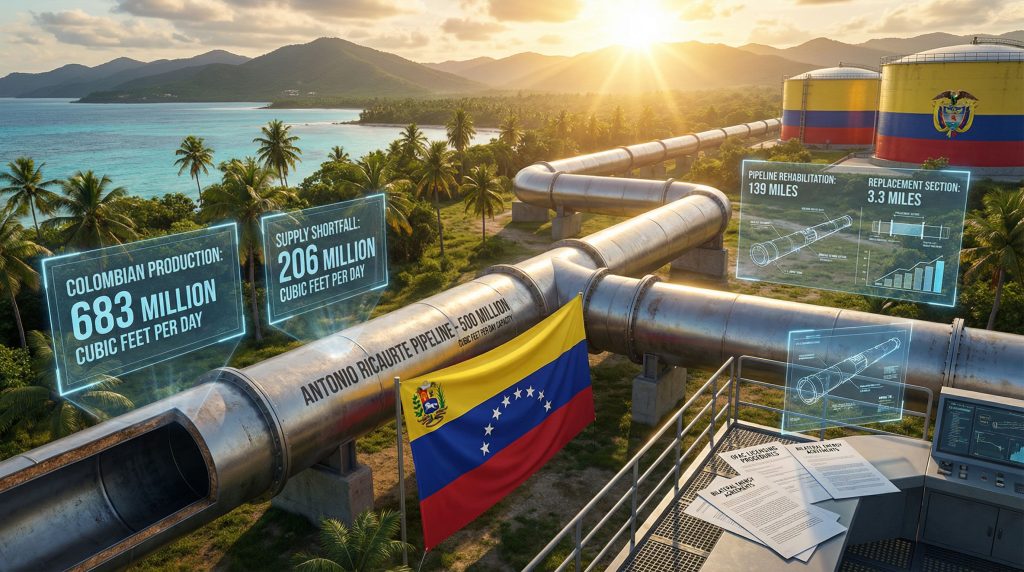
Pipeline rehabilitation projects spanning multiple jurisdictions must comply with harmonised technical specifications that address both operational efficiency and environmental protection. The Antonio Ricaurte pipeline, stretching 224 kilometres (139 miles) across international waters, exemplifies the complexity of cross-border energy infrastructure management. Furthermore, technical assessments indicate that approximately 5 kilometres (3.3 miles) of the pipeline require complete replacement due to corrosion and structural degradation from over a decade of dormancy.
Pipeline integrity evaluation methodologies for aging infrastructure involve comprehensive inspection protocols using advanced diagnostic technologies including:
- Smart pig inspection systems for internal corrosion assessment
- External coating integrity analysis using electromagnetic survey techniques
- Pressure testing procedures to verify structural capacity under operational loads
- Flow assurance modelling to optimise gas transmission efficiency
- Cathodic protection system evaluation for long-term corrosion prevention
The rehabilitation process requires specialised technical expertise in marine pipeline construction, given the trans-Caribbean nature of the infrastructure. However, environmental monitoring protocols must address potential impacts on marine ecosystems while ensuring compliance with international maritime law and coastal zone management regulations.
Bilateral Energy Agreement Structures and Dispute Resolution
Energy partnerships between neighbouring countries typically incorporate sophisticated contractual frameworks designed to manage price volatility, supply security, and payment mechanisms. In addition, the framework for natural gas supply contracts must address currency fluctuation risks, particularly relevant when one partner faces economic instability or sanctions-related financial constraints.
Payment stabilisation mechanisms often include:
- Escrow arrangements through international financial institutions
- Commodity-backed payment systems using oil or gas as collateral
- Multi-currency settlement options to mitigate exchange rate risks
- Force majeure provisions covering political and technical disruptions
- Graduated pricing structures based on supply volume and delivery reliability
Dispute resolution frameworks for energy partnerships typically incorporate international arbitration procedures under established institutional rules such as the International Chamber of Commerce or the London Court of International Arbitration. These mechanisms provide neutral venues for resolving commercial disputes while maintaining the operational continuity essential for energy security.
When big ASX news breaks, our subscribers know first
Sanctions Relief Mechanisms and Treasury Department Procedures
The complexity of sanctions relief in energy infrastructure projects requires detailed understanding of Office of Foreign Assets Control (OFAC) licensing procedures and the specific authorisation categories available for cross-border energy cooperation. For instance, general licences for energy infrastructure typically cover maintenance, safety, and humanitarian purposes, while specific licences may be required for commercial operations involving sanctioned entities.
OFAC Licensing Categories for Energy Projects
The Treasury Department's approach to energy sector authorisations involves multiple licensing categories designed to balance economic sanctions enforcement with regional stability considerations:
- General Licence Category A: Maintenance and safety operations for existing infrastructure
- General Licence Category B: Humanitarian energy supplies for civilian populations
- Specific Licence Applications: Commercial energy transactions requiring individual review
- Emergency Authorisation Procedures: Rapid response mechanisms for energy security crises
The timeline for sanctions modification processes varies significantly based on the scope of requested activities and the geopolitical context surrounding the application. Moreover, emergency authorisations for critical energy infrastructure can be processed within 72-96 hours, while comprehensive commercial licences may require 60-180 days for complete review and approval.
Economic Impact Assessment of Policy Changes
The cost differential between liquefied petroleum gas (LPG) imports and pipeline natural gas represents a crucial factor in regional energy policy decisions. Current market analysis indicates that LPG imports cost approximately 40-60% more than pipeline gas delivered through rehabilitated cross-border infrastructure. These us tariffs and inflation dynamics significantly impact regional energy costs. For Colombia, which projects that 30% of domestic natural gas demand will be met through imports in 2026, this price differential represents significant fiscal pressure.
| Supply Option | Cost per MMBtu | Infrastructure Investment | Timeline to Implementation |
|---|---|---|---|
| LPG Imports | $12-18 | $2-3 billion (terminals) | 18-24 months |
| Venezuelan Pipeline Gas | $6-10 | $500 million (rehabilitation) | 24-36 months |
| Domestic Production Enhancement | $8-14 | $3-5 billion (exploration) | 48-72 months |
The balance of trade implications extend beyond immediate cost considerations to include long-term economic competitiveness and fiscal sustainability. Countries heavily dependent on energy imports face currency pressure and reduced fiscal flexibility, particularly during periods of global commodity price volatility.
Infrastructure Investment Models and Public-Private Partnership Frameworks
Cross-border energy infrastructure projects require sophisticated financing structures that can manage political risk while ensuring adequate returns for private investors. Consequently, the complexity increases when projects involve countries with different regulatory environments, credit ratings, and political stability profiles.
Risk Allocation Structures for Cross-Border Projects
Effective public-private partnerships (PPPs) for energy infrastructure must carefully allocate risks between public and private sector participants based on each party's ability to manage specific risk categories:
Government Risk Allocation:
- Regulatory and permitting risks
- Political stability and policy continuity
- Currency convertibility and transfer risks
- Force majeure events related to sovereign actions
Private Sector Risk Allocation:
- Construction and engineering risks
- Operational performance and maintenance
- Technology and equipment performance
- Commercial and market risks
Shared Risk Categories:
- Environmental and social impact management
- Force majeure events (natural disasters, pandemics)
- Regulatory changes affecting project economics
- Interface risks between different project components
International development banks play crucial roles in providing both financing and risk mitigation for cross-border energy projects. The World Bank Group's Multilateral Investment Guarantee Agency (MIGA) offers political risk insurance covering expropriation, currency inconvertibility, war, and civil disturbance. Regional development banks such as the Inter-American Development Bank provide additional financing options specifically designed for Latin American energy integration projects.
Technical Feasibility Assessment Protocols
Pipeline rehabilitation projects require comprehensive technical due diligence processes that assess both current infrastructure condition and future operational requirements. For the Antonio Ricaurte pipeline, technical assessments must evaluate the 500 million cubic feet per day design capacity against current and projected demand patterns in both Colombia and potential future markets.
Corrosion assessment methodologies for dormant marine pipelines involve:
- Ultrasonic thickness measurements at predetermined inspection intervals
- Magnetic flux leakage detection for identifying metal loss areas
- Radiographic testing for critical weld joint evaluation
- Hydrostatic pressure testing to verify structural integrity
- Internal inspection using intelligent pigs equipped with high-resolution sensors
Capacity utilisation projections must consider Colombia's projected natural gas supply deficit of 206 million cubic feet per day, representing approximately 41% of the pipeline's maximum capacity. This utilisation rate provides economic viability while maintaining reserve capacity for demand growth or supply diversification.
Strategic Reserve Management and Regional Energy Security Cooperation
Regional energy security frameworks require coordination mechanisms that can respond rapidly to supply disruptions while maintaining market stability during normal operations. The development of strategic reserve management systems involves both physical storage infrastructure and financial mechanisms for emergency supply coordination.
Emergency Supply Coordination Mechanisms
Effective regional energy security cooperation requires pre-established protocols for information sharing, reserve activation, and supply reallocation during crisis situations. These mechanisms typically include:
Information Sharing Protocols:
- Real-time supply and demand monitoring systems
- Early warning mechanisms for potential disruptions
- Coordinated market intelligence and price reporting
- Joint assessment of regional energy security threats
Reserve Activation Procedures:
- Graduated response levels based on disruption severity
- Automatic trigger mechanisms for emergency reserve releases
- Coordinated timing of reserve activation across participating countries
- Market intervention protocols to prevent price manipulation
Supply Reallocation Mechanisms:
- Pre-negotiated emergency supply agreements
- Shared transportation infrastructure utilisation
- Coordinated procurement strategies for spot market purchases
- Joint contracting for long-term supply security
Buffer stock requirements for natural gas importing nations typically range from 30-90 days of average consumption, depending on supply source diversification and transportation infrastructure resilience. Countries with limited supply diversity or transportation bottlenecks require higher reserve levels to maintain energy security during extended disruptions.
Crisis Response Protocols for Energy Supply Disruptions
Energy supply crisis response requires coordinated action across multiple government agencies, private sector participants, and international partners. However, effective protocols establish clear command structures, communication channels, and decision-making authorities to enable rapid response during emergency situations.
The Colombian government's experience with energy supply shortages during recent droughts provides valuable insights into crisis response effectiveness. During the 2023-2024 drought period, when hydroelectric generation fell by 35%, thermal generation increased by 180%, placing unprecedented demand on natural gas supplies. This crisis highlighted the importance of diversified supply sources and robust transportation infrastructure for maintaining grid stability.
Investment Protection Mechanisms and International Legal Frameworks
Cross-border energy infrastructure investments require comprehensive legal protection mechanisms that can provide recourse against political risks while ensuring compliance with international law principles. Furthermore, bilateral investment treaties (BITs) provide the foundation for investor protection, while specialised energy sector agreements address industry-specific risks and operational requirements.
Bilateral Investment Treaty Provisions for Energy Infrastructure
Modern bilateral investment treaties incorporate sophisticated provisions designed specifically to address energy sector investment risks:
Expropriation Protection Clauses:
- Direct expropriation coverage for physical asset seizure
- Indirect expropriation protection against regulatory measures
- Fair market value compensation requirements
- Prompt payment and currency convertibility guarantees
Fair and Equitable Treatment Standards:
- Regulatory transparency and predictability requirements
- Due process protections in administrative procedures
- Non-discrimination clauses preventing arbitrary treatment
- Legitimate expectations protection for established investors
National Treatment and Most Favoured Nation Provisions:
- Equal treatment compared to domestic investors
- Equal treatment compared to third-country investors
- Exceptions for national security considerations
- Grandfathering provisions for existing discriminatory measures
Investor-state dispute settlement (ISDS) procedures provide neutral arbitration forums for resolving investment disputes outside domestic court systems. Nevertheless, energy sector ISDS cases often involve complex technical and economic analysis, requiring arbitrators with specialised industry expertise. Recent trends in energy sector arbitration include increased focus on environmental and social impact considerations, particularly for projects affecting indigenous communities or environmentally sensitive areas.
Political Risk Insurance Frameworks
Political risk insurance for pipeline rehabilitation projects must address both traditional political risks and energy sector-specific exposures. Coverage typically includes:
Traditional Political Risk Coverage:
- Currency inconvertibility and transfer restrictions
- Expropriation and nationalisation protection
- Political violence and civil disturbance coverage
- Breach of contract by government entities
Energy Sector-Specific Coverage:
- Regulatory change affecting project economics
- Environmental permit revocation or modification
- Transportation and export licence cancellation
- Sanctions-related business interruption
Premium structures for high-risk jurisdictions reflect both country-specific political risks and project-specific technical and commercial risks. For Venezuela-related energy projects, political risk insurance premiums typically range from 3-8% annually of insured value, depending on coverage scope and policy duration.
Claims procedures for political force majeure events require careful documentation of both the triggering event and its direct causal relationship to project losses. Energy infrastructure projects face particular challenges in demonstrating causation when political events create indirect market effects or regulatory uncertainty rather than direct operational interference.
Environmental Compliance and Long-Term Sustainability Planning
Cross-border energy infrastructure projects must navigate complex environmental regulatory frameworks that address both immediate operational impacts and long-term sustainability objectives. The intersection of energy security needs with climate change commitments creates particular challenges for natural gas infrastructure development in an era of energy transition, especially when considering canada energy transition challenges facing neighbouring regions.
Transition Period Management Strategies
The role of natural gas as a transition fuel requires careful policy design to ensure energy security during renewable energy scaling while avoiding long-term fossil fuel lock-in effects. Transition period management strategies must balance:
Interim Supply Security Requirements:
- Baseload power generation capacity maintenance
- Peak demand response capabilities
- Grid stability and frequency regulation services
- Emergency backup power for critical infrastructure
Renewable Energy Integration Support:
- Flexible generation for renewable intermittency management
- Grid balancing services during renewable capacity addition
- Reduced emissions compared to coal-fired alternatives
- Infrastructure utilisation optimisation during transition period
Investment Recovery and Stranding Risk:
- Depreciation schedules aligned with transition timelines
- Asset repurposing potential for hydrogen or biogas
- Contractual provisions for early retirement scenarios
- Risk sharing between public and private sectors
Carbon pricing mechanisms for natural gas imports create additional complexity in project economics, particularly when carbon prices vary significantly between trading systems. The European Union's Emissions Trading System (EU ETS) prices have ranged from €50-90 per tonne CO2 in recent years, while emerging carbon markets often trade at substantially lower prices.
Climate Commitment Reconciliation Frameworks
Energy infrastructure investments must align with national climate commitments under the Paris Agreement while maintaining energy security and economic development objectives. This alignment requires sophisticated policy frameworks that can manage apparent contradictions between short-term energy needs and long-term climate goals.
Phase-out timelines for fossil fuel infrastructure typically extend 20-40 years from initial investment, creating potential conflicts with net-zero emission targets typically set for 2050 or earlier. Resolution of these conflicts requires:
- Progressive emission reduction requirements for existing infrastructure
- Mandatory renewable energy integration quotas for system operators
- Carbon capture and storage requirements for large emission sources
- Hydrogen blending mandates for natural gas pipeline systems
- Biogas integration requirements to reduce fossil fuel content
The Colombian government's commitment to net-zero emissions by 2050 creates specific challenges for natural gas infrastructure development. Current policy frameworks attempt to reconcile these objectives through:
- Temporary authorisation for essential energy security infrastructure
- Mandatory emission offset requirements for new fossil fuel projects
- Technology upgrade mandates to enable future hydrogen compatibility
- Revenue recycling mechanisms directing fossil fuel revenues toward renewable energy development
This approach requires balancing critical minerals & energy security needs with environmental commitments.
The next major ASX story will hit our subscribers first
Regional Integration Models and Comparative Analysis
The potential for U.S. intervention in Venezuela to solve Colombia's energy crisis provides valuable insights for other regions facing similar energy security challenges. Comparative analysis of energy intervention models reveals common patterns in regulatory frameworks, financing mechanisms, and implementation strategies across different geographical and political contexts.
European Union Energy Security Response Mechanisms
The European Union's response to energy supply disruptions following the Ukraine conflict provides a relevant comparison for regional energy crisis management. The EU's approach combined emergency demand reduction measures, supply diversification initiatives, and accelerated renewable energy deployment within an integrated regulatory framework.
Key EU Policy Tools:
- Emergency demand reduction mandates requiring 15% natural gas consumption reduction
- Joint procurement mechanisms for liquefied natural gas purchases
- Infrastructure sharing agreements for emergency supply redistribution
- Accelerated permitting procedures for renewable energy projects and LNG terminals
The EU's experience demonstrates both the potential effectiveness and limitations of coordinated regional responses to energy supply crises. While joint procurement reduced individual country vulnerability to price manipulation, infrastructure bottlenecks and limited storage capacity constrained the effectiveness of supply diversification efforts.
Asian Regional Energy Cooperation Frameworks
Asian energy cooperation models, particularly the ASEAN+3 energy partnership, provide insights into long-term regional energy integration strategies. Unlike crisis-driven responses, these frameworks focus on gradual market integration and infrastructure development over 10-20 year timeframes.
The East Asia Summit Energy Cooperation Framework emphasises:
- Gradual market liberalisation with phased elimination of trade barriers
- Coordinated infrastructure development through multilateral development bank financing
- Technology transfer mechanisms for renewable energy and energy efficiency
- Capacity building programmes for regulatory harmonisation
Asian energy cooperation faces particular challenges related to diverse economic development levels, varying regulatory systems, and complex geopolitical relationships. Success factors include strong institutional frameworks, technical assistance programmes, and flexible implementation timelines that accommodate different national priorities.
African Cross-Border Pipeline Development Experiences
African natural gas pipeline projects provide relevant technical and commercial insights for cross-border infrastructure development in challenging operating environments. The West Africa Gas Pipeline connecting Nigeria to Ghana, Togo, and Benin demonstrates both successful coordination mechanisms and implementation challenges.
Lessons from African Pipeline Development:
- Phased construction approaches reducing initial capital requirements and political risk exposure
- Anchor customer agreements providing revenue certainty for project financing
- Local content requirements building domestic capacity while managing costs
- Regional development bank involvement providing both financing and technical assistance
- Flexible tariff structures accommodating different economic development levels
The West Africa Gas Pipeline project required eight years from initial agreement to commercial operation, highlighting the extended timelines typical for cross-border energy infrastructure. Technical challenges included marine construction in difficult sea conditions, while commercial challenges involved coordinating regulatory approval processes across multiple jurisdictions.
Implementation Timeline and Economic Impact Analysis
The rehabilitation of the Antonio Ricaurte pipeline represents a critical test case for cross-border energy cooperation effectiveness during regional energy crises. Current technical assessments indicate a 24-36 month timeline for complete pipeline rehabilitation, with initial limited operations potentially beginning within 18-24 months.
Rehabilitation Timeline Breakdown:
| Phase | Duration | Key Activities | Critical Path Items |
|---|---|---|---|
| Technical Assessment | 6-9 months | Detailed inspection, engineering design | Marine survey completion, regulatory approval |
| Procurement and Contracts | 9-12 months | Equipment sourcing, contractor selection | Specialised marine construction capacity |
| Construction Phase 1 | 12-18 months | Replacement section installation | Weather windows, logistics coordination |
| Testing and Commissioning | 6-9 months | Pressure testing, flow certification | Cross-border regulatory coordination |
The economic impact of successful pipeline rehabilitation extends beyond immediate energy cost savings to include broader economic benefits from improved energy security, reduced import dependency, and enhanced regional integration. For Colombia, pipeline gas imports could reduce energy costs by $800 million to $1.2 billion annually compared to continued LPG import dependence.
Venezuela's economic benefits from renewed gas exports include foreign currency earnings, infrastructure utilisation optimisation, and enhanced regional political relationships. Current estimates suggest potential export revenues of $400-600 million annually at projected export volumes and prevailing regional gas prices.
The broader regional implications include demonstration effects for other cross-border energy cooperation initiatives, enhanced energy security for multiple countries, and potential acceleration of similar projects throughout Latin America. Success in Venezuelan-Colombian gas cooperation could provide a template for addressing energy security challenges in other regions facing similar geopolitical and infrastructure constraints.
These developments must be understood within the broader context of trump tariff implications and us-china trade war impact on global energy markets.
The broader implications of U.S. intervention in Venezuela to solve Colombia's energy crisis extend beyond immediate energy supply considerations to encompass regional geopolitical dynamics, economic development strategies, and long-term sustainability objectives. For instance, the Council on Foreign Relations has analysed the complex political situation in Venezuela and its regional implications. Furthermore, The Guardian has reported on Venezuela's strategic mineral wealth and its importance to US energy security interests.
This analysis is intended for educational and informational purposes only and should not be construed as investment advice. Energy infrastructure investments involve significant risks including political, regulatory, technical, and market risks. Readers should conduct their own research and consult with qualified professionals before making investment decisions.
Ready to Capitalise on Energy Infrastructure Opportunities?
Discovery Alert's proprietary Discovery IQ model delivers real-time alerts on significant ASX mineral discoveries, instantly empowering subscribers to identify actionable opportunities in the energy and resources sector ahead of the broader market. Understand why major mineral discoveries can lead to substantial market returns by exploring Discovery Alert's dedicated discoveries page, showcasing historic examples of exceptional outcomes, and begin your 14-day free trial today to position yourself ahead of the market.