July 10, 2026
What Regulatory Framework Is Driving Europe's Critical Materials Strategy?
European industrial policy has undergone a fundamental transformation as geopolitical tensions expose critical vulnerabilities in global supply chains. The continent's dependence on external sources for essential materials has prompted an unprecedented regulatory response designed to establish strategic autonomy across key industrial sectors. Furthermore, the evolution of critical minerals strategy demonstrates how Europe's rare earth independence has become central to maintaining industrial competitiveness.
The EU Critical Raw Materials Act: A Comprehensive Policy Response
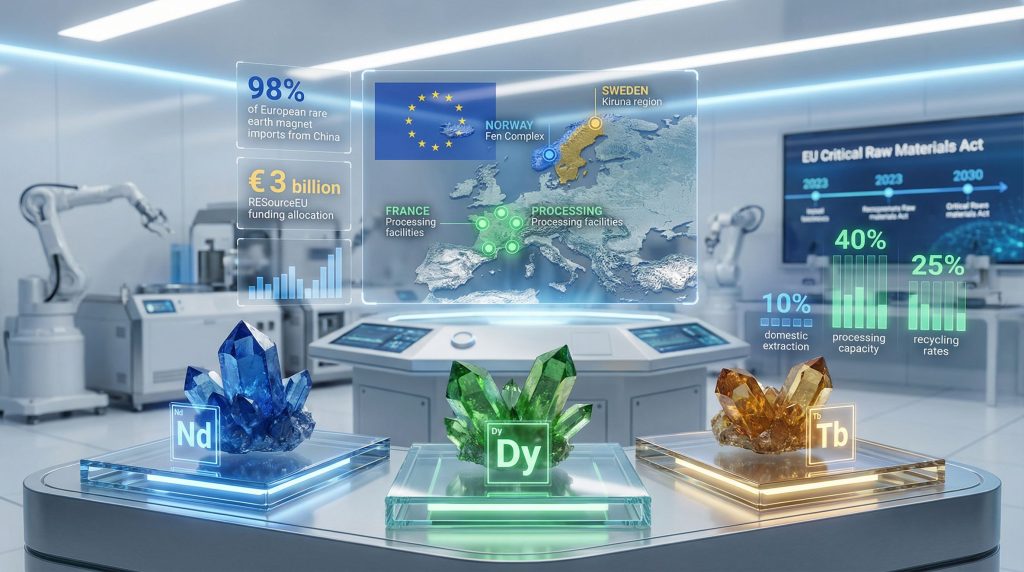
The European Union's regulatory architecture for critical materials independence centers on the Critical Raw Materials Act, establishing three mandatory benchmarks that member states must achieve by 2030. These targets represent the first quantitative framework for European material sovereignty: 10% domestic extraction capacity, 40% processing infrastructure development, and 25% recycling rates for critical elements essential to industrial production.
This legislative framework, formally adopted in 2023, operates through a phased implementation strategy spanning the remainder of the decade. The Act designates specific projects as strategically vital, enabling expedited permitting processes that bypass traditional regulatory timelines. Member states must demonstrate compliance through detailed capacity development plans, with enforcement mechanisms ensuring alignment with continental objectives.
The regulatory structure includes provisions for fast-track approval mechanisms, allowing designated projects to circumvent standard environmental assessment procedures when national security considerations warrant such exemptions. This represents a significant departure from previous EU regulatory approaches, prioritizing strategic independence over traditional environmental safeguards in specific circumstances.
RESourceEU Initiative: Coordinated Investment Architecture
The RESourceEU program establishes the financial foundation for Europe's materials independence strategy, allocating €3 billion across extraction, processing, and recycling sectors. This initiative coordinates investment flows between member states whilst establishing joint purchasing mechanisms designed to leverage collective bargaining power in international markets.
Strategic stockpiling requirements form a central component of the RESourceEU framework, mandating buffer reserves for critical materials based on consumption patterns and supply chain vulnerability assessments. Partnership frameworks with resource-rich nations including Canada, Australia, and Kazakhstan provide alternative sourcing mechanisms whilst reducing dependence on concentrated supply chains.
Risk assessment protocols embedded within RESourceEU evaluate supply chain vulnerabilities across multiple dimensions: geological concentration, political stability, transportation infrastructure, and processing capacity. These assessments inform investment prioritisation and strategic partnership development, ensuring resources target the most critical gaps in European industrial capacity.
When big ASX news breaks, our subscribers know first
Which Geographic Regions Offer the Greatest Strategic Value for European Independence?
The Nordic region has emerged as the cornerstone of European efforts to achieve critical materials independence, with geological surveys revealing substantial deposits previously unknown to commercial markets. These discoveries fundamentally alter the continent's resource profile and provide realistic pathways toward meaningful supply chain diversification.
Nordic Deposits: Transforming Europe's Resource Landscape
Norway's Fen Carbonatite Complex represents the most significant geological discovery in European rare earth exploration, containing an estimated 8.8 million tonnes of total rare earth oxides with approximately 1.5 million tonnes concentrated in heavy rare earth elements essential for permanent magnet production. This deposit, announced in June 2024, exceeds previous European reserve estimates by substantial margins.
| Location | Estimated Reserves | Key Elements | Timeline | Strategic Significance |
|---|---|---|---|---|
| Norway (Fen Complex) | 8.8M tonnes REO | Heavy REEs, magnets | 2030s | Europe's largest deposit |
| Sweden (Kiruna) | Under assessment | Light REEs, iron ore | 2030s | Arctic Circle proximity |
| France (Solvay expansion) | Processing facility | All 17 REEs | 2025-2027 | Existing infrastructure |
Sweden's LKAB Kiruna project complements Norwegian developments through proximity to established mining infrastructure and advanced extraction technologies. Located adjacent to the world's largest underground iron ore operation, this facility benefits from existing logistics networks and skilled workforce capabilities that reduce development timelines and capital requirements.
The geographic distribution of Nordic deposits provides strategic redundancy against localised disruptions whilst enabling economies of scale in processing and transportation infrastructure. Arctic locations offer political stability and regulatory predictability essential for long-term industrial planning, contrasting with resource-rich regions experiencing governance challenges.
Processing Infrastructure: Building European Capacity
European processing capabilities currently concentrate in two primary facilities: Solvay's western France operation and Neo Performance Materials' Estonian plant. Solvay's expansion receives €23 million in French government tax credits, targeting enhanced throughput for all 17 rare earth elements through modernised separation and purification processes.
The French facility operates with approximately 80 years of processing experience, providing institutional knowledge and established regulatory compliance that new facilities would require years to develop. Estonia's Baltic location offers strategic value through proximity to Nordic extraction sites and existing trade relationships with resource-producing regions.
Recycling infrastructure represents the most immediately viable path toward supply independence, with circular economy solutions potentially supplying 30% of European rare earth demand through recovery of end-of-life motors and electronic equipment. Moreover, advances in battery recycling breakthrough technologies provide additional pathways for recovering critical materials while reducing waste.
How Do Current Supply Chain Vulnerabilities Impact European Industries?
China's dominance across rare earth supply chains creates systemic vulnerabilities that extend far beyond traditional trade relationships, encompassing strategic industries essential to European economic competitiveness and national security objectives. Furthermore, Europe's dependency on Chinese raw materials has become increasingly apparent as geopolitical tensions escalate.
Quantifying China's Market Dominance
Chinese control over global rare earth markets operates at multiple levels: 98% of European rare earth magnet imports, 95% of global rare earth oxide production, and 70% of European total imports originate from Chinese sources. This concentration extends beyond rare earths to include similar proportions of magnesium, gallium, and germanium imports essential for semiconductor and defense applications.
The 2025 export restriction implementation demonstrated the immediate vulnerability of European manufacturing to Chinese policy decisions. Export licence constraints resulted in a 75% reduction in magnet availability, causing production halts across automotive manufacturing and forcing reassessment of just-in-time supply chain strategies.
Processing capacity concentration amplifies extraction dependencies, with 85-90% of global rare earth processing occurring within Chinese facilities. This creates bottlenecks even when alternative sources provide raw materials, as limited processing capacity constrains global supply regardless of mining diversity.
Industrial Sector Risk Assessment
Automotive manufacturing experienced the most immediate impact from 2025 supply disruptions, with electric vehicle production lines halting due to permanent magnet shortages. Just-in-time inventory management, optimised for cost efficiency rather than supply security, provided insufficient buffer capacity to weather even brief supply interruptions.
Critical Dependencies by Industry:
- Automotive: EV motor production requires neodymium and dysprosium magnets with no viable substitutes at current performance standards
- Renewable Energy: Wind turbine generators depend on permanent magnets for efficient power conversion
- Electronics: Semiconductor fabrication utilises gallium and germanium substrates with limited alternative materials
- Defence: Strategic weapons systems incorporate rare earth elements in guidance systems and advanced electronics
The defence sector faces particular challenges due to stringent performance requirements and extended procurement timelines that complicate rapid supplier transitions. Military applications often require materials meeting specifications that limit sourcing flexibility whilst demanding supply chain transparency for security clearance purposes.
What Investment Mechanisms Are Accelerating European Self-Sufficiency?
Financial architecture supporting European materials independence operates through coordinated public and private investment mechanisms designed to de-risk long-term capital commitments whilst ensuring strategic objectives receive adequate funding support. In addition, the broader mining industry evolution demonstrates how traditional mining practices are adapting to meet these strategic imperatives.
Financial Architecture for Independence
Germany leads member state investment commitments with €1 billion allocated over the 2024-2028 period for domestic capacity development across extraction, processing, and recycling infrastructure. This commitment establishes benchmark funding levels that other major economies are expected to match through national strategic programmes.
EU-wide investment requirements reach €25-50 billion over the next decade, reflecting the scale of infrastructure development necessary to achieve meaningful supply independence. The wide range indicates substantial uncertainty regarding actual capital needs, particularly for mining projects requiring extensive permitting and environmental compliance processes.
Private sector incentives include tax credits, direct grants, and risk-sharing mechanisms designed to encourage commercial investment in strategic materials projects. The French government's support for Solvay's expansion exemplifies direct financial assistance, whilst loan guarantees and equity participation provide additional de-risking instruments for larger projects.
Timeline for Strategic Autonomy
European independence strategy operates through a phased approach recognising the extended timelines required for mining project development and infrastructure construction:
Phased Implementation Strategy:
- 2025-2027: Processing expansion and recycling infrastructure development
- 2028-2030: First domestic mining operations achieving commercial production
- 2030-2035: Significant supply chain diversification across multiple sources
- 2035+: Potential achievement of 65% supply independence target
Near-term mitigation focuses on maximising existing capacity utilisation and developing recycling infrastructure that provides immediate supply augmentation. Medium-term objectives centre on bringing Nordic mining projects online whilst expanding processing capabilities to handle increased domestic production.
Long-term strategic autonomy requires sustained investment over multiple economic cycles, demanding political commitment that transcends electoral timelines. Success depends on maintaining policy consistency across changing governmental administrations whilst adapting to evolving geopolitical circumstances.
Which Recycling Technologies Could Bridge the Supply Gap?
Circular economy solutions provide the most immediately viable pathway for reducing European dependence on external rare earth sources whilst developing domestic capacity for long-term strategic independence. Consequently, advances in recycling technology represent a crucial component of Europe's rare earth independence strategy.
Circular Economy Solutions
End-of-life motor recovery systems target permanent magnets embedded in automotive components, industrial equipment, and consumer electronics reaching replacement cycles. Current European equipment inventory contains substantial rare earth content that recycling technologies can recover at competitive costs compared to primary extraction.
Permanent magnet recycling processes utilise advanced separation techniques to extract neodymium, dysprosium, and other critical elements whilst maintaining material purity standards required for industrial applications. Technology partnerships with Asian leaders in recycling innovation provide access to proven methodologies whilst building European processing expertise.
Urban mining initiatives expand beyond rare earths to encompass broader critical materials recovery from electronic waste streams. Integrated recycling facilities can process multiple material types simultaneously, improving economic viability whilst addressing diverse supply chain vulnerabilities across industrial sectors.
Short-Term Mitigation Strategies
Strategic stockpiling provides buffer capacity against supply disruptions whilst domestic production capacity develops. Government-managed reserves complement private sector inventory management, ensuring adequate materials availability during geopolitical tensions or natural disasters affecting supply chains.
Manufacturing efficiency improvements reduce total rare earth consumption through optimised component design and processing techniques. Substitution research explores alternative materials for less critical applications, reserving limited rare earth supplies for strategic uses requiring specific performance characteristics.
Emergency supply agreements with allied nations provide fallback options when primary sources face disruption. Australia, Canada, and other resource-rich democracies offer alternative sourcing arrangements based on shared security interests rather than purely commercial relationships.
How Do Environmental Regulations Shape European Mining Development?
Environmental protection requirements create significant challenges for European mining project development whilst potentially offering competitive advantages through sustainable extraction methodologies and enhanced social acceptance. However, the drive toward sustainable mining transformation must balance environmental concerns with strategic security needs.
Sustainability Requirements vs. Strategic Needs
Environmental impact assessment protocols require comprehensive evaluation of mining activities across multiple dimensions: air and water quality, biodiversity preservation, landscape modification, and community disruption. These assessments extend project timelines whilst ensuring long-term environmental protection aligns with strategic materials objectives.
Norway's Fen Complex project proposes innovative drilling techniques involving narrow underground tunnels that minimise surface disruption whilst enabling resource extraction. This approach reduces environmental impact compared to traditional open-pit mining whilst addressing community concerns about landscape preservation.
Community consultation requirements mandate extensive stakeholder engagement before project approval, creating opportunities for opposition whilst building social licence for operations. Swedish LKAB's Kiruna expansion requires relocating thousands of residents, demonstrating the complex social challenges accompanying resource development.
Regulatory Balance: Speed vs. Environmental Protection
Fast-track permitting provisions within the Critical Raw Materials Act enable expedited approvals for strategically designated projects whilst maintaining environmental safeguards through modified assessment procedures. This approach balances security imperatives with environmental protection through risk-based regulatory frameworks.
Environmental exemptions for critical materials projects create precedents that may influence future resource development policies across Europe. Careful implementation ensures strategic objectives receive priority without undermining broader environmental protection frameworks essential for sustainable development.
Public acceptance challenges require transparent communication about strategic necessity whilst addressing legitimate environmental concerns through enhanced mitigation measures. Successful projects demonstrate compatibility between resource extraction and environmental protection through technological innovation and rigorous oversight.
The next major ASX story will hit our subscribers first
What Are the Long-Term Implications for European Industrial Policy?
European materials independence represents a fundamental shift toward economic nationalism within industrial policy frameworks, prioritising strategic autonomy over traditional market efficiency considerations whilst maintaining international cooperation where possible. Furthermore, securing critical raw materials has become central to Europe's rare earth independence strategy.
Strategic Autonomy Goals and Realistic Timelines
The 2030 targets established through the Critical Raw Materials Act face feasibility constraints acknowledged by policy analysts and industry experts. Achieving 10% domestic extraction and 40% processing capacity within six years requires unprecedented coordination between public investment, private sector development, and regulatory streamlining.
Realistic timelines for substantial independence extend 10-15 years beyond initial targets, reflecting the complex interactions between geological exploration, permitting processes, infrastructure development, and market dynamics. Interim milestones provide measurable progress indicators whilst acknowledging longer-term strategic objectives.
Continued diplomatic engagement with China remains necessary during the transition period, requiring careful balance between competitive positioning and cooperative relationships. Complete decoupling proves neither economically viable nor strategically advisable given China's continued importance in global supply chains.
Economic Security Doctrine Implementation
Critical materials receive designation as national security priorities equivalent to defence capabilities or energy infrastructure, justifying extraordinary government intervention in traditionally market-driven sectors. This approach represents significant evolution in European economic philosophy toward strategic industrial policy.
Industrial policy coordination across member states creates unprecedented requirements for shared sovereignty over economic decision-making. Success demands alignment between national interests and continental objectives whilst maintaining competitive dynamics within European markets.
Technology sovereignty in processing capabilities becomes essential for maintaining control over supply chain vulnerabilities beyond raw material extraction. Advanced separation and purification technologies represent strategic assets requiring protection through export controls and technology transfer restrictions.
Workforce development for specialised mining and processing requires educational investment and immigration policies supporting skilled labour attraction. Technical expertise becomes a strategic resource requiring cultivation through targeted training programmes and international talent recruitment.
Navigating the Transition to Rare Earth Independence
Europe's pursuit of rare earth independence reflects broader shifts in global economic relationships where strategic considerations increasingly override pure market efficiency. The comprehensive policy framework established through the Critical Raw Materials Act and RESourceEU initiative creates institutional foundations for long-term independence whilst acknowledging the complex challenges inherent in transforming established supply chains.
The Nordic region's geological potential, combined with France's processing capabilities and continent-wide recycling initiatives, provides realistic pathways toward substantial supply diversification. However, achieving meaningful independence requires sustained investment over multiple decades whilst maintaining technological competitiveness and environmental sustainability standards.
Success in establishing Europe's rare earth independence will depend on balancing strategic objectives with economic realities, environmental protection with security imperatives, and international cooperation with domestic capability development. The transition represents one of the most significant industrial policy challenges in modern European history, with outcomes determining the continent's strategic autonomy for generations to come.
As global supply chains continue evolving under geopolitical pressures, Europe's experience in building critical materials independence may serve as a model for other regions seeking strategic autonomy whilst maintaining economic prosperity and environmental stewardship. The next decade will prove whether democratic societies can successfully navigate the complex trade-offs between market efficiency and strategic security in an increasingly contested global environment.
Ready to Capitalise on Europe's Critical Materials Independence Drive?
Europe's strategic shift towards rare earth independence is creating unprecedented opportunities across mining, processing, and recycling sectors throughout the continent. Discovery Alert's proprietary Discovery IQ model delivers real-time alerts on significant ASX mineral discoveries, instantly empowering subscribers to identify actionable opportunities ahead of the broader market as global supply chains reshape around strategic autonomy objectives. Begin your 30-day free trial today and secure your market-leading advantage in this transformative industrial transition.