May 22, 2026
Regulatory Framework Evolution and Environmental Enforcement in Australian Mining
The intersection of legacy mining agreements and contemporary environmental standards represents one of Australia's most significant regulatory challenges. When mining operations established decades ago under different legal frameworks encounter modern conservation requirements, the resulting tensions reveal fundamental questions about environmental governance, corporate accountability, and the balance between economic activity and ecosystem protection. These dynamics become particularly pronounced in biodiversity hotspots where irreplaceable natural systems face ongoing industrial pressure.
The evolution from industry self-regulation toward active government oversight reflects broader shifts in environmental policy philosophy across Australia. Where once mining companies operated under agreements that emphasized resource extraction with minimal environmental constraints, today's regulatory landscape demands comprehensive ecosystem stewardship and verifiable restoration outcomes. This transformation challenges existing operations to modernise their practices while maintaining economic viability in increasingly competitive global markets.
When big ASX news breaks, our subscribers know first
Legacy Mining Agreements Meet Contemporary Conservation Standards
The regulatory framework governing major mining operations in Western Australia's jarrah forests illustrates the complexities of modernising outdated industrial agreements. Alcoa's environmental record in Western Australia operates under provisions established in 1961, predating comprehensive environmental protection legislation by several decades. This creates unique jurisdictional challenges where contemporary mining projects must navigate extensive environmental assessment processes while legacy operations continue under fundamentally different regulatory structures.
The 1961 mining agreement framework reflects mid-20th century priorities that emphasised resource development with limited consideration of long-term ecological impacts. Contemporary environmental standards, by contrast, require that any disruption to pristine ecosystems must be followed by exact restoration of original conditions. This includes regeneration of old-growth forest elements such as grass trees reaching 200-300 years in age, zamia palms potentially 400 years old, and jarrah trees spanning 300-400 years of growth.
Understanding mining permitting basics becomes crucial when evaluating how these legacy agreements compare to modern environmental assessment requirements.
Federal Versus State Jurisdictional Complexities
The application of federal environmental powers to state-based mining operations creates layered oversight mechanisms that can both strengthen and complicate enforcement actions. The Environment Protection and Biodiversity Conservation (EPBC) Act provides Commonwealth authorities with tools to address impacts on matters of national environmental significance, even when state agreements exist.
Recent enforcement actions demonstrate how federal intervention can address regulatory gaps in state-level oversight. When mining activities affect biodiversity hotspots or threatened species habitats, federal authorities retain jurisdiction regardless of existing state mining agreements. This dual-layer regulatory structure ensures that nationally significant environmental values receive protection even under legacy industrial arrangements.
Federal Enforcement Actions and Penalty Structures
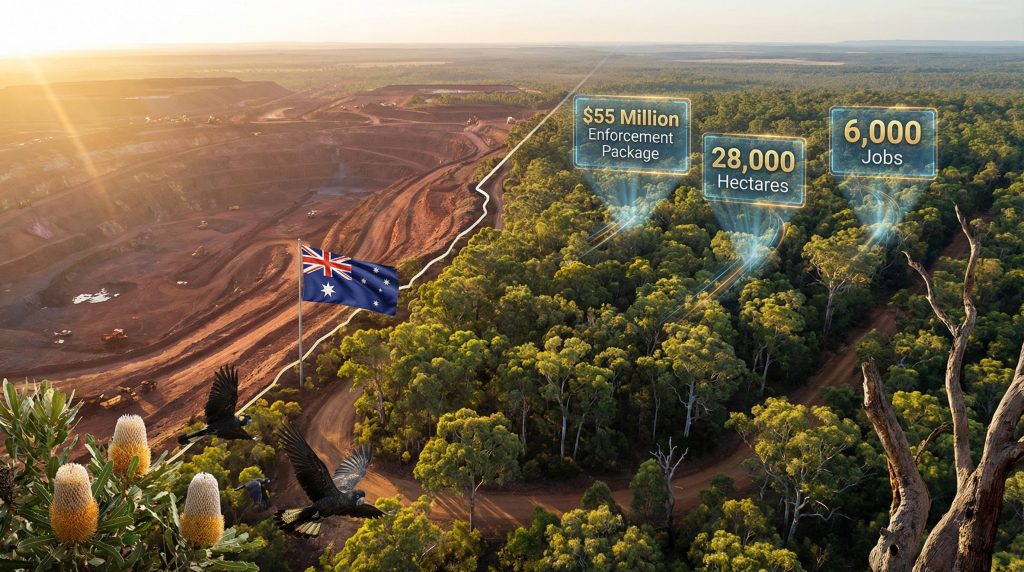
The $55 million enforcement package against Alcoa represents one of Australia's most significant environmental penalties in the mining sector. This action addresses unlawful forest clearing activities that occurred between 2019 and 2025 without required federal environmental approval, demonstrating the retrospective application of environmental laws to ongoing operations.
| Penalty Component | Amount (AUD) | Purpose |
|---|---|---|
| Direct violation penalties | $36 million | Unlawful clearing enforcement |
| Environmental restoration fund | $15 million | Forest rehabilitation programmes |
| Research and monitoring investment | $4 million | Biodiversity monitoring systems |
The enforcement action occurred despite Alcoa's position that it had operated within existing legal frameworks. This highlights the evolving interpretation of environmental compliance requirements and the federal government's willingness to pursue retrospective enforcement where environmental violations are identified. The conditional continuation of limited clearing activities during ongoing assessments reflects a balanced approach between immediate environmental protection and recognition of existing industrial operations.
Furthermore, companies facing similar regulatory challenges may find themselves subject to a class action lawsuit if governance standards are deemed inadequate.
Comparative Context in Australian Mining Enforcement
When benchmarked against other major environmental penalties in Australia's resources sector, the $55 million enforcement package establishes new precedents for federal environmental enforcement. Previous penalties for mining-related environmental violations typically ranged in the low millions, making this action approximately ten times larger than historical norms.
This escalation signals a fundamental shift in government approach to environmental enforcement. Rather than treating violations as regulatory cost-of-business, federal authorities are implementing penalty structures designed to create genuine economic incentives for environmental compliance. The precedent-setting nature of this enforcement action likely influences compliance calculations across the entire Australian mining industry.
Ecological Significance of Northern Jarrah Forest Systems
The Northern Jarrah Forest represents a globally unique ecosystem containing species assemblages found nowhere else on Earth. This biodiversity hotspot classification reflects the concentration of endemic species that have evolved specifically within jarrah forest conditions over millions of years. The irreplaceable nature of these ecosystems means that any disturbance removes ecological values that cannot be recreated through rehabilitation technologies.
Critical biodiversity considerations include:
• Endemic plant species requiring specific soil chemistry and mycorrhizal relationships
• Threatened black cockatoo populations dependent on old-growth hollow-bearing trees
• Complex understory communities adapted to specific light and moisture conditions
• Soil microbiome communities that support unique nutrient cycling processes
The 28,000-hectare mining footprint represents an area larger than many metropolitan regions, spanning decades of forest conversion within one of Australia's most biodiverse landscapes. This scale of impact raises fundamental questions about the cumulative effects of ongoing resource extraction in irreplaceable natural systems.
Moreover, industry discussions at the WA mining conference frequently address these environmental challenges facing the sector.
Old-Growth Forest Temporal Scales and Restoration Challenges
"The restoration of jarrah forest ecosystems operates on temporal scales that exceed human planning horizons, with key structural elements requiring centuries to develop equivalent ecological function."
Contemporary environmental standards recognise that true ecosystem restoration must recreate not just vegetation cover, but the complex structural and functional relationships that define intact forest systems. This includes:
• Canopy architecture developing over 100-300 years to provide nesting hollows for native fauna
• Soil development requiring decades to centuries for mycorrhizal network establishment
• Genetic diversity within plant populations that cannot be replicated through plantation-style rehabilitation
• Ecosystem services such as watershed protection and carbon sequestration that develop slowly over time
Rehabilitation Effectiveness and Scientific Assessment
Independent scientific assessment of rehabilitation outcomes reveals significant gaps between company claims and measurable ecological restoration. A peer-reviewed analysis published in 2024 found rehabilitation efforts characterised as substandard and following a poor to declining trajectory when evaluated against contemporary restoration benchmarks.
The research identified fundamental disconnects between rehabilitation approaches developed decades ago and current understanding of ecosystem restoration science. Traditional approaches focused primarily on vegetation establishment without addressing the complex ecological relationships necessary for long-term ecosystem function.
Industry leaders are increasingly exploring mine reclamation innovations to address these restoration challenges more effectively.
The 800-to-1000 Hectare Restoration Formula
Under new federal agreement terms, Alcoa committed to limiting clearing to 800 hectares annually while increasing rehabilitation to 1,000 hectares per year by 2027. This creates a theoretical net environmental gain of 200 hectares annually, though the definition and measurement of successful rehabilitation remains scientifically complex.
Key implementation challenges include:
• Timeline disparities between rapid clearing and decades-long restoration processes
• Quality metrics defining what constitutes successful ecosystem restoration
• Monitoring systems providing independent verification of rehabilitation outcomes
• Adaptive management mechanisms for addressing restoration failures or unexpected outcomes
The commitment to increase rehabilitation rates represents a significant shift from historical practices, though the technical feasibility of achieving quality ecosystem restoration at industrial scales remains scientifically uncertain.
Economic Pressures and Political Decision-Making
The balance between environmental protection and regional economic activity creates complex political pressures that influence regulatory decision-making. Thousands of Western Australians work directly or indirectly with mining operations, creating significant employment dependencies in regional communities.
These employment considerations factor prominently into regulatory approaches, with government officials acknowledging the importance of maintaining economic activity while raising environmental performance standards. According to ABC News, the challenge lies in developing regulatory frameworks that protect environmental values without causing unnecessary economic disruption to established industrial operations and dependent communities.
Strategic Assessment Framework Development
The development of a Strategic Assessment framework extending to 2045 represents an innovative approach to long-term environmental planning in resource extraction contexts. This framework attempts to integrate decades-long environmental planning with ongoing mining operations, creating predictability for both environmental outcomes and industrial planning.
The Strategic Assessment approach addresses several regulatory challenges:
• Cumulative impact assessment across multiple mine sites and decades of operation
• Adaptive management systems responding to new scientific understanding
• Stakeholder engagement mechanisms ensuring ongoing community input
• Offset and restoration programmes delivering net environmental benefit over time
The next major ASX story will hit our subscribers first
Public Participation and Transparency Mechanisms
The unprecedented level of public engagement in environmental decision-making processes reflects growing community expectations for transparency in regulatory frameworks. Public consultation processes generated approximately 60,000 submissions, representing one of the largest community responses to environmental decision-making in Australian history.
This level of public engagement indicates significant community concern about environmental management in biodiversity hotspots. The volume and quality of submissions provided regulators with detailed input on community values, scientific concerns, and alternative management approaches.
Corporate Accountability and Information Disclosure
Recent enforcement actions by advertising standards authorities found that environmental claims made in public communications were inaccurate or misleading. This enforcement demonstrates growing scrutiny of corporate environmental communications and the requirement for substantiated claims about restoration outcomes.
Enhanced transparency mechanisms include:
• Regular public reporting on rehabilitation progress and outcomes
• Independent monitoring systems with public data accessibility
• Third-party verification of environmental performance claims
• Clear remediation procedures when performance targets are not achieved
These transparency measures represent a shift from trust-based to verification-based environmental compliance, reflecting broader changes in environmental governance expectations.
Environmental Governance Evolution and Industry Implications
The transition from industry self-regulation toward active government oversight reflects fundamental changes in environmental governance philosophy. Where legacy mining agreements emphasised industry discretion in environmental management, contemporary approaches require verifiable environmental outcomes and independent oversight.
This evolution challenges established mining operations to modernise environmental management systems while maintaining operational viability. The integration of federal and state oversight mechanisms creates new compliance requirements that extend beyond traditional state-based mining regulation.
In addition, the sector is witnessing increased adoption of renewable energy innovations as companies seek to improve their overall environmental performance.
Precedent Setting for Future Resource Development
The regulatory approach developed for jarrah forest mining operations establishes precedents that likely influence future resource development approvals across Australia. Key precedent elements include:
• Retrospective enforcement of environmental violations under evolving regulatory interpretations
• Federal intervention in state-based mining operations affecting national environmental significance
• Scientific peer review requirements for rehabilitation effectiveness claims
• Long-term strategic planning integrating environmental and industrial planning horizons
These precedents signal to the broader resources industry that environmental compliance expectations continue to evolve, with potential implications for existing operations established under different regulatory frameworks.
Future Regulatory Reform and Industry Adaptation
The modernisation of environmental frameworks governing Western Australian mining operations represents the beginning of broader regulatory reform processes. State government commitments to bring legacy mining agreements under contemporary environmental protection arrangements indicate systematic changes ahead for the resources sector.
Upcoming regulatory reforms likely include enhanced penalties for environmental violations, expanded monitoring requirements, and integration of climate change considerations into mining approvals. These changes reflect growing political and community expectations for environmental performance in resource extraction activities.
Technology Innovation and Sustainable Resource Extraction
The path toward sustainable resource extraction requires significant technological innovation in both impact minimisation and ecosystem restoration. Current rehabilitation technologies remain inadequate for recreating the complex ecological relationships found in old-growth forest systems.
Emerging technological approaches include:
• Advanced soil microbiome restoration techniques for mycorrhizal network reestablishment
• Precision seeding technologies for complex understory community restoration
• Real-time environmental monitoring systems providing continuous compliance verification
• Predictive modeling systems for long-term ecosystem restoration trajectory assessment
The integration of these technological innovations with enhanced regulatory frameworks represents the future direction for environmentally sustainable resource extraction in biodiversity hotspots. However, as highlighted by The Guardian, significant penalties continue to underscore the urgent need for improved environmental stewardship in the mining sector.
Consequently, the Alcoa environmental record in Western Australia case demonstrates the challenges and opportunities inherent in modernising environmental governance for established industrial operations. As regulatory expectations continue to evolve, the balance between environmental protection and economic activity will require ongoing innovation in both technology and policy frameworks.
Disclaimer: This analysis is based on publicly available information and should not be considered as investment advice. Environmental regulatory frameworks continue to evolve, and future changes may affect the issues discussed in this article.
Want to Stay Ahead of ASX Mining Discoveries?
Discovery Alert's proprietary Discovery IQ model delivers instant notifications on significant mineral discoveries across the ASX, helping investors identify actionable opportunities before the broader market catches on. With environmental regulations reshaping the mining landscape, staying informed about major discoveries and their potential returns has never been more crucial for positioning yourself ahead of regulatory and market shifts.