June 27, 2026
Understanding Revolutionary Remote-Controlled Systems in Mining Operations
Industrial automation has fundamentally altered manufacturing processes across multiple sectors, yet underground mining operations have remained remarkably resistant to technological transformation. This resistance stems largely from the unique environmental challenges posed by confined spaces, unstable geological conditions, and the inherent unpredictability of subsurface operations. However, recent advances in Brokk remote-controlled mining equipment are beginning to reshape how extraction operations approach both productivity and safety protocols.
The convergence of several technological factors has created an inflection point for mining automation. Enhanced battery technology now provides sufficient power density for heavy-duty operations in confined spaces. Improved radio communication systems enable reliable control at significant distances from hazardous work zones. Advanced hydraulic systems deliver precise force application through compact mechanical packages. These developments have culminated in sophisticated remote-controlled platforms capable of performing complex underground tasks without direct human presence.
Core Technology Architecture Behind Automated Mining Systems
Remote-controlled mining equipment operates through integrated electromagnetic command systems that enable operators to maintain safe distances from active work zones. These systems utilize radio frequency communication protocols to transmit control signals across distances up to several hundred meters, depending on underground conditions and signal interference factors.
Electric power systems form the foundation of modern remote mining equipment, delivering zero-emission performance in confined underground environments. This electric architecture eliminates the ventilation requirements associated with diesel-powered alternatives while reducing thermal loads and acoustic interference that can compromise operator communication and equipment monitoring. Furthermore, AI in mining operations is enhancing these electric systems through intelligent power management and predictive maintenance protocols.
The mechanical design philosophy prioritises compact dimensions that accommodate existing mine infrastructure while maximising functional capability. Standard tunnel dimensions and headroom clearances constrain equipment proportions, requiring innovative engineering solutions to deliver substantial breaking force and material handling capacity within geometric limitations.
Multi-directional hydraulic arm configurations provide operational versatility through articulated joint systems that enable precise positioning and force application. These hydraulic systems integrate multiple attachment points, allowing rapid tool changes without mechanical reconfiguration or extended downtime periods.
Technical Performance Classifications Across Equipment Categories
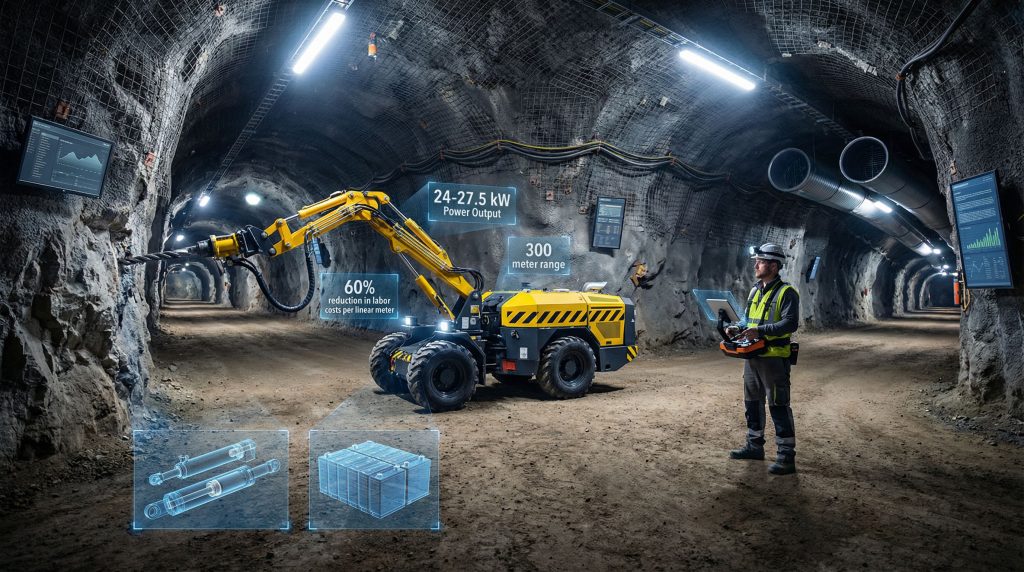
Modern remote-controlled mining equipment spans multiple performance categories designed for specific operational requirements. Light-duty platforms typically deliver 24-27.5 kW power output with machine weights ranging from 1.7 to 2.1 tons, optimised for rock scaling, light material breaking, and precision work in confined access areas.
Medium-duty systems operate in the 37 kW power range with weights between 3-4 tons, providing enhanced capability for heavy material breaking, drilling support operations, and sustained high-force applications. These systems balance mobility with power delivery for versatile underground applications.
Heavy-duty platforms exceed 60 kW power output with machine weights of 6+ tons, designed for primary material crushing, bulk handling operations, and applications requiring maximum force delivery. These units often serve as primary processing equipment rather than auxiliary support tools.
Equipment Performance Matrix:
| Machine Class | Power Output | Weight Range | Primary Applications |
|---|---|---|---|
| Light-duty | 24-27.5 kW | 1.7-2.1 tons | Scaling, precision work |
| Medium-duty | 37 kW | 3-4 tons | Heavy breaking, drilling |
| Heavy-duty | 60+ kW | 6+ tons | Primary crushing, bulk handling |
Advanced Control Integration and Safety Protocols
Remote operation capabilities extend beyond simple radio control to encompass sophisticated feedback systems that provide operators with real-time performance data. Force sensors integrated into hydraulic systems enable precise control of breaking and drilling operations, preventing equipment damage from excessive loading while optimising productivity.
Emergency stop protocols form critical safety infrastructure, providing multiple redundant systems for immediate equipment shutdown. These fail-safe mechanisms activate automatically in response to communication loss, operator command, or predetermined safety threshold violations. In addition, data-driven mining future initiatives are incorporating these safety systems into broader mine monitoring networks.
Integration with mine communication networks allows remote equipment to interface with broader mine monitoring systems, enabling centralised oversight and coordination with other underground operations. This connectivity facilitates predictive maintenance protocols and operational optimisation through data analysis.
When big ASX news breaks, our subscribers know first
Revolutionising Underground Safety Through Remote Operation Technology
Traditional mining operations require personnel presence in locations where geological instability, equipment hazards, and environmental conditions create significant risk exposure. The fundamental principle driving remote equipment adoption centres on eliminating human presence from these high-risk zones while maintaining operational capability and productivity levels.
Zero-entry protocols represent a paradigm shift in mining safety philosophy, moving beyond personal protective equipment and hazard mitigation toward complete hazard elimination through technology substitution. This approach recognises that the most effective safety measure involves removing personnel from dangerous environments rather than attempting to make dangerous environments safer for personnel.
Hazard Categories Addressed Through Remote Operations
Unstable ground conditions present one of the most significant ongoing risks in underground mining operations. Remote-controlled equipment enables material extraction, support installation, and clearing operations in areas where roof falls, wall collapses, or floor instability would pose unacceptable risks to human operators.
Oversize material handling and blockage clearing operations traditionally require personnel to work in close proximity to heavy machinery and unstable material piles. Remote operation eliminates crushing hazards, falling object risks, and equipment entanglement dangers whilst maintaining clearing capability.
Confined space operations, particularly in areas with limited ventilation or potential gas accumulation, benefit significantly from remote control systems. Electric operation eliminates exhaust emissions whilst remote control removes personnel from potentially hazardous atmospheric conditions. Moreover, underground mining innovation is advancing these capabilities through enhanced sensor integration.
Equipment maintenance and emergency response scenarios often occur under time pressure in challenging environments. Remote capability enables rapid response to equipment failures, blockages, or emergency situations without exposing personnel to additional risks.
Operational Efficiency Gains Through Continuous Remote Operation
Brokk remote-controlled mining equipment enables 24/7 operation cycles without the fatigue factors and shift change requirements associated with human operators. This continuous operation capability can significantly increase productive hours per day, particularly for critical path operations that constrain overall mine productivity.
Consistent performance levels result from elimination of human variability factors such as operator skill differences, fatigue-related performance degradation, and safety-driven conservatism that may reduce operational intensity. Remote systems maintain optimal performance parameters regardless of shift duration or operational complexity.
Predictive maintenance capabilities enhance operational reliability through continuous monitoring and data collection. Remote systems can provide detailed operational data that enables maintenance scheduling optimisation and component failure prediction, reducing unplanned downtime events.
Comprehensive Task Capabilities of Remote-Controlled Mining Equipment
Modern remote-controlled mining systems demonstrate remarkable versatility across the spectrum of underground operational requirements. These platforms integrate multiple tool interfaces and hydraulic capabilities to address diverse material handling, processing, and maintenance tasks through single equipment deployments.
Primary Material Processing and Breaking Operations
Secondary breaking operations at crushing stations represent a core application for remote equipment. When primary blasting produces oversize material that exceeds crusher specifications, traditional approaches require personnel to work in close proximity to unstable material piles and active crushing equipment. Remote breaking capability eliminates personnel exposure whilst maintaining material flow rates.
Grizzly clearing and material flow optimisation benefit significantly from remote operation, as these tasks typically occur at transfer points where personnel face falling object hazards and equipment entanglement risks. Remote systems can clear blockages, break oversize material, and optimise material distribution without personnel presence in hazardous zones.
Conveyor maintenance and debris removal operations often require work beneath active systems or in confined spaces adjacent to moving machinery. Remote capability enables thorough cleaning and maintenance without exposing personnel to conveyor hazards or requiring system shutdowns that impact overall mine productivity.
Stockpile management and material redistribution activities benefit from remote operation in situations where material stability or equipment proximity creates safety concerns. Remote systems can reshape stockpiles, relocate material, and optimise storage configurations without personnel exposure to unstable material conditions.
Specialised Underground Development and Maintenance Operations
Rock scaling and loose material removal operations require personnel to work beneath potentially unstable rock surfaces where falling objects pose significant risks. Remote scaling capability enables thorough surface preparation and hazard removal without exposing workers to falling rock dangers.
Ground support installation, including bolt hole drilling and support positioning, benefits from remote operation in areas where ground conditions may be unstable during the installation process. Remote drilling ensures proper support placement whilst eliminating personnel exposure during critical ground stabilisation activities.
Confined space excavation and cleanup operations often occur in areas with limited access, poor ventilation, or structural concerns that make personnel presence hazardous. Remote systems provide excavation capability in these challenging environments without compromising safety protocols. Additionally, mining industry evolution 2025 trends are driving increased adoption of these advanced capabilities.
Surface preparation for concrete application, rehabilitation work, and structural modifications can be accomplished remotely in areas where access limitations or structural concerns would otherwise require extensive safety measures or work postponement.
Advanced Attachment Systems for Multi-Purpose Applications
Remote Equipment Attachment Capabilities:
| Attachment Category | Operational Function | Typical Applications |
|---|---|---|
| Hydraulic breakers | Rock fragmentation | Secondary breaking, scaling operations |
| Drum cutters | Precision material removal | Tunnel profiling, surface preparation |
| Rock splitters | Controlled material fracturing | Selective breaking, structural work |
| Drilling systems | Hole creation and positioning | Support installation, sample collection |
| Material grapples | Handling and placement | Debris removal, component positioning |
| Vacuum systems | Fine material removal | Conveyor cleaning, dust control |
Attachment versatility enables single equipment platforms to address multiple operational requirements without requiring separate specialised machines for each task type. This capability reduces equipment fleet requirements, maintenance complexity, and operational coordination challenges whilst maintaining comprehensive task coverage.
Quick-change attachment systems minimise downtime associated with tool changes, enabling efficient transition between different operational requirements within single work shifts. Hydraulic coupling systems facilitate rapid attachment changes without manual tool handling or mechanical adjustments.
Electric Power Systems and Underground Performance Optimisation
Electric power architecture fundamentally transforms the operational environment for underground mining equipment through elimination of combustion emissions, reduced thermal loads, and enhanced power delivery characteristics. These advantages create significant operational and economic benefits that extend beyond simple equipment performance improvements.
Environmental and Operational Advantages of Electric Systems
Zero-emission operation eliminates the substantial ventilation requirements associated with diesel equipment, reducing ventilation costs and enabling operation in areas where air quality constraints would otherwise limit equipment use. Underground ventilation systems typically consume 40-50% of total mine electrical load, making emission reduction particularly valuable from both environmental and economic perspectives.
Reduced heat generation from electric motors creates more comfortable working environments and reduces cooling requirements in confined spaces. Electric motors operate at 85-95% efficiency compared to diesel engines at 35-40% efficiency, dramatically reducing waste heat production that must be managed through ventilation systems.
Lower noise levels from electric operation improve communication capabilities and reduce operator fatigue from noise exposure. Electric motor systems typically operate at 70-75 decibels compared to diesel equipment at 90-100+ decibels, enabling better coordination and safer working conditions. Furthermore, electric vehicles in mining are contributing to this trend toward quieter, cleaner operations.
Simplified logistics result from elimination of fuel storage, handling, and supply requirements in underground environments. Fuel transport and storage in underground locations creates additional safety concerns and logistical complexity that electric systems completely eliminate.
Power Management and Performance Optimisation
Advanced power management systems optimise energy delivery based on operational requirements and attachment demands. Variable frequency drives enable precise motor control for different applications, from high-torque breaking operations to precision positioning tasks requiring fine control.
Load balancing capabilities prevent equipment instability during high-force operations by automatically adjusting power distribution between traction, hydraulics, and attachment systems. These systems monitor machine stability and automatically limit power delivery to prevent tipping or loss of traction.
Energy recovery systems capture power from hydraulic operations and braking activities, extending operational periods between charging cycles. Regenerative hydraulic systems can recover 15-25% of hydraulic energy during lowering operations, improving overall system efficiency.
Integrated monitoring systems provide real-time feedback on power consumption, operational efficiency, and maintenance requirements. These systems enable predictive maintenance protocols and operational optimisation through detailed performance data analysis.
Economic Impact and Return on Investment Analysis
The economic benefits of remote-controlled mining equipment extend beyond simple productivity improvements to encompass labour cost reduction, safety-related savings, and operational flexibility enhancements that create substantial long-term value propositions for mining operations.
Labour Cost Optimisation and Productivity Enhancement
Remote operation enables significant labour cost reductions through elimination of specialised operator requirements for hazardous tasks. Traditional operations often require premium labour rates for work in dangerous environments, whilst remote operation enables standard operator rates for equipment control from safe locations.
Reduced insurance premiums result from improved safety records and reduced personnel exposure to high-risk activities. Insurance cost reductions can be substantial for operations with strong safety performance records and documented risk reduction measures.
Accelerated project timelines through continuous operation capabilities create value through faster project completion and earlier revenue generation. Projects that can maintain 24-hour operation cycles often complete weeks or months ahead of traditional schedules.
Enhanced operational flexibility enables rapid response to changing conditions or emergency situations without requiring specialised personnel deployment or extensive safety preparations. This flexibility often prevents costly delays and maintains production continuity during disruptive events.
Maintenance and Operational Cost Structure
Electric power systems typically require lower maintenance than comparable diesel equipment through elimination of engine oil changes, fuel system maintenance, and emission control system servicing. Electric motor maintenance primarily involves bearing lubrication and electrical connection inspection.
Precise hydraulic control through remote operation reduces component wear by enabling optimal force application and preventing equipment overload or misuse. Remote operators can apply consistent technique and avoid the operational variations that often lead to premature component failure.
Extended equipment lifespan results from controlled operation and reduced exposure to operator-induced damage or misuse. Brokk remote-controlled mining equipment eliminates many of the factors that contribute to premature equipment wear in challenging underground environments.
Simplified inventory management for electric systems reduces spare parts complexity and storage requirements compared to diesel equipment with extensive engine and emission control components.
Investment Payback and Long-Term Value Creation
Typical payback periods for remote-controlled mining equipment range from 12-24 months depending on application intensity, labour cost savings, and safety benefit valuations. High-utilisation applications with significant safety benefits often achieve shorter payback periods through rapid cost savings accumulation.
Avoided costs from safety incidents provide substantial but often underestimated value through prevention of injury-related costs, regulatory penalties, and operational disruptions. Major safety incidents can cost millions of dollars in direct costs and operational delays.
Increased mine throughput through reduced operational bottlenecks creates value by enabling higher production rates from existing infrastructure. Remote equipment often eliminates delays associated with safety preparations, personnel positioning, and hazard assessment procedures.
Enhanced operational reputation and regulatory standing provide long-term competitive advantages through improved stakeholder relationships and simplified permitting processes for future projects.
Industry Applications and Market Adoption Patterns
Remote-controlled mining equipment has achieved significant penetration across diverse mining sectors, with applications spanning underground precious metals, base metals, industrial minerals, and specialised construction projects. Each sector presents unique operational requirements and adoption drivers that shape equipment deployment strategies.
Underground Precious Metals and Base Metals Operations
Gold mining operations utilise remote equipment extensively for stope cleaning and ore recovery optimisation in areas where ground conditions may be unstable following blasting operations. Remote capability enables thorough material recovery without exposing personnel to potential ground failure risks.
Development heading advancement in narrow vein deposits benefits significantly from remote operation, as confined working spaces often create elevated safety risks for traditional equipment operators. Remote systems enable efficient development whilst maintaining appropriate safety distances.
Ground support installation in unstable conditions becomes feasible through remote drilling and positioning systems that can complete support installation without personnel presence in potentially dangerous areas.
Emergency response capabilities for equipment recovery and blockage clearing provide critical operational continuity when unexpected events occur in underground workings. Remote systems often serve as the primary response tool for situations where immediate human intervention would be unsafe.
Surface Mining and Quarrying Applications
Crusher maintenance and component replacement operations benefit from remote capability when work must be performed in close proximity to active crushing equipment or in areas with elevated falling object risks.
Overburden removal in confined areas or unstable locations enables continued operation where traditional equipment deployment would require extensive safety measures or work postponement. Consequently, Brokk's specialised mining equipment provides these critical capabilities for challenging surface applications.
Slope stabilisation and remediation work often requires operation in areas where geological stability is questionable. Remote systems enable necessary work without exposing personnel to slope failure risks.
Processing plant maintenance and facility upgrades can be accomplished with minimal personnel exposure to industrial hazards through remote operation capability.
Global Market Penetration and Adoption Trends
Current global deployment encompasses over 8,000 units operating across 100+ countries, indicating substantial market acceptance and proven operational value. This deployment level demonstrates successful technology transfer across diverse geological, regulatory, and operational environments.
Accelerated adoption in safety-conscious jurisdictions reflects regulatory pressure and cultural emphasis on worker protection. Regions with stringent safety regulations often lead adoption curves for technologies that eliminate personnel exposure to hazardous conditions.
Growing demand in emerging mining markets indicates technology transfer to operations seeking competitive advantages through safety and productivity improvements. Emerging markets often adopt advanced technologies rapidly when clear operational benefits are demonstrated.
Expansion into adjacent industrial sectors, including tunnelling, demolition, and nuclear facility maintenance, demonstrates technology versatility and broadening market applications beyond traditional mining operations. For instance, advanced demolition machines are finding applications across multiple industries.
The next major ASX story will hit our subscribers first
Future Technological Developments and Innovation Trajectories
The evolution of remote-controlled mining equipment continues through integration of advanced sensor technologies, artificial intelligence systems, and enhanced connectivity solutions that promise to further transform underground operations through increased automation and operational intelligence.
Advanced Sensor Integration and Autonomous Operation
LiDAR mapping systems enable three-dimensional environmental modelling that supports autonomous navigation and obstacle avoidance. These systems create detailed spatial maps that enable equipment to operate independently within predefined operational parameters.
Force feedback systems provide operators with tactile sensation during remote operation, enabling more precise control and reducing learning curves for equipment operation. Haptic feedback systems translate hydraulic forces and material resistance into operator sensations.
Predictive maintenance through IoT connectivity enables continuous monitoring of component condition and performance trends. Advanced sensors monitor vibration, temperature, pressure, and electrical parameters to predict component failures before they occur.
Machine learning algorithms analyse operational patterns to optimise performance parameters automatically. These systems learn from operational data to improve efficiency, reduce wear, and enhance productivity through continuous optimisation.
Enhanced Communication and Operational Integration
5G connectivity enables real-time data transmission and remote operation with minimal latency, supporting more responsive control and enhanced operator experience. High-bandwidth connectivity also enables remote expert support and troubleshooting.
Augmented reality interfaces provide operators with enhanced situational awareness through overlay of operational data, equipment status, and environmental information on real-world views of equipment and work areas.
Cloud-based fleet management platforms enable centralised monitoring and coordination of multiple equipment units across different locations. These systems provide operational overview and optimisation opportunities across entire equipment fleets.
Integration with mine planning software systems enables automated coordination between equipment operation and broader mine planning objectives, optimising resource allocation and operational sequencing.
Strategic Implementation and Technology Adoption
Successful implementation of remote-controlled mining equipment requires comprehensive evaluation of technical requirements, operational integration needs, and long-term strategic objectives. Organisations must consider multiple factors when evaluating technology adoption decisions.
Technical Assessment and Site-Specific Requirements
Dimensional constraints and access limitations often determine equipment size and configuration requirements for specific underground operations. Existing infrastructure dimensions, including tunnel heights, turn radii, and loading dock specifications, constrain equipment selection options.
Power infrastructure availability and electrical capacity requirements must align with equipment specifications and charging infrastructure needs. Electrical system upgrades may be necessary to support high-power equipment charging and operation.
Attachment compatibility assessments ensure that selected equipment can accommodate existing operational workflows and tool requirements. Standardisation of attachment interfaces enables greater operational flexibility and inventory optimisation.
Communication system compatibility with existing mine networks ensures seamless integration with current operational and safety systems. Radio frequency coordination prevents interference with existing mine communication and monitoring systems.
Financial Analysis and Implementation Planning
Total cost of ownership calculations must include equipment acquisition costs, training expenses, maintenance requirements, and support infrastructure investments. Long-term operational costs often differ significantly from initial acquisition costs.
Service network availability and spare parts accessibility impact operational reliability and maintenance costs. Local service capabilities reduce response times and maintenance costs whilst improving equipment availability.
Scalability options for fleet expansion enable growth accommodation without requiring wholesale technology changes. Standardised platforms facilitate fleet expansion and cross-training opportunities.
Regulatory compliance requirements vary by jurisdiction and may impact equipment specifications or operational procedures. Early regulatory engagement ensures compliance and prevents implementation delays.
Risk Management and Operational Transition
Phased deployment strategies enable gradual technology adoption whilst maintaining operational continuity and minimising disruption risks. Initial deployments in less critical applications provide learning opportunities before broader implementation.
Operator training programmes require development of new skill sets and certification procedures for remote equipment operation. Training programmes must address both technical operation and safety procedures specific to remote systems.
Backup systems and redundancy planning ensure operational continuity if remote systems experience failures or require maintenance. Hybrid operational approaches maintain traditional capabilities during technology transition periods.
Performance monitoring and optimisation protocols enable continuous improvement and technology refinement based on operational experience and performance data analysis.
Technology Transformation and Strategic Mining Advantages
The integration of remote-controlled equipment represents a fundamental transformation in mining operational philosophy that extends beyond simple technology adoption to encompass comprehensive reimagining of underground work processes and safety protocols. This transformation creates competitive advantages through enhanced safety performance, operational efficiency, and technological leadership that position adopting organisations for long-term success.
Organisations implementing Brokk remote-controlled mining equipment consistently report measurable improvements in safety metrics, operational efficiency, and cost management that justify technology investments through multiple value creation pathways. These improvements often exceed initial projections as operations develop expertise and identify additional application opportunities.
Future mining operations will increasingly rely on remote and automated systems as regulatory requirements continue evolving toward enhanced worker protection and environmental performance. Early technology adoption provides operational experience and competitive positioning advantages that become increasingly valuable as industry standards evolve.
The demonstrated success of remote-controlled mining technology across diverse global operations indicates robust technology maturity and broad applicability across different geological and operational environments. This proven performance record reduces implementation risks and provides confidence in technology reliability for mission-critical applications.
Disclaimer: This analysis is based on publicly available information and industry reports. Equipment performance specifications and financial projections may vary based on specific operational conditions, geological factors, and implementation approaches. Organisations should conduct comprehensive feasibility studies and pilot programmes before making technology adoption decisions.
Looking to Invest in Mining Technology Leaders?
Discovery Alert's proprietary Discovery IQ model delivers real-time notifications on significant ASX mineral discoveries, including breakthrough automation and technology companies transforming mining operations. Explore historic examples of major mining discoveries that have generated substantial returns, or begin your 30-day free trial today to position yourself ahead of market movements.