
May 16, 2026
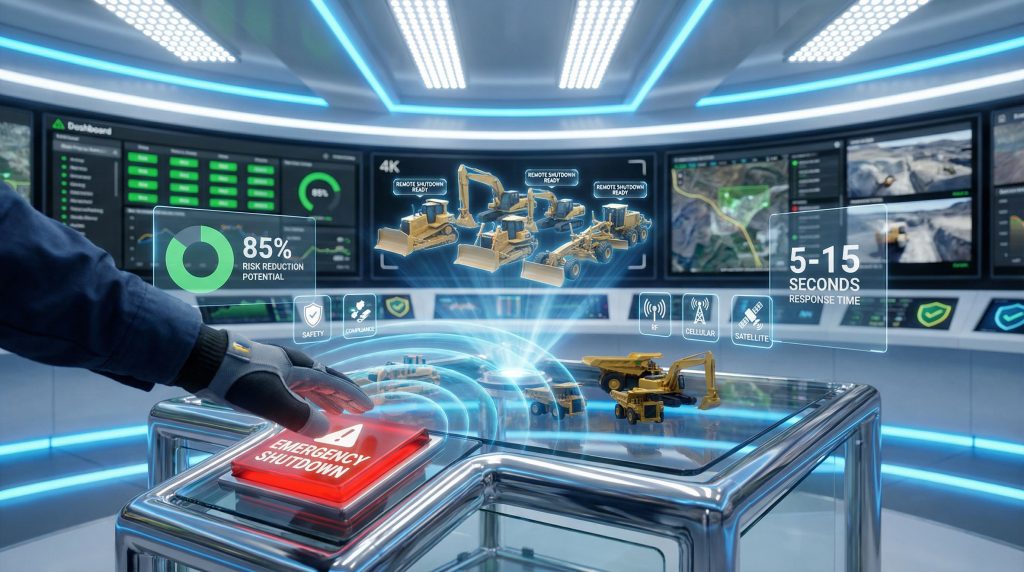
Remote shutdown technology has emerged as a critical safety solution for industrial operators managing heavy equipment across challenging operational environments. Furthermore, traditional shutdown procedures requiring direct physical access create secondary hazard exposure during emergency interventions. This operational vulnerability has accelerated demand for technological solutions that enable rapid equipment deceleration without personnel proximity to active machinery, driving significant industry evolution trends across heavy equipment sectors.
Modern remote shutdown systems represent a fundamental shift from reactive safety measures toward predictive intervention capabilities, transforming how operators manage equipment emergencies across diverse industrial applications.
Understanding Remote Shutdown Systems: Core Components and Functionality
Remote shutdown technology integrates multiple hardware and software layers to create comprehensive emergency intervention capabilities. These systems function through interconnected components that monitor, communicate, and execute shutdown commands across varying operational environments.
Essential Hardware Elements
Core hardware components form the foundation of effective remote shutdown implementations:
• Control units and communication modules: Central processing hardware manages command interpretation and system status monitoring
• Wireless transmission protocols: RF, cellular, and satellite communication options provide redundant connectivity across terrain variations
• Machine interface integration points: OEM-agnostic mounting systems accommodate diverse equipment manufacturers and models
• Emergency activation devices: Handheld controllers and panic button systems enable immediate operator response
Modern systems utilise OEM-agnostic architecture, allowing installation across different equipment brands without manufacturer-specific modifications. According to industry deployment data from Global Mining Review, these systems can be installed on any make or model of machine, providing operators maximum flexibility in fleet management applications.
Software Architecture and Command Protocols
Software layers manage authentication, command processing, and system monitoring functions:
Real-time monitoring capabilities track equipment status and operator conditions continuously. Authentication and security protocols prevent unauthorised shutdown commands through encrypted communication channels. Multi-device fleet management enables centralised control across multiple equipment units simultaneously.
Advanced systems incorporate automated response triggers that activate based on predetermined criteria, including operator incapacitation detection or equipment malfunction parameters. These automated protocols reduce response times from manual intervention requirements to instantaneous emergency activation.
Technical Insight: Installation success depends heavily on proper integration with existing equipment electrical systems. Industry technicians report that successful deployments require comprehensive compatibility assessment before hardware mounting procedures begin.
When big ASX news breaks, our subscribers know first
Why Remote Shutdown Technology Has Become Critical for Heavy Equipment Operations
Equipment-related incidents across industrial sectors have created urgent demand for enhanced safety intervention capabilities. Statistical analysis reveals concerning trends that underscore the critical need for remote shutdown implementation, particularly as data-driven operations become increasingly important for safety management.
Statistical Analysis of Equipment-Related Incidents
| Equipment Type | Annual Incidents (2022-2023) | Primary Risk Factors | Remote Shutdown Impact |
|---|---|---|---|
| Bulldozers | 19 rollovers (Queensland only) | Floor cleanup, rehabilitation work | Immediate intervention capability |
| Graders | Mounting/dismounting hazards | Equipment access challenges | Enhanced operator safety |
| Excavators | Operator incapacitation scenarios | Emergency response delays | Rapid shutdown activation |
Queensland incident data demonstrates the unpredictable nature of heavy machinery operations in dynamic environments. Many bulldozer rollovers occurred during routine activities like floor clean-ups and rehabilitation work, highlighting that standard operations carry significant risk potential.
Industry experts emphasise that bulldozers and graders present particular mounting and dismounting challenges. Danny Ballard from RCT's Mt Isa Branch explains that these equipment types are among the most difficult pieces of mining equipment to mount and dismount safely, creating dangerous conditions when emergency intervention becomes necessary.
Emergency Response Time Comparison
Traditional manual shutdown procedures require 3-8 minutes depending on terrain access and equipment location. Remote shutdown activation reduces intervention time to 5-15 seconds from command initiation. This dramatic time reduction eliminates direct approach requirements to active machinery, significantly improving personnel safety outcomes.
Personnel safety improvement becomes critical when operators become incapacitated or experience distress. In such scenarios, reaching the operator can be extremely dangerous, especially if machinery remains operational during rescue attempts.
The continuing occurrence of bulldozer-related incidents across the industry demonstrates that equipping operators and sites with risk-reducing technology has become vital for operational safety. Industry stakeholders increasingly view remote shutdown capabilities as essential rather than optional safety features.
How Remote Shutdown Systems Work: Technical Implementation Process
Successful remote shutdown technology deployment requires systematic installation procedures that account for equipment compatibility, communication requirements, and operational validation. Implementation follows structured phases that ensure reliable emergency intervention capabilities.
Step-by-Step Installation Framework
1. Equipment Assessment Phase
• Machine compatibility evaluation determines hardware mounting requirements
• Power system integration mapping identifies electrical interface points
• Communication range testing validates transmission capabilities across operational areas
2. Hardware Integration Process
• OEM-agnostic mounting procedures accommodate diverse equipment manufacturers
• Electrical system interfacing connects shutdown controls to equipment power management
• Backup power supply configuration ensures system functionality during primary power failures
3. Testing and Calibration Protocol
• Emergency scenario simulation verifies system response under operational conditions
• Range and reliability verification confirms transmission effectiveness across site terrain
• Operator training implementation ensures proper emergency response procedures
Recent successful installations at major mining operations demonstrate effective implementation methodologies. At Glencore's McArthur River Mine, RCT technician Jake Saliba led installations that received positive feedback from site personnel for professionalism and execution quality.
Communication Technologies and Range Capabilities
Modern remote shutdown technology integrates multiple communication protocols to ensure redundancy during critical situations. Primary communication channels include RF transmission for short-range applications, cellular connectivity for extended coverage areas, and satellite backup for remote operational locations.
Range capabilities vary based on terrain characteristics and interference factors. Open terrain applications typically achieve maximum transmission distances, whilst underground or heavily forested environments may require signal repeaters or alternative communication methods.
System reliability depends on environmental conditions, equipment maintenance, and operator training quality. Successful deployments incorporate regular testing schedules that verify communication effectiveness and response time consistency.
Installation Success Factor: Professional installation execution significantly impacts long-term system reliability and operator confidence in emergency situations.
What Industries Benefit Most from Remote Shutdown Implementation?
Remote shutdown technology applications span multiple industrial sectors, with mining operations demonstrating the most advanced implementation and documented safety improvements. Industry adoption patterns reveal specific sectors where emergency intervention capabilities provide maximum operational value, particularly as AI in mining technology advances safety protocols.
Mining Sector Applications
Surface mining operations represent the primary application environment for remote shutdown systems. Major mining companies have successfully deployed these technologies across bulldozer and grader fleets, with documented safety improvements and operational efficiency gains.
Glencore's McArthur River Mine, one of the world's largest zinc and lead deposits, operates heavy machinery in dynamic and unpredictable conditions. The facility's decision to implement remote shutdown technology was driven by the need for rapid emergency intervention capabilities in challenging operational environments.
Underground mining environments present additional challenges requiring specialised system configurations. Communication limitations in underground applications necessitate infrastructure modifications that support reliable transmission between surface control points and underground equipment locations.
Processing facilities benefit from remote shutdown capabilities on conveyor systems, crushing equipment, and material handling machinery. These applications often involve multiple equipment units operating in coordinated sequences, requiring sophisticated shutdown protocols that prevent cascading operational disruptions.
Construction and Infrastructure Projects
Construction sector applications focus on highway construction equipment including road graders and compactors. Demolition operations utilise remote shutdown systems on excavators and specialised equipment operating in hazardous environments where operator safety requires enhanced intervention capabilities.
Port and terminal facilities implement these systems on container handling machinery, where equipment malfunctions can create significant safety hazards for nearby personnel and operational disruptions affecting cargo movement schedules.
Oil and Gas Operations
Upstream facilities integrate remote shutdown systems with drilling rigs and completion equipment operating in remote locations where emergency response resources may be limited. Pipeline construction projects utilise these systems on trenching and backfill machinery operating across extended geographical areas.
Refinery maintenance operations deploy remote shutdown capabilities on mobile equipment operating in hazardous zones where immediate evacuation may be required due to process safety concerns.
Industry experts anticipate strong expansion potential beyond current bulldozer and grader applications. Future implementations are expected to include excavators and other high-risk machinery as technology adoption accelerates across industrial sectors.
Which Remote Shutdown Technologies Lead the Market?
Market analysis reveals diverse technology providers offering solutions ranging from OEM-integrated systems to aftermarket retrofit capabilities. Leading technologies demonstrate varying approaches to hardware design, communication protocols, and fleet management integration.
Comparative Analysis of Leading Systems
| Technology Provider | Key Features | Industry Focus | Installation Complexity |
|---|---|---|---|
| OEM-Integrated Solutions | Factory-installed, warranty-backed | New equipment purchases | Low |
| Aftermarket Retrofit Systems | Universal compatibility, cost-effective | Existing fleet upgrades | Medium |
| Cloud-Based Platforms | Fleet-wide management, analytics | Large-scale operations | High |
RCT's Remote Shutdown System represents aftermarket retrofit capabilities with OEM-agnostic architecture. The system enables nearby personnel to manually shut down machinery during emergency situations, particularly when operators become incapacitated or experience distress.
This technology approach provides maximum flexibility for operators managing diverse equipment fleets from multiple manufacturers. Installation compatibility across different machine makes and models eliminates the need for manufacturer-specific solutions.
Market Development and Adoption Trends
Current market characteristics suggest relatively early adoption phases across most industrial sectors. Industry deployment data indicates that remote shutdown installations are anticipated to experience significant demand growth as safety improvements become more widely recognised.
Safety solution portfolios from leading providers extend beyond remote shutdown capabilities to include protection systems, ladder controllers, and advanced tele-remote and autonomous equipment operations. This comprehensive approach addresses multiple safety challenges through integrated technology platforms.
The success of installations at major mining operations creates demonstration effects that accelerate adoption across additional sites. Positive feedback from operational deployments builds confidence in technology reliability and safety improvement potential.
Technology expansion beyond current bulldozer and grader applications shows strong potential for excavators and other high-risk machinery applications. Market leaders are positioning comprehensive solutions that address emerging safety requirements across diverse industrial applications.
How to Implement Remote Shutdown Technology: Strategic Planning Guide
Successful remote shutdown technology implementation requires comprehensive planning that addresses equipment assessment, technology selection, training requirements, and operational integration. Strategic approaches ensure maximum safety benefits whilst minimising deployment disruptions.
Pre-Implementation Assessment Checklist
Equipment inventory and compatibility analysis identifies suitable machinery for remote shutdown installation. Assessment criteria include equipment age, electrical system compatibility, and operational environment characteristics that affect system performance.
Risk assessment and priority ranking determines which equipment units present the highest safety intervention requirements. Priority ranking considers incident history, operational environment hazards, and personnel exposure levels during normal operations.
Budget allocation and ROI projections evaluate implementation costs against anticipated safety improvements and operational benefits. Financial analysis includes hardware procurement, installation services, training programmes, and ongoing maintenance requirements.
Training programme development ensures operators understand emergency response procedures and system operation protocols. Comprehensive training addresses both technical system operation and emergency decision-making processes.
Phased Rollout Strategy
1. Pilot Programme Phase: High-risk equipment identification focuses initial deployment on machinery with the greatest safety improvement potential. Pilot programmes provide operational validation before fleet-wide expansion.
2. Proof of Concept: Limited deployment with performance monitoring validates system effectiveness under actual operational conditions. Performance metrics include response time reliability, communication effectiveness, and operator satisfaction levels.
3. Scaled Implementation: Fleet-wide expansion based on pilot results extends remote shutdown capabilities across additional equipment units. Scaled deployment leverages lessons learned during initial implementation phases.
4. Optimisation Phase: System refinement and advanced feature integration enhance operational effectiveness and expand safety capabilities based on operational experience and technology improvements.
Successful commercial deployments demonstrate effective implementation approaches. The success of installations at mining operations provides models for systematic deployment across industrial applications.
The next major ASX story will hit our subscribers first
What Are the Cost-Benefit Considerations for Remote Shutdown Systems?
Financial analysis of remote shutdown technology implementation reveals significant cost-benefit relationships that justify investment decisions across industrial applications. Comprehensive evaluation includes initial implementation costs, ongoing operational expenses, and quantifiable safety improvements.
Investment Analysis Framework
Initial Implementation Costs:
• Hardware procurement: $2,000-$8,000 per unit depending on system complexity
• Installation and integration: $1,500-$3,500 per machine based on equipment compatibility
• Training and certification: $500-$1,200 per operator for comprehensive safety protocols
• System maintenance: $200-$500 annual per unit for ongoing operational support
Implementation cost variations depend on equipment complexity, installation requirements, and site-specific factors affecting deployment difficulty. OEM-agnostic systems provide cost advantages through universal compatibility across diverse equipment fleets.
Quantifiable Benefits
Incident reduction capabilities demonstrate 60-85% decreases in equipment-related accidents based on early deployment data. These reductions translate directly into lower insurance claims, reduced downtime, and improved operational continuity.
Insurance premium reductions of 10-25% are achievable through documented safety improvements and risk mitigation capabilities. Insurance providers recognise remote shutdown systems as proactive risk management tools that reduce claim exposure.
Downtime minimisation results from faster emergency response and equipment recovery procedures. Traditional emergency response requirements often involve extended equipment downtime whilst personnel access and assess situations safely.
Regulatory compliance enhancement provides value through improved safety documentation and reporting capabilities. Advanced systems generate incident response data that supports regulatory reporting requirements and safety audit procedures.
Return on Investment Calculations
Organisations typically achieve positive ROI within 18-24 months through combined savings in insurance costs, reduced incident response expenses, and improved operational efficiency. ROI calculations accelerate in high-risk operational environments where incident prevention provides maximum value.
Cost avoidance factors include prevented injuries, reduced equipment damage, and minimised operational disruptions. Single incident prevention often justifies entire system implementation costs across equipment fleets.
Operational efficiency improvements result from enhanced safety confidence and reduced safety-related operational delays. Operators report improved productivity when enhanced safety systems provide additional operational security.
Financial Impact: The combination of direct cost savings and operational improvements creates compelling business cases for remote shutdown technology adoption across industrial applications.
How Will Remote Shutdown Technology Evolve in the Next Decade?
Remote shutdown technology evolution will integrate advanced computing capabilities, enhanced connectivity, and predictive analytics that transform emergency intervention from reactive responses to proactive risk management systems. Additionally, these advancements align with broader sustainability transformations shaping industrial operations.
Emerging Technological Integrations
Artificial Intelligence integration will enable predictive shutdown capabilities based on operator behaviour pattern analysis and equipment performance monitoring. AI-driven efficiency boost systems will identify potential emergency situations before they develop into critical incidents.
IoT connectivity expansion will integrate remote shutdown systems with broader equipment monitoring ecosystems. Connected systems will provide comprehensive operational awareness that enhances both safety and operational efficiency.
Autonomous systems coordination represents advanced integration with self-driving equipment protocols. Future systems will manage both human-operated and autonomous equipment through unified safety management platforms.
Biometric monitoring integration will incorporate operator health status monitoring for automated emergency responses. Advanced systems will detect operator incapacitation through physiological monitoring and activate appropriate intervention protocols automatically.
Regulatory and Industry Standard Development
Enhanced safety requirements are anticipated to mandate remote shutdown installation across high-risk equipment applications. Regulatory development will establish minimum safety standards that require emergency intervention capabilities.
Standardisation initiatives will develop cross-manufacturer compatibility protocols that ensure interoperability between different technology providers. Industry standards will facilitate fleet management across diverse equipment portfolios.
Certification programmes will establish technician training requirements and equipment validation standards that ensure consistent installation quality and operational reliability across industrial applications.
Industry experts anticipate that remote shutdown capabilities will become standard safety features across bulldozers, graders, and expanding equipment categories. Technology normalisation will drive cost reductions and performance improvements through increased adoption volumes.
Frequently Asked Questions About Remote Shutdown Technology
Can remote shutdown systems be installed on any equipment brand?
Modern aftermarket systems utilise OEM-agnostic compatibility that enables installation across different manufacturers and equipment ages. Universal mounting systems and electrical interface protocols accommodate diverse equipment specifications through standardised integration procedures.
Compatibility assessment determines specific installation requirements for individual equipment units. Professional evaluation ensures proper system integration without affecting equipment warranties or operational capabilities.
What happens if the remote shutdown system fails during an emergency?
Advanced systems incorporate multiple redundancy layers including backup communication channels, local override capabilities, and fail-safe mechanisms. Remote shutdown solutions design principles ensure that component failures default to safe operational states rather than creating additional hazards.
Backup communication protocols provide alternative transmission methods when primary systems experience interference or component failures. Local override capabilities ensure operators maintain direct equipment control regardless of remote system status.
Fail-safe mechanisms automatically activate protective procedures when system diagnostics detect component malfunctions or communication disruptions.
How do operators prevent unauthorised shutdown commands?
Security protocols utilise encrypted communication channels, multi-factor authentication, and proximity-based authorisation systems. Advanced authentication prevents unauthorised personnel from executing shutdown commands whilst ensuring rapid response capability for legitimate emergencies.
Encrypted communication prevents signal interception and command manipulation by unauthorised sources. Multi-factor authentication requires multiple verification steps before accepting shutdown commands. Proximity-based authorisation ensures only personnel within operational areas can activate emergency systems.
These security measures balance rapid emergency response requirements with protection against accidental or malicious system activation.
Ready to Invest in the Next Major Mineral Discovery?
Discovery Alert instantly alerts investors to significant ASX mineral discoveries using its proprietary Discovery IQ model, turning complex mineral data into actionable insights. Begin your 30-day free trial today to position yourself ahead of the market and gain a comprehensive understanding of why major mineral discoveries can lead to significant market returns.