June 11, 2026
Strategic Vulnerabilities Drive Renewable Energy Security Transformation
Australia's critical dependence on imported petroleum products has reached a strategic inflection point, with approximately 90% of fuel imports flowing through vulnerable maritime chokepoints. This dependency matrix exposes fundamental weaknesses in national energy resilience, particularly when geopolitical tensions disrupt traditional supply corridors. The recent emergence of supply chain disruptions through the Strait of Hormuz has catalyzed a comprehensive policy reorientation toward domestic renewable fuel production capabilities. Furthermore, the government's decision when Australia selects renewable projects for aid scheme represents a strategic pivot toward energy independence.
The shift represents more than conventional environmental policy. It reflects strategic risk management designed to reduce exposure to external supply shocks while building domestic energy manufacturing capacity. This transformation aligns with broader Indo-Pacific security considerations and positions Australia as a potential renewable energy exporter rather than a passive fuel importer.
When big ASX news breaks, our subscribers know first
What Drives Australia's New Approach to Renewable Project Selection?
Geopolitical Supply Chain Vulnerabilities Reshape Energy Strategy
Middle East tensions have exposed critical vulnerabilities in Australia's energy supply architecture. The Strait of Hormuz serves as a bottleneck through which substantial portions of global oil trade pass, creating cascading risks for import-dependent economies. When Iran's actions threatened navigation through this waterway, Australia faced immediate questions about fuel security and price volatility.
Traditional risk assessment frameworks focused primarily on commercial supply disruptions. Current analysis incorporates state-level interference with maritime trade routes, weaponization of energy exports, and coordinated attacks on critical infrastructure. These factors have fundamentally altered the strategic calculus surrounding energy independence. However, this transformation aligns with the broader canada energy transition challenges facing resource-dependent economies globally.
Key vulnerability indicators include:
• Maritime chokepoint dependency exposing Australia to single-point-of-failure risks
• Limited domestic refining capacity reducing flexibility during supply disruptions
• Price volatility transmission from geopolitical events to domestic fuel costs
• Strategic inventory limitations constraining response options during extended disruptions
The petroleum import dependency creates economic exposure beyond direct fuel costs. Transportation, logistics, agriculture, and manufacturing sectors all face cascading impacts when fuel prices spike due to supply chain interference. This systemic risk has prompted policy makers to prioritise domestic production capabilities across multiple fuel categories.
The Investor Front Door Pilot: A Policy Innovation Framework
Australia's Investor Front Door pilot program represents a streamlined approval mechanism for projects deemed nationally significant. This initiative selects specific renewable energy projects for accelerated development pathways, reducing traditional bureaucratic timelines and providing enhanced government coordination throughout project lifecycles. Moreover, this Australia selects renewable projects for aid scheme approach addresses longstanding concerns about regulatory delays.
The program has selected four strategic projects spanning renewable fuels, hydrogen production, critical minerals processing, and electric freight infrastructure. HAMR Energy's Portland Renewable Fuels project in Victoria and the Murchison Green Hydrogen project in Western Australia represent the renewable energy selections within this framework.
Pilot program advantages:
• Reduced approval timelines through coordinated federal-state processes
• Enhanced investor certainty via direct government engagement
• Streamlined regulatory coordination across multiple agencies
• Prioritised resource allocation for critical infrastructure development
This policy innovation addresses traditional project development bottlenecks that have historically delayed large-scale renewable energy investments. By providing a dedicated pathway for nationally significant projects, the framework aims to attract capital while accelerating deployment timelines for strategic energy infrastructure.
Which Project Categories Receive Priority Under the New Selection Criteria?
Low-Carbon Liquid Fuel Production Pathways
Sustainable aviation fuel and green methanol production represent critical gaps in Australia's renewable energy portfolio. The transportation sector, particularly aviation and shipping, faces limited electrification options, making liquid biofuels essential for decarbonisation pathways.
HAMR Energy's Portland Renewable Fuels project exemplifies integrated liquid fuel production. The facility will process 300,000 tonnes per year of low-carbon methanol from local forestry residue, with additional capacity for methanol-to-jet conversion at a 140 million litre per year facility in South Australia. Consequently, this project demonstrates how the critical minerals energy security strategy integrates with renewable fuel production.
| Fuel Category | Current Production (t/yr) | Target Capacity (t/yr) | Supply Gap Analysis |
|---|---|---|---|
| Sustainable Aviation Fuel | <5,000 | 500,000+ | 99% production shortfall |
| Green Methanol | 0 | 300,000+ | Complete capacity gap |
| Marine Biofuels | Minimal | 200,000+ | Early development stage |
| Green Hydrogen | Pilot scale | Commercial scale | Technology scaling required |
Technical pathway advantages:
• Forestry residue utilisation avoids food crop competition
• Methanol-to-jet conversion provides scalable SAF production
• Integrated facility design reduces transportation and conversion costs
• Local feedstock sourcing minimises supply chain vulnerabilities
The forestry residue approach leverages abundant biomass streams from Victoria's timber processing regions. This feedstock strategy avoids direct competition with agricultural food production while utilising previously undervalued waste materials. The integrated design connecting Victoria production with South Australian conversion facilities demonstrates supply chain localisation principles.
Green Hydrogen and Ammonia Infrastructure Development
Western Australia's renewable energy resources position the state competitively for large-scale hydrogen production. The Murchison Green Hydrogen project combines wind and solar generation with electrolysis technology to produce green ammonia for domestic use and export markets. In addition, this approach supports renewable energy transformations across industrial sectors.
Green hydrogen production requires substantial renewable electricity inputs and water resources. Western Australia's wind and solar capacity factors rank among the world's highest, providing competitive advantages for hydrogen production economics. The ammonia synthesis pathway offers enhanced storage and transportation properties compared to pure hydrogen gas.
Production pathway components:
• Wind and solar integration for renewable electricity generation
• Large-scale electrolysis for hydrogen production from water
• Ammonia synthesis for enhanced storage and transport properties
• Export infrastructure targeting Indo-Pacific hydrogen demand
The project leverages Western Australia's established mining and export infrastructure while developing new capabilities in renewable energy products. Ammonia offers advantages as a hydrogen carrier, avoiding the technical challenges associated with pure hydrogen transport over long distances.
The transformation of Australia's energy export profile from fossil fuels to renewable hydrogen products represents a fundamental shift in competitive positioning within Indo-Pacific energy markets.
How Do Federal Selection Mechanisms Compare Across Different Renewable Programs?
Capacity Investment Scheme Integration
Australia operates multiple renewable energy support mechanisms across federal and state jurisdictions. The Capacity Investment Scheme (CIS) provides revenue underwriting for renewable generation projects, while the Investor Front Door pilot focuses on streamlined approvals for nationally significant developments. Furthermore, ARENA's comprehensive funding framework complements these initiatives by supporting innovation and deployment.
These complementary frameworks address different aspects of project development risk. Revenue underwriting mechanisms reduce market price exposure, while accelerated approval processes reduce regulatory and timeline risks. The integration of these support systems creates comprehensive risk mitigation for strategic renewable energy investments.
Program comparison framework:
• CIS revenue underwriting provides long-term price certainty
• Fast-track approvals reduce development timeline risks
• Coordinated federal support integrates multiple government agencies
• State-level coordination aligns jurisdictional requirements
The multiplication of renewable support schemes across federal and state levels creates both opportunities and complexity for project developers navigating multiple approval pathways simultaneously. However, successful integration can provide enhanced investment certainty and reduced capital costs.
ARENA Funding and Policy Coordination
The Australian Renewable Energy Agency (ARENA) coordinates federal renewable energy investments with state-level initiatives. This framework requires alignment between competitive tender processes, long-term contracts, and strategic project selection criteria. Consequently, when Australia selects renewable projects for aid scheme initiatives, coordination becomes crucial for maximising outcomes.
Federal renewable energy budget allocations support multiple pathways including research and development, commercial demonstration projects, and large-scale deployment programs. The coordination challenge involves optimising resource allocation across these different intervention points while maintaining policy coherence.
Coordination mechanisms include:
• Research and development funding for early-stage technologies
• Commercial demonstration support for technology scaling
• Deployment incentives for large-scale project development
• State program alignment for jurisdictional coordination
What Economic Modelling Underpins Australia's 2030 Renewables Target?
Investment Risk Mitigation Through Revenue Certainty
Revenue certainty mechanisms reduce the cost of capital for renewable energy projects by providing predictable cash flow streams. This approach addresses investor concerns about market price volatility and regulatory changes that could affect project economics over long operational lifespans. Moreover, this strategy supports the renewable mining transition by reducing investment risks.
Investment modelling incorporates multiple risk factors including commodity price volatility, regulatory changes, technology cost evolution, and market demand growth. Revenue underwriting mechanisms specifically target market price risks while maintaining competitive incentives for cost reduction and operational efficiency.
Risk mitigation components:
• Price floor mechanisms protect against market downturns
• Ceiling provisions maintain competitive pricing pressures
• Long-term contracts provide investment certainty
• Performance requirements ensure operational standards
International comparisons with European and US renewable support schemes demonstrate the effectiveness of revenue certainty in accelerating deployment while reducing financing costs. Australian policy frameworks adapt these proven mechanisms to local market conditions and strategic priorities.
Supply Chain Localisation vs Import Dependency Trade-offs
Strategic supply chain decisions involve complex trade-offs between cost optimisation and security considerations. Domestic manufacturing capabilities require substantial capital investment and higher initial costs compared to imported components. However, local production provides supply chain security and economic development benefits. This challenge mirrors the Australia energy export challenges facing traditional resource sectors.
The selection of Ardea Resources' Kalgoorlie nickel project within the fast-track program indicates Australia's commitment to downstream value chain development. Nickel processing capabilities support battery material production and reduce critical mineral import dependencies.
Localisation strategy elements:
• Critical mineral processing for battery material supply chains
• Manufacturing capacity development for renewable energy components
• Workforce development for specialised technical skills
• Technology transfer from international partners
Supply chain resilience requires balancing cost competitiveness with strategic autonomy. The optimal approach involves selective localisation of critical components while maintaining competitive sourcing for standard materials and equipment.
Which Geographic and Technological Factors Influence Project Selection?
Resource Availability Mapping for Optimal Project Placement
Geographic placement decisions reflect strategic alignment between renewable resource quality and industrial feedstock requirements. Victoria's forestry residue availability positions the Portland Renewable Fuels project to utilise abundant biomass streams from timber processing operations.
Western Australia's wind and solar resources provide competitive advantages for energy-intensive hydrogen production. The state's coastal regions offer high wind capacity factors, while inland areas receive exceptional solar irradiance levels throughout the year.
Resource assessment criteria:
• Wind resource quality including capacity factors and seasonal variation
• Solar irradiance levels for photovoltaic and thermal applications
• Water availability for electrolysis and industrial processes
• Grid infrastructure proximity for electricity transmission
• Export facility access for international market development
The Murchison Green Hydrogen project location leverages Western Australia's renewable energy advantages while providing access to export infrastructure for Indo-Pacific hydrogen markets. This positioning optimises both production economics and market access requirements.
Grid Integration Challenges and Solutions
Large-scale renewable energy integration requires coordinated solutions for intermittency management, transmission capacity, and grid stability services. Hydrogen and methanol production can serve dual roles as energy storage mechanisms and industrial feedstock, potentially addressing multiple grid integration challenges simultaneously.
Energy-intensive industrial processes like hydrogen production can provide demand-side flexibility by adjusting production schedules to match renewable generation patterns. This approach maximises renewable energy utilisation while maintaining industrial output levels.
Integration solution components:
• Transmission infrastructure for renewable energy zones
• Energy storage systems for intermittency management
• Demand flexibility through industrial load management
• Grid stability services from renewable generation assets
The co-location of renewable generation with energy-intensive industrial processes creates synergies that improve overall system economics while reducing grid infrastructure requirements.
The next major ASX story will hit our subscribers first
How Do International Comparisons Inform Australia's Renewable Strategy?
Learning from Global Renewable Acceleration Programs
International renewable energy policies provide valuable insights for Australian strategy development. The European Green Deal demonstrates large-scale policy coordination across multiple jurisdictions, while the US Inflation Reduction Act showcases comprehensive incentive structures for clean energy investments.
China's renewable manufacturing dominance presents both opportunities and strategic challenges for Australian policy development. Competition with low-cost manufacturing requires strategic focus on high-value applications and technological innovation rather than commodity production.
International best practices:
• Comprehensive policy frameworks integrating multiple support mechanisms
• Long-term investment certainty through sustained political commitment
• Technology innovation support for competitive advantage development
• Export market development for renewable energy products
Australia's geographic advantages in renewable resources and proximity to Indo-Pacific growth markets provide unique positioning opportunities that differentiate the national strategy from European or North American approaches.
Export Market Development for Green Energy Products
Indo-Pacific hydrogen demand projections indicate substantial market opportunities for Australian renewable energy exports. Green hydrogen and ammonia production can leverage existing export infrastructure while developing new trade relationships with regional partners.
Competitive positioning requires consideration of Middle East green hydrogen projects that benefit from lower renewable generation costs and established energy export relationships. Australia's advantages include political stability, technical expertise, and established trade partnerships.
Export strategy considerations:
• Market demand analysis for hydrogen and ammonia products
• Competitive positioning against global suppliers
• Trade agreement development for preferential market access
• Infrastructure investment for export facility capacity
Carbon border adjustment mechanisms in major economies create additional incentives for low-carbon energy exports, potentially providing competitive advantages for Australian renewable energy products.
What Timeline and Milestones Define Success for Selected Projects?
Short-term Delivery Expectations (2025-2027)
Selected projects face specific milestones for construction commencement and capacity development. HAMR Energy's Portland Renewable Fuels project aims to achieve final investment decision status through the fast-track approval process, targeting construction startup within the immediate timeline.
The Murchison Green Hydrogen project requires coordination of wind and solar generation development with hydrogen production facility construction. This integrated approach demands precise timing to optimise capital utilisation and operational readiness.
Critical milestones include:
• Final investment decisions for selected projects
• Construction commencement within approved timelines
• Early production from pilot and demonstration phases
• Supply chain establishment for ongoing operations
Performance monitoring frameworks will track progress against established milestones while providing flexibility for technical and market evolution throughout project development phases.
Long-term Strategic Outcomes (2028-2035)
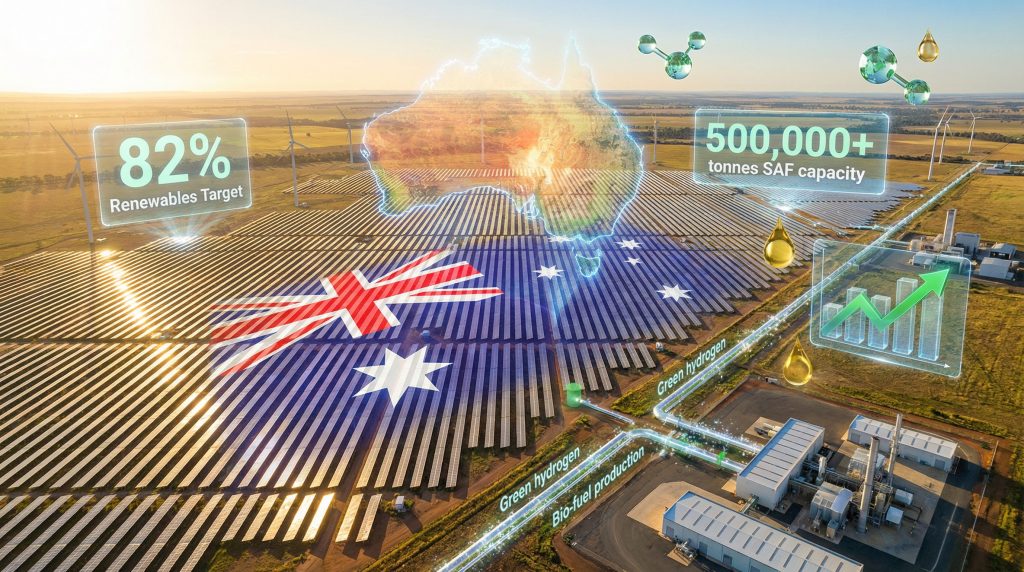
Australia's renewable energy transformation targets 82% renewable electricity generation by 2030, requiring substantial capacity additions across multiple technologies. The selected projects contribute to this target while establishing capabilities for export market development. In addition, the Clean Energy Australia Report provides comprehensive analysis of progress toward these ambitious goals.
Energy security resilience improvements will be measured through reduced import dependency ratios and enhanced domestic production capabilities across critical fuel categories. Economic diversification benefits extend beyond energy security to include manufacturing, employment, and technology development outcomes.
Strategic outcome metrics:
• Renewable generation capacity relative to national targets
• Import dependency reduction across fuel categories
• Export revenue development from renewable energy products
• Industrial capability in clean energy technologies
The transition represents a fundamental shift from resource extraction toward advanced manufacturing and clean energy production, positioning Australia for competitive advantage in global energy markets.
What Investment and Market Implications Emerge from the Selection Process?
Capital Market Response to Government Support Mechanisms
Government support mechanisms improve project bankability by reducing multiple categories of development and operational risk. Revenue certainty provisions particularly address investor concerns about long-term market price exposure in emerging clean energy markets.
Institutional investors demonstrate increasing appetite for renewable infrastructure investments supported by government frameworks. This trend reflects both return expectations and environmental, social, and governance (ESG) investment mandates across major capital providers.
Investment impact factors:
• Reduced financing costs through government risk mitigation
• Enhanced project bankability for institutional capital
• Improved return predictability through revenue certainty
• ESG investment alignment with sustainability mandates
The fast-track approval process specifically reduces development timeline risks that have historically deterred large-scale renewable energy investments. This improvement in investment conditions supports increased capital allocation to strategic projects.
Supply Chain Development Opportunities
Local content requirements and manufacturing incentives create opportunities for domestic supply chain development across the renewable energy sector. Skills development initiatives support workforce transition while building technical capabilities for emerging technologies.
Technology transfer arrangements with international partners can accelerate domestic capability development while maintaining competitive manufacturing costs. Strategic partnerships balance knowledge acquisition with intellectual property protection.
Supply chain development elements:
• Manufacturing capacity for renewable energy components
• Technical workforce development programs
• Technology transfer through international partnerships
• Local content requirements in government-supported projects
The integration of supply chain development with project selection creates multiplier effects that extend economic benefits beyond individual facilities to broader industrial capability enhancement.
Investment Considerations and Risk Assessment
Australia's renewable energy fast-track program represents a strategic policy response to geopolitical vulnerabilities and supply chain risks. The selected projects demonstrate integrated approaches to energy security, economic development, and export market positioning.
Investors should consider the program within broader contexts of Indo-Pacific energy market development, international competitive dynamics, and technology evolution trajectories. The combination of government support mechanisms with strategic project selection creates investment opportunities while maintaining exposure to market and technology risks. However, when Australia selects renewable projects for aid scheme initiatives, it signals strong government commitment to energy transition objectives.
Key investment themes:
• Energy security driving domestic production capabilities
• Export market development for renewable energy products
• Supply chain localisation creating industrial opportunities
• Technology scaling from demonstration to commercial deployment
The transformation of Australia's energy sector from import dependence toward renewable export capability reflects global trends while leveraging unique geographic and resource advantages. Success will depend on effective execution of selected projects and continued policy support for strategic renewable energy development.
This analysis is based on publicly available information and should not be construed as investment advice. Investors should conduct independent research and consider their specific circumstances before making investment decisions. Market conditions, technology costs, and policy frameworks may change, affecting project economics and investment outcomes.
What If You Could Spot the Next Major Mineral Discovery Before It Hits the Market?
Discovery Alert's proprietary Discovery IQ model delivers instant notifications when significant mineral discoveries are announced on the ASX, transforming complex geological data into actionable investment insights. With historic discoveries generating substantial returns for early investors, explore Discovery Alert's proven track record and begin your 14-day free trial today to position yourself ahead of the market.