
August 20, 2026
Understanding the Structural Forces Behind Resource-Dependent Economy Vulnerabilities
The global energy landscape has entered a period of unprecedented volatility, where traditional petroleum-exporting nations face mounting pressure from multiple converging forces. Currency fluctuations, evolving geopolitical relationships, and shifting demand patterns are fundamentally reshaping how resource-dependent economies generate fiscal revenues. These macro-economic pressures reveal the inherent vulnerabilities of nations heavily reliant on hydrocarbon exports for government financing, particularly when external market conditions deteriorate simultaneously across multiple dimensions.
Resource extraction economies historically demonstrate cyclical revenue patterns tied to commodity price movements, yet recent developments suggest structural changes that extend beyond typical market cycles. Furthermore, the intersection of financial sanctions, infrastructure disruptions, and currency appreciation effects creates compounding challenges that traditional economic models struggle to accommodate. Understanding these dynamics provides critical insights into how quickly established revenue streams can erode when multiple risk factors converge.
When big ASX news breaks, our subscribers know first
What Caused Russia's Historic Energy Revenue Collapse?
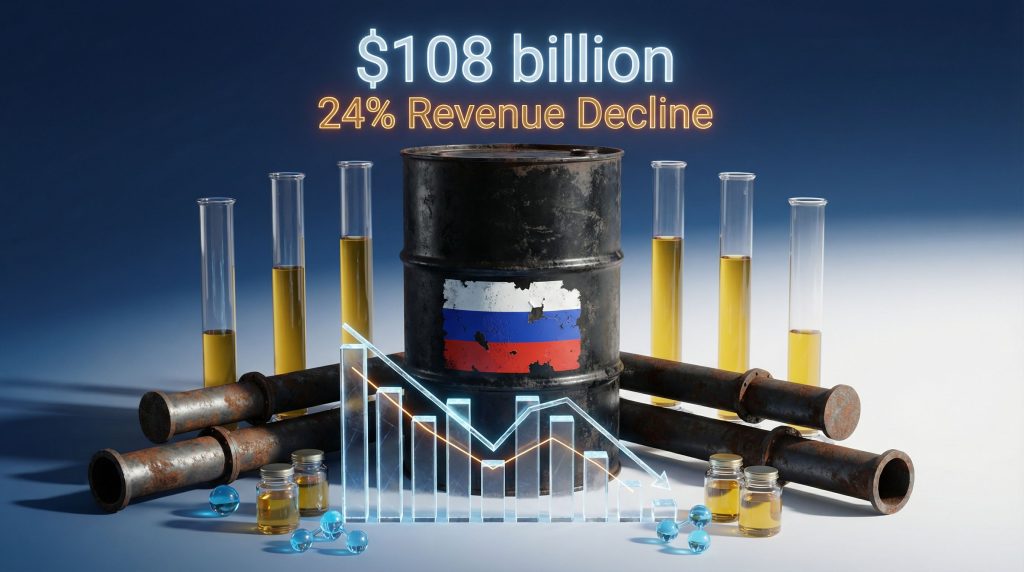
The Russian oil and gas revenue decline of 2025 exemplifies how multiple economic pressures can converge to create severe fiscal challenges for hydrocarbon-dependent nations. Federal energy tax revenues plummeted 24% to 8.48 trillion rubles ($108 billion equivalent), representing the lowest collection levels since the early 2020s according to Russian Finance Ministry data.
The Perfect Storm of Economic Pressures
Several interconnected factors contributed to this dramatic revenue contraction:
- Global market oversupply concerns: International crude markets faced persistent oversupply pressures throughout 2025
- Sanctions-induced pricing discounts: Western restrictions created additional friction costs for buyers
- Currency appreciation headwinds: A stronger domestic currency reduced revenue conversion rates
- Infrastructure access limitations: Loss of traditional export routes forced costly alternatives
The oil sector specifically experienced a 22% year-over-year decline to 7.13 trillion rubles, marking the steepest reduction since 2023. This deterioration occurred despite maintained physical production volumes, highlighting how oil price movements can decouple revenue performance from operational output.
Quantifying the Financial Impact
Russia's energy revenue crisis demonstrates the vulnerability of petroleum-dependent fiscal structures to external shocks. The Urals crude benchmark averaged $57.65 per barrel for tax calculation purposes in 2025, representing a 15% annual decline from the previous year's levels.
| Revenue Component | 2024 Level | 2025 Level | Percentage Change |
|---|---|---|---|
| Oil Tax Revenue | 9.15 trillion rubles | 7.13 trillion rubles | -22% |
| Gas Tax Revenue | 1.93 trillion rubles | 1.35 trillion rubles | -30% |
| Total Energy Revenue | 11.08 trillion rubles | 8.48 trillion rubles | -24% |
The magnitude of this decline forced significant adjustments to government financing strategies. Consequently, authorities depleted over 50% of the National Wellbeing Fund reserves while simultaneously increasing debt issuance to bridge budgetary gaps.
Currency Exchange Rate Transmission Effects
A critical but often overlooked factor in resource economy revenue volatility involves currency exchange rate movements. The Russian ruble strengthened 6.4% against the US dollar during 2025, averaging 85.67 rubles per dollar. This appreciation created a direct headwind for energy revenues, as dollar-denominated crude sales generated fewer rubles when converted for domestic budget purposes.
The dual currency exposure mechanism affects petroleum exporters through:
- International pricing in USD: Global crude markets price commodities in US dollars
- Domestic revenue conversion: Government budgets require local currency for spending
- Exchange rate volatility: Currency movements can amplify or offset commodity price changes
- Revenue timing effects: Monthly conversion rates influence quarterly revenue collections
How Do Oil Price Dynamics Affect Petro-State Budgets?
Petroleum-exporting nations face unique fiscal challenges due to their dependence on volatile commodity revenues for government operations. Unlike diversified economies with stable tax bases, petro-states experience budget volatility that directly correlates with international energy market conditions.
Global Market Fundamentals and Revenue Implications
The 2025 crude oil market environment demonstrated how oversupply concerns can rapidly compress government revenues even when physical production remains stable. Moreover, global crude markets faced persistent oversupply pressures, contributing to broad-based price weakness across major benchmarks.
Current Benchmark Pricing (January 2026):
- WTI Crude: $59.26 per barrel (+0.12%)
- Brent Crude: $63.79 per barrel (+0.05%)
- Natural Gas: $3.17 (+1.47%)
These pricing levels reflect ongoing market uncertainty about demand growth prospects and supply discipline among major producers. The convergence of multiple oil benchmarks around the $59-64 range suggests market consensus regarding fair value under current supply-demand conditions.
Sanctions-Induced Price Spread Mechanisms
Beginning in November 2025, US sanctions targeting major Russian producers Rosneft and Lukoil created significant pricing distortions in international crude markets. The sanctions did not eliminate Russian production but instead forced buyers to demand substantial price concessions to continue purchases.
The resulting Urals-Brent spread widened to approximately $27 per barrel at export points, representing a significant increase from pre-sanctions differentials. In addition, this spread reflects the additional risk premium buyers demand when purchasing crude from sanctioned entities, effectively transferring wealth from producers to consumers through mandated price discounts.
Budget Dependency and Revenue Volatility
Petro-states typically structure their fiscal systems around energy sector taxation through multiple revenue streams:
- Corporate profit taxes: Levied on energy company earnings
- Export duties: Applied to hydrocarbon export volumes
- Resource extraction fees: Charged for natural resource access rights
- Value-added taxes: Collected on energy sector commercial activities
Russia's Russian oil and gas revenue decline affected all these categories simultaneously, demonstrating how commodity price shocks cascade through multiple fiscal mechanisms. The 24% combined revenue reduction reflects the cumulative impact across these diverse taxation methods rather than disruption to any single revenue source.
What Role Do Western Sanctions Play in Energy Market Disruption?
Economic sanctions targeting energy sector entities create market friction that manifests as pricing discounts rather than production shutdowns. The November 2025 blacklisting of Rosneft and Lukoil by US authorities exemplifies how targeted restrictions translate into direct financial impacts on resource-dependent economies.
Targeted Company Restrictions and Market Responses
The sanctions implementation timeline reveals how quickly global commodity markets adjust to geopolitical restrictions:
Pre-November 2025:
- Urals crude traded at standard discounts to Brent benchmark
- Russian producers maintained access to traditional trading channels
- Buyers faced minimal compliance complications for purchases
Post-November 2025:
- Urals-Brent spread expanded to $27 per barrel
- Buyers demanded financial incentives to continue transactions
- Alternative trading arrangements became necessary for continued sales
This rapid market adjustment demonstrates how sanctions create immediate friction costs that buyers transfer to sellers through negotiated price concessions. Rather than eliminating supply, sanctions effectively impose a tax on sanctioned crude that reduces producer revenues while maintaining global supply availability.
Infrastructure Dependencies and Strategic Vulnerabilities
Energy export infrastructure represents a critical vulnerability for resource-dependent economies. Russia's reliance on Ukrainian pipeline networks for European gas deliveries created strategic exposure that materialised when the transit agreement expired on January 1, 2025.
Infrastructure Impact Assessment:
| Export Route | Status | Volume Impact | Alternative Options |
|---|---|---|---|
| Ukrainian Pipeline | Terminated Jan 1, 2025 | Complete cessation | Limited capacity alternatives |
| Turkish Stream | Operational | Reduced capacity | Cannot fully replace Ukrainian route |
| Power of Siberia | Operational | Growing volumes | Geographic limitations |
The loss of Ukrainian transit routes forced Gazprom to rely entirely on alternative infrastructure with significantly lower combined capacity. This physical constraint limits the ability to redirect European-bound volumes to alternative markets, creating structural revenue compression independent of pricing factors.
Furthermore, these developments have implications for global markets. The Trump tariffs impact on energy trade patterns shows similar disruptions to established trading relationships.
Financial Friction Mechanisms
Modern sanctions regimes operate through financial system restrictions rather than physical supply interdiction. The targeting of specific Russian energy companies created compliance challenges for international buyers while maintaining global energy supply availability.
Sanctions transmission mechanisms include:
- Banking system restrictions: Limiting sanctioned entities' access to international financial networks
- Insurance and shipping complications: Increasing operational costs for alternative transportation
- Compliance risk premiums: Requiring buyers to invest in enhanced due diligence procedures
- Reputational risk considerations: Creating commercial incentives to avoid sanctioned counterparties
These friction costs translate into direct pricing impacts as buyers demand compensation for increased operational complexity and compliance expenses.
How Are Geopolitical Shifts Transforming Global Gas Markets?
The global natural gas market has undergone fundamental structural changes as traditional supply relationships dissolve and new trading patterns emerge. Russia's gas revenue collapse to 1.35 trillion rubles in 2025, representing a 30% annual decline to pandemic-era levels, illustrates how quickly established market relationships can disappear.
European Energy Security Transformation
European natural gas markets have experienced the most dramatic transformation, with traditional supply relationships fundamentally altered. Russia previously served as Europe's single largest gas supplier through an extensive pipeline network that provided reliable, cost-effective energy deliveries for decades.
Market Share Evolution:
- Historical position: Russia supplied approximately 40% of European gas imports pre-2022
- Current status: Nearly complete elimination of European client base
- Infrastructure impact: Ukrainian pipeline closure eliminated primary westbound export capacity
- Alternative suppliers: Increased reliance on LNG imports from US, Qatar, and other suppliers
This transformation represents one of the most rapid and complete supply source substitutions in modern energy market history. The speed of this transition demonstrates both European determination to achieve energy independence and the market's ability to reallocate supply chains when sufficient economic incentives exist.
Asian Market Pivot Limitations
Russia's strategic response to European market loss involved increasing natural gas exports to China through existing pipeline infrastructure. However, this geographical diversification strategy faces significant limitations that prevent full revenue replacement.
Physical Infrastructure Constraints:
- Pipeline capacity limitations: Existing eastbound infrastructure cannot match historical European volumes
- Geographic concentration: Heavy reliance on single-customer relationships creates new vulnerabilities
- Price negotiation dynamics: Reduced alternatives strengthen buyer negotiating positions
- Long-term contract structures: Asian markets typically require different commercial terms than European spot markets
The analysis specifically notes that increased Chinese deliveries cannot fully replace the European market, indicating structural capacity constraints that limit revenue recovery potential regardless of pricing negotiations.
Gas Revenue Decline Structural Factors
The Russian oil and gas revenue decline in the gas sector particularly reflects more than just temporary market disruption – it represents a permanent loss of the European customer base that historically provided the majority of natural gas export revenues. The development of natural gas forecasts shows global market restructuring continues.
Several structural factors contribute to this revenue compression:
- Volume reduction: Physical export volumes declined due to infrastructure limitations
- Price pressure: Reduced market access weakened negotiating power with remaining customers
- Alternative supply development: European investment in LNG infrastructure reduced long-term demand prospects
- Contract renegotiation: Existing long-term agreements faced force majeure claims and early termination
Long-term Market Structure Implications
The transformation of global gas markets extends beyond immediate revenue impacts to fundamental changes in market structure and trading relationships. European energy security strategies now prioritise supply diversification and infrastructure resilience over cost optimisation.
Emerging Market Characteristics:
- Supplier diversification mandates: European policy requires multiple supply sources
- LNG infrastructure investment: Massive capital allocation toward flexible import capabilities
- Strategic reserve expansion: Enhanced emergency supply planning and storage capacity
- Renewable energy acceleration: Long-term demand destruction through alternative energy sources
These structural changes suggest that revenue losses for traditional pipeline gas exporters may represent permanent market share shifts rather than cyclical disruptions.
What Are the Broader Economic Implications for Resource-Dependent Nations?
The Russian energy revenue crisis provides a case study in how quickly resource-dependent economies can face fiscal pressure when multiple external factors converge. Government authorities responded to the 24% revenue decline through several emergency fiscal measures that highlight the limited options available to petroleum-dependent states during commodity market stress.
Fiscal Policy Emergency Responses
Resource-dependent economies typically maintain sovereign wealth funds and emergency reserves to manage commodity price volatility. However, the magnitude and persistence of Russia's revenue decline forced rapid depletion of these buffers.
Emergency Fiscal Measures:
- National Wealth Fund utilisation: Over 50% of reserves consumed to bridge budget gaps
- Debt issuance acceleration: Increased government borrowing at elevated interest rates
- Military spending prioritisation: Defence budget expansion despite revenue constraints
- Social spending deferrals: Non-essential programmes delayed or reduced
These responses illustrate the difficult trade-offs resource-dependent governments face when commodity revenues decline sharply. The choice between depleting reserves, increasing debt, or reducing expenditures each carries significant long-term economic consequences.
Budget Forecasting and Planning Challenges
Petroleum-dependent economies face inherent challenges in budget planning due to commodity price volatility. Russia's 2025 experience demonstrates how quickly budget assumptions can become obsolete when multiple external factors deteriorate simultaneously.
Forecasting Complications:
- Oil price assumption gaps: Budget planning based on price levels that market conditions cannot sustain
- Currency volatility: Exchange rate movements that amplify or offset commodity price changes
- Sanctions uncertainty: Difficulty predicting timing and scope of future restrictions
- Infrastructure risks: Potential loss of export routes through geopolitical developments
The interaction between these factors creates non-linear budget impacts that traditional forecasting models struggle to capture accurately. The situation mirrors broader challenges, as seen in Venezuela oil policy changes affecting global energy markets.
The next major ASX story will hit our subscribers first
How Do Energy Market Disruptions Affect Global Supply Chains?
Energy market disruptions create ripple effects throughout global supply chains, yet the Russian experience demonstrates how physical supply can remain stable even during severe revenue crises. This distinction between financial impact and supply security provides important insights for global energy market analysis.
Production Volume Stability During Revenue Decline
Despite experiencing the largest energy revenue decline since the early 2020s, Russia maintained stable physical production volumes throughout 2025. This demonstrates how financial pressure on governments differs from operational disruption to energy companies.
Production vs. Revenue Divergence:
- Physical output: Oil and gas production volumes remained largely stable
- Export capacity: Alternative routing maintained international supply contributions
- Revenue impact: Government tax collections declined due to pricing and currency factors
- Company operations: Energy producers continued normal extraction and processing activities
This divergence highlights how sanctions and market pressures can significantly impact government finances while maintaining global energy supply security.
Alternative Trading Arrangements
The development of alternative trading mechanisms following sanctions implementation reveals the adaptability of global commodity markets. Energy flows continued through modified commercial arrangements that accommodated new restrictions while maintaining supply chain functionality.
Market Adaptation Mechanisms:
- Shadow fleet operations: Alternative shipping arrangements using non-Western vessels
- Financial structure modifications: Trading through entities not subject to direct sanctions
- Geographic route diversification: Increased reliance on Asian markets and alternative export terminals
- Pricing arrangement adjustments: Modified contract terms reflecting new risk premiums
These adaptations demonstrate the global energy market's resilience in maintaining supply chains despite significant geopolitical disruption.
Global Energy Security Assessment
The Russian oil and gas revenue decline provides insights into global energy security dynamics that extend beyond any single supplier or market relationship. The maintenance of physical supply during severe financial pressure suggests that energy security concerns may be overstated when alternative suppliers and trading mechanisms exist.
| Supply Chain Factor | Impact Assessment | Market Response |
|---|---|---|
| Physical Production | Stable | No global shortage |
| Transportation Routes | Modified | Alternative channels developed |
| Financial Arrangements | Disrupted | New structures emerged |
| Pricing Mechanisms | Distorted | Risk premiums incorporated |
Additionally, the broader implications extend to other markets, as evidenced by developments in Saudi exploration licenses affecting global energy supply dynamics.
What Does This Mean for Future Energy Market Structure?
The transformation of energy market relationships during 2025 suggests structural changes that will persist beyond current geopolitical tensions. Investment flows, infrastructure development, and strategic planning by both suppliers and consumers reflect long-term adaptations rather than temporary adjustments.
Market Diversification and Infrastructure Investment
Energy importers have accelerated infrastructure investments designed to reduce dependence on any single supplier or supply route. These capital commitments represent long-term strategic decisions that will shape market structure for decades.
Infrastructure Development Priorities:
- LNG import terminal expansion: Massive capacity additions in Europe and Asia
- Pipeline route diversification: Alternative supply corridors reducing transit risk
- Strategic reserve capacity: Enhanced emergency supply storage capabilities
- Renewable energy acceleration: Long-term demand destruction through alternative sources
The scale of these investments suggests permanent changes to global energy infrastructure rather than temporary security measures.
Investment Flow Redirection
Capital allocation in the global energy sector has shifted dramatically in response to supply security concerns and geopolitical risk assessments. These investment pattern changes will influence future production capacity and market relationships.
Capital Reallocation Trends:
- Jurisdictional risk assessment: Enhanced focus on political stability in investment decisions
- Technology development acceleration: Increased funding for alternative energy sources
- Supply chain resilience: Investment in redundant infrastructure and supplier relationships
- Strategic partnership formation: Long-term contracts emphasising security over cost optimisation
Risk Management Evolution
Energy market participants have fundamentally revised their risk management approaches based on lessons learned from recent market disruptions. These changes will influence trading patterns, contract structures, and strategic planning for years to come.
The rapid transformation of global energy trading relationships during 2025 demonstrates how quickly established market structures can change when geopolitical and economic pressures converge, forcing both suppliers and consumers to develop more resilient and diversified energy strategies.
Enhanced Risk Management Approaches:
- Supplier diversification requirements: Multiple source mandates for critical energy supplies
- Geographic risk assessment: Enhanced evaluation of transit route vulnerabilities
- Contract flexibility enhancement: Terms allowing for supply source substitution during emergencies
- Financial hedge strategies: Sophisticated approaches to managing commodity price and geopolitical risks
Understanding the Lessons for Global Energy Economics
The Russian oil and gas revenue decline of 2025 provides valuable insights into the vulnerabilities of resource-dependent economic models and the adaptability of global energy markets. The 24% revenue contraction to 8.48 trillion rubles occurred despite maintained physical production, highlighting how external economic pressures can rapidly reshape energy market relationships.
Policy Framework Implications
The crisis demonstrates the effectiveness of economic pressure tools in influencing state behaviour while maintaining global energy supply security. Sanctions targeting specific entities created market friction that reduced government revenues without eliminating international energy availability.
Key Policy Insights:
- Economic pressure effectiveness: Financial restrictions can significantly impact resource-dependent economies
- Supply security maintenance: Physical energy supply remained stable during revenue crisis
- Market adaptation capacity: Global trading systems demonstrated remarkable flexibility in developing alternative arrangements
- Infrastructure vulnerability: Dependence on single export routes creates strategic weaknesses
Future Market Evolution Trajectories
The structural changes initiated during 2025 will likely persist and expand regardless of future geopolitical developments. Investment patterns, infrastructure development, and strategic planning by market participants reflect permanent adaptations to enhanced risk awareness.
Long-term Market Transformation:
- Supplier relationship diversification: Permanent shift away from single-source dependencies
- Infrastructure resilience enhancement: Continued investment in alternative supply routes and backup capabilities
- Technology acceleration: Increased funding for alternative energy sources and efficiency improvements
- Risk premium integration: Geopolitical factors becoming permanent components of energy pricing models
The Russian energy revenue crisis ultimately illustrates how rapidly global energy economics can transform when multiple pressures converge. While resource-dependent economies face significant vulnerabilities during commodity market stress, the broader global energy system demonstrates remarkable adaptability in maintaining supply security through alternative arrangements. These lessons will continue shaping energy market structure and risk management approaches for years to come, as both suppliers and consumers develop more resilient strategies for navigating an increasingly complex geopolitical environment.
Furthermore, the comprehensive analysis confirms that this revenue decline represents a historic low point for Russian energy sector finances, emphasising the long-term implications for global energy market structure.
Ready to Invest in the Next Major Mineral Discovery?
Discovery Alert instantly alerts investors to significant ASX mineral discoveries using its proprietary Discovery IQ model, turning complex mineral data into actionable insights. Begin your 30-day free trial today at Discovery Alert and position yourself ahead of the market while understanding how major mineral discoveries can lead to significant returns.