June 9, 2026
Resource Diplomacy in the Western Hemisphere: Brazil's Rise as a Critical Minerals Processing Hub
The global transition toward renewable energy and advanced manufacturing has fundamentally altered strategic resource calculations across major economies. As the US aims to process critical minerals in Brazil, traditional mining partnerships are evolving into comprehensive processing ecosystems. Furthermore, this transformation reflects not merely a shift in commodity flows, but a recognition that downstream value-addition capabilities determine long-term economic competitiveness through critical minerals strategy implementation.
Brazil's emergence as a preferred partner in Western supply chain diversification strategies represents a convergence of geological abundance with industrial sophistication. Unlike resource-rich nations that primarily export raw materials, Brazil possesses the technical infrastructure and regulatory frameworks necessary to support complex processing operations. Consequently, this combination positions the country as a cornerstone in efforts to reduce dependence on concentrated supply chains.
When big ASX news breaks, our subscribers know first
Brazil's Geological Advantage Creates Processing Opportunities
The scale of Brazil's mineral endowments extends far beyond simple reserve quantities to encompass composition characteristics that make processing economically viable. According to data from Brazil's geological service SGB, the country maintains dominant positions across multiple strategic material categories. Additionally, these positions align perfectly with the energy transition outlook for the next decade.
| Mineral Category | Global Ranking | Strategic Applications | Current Utilization |
|---|---|---|---|
| Niobium | #1 worldwide | Superalloys, advanced steel | High production rates |
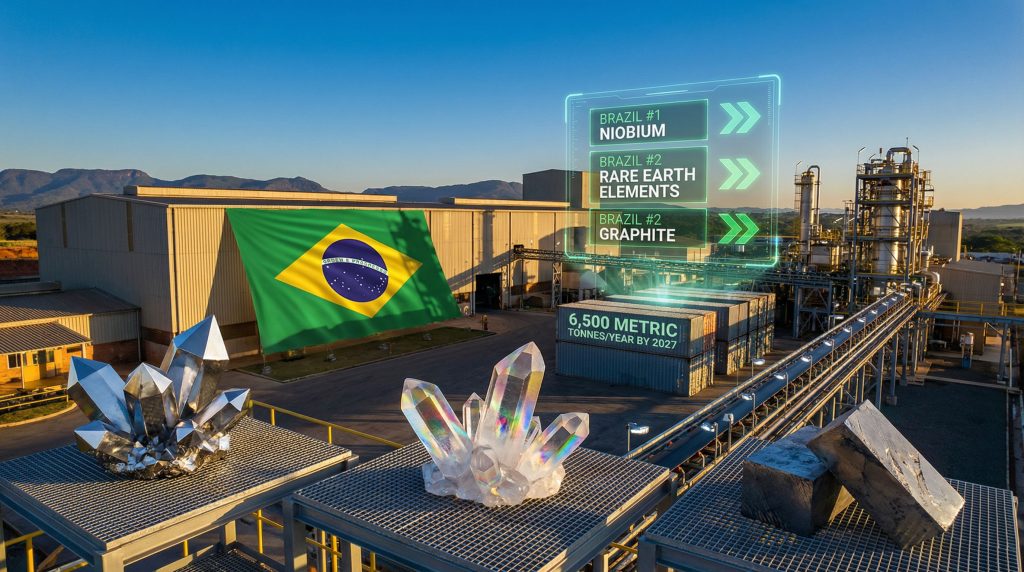
| Rare Earth Elements | #2 globally | Permanent magnets, electronics | Under 1% global output |
| Graphite | #2 globally | Battery anodes, steel production | Limited processing |
| Nickel | #3 globally | Stainless steel, EV batteries | Moderate extraction |
| Lithium | #6 globally | Battery cathodes | Early development stage |
The disparity between Brazil's geological wealth and current production levels reveals significant untapped potential. Despite ranking second globally in rare earth reserves, Brazil accounted for less than 1% of global rare earth production in 2024. This underutilisation stems not from technical constraints but from historical focus on raw material exports rather than value-added processing.
Heavy Rare Earth Concentrations Drive Strategic Value
Brazil's rare earth deposits contain elevated concentrations of heavy rare earths, particularly dysprosium and terbium, which are essential for high-performance permanent magnets used in wind turbines, electric vehicle motors, and defence systems. These elements represent critical bottlenecks in Western supply chains due to their concentration in Chinese processing operations.
The geological composition of Brazilian deposits naturally yields mixed rare earth carbonate with heavy rare earth concentrations. For instance, this provides feedstock suitable for advanced manufacturing applications without requiring extensive beneficiation processes. This compositional advantage reduces processing costs and technical complexity compared to light rare earth-dominated deposits found in other regions.
Comparative Analysis: Why Brazil Outpaces Regional Competitors
The United States has established critical minerals cooperation agreements with Argentina, Ecuador, Paraguay, and Peru. However, Brazil emerges as the primary focus for processing development initiatives. This preference reflects fundamental differences in industrial capacity and technical sophistication across potential partner nations.
Industrial Infrastructure Distinguishes Brazil's Capabilities
Brazil's diversified manufacturing base provides essential support infrastructure for mineral processing operations. The country's established metallurgical sector, sophisticated financial markets, and technical workforce create enabling conditions that smaller economies cannot replicate at scale. In addition, mining industry innovation drives competitive advantages.
Brazil's Competitive Advantages:
- Operational rare earth processing facilities (Serra Verde complex)
- Advanced separation technology expertise
- Established supply chain networks
- Regulatory framework maturity
- Access to international capital markets
- Technical education infrastructure
Regional Partner Limitations:
- Argentina: Strong lithium reserves but limited downstream processing capacity
- Peru: Copper-focused mineral sector with minimal rare earth potential
- Ecuador: Early-stage mineral development with basic infrastructure
- Paraguay: Limited geological survey data and processing expertise
Marisa Cesar, board president of Brazil's critical minerals association, highlighted that Brazil possesses the fundamental capabilities to become a leading global player. However, it faces competitive disadvantages in fiscal incentive structures. According to Cesar, other countries often provide more favourable economic conditions for midstream and downstream facility development than Brazil currently offers.
Processing Technology Readiness Levels
The existence of operational facilities like Serra Verde demonstrates Brazil's technical readiness to expand processing capacity rapidly. Unlike greenfield development scenarios in less industrialised nations, Brazil can leverage existing expertise and infrastructure. Furthermore, this accelerates project timelines and reduces development risks whilst supporting US aims to process critical minerals in Brazil.
Development Finance Corporation Investments Transform Market Dynamics
The US Development Finance Corporation's strategic investments in Brazilian rare earth projects represent more than traditional project financing. These commitments establish integrated processing nodes designed to support broader supply chain restructuring away from Chinese dominance.
Current DFC-Backed Project Portfolio
Serra Verde Rare Earth Complex:
- Location: Goiás state, Brazil
- Current Status: Commercial production achieved 2024
- Expansion Target: 6,500 metric tonnes per year by 2027
- Product Focus: Heavy rare earth carbonate (dysprosium, terbium)
- Strategic Value: First major Western heavy rare earth production outside China
Aclara Rare Earth Project:
- Location: Goiás state, Brazil
- Production Timeline: Second half 2028 startup, full ramp-up 2029
- Product Specification: Mixed rare earth carbonate with heavy rare earth concentration
- Market Impact: Diversifies Western supply sources for permanent magnet feedstock
The concentration of both projects within Goiás state reflects existing geological survey data, infrastructure networks, and regulatory familiarity. Consequently, this reduces development timelines and operational risks. This geographic clustering also enables shared technical expertise and supply chain efficiencies between projects.
Technology Transfer and Technical Cooperation Components
DFC investments include technical cooperation elements designed to enhance Brazil's processing capabilities beyond individual project boundaries. According to Assistant Secretary of State Caleb Orr, the US views financing and technical cooperation as complementary tools for developing sustainable processing capacity.
"The US approach combines financial support with technology transfer to create processing capabilities that can operate independently and compete globally. This strategy recognises that sustainable supply chain diversification requires technical expertise development, not merely capital investment."
Geopolitical Implications of Strategic Resource Partnerships
Brazil's participation in the 2026 Critical Minerals Ministerial in Washington, DC signals formal alignment with US-led supply chain security initiatives. This engagement represents a fundamental shift from Brazil's historically neutral position on great power resource competition toward active participation in Western supply chain architecture.
Supply Chain Security vs. Economic Nationalism
President Lula's policy requiring foreign companies to establish end-to-end value chains within Brazil creates natural alignment with US processing objectives. Additionally, it satisfies Brazilian economic development goals. According to Lula's November 2025 statement, Brazil will not function merely as a raw material exporter but will require industrialisation commitments from foreign investors.
This policy framework addresses two strategic objectives simultaneously: reducing Chinese processing dominance while ensuring Brazil captures downstream value-addition. The approach represents economic nationalism that supports rather than conflicts with Western supply chain diversification goals.
Regional Resource Security Architecture
Assistant Secretary Orr's characterisation of Brazil as an essential partner reflects broader US strategy. For instance, this establishes Western hemisphere resource security networks. The emphasis on strong partnerships indicates recognition that critical minerals cooperation requires deeper political commitment than traditional commercial arrangements.
Strategic Framework Elements:
- Joint investment in processing technology development
- Coordinated export allocation agreements
- Shared environmental compliance standards
- Integrated supply chain planning
- Technical expertise exchange programs
Processing Technology Development Priorities
The focus on heavy rare earth processing reflects both geological advantages and strategic bottleneck identification. Current Chinese dominance in separation technology and processing capacity creates vulnerabilities that Western nations seek to address. However, through domestic capability development and battery materials update initiatives, these challenges can be overcome.
Heavy Rare Earth Separation Technology
Brazilian projects target mixed rare earth carbonate production with elevated heavy rare earth concentrations. These require advanced separation technologies to isolate individual elements. These processes include:
Magnetic Separation Enhancement:
- High-gradient magnetic separation for heavy rare earth concentration
- Rare earth permanent magnet recovery and recycling integration
- Selective extraction of dysprosium and terbium compounds
Solvent Extraction Optimisation:
- Multi-stage extraction circuits for element purification
- Selective complexing agents for heavy rare earth isolation
- Closed-loop processing to minimise environmental impact
Battery Material Processing Integration
Beyond rare earths, Brazil's lithium and graphite reserves present opportunities for integrated battery material processing. The development of lithium carbonate and hydroxide production capabilities would complement rare earth processing. Furthermore, this creates synergies across critical material categories.
Processing Development Pathways:
- Lithium carbonate and hydroxide production facilities
- Natural graphite purification and spheroidisation
- Nickel sulfate processing for battery applications
- Integrated recycling capabilities for end-of-life materials
The next major ASX story will hit our subscribers first
Regulatory and Environmental Advantages
Brazil's established mining regulations and environmental frameworks provide operational predictability that emerging mining jurisdictions cannot match. The country's mature legal structure reduces regulatory risk and enables long-term planning for processing facility development.
Environmental Compliance Infrastructure
Brazilian environmental regulations require comprehensive impact assessments and ongoing monitoring that align with international sustainability standards. This regulatory maturity reduces compliance costs and reputational risks for international investors. In addition, it provides advantages compared to less developed regulatory environments.
Regulatory Advantage Factors:
| Regulatory Area | Brazil's Position | Investor Benefits |
|---|---|---|
| Environmental Standards | Comprehensive frameworks | Predictable compliance costs |
| Mining Rights | Clear title systems | Reduced legal disputes |
| Labor Regulations | International standards | Sustainable workforce practices |
| Infrastructure Access | Established networks | Lower development requirements |
Market Impact and Price Discovery Implications
The development of Western processing capacity in Brazil could fundamentally reshape global critical minerals pricing dynamics. Current price discovery mechanisms reflect Chinese processing dominance and limited alternative supply sources. Therefore, data-driven mining operations become essential for competitive advantage.
Short-term Market Effects (2026-2028)
Initial production from Serra Verde's expanded capacity and Aclara's startup will introduce marginal Western supply into heavy rare earth markets. These markets are currently dominated by Chinese processors. While volumes remain small relative to global demand, the availability of Western-processed material provides pricing alternatives for downstream manufacturers.
Market Dynamics Changes:
- Enhanced price transparency in heavy rare earth markets
- Reduced premium for non-Chinese supply sources
- Increased bargaining power for Western permanent magnet manufacturers
- Development of regional pricing benchmarks outside Chinese influence
Long-term Strategic Implications (2029-2035)
Successful establishment of Brazilian processing capabilities could catalyse broader supply chain restructuring across critical mineral categories. The demonstration of viable Western processing alternatives may encourage additional investment and technology development across the region.
Structural Market Changes:
- Geographic diversification of processing capacity
- Technology transfer acceleration to allied nations
- Development of Western hemisphere supply chain networks
- Reduced strategic dependence on concentrated supply sources
Implementation Challenges and Risk Mitigation
Despite strategic alignment between US and Brazilian objectives, several implementation challenges require careful management to ensure successful outcomes.
Technical and Operational Risks
Processing technology adaptation to Brazilian ore characteristics may require significant technical development and workforce training. The complexity of heavy rare earth separation processes demands specialised expertise that must be developed locally to ensure operational sustainability.
Critical Success Factors:
- Technology transfer effectiveness from established processors
- Workforce development in specialised metallurgical techniques
- Supply chain integration with downstream manufacturers
- Environmental management system implementation
Market Competition and Pricing Pressures
Brazilian processing operations must compete with established Chinese suppliers that benefit from scale economies, integrated supply chains, and government support. Price volatility in global markets could affect project economics and investment returns.
Risk Mitigation Strategies:
- Long-term supply agreements with Western manufacturers
- Government support for strategic material production
- Technology development partnerships to reduce costs
- Integrated recycling capabilities to secure feedstock supply
What Success Metrics Will Define the US-Brazil Partnership?
The success of US-Brazil critical minerals cooperation will be measured not merely by production volumes. Instead, it will be evaluated by broader supply chain resilience and technological independence achievements.
Production and Capacity Targets
By 2030, successful implementation should establish Brazil as a significant Western hemisphere source of processed critical minerals. This includes particular strength in heavy rare earths and battery materials.
Quantitative Success Indicators:
- 15,000+ tonnes annual rare earth oxide production
- 50,000+ tonnes lithium carbonate equivalent capacity
- Diversified processing across 5+ mineral categories
- 25%+ reduction in Western dependence on Chinese processing
Technology and Expertise Development
Long-term success requires the establishment of indigenous technical capabilities that can operate independently and compete globally. This includes research and development capabilities, workforce expertise, and supply chain management systems.
Strategic Outcome Measures:
- Independent processing technology development
- Regional technical education and training programs
- Supply chain integration with North American manufacturers
- Export capacity to allied nations and partners
How Will This Partnership Transform Global Supply Chains?
The development of critical minerals processing capabilities in Brazil represents a fundamental shift in global resource security architecture. Furthermore, the US aims to process critical minerals in Brazil through comprehensive partnership frameworks that extend beyond traditional resource extraction.
Success in this initiative could establish a template for broader Western hemisphere resource cooperation. In addition, it could demonstrate the viability of supply chain diversification strategies beyond traditional great power resource dependencies.
The partnership's success ultimately depends on effective technology transfer, workforce development, and market integration. However, with proper implementation, it offers the potential to fundamentally reshape critical minerals markets whilst strengthening Western supply chain resilience.
Note: This analysis is based on publicly available information and market developments as of February 2026. Readers should conduct independent research and consult with qualified professionals before making investment or business decisions related to critical minerals markets.
Ready to Capitalise on Critical Minerals Investment Opportunities?
As the US-Brazil partnership reshapes critical minerals markets and creates new supply chain dynamics, identifying profitable mining discoveries becomes essential for market advantage. Discovery Alert's proprietary Discovery IQ model delivers real-time alerts on significant ASX mineral discoveries, instantly transforming complex geological announcements into actionable trading insights that help investors position ahead of major market movements. Begin your 14-day free trial today to secure your competitive edge in the rapidly evolving critical minerals sector.