June 4, 2026
Resource Extraction Economics Drive North Sea Revival
The offshore energy sector has entered a new phase of technological sophistication, where advanced drilling capabilities and infrastructure optimization are unlocking previously uneconomical hydrocarbon reserves. This transformation is particularly evident in mature basins like the Norwegian Continental Shelf, where operators are leveraging existing pipeline networks and processing facilities to develop smaller discoveries that would have been stranded assets just a decade ago.
Recent technological breakthroughs in High Pressure, High Temperature (HPHT) drilling systems, combined with enhanced seismic interpretation methods, have fundamentally altered the economic threshold for offshore gas development. Furthermore, the convergence of these factors creates compelling investment opportunities in regions with established infrastructure, particularly as European energy security concerns drive demand for reliable, pipeline-delivered natural gas.
When big ASX news breaks, our subscribers know first
What Makes the Latest Norwegian Continental Shelf Finds Strategically Important?
Resource Scale and Commercial Viability Assessment
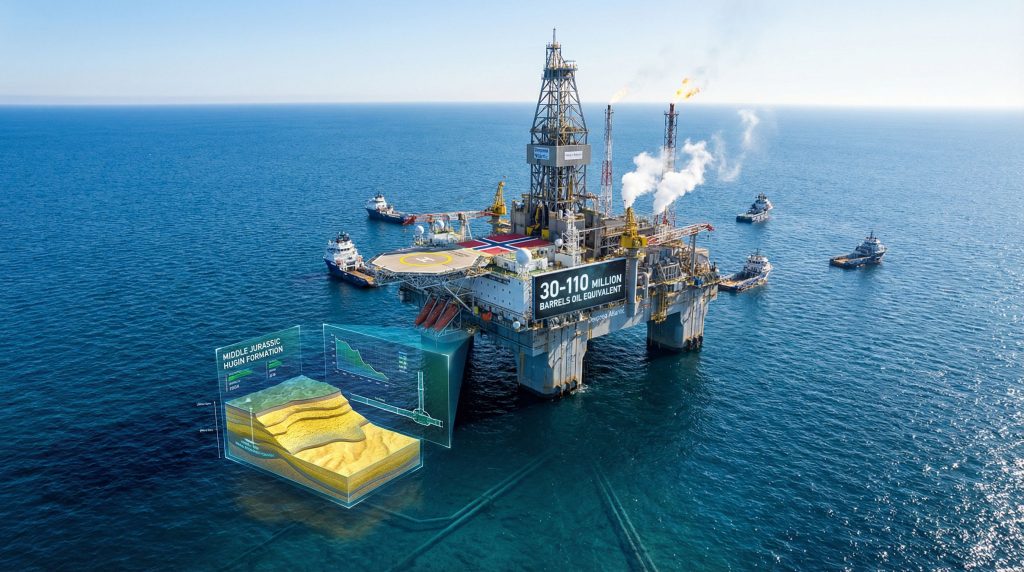
The Equinor North Sea gas discovery represents a significant addition to Norway's hydrocarbon resource base, with combined potential reserves spanning 28 to 113 million barrels of oil equivalent across two distinct prospects. The Lofn prospect alone contains an estimated 22 to 63 million barrels, while the adjacent Langemann prospect holds 6 to 50 million barrels of recoverable resources.
These discoveries were made through wells 15/5-8 S and 15/5-8 A, positioned approximately 7 kilometres north of the established Eirin field and roughly 240 kilometres west of Stavanger. Moreover, the strategic location within Production Licence 1140, awarded in 2022, places these finds within an established infrastructure corridor that significantly enhances their commercial viability.
Key Economic Factors:
• Proximity to existing processing infrastructure reduces capital expenditure requirements
• Middle Jurassic Hugin Formation reservoirs offer proven production characteristics
• Gas and condensate composition provides premium pricing relative to dry gas
• Shallow water depth enables cost-effective subsea development solutions
The economic threshold for North Sea gas projects has evolved significantly since 2022, when European energy security concerns elevated the strategic value of reliable pipeline deliveries. Current TTF (Title Transfer Facility) pricing environments, combined with long-term supply contract premiums, support development economics for discoveries in the 50 to 100 million barrel range when tied back to existing infrastructure.
Geological Formation Analysis: Middle Jurassic Opportunities
Both discoveries encountered hydrocarbons within the Middle Jurassic Hugin Formation, confirming the presence of gas and condensate-bearing sandstone reservoirs. This geological success validates enhanced seismic interpretation techniques that have improved pre-drill risk assessment in mature basin exploration.
The Hugin Formation represents one of the North Sea's most prolific reservoir intervals, characterised by:
• High porosity sandstone with proven flow rates in offset wells
• Structural compartmentalisation that creates multiple development targets
• Pressure regime compatibility with existing field infrastructure
• Hydrocarbon column thickness supporting extended production profiles
While deeper Triassic targets proved water-bearing, operators collected extensive core samples and pressure data that will inform future exploration strategies across the licence area. Consequently, the systematic evaluation of multiple geological intervals demonstrates the comprehensive approach required for modern North Sea exploration success.
Why Are Tie-Back Developments Becoming the Dominant North Sea Strategy?
Infrastructure Leverage Economics
The transformation of North Sea development economics centres on maximising utilisation of existing infrastructure assets. The 7-kilometre proximity between the new discoveries and the Eirin field creates immediate tie-back opportunities that can reduce total development costs by 60 to 80 percent compared to standalone facilities.
Infrastructure Optimisation Benefits:
• Shared processing capacity eliminates need for dedicated platforms
• Existing pipeline connections provide direct export routes
• Established maintenance and logistics support reduces operating costs
• Proven regulatory pathways accelerate project approvals
The Sleipner area infrastructure hub, encompassing multiple producing fields and processing facilities, represents decades of capital investment that creates substantial value for new discoveries. In addition, this network effect allows smaller resources to achieve economic viability through shared infrastructure utilisation.
Development Cost Comparison:
| Development Type | Capital Cost Range | Timeline to Production | Infrastructure Risk |
|---|---|---|---|
| Greenfield Platform | $2-5 billion | 5-7 years | High |
| Subsea Tie-back | $300-800 million | 24-36 months | Low |
| Enhanced Tie-back | $500 million-1.2 billion | 30-42 months | Medium |
Environmental and Regulatory Advantages
Norwegian regulatory framework increasingly favours development approaches that minimise environmental impact through infrastructure reuse. Tie-back projects generate significantly lower carbon emissions during construction and operation, aligning with Norway's petroleum sector climate objectives.
The established regulatory pathway for tie-back developments also provides timeline advantages. However, projects utilising existing infrastructure benefit from streamlined environmental impact assessments and accelerated approval processes, reducing regulatory risk and time-to-production.
ESG Compliance Benefits:
• Reduced construction vessel requirements minimise marine impact
• Lower steel and concrete consumption decreases embodied carbon
• Shared facility utilisation optimises energy consumption
• Enhanced decommissioning economics through asset sharing
How Do These Discoveries Impact European Gas Supply Security?
Strategic Energy Independence Implications
Norway's position as Europe's largest pipeline gas supplier has become increasingly critical following the 2022 energy crisis. The country delivered approximately 120 billion cubic metres of natural gas to Europe in 2023, representing roughly 76 percent of total European pipeline imports according to International Energy Agency data.
The incremental production from the Equinor North Sea gas discovery, while modest in absolute terms, contributes to Europe's broader supply diversification strategy. Furthermore, each additional North Sea development reduces dependence on more volatile supply sources and strengthens long-term energy security frameworks, particularly when considering natural gas price trends and their impact on regional markets.
Supply Security Metrics:
• Norwegian production capacity: 120+ bcm annually
• European total demand: 400-450 bcm annually
• Pipeline import share: ~30 percent of total supply
• LNG import share: ~25 percent of total supply
Market Timing and Price Dynamics
The current European gas pricing environment reflects fundamental shifts in global energy trade patterns. Forward curve analysis indicates sustained premium pricing for reliable, pipeline-delivered natural gas, particularly during winter heating seasons when storage capacity constraints create supply bottlenecks.
"Norwegian pipeline gas maintains structural advantages over LNG imports, including lower transportation costs, reduced regasification requirements, and enhanced supply reliability during peak demand periods."
Price Support Factors:
• Long-term supply contract premiums for pipeline deliveries
• Seasonal demand peaks driving winter price spikes
• LNG competition limited by regasification capacity
• Carbon pricing advantages for lower-emission pipeline gas
What Does the Partnership Structure Reveal About Industry Consolidation Trends?
Equinor-Aker BP Strategic Alliance Analysis
The joint development approach between Equinor ASA and Aker BP ASA exemplifies evolving partnership structures in mature offshore basins. This collaboration combines Equinor's state-backed financial capacity and regulatory relationships with Aker BP's operational agility and mid-tier development expertise.
Partnership Synergies:
• Risk distribution across complementary operator profiles
• Technology sharing for HPHT development challenges
• Portfolio optimisation through asset clustering
• Regulatory efficiency through established operator presence
The alliance structure enables both companies to participate in exploration upside while distributing geological and commercial risks. Additionally, Equinor's extensive North Sea infrastructure provides development options, while Aker BP's focused operational approach enhances project execution efficiency.
Norwegian Continental Shelf Licensing Evolution
Production Licence 1140's award in 2022 reflects Norway's strategic approach to maintaining exploration momentum in mature basin areas. The licensing framework incentivises operators to pursue smaller discoveries through favourable fiscal terms and infrastructure access arrangements.
Licensing Framework Benefits:
• Reduced government revenue take for tie-back developments
• Accelerated exploration period timelines
• Infrastructure sharing incentives
• Enhanced data sharing requirements across licence areas
The Norwegian Petroleum Directorate's licensing strategy emphasises maximising recovery from existing infrastructure while maintaining exploration activity across the continental shelf. Consequently, this approach supports both near-term production and long-term resource development, while considering the exploration licensing impact of regional policy frameworks.
How Are Advanced Drilling Technologies Enabling Smaller Field Economics?
Deepsea Atlantic Rig Capabilities and Efficiency Metrics
The deployment of Odfjell Drilling's Deepsea Atlantic rig for this exploration campaign demonstrates how advanced drilling technology reduces per-barrel discovery costs. This 6th-generation semi-submersible platform incorporates sophisticated pressure control systems and automated drilling optimisation that enhance performance in challenging HPHT environments.
Technical Specifications:
• Water depth capability: 3,000 metres
• Drilling depth capacity: 8,000+ metres measured depth
• Pressure rating: 15,000 psi bore capability
• HPHT specialisation: Advanced blowout prevention systems
The rig's advanced capabilities enabled successful drilling of both exploration wells while collecting comprehensive geological data. For instance, real-time drilling parameter optimisation and enhanced pressure management systems minimise non-productive time, reducing total well costs by 20 to 30 percent compared to conventional drilling approaches.
Exploration Success Rate Improvements
Modern exploration success reflects convergence of multiple technological advancements, including enhanced seismic interpretation, geological modelling accuracy, and real-time drilling optimisation. The successful targeting of Middle Jurassic Hugin Formation reservoirs demonstrates improved pre-drill risk assessment capabilities.
Technology Integration Benefits:
• 4D seismic interpretation reduces geological uncertainty
• Machine learning algorithms enhance prospect evaluation
• Real-time drilling data improves geosteering accuracy
• Advanced logging tools provide superior reservoir characterisation
The systematic approach to data collection during drilling operations creates valuable information for future development planning and additional exploration targeting across the licence area. Furthermore, these ai-driven drilling innovations are transforming industry practices across multiple sectors.
The next major ASX story will hit our subscribers first
What Are the Development Timeline and Production Forecasts?
Fast-Track Development Scenarios
Tie-back development timelines typically span 24 to 36 months from final investment decision to first production, significantly faster than greenfield platform developments. The proximity to existing Eirin field infrastructure creates opportunities for accelerated development through proven subsea systems and established export routes.
Development Phase Timeline:
• Months 1-6: Detailed engineering and subsea system design
• Months 7-18: Subsea equipment manufacturing and testing
• Months 19-30: Installation and commissioning operations
• Months 31-36: Production ramp-up and optimisation
Peak production rates for combined discoveries could reach 15,000 to 25,000 barrels of oil equivalent per day, depending on reservoir performance and development scope. Moreover, extended production profiles spanning 10 to 15 years support robust project economics through infrastructure sharing arrangements.
Production Integration Planning
Integration with existing field operations requires sophisticated production optimisation across multiple reservoir systems. The combined facility utilisation strategy maximises processing capacity while maintaining operational flexibility for individual field management.
Integration Considerations:
• Pressure regime compatibility across tied-back wells
• Processing capacity allocation during peak production periods
• Maintenance scheduling coordination to minimise downtime
• End-of-field-life planning for shared infrastructure assets
How Do These Finds Compare to Other Recent North Sea Discoveries?
2025 Exploration Performance Benchmarking
The combined 28 to 113 million barrel resource estimate places these discoveries among the more significant Norwegian Continental Shelf finds in 2025. This success rate reflects improved exploration targeting and technological capabilities across the mature basin, contributing to what Equinor described as a "standout exploration year" for the region.
Discovery Size Ranking:
| Discovery | Resource Estimate (MBOE) | Formation | Development Approach |
|---|---|---|---|
| Lofn/Langemann | 28-113 | Middle Jurassic | Tie-back |
| Comparable Discovery A | 45-85 | Paleocene | Standalone |
| Comparable Discovery B | 15-40 | Triassic | Tie-back |
The resource quality, characterised by gas and condensate production, provides premium value compared to dry gas discoveries. Consequently, condensate yields offer additional revenue streams and enhanced project economics through liquid hydrocarbon pricing.
Regional Development Pattern Analysis
The Sleipner area continues emerging as a North Sea infrastructure hub, with multiple operators leveraging existing facilities for new development projects. This clustering effect creates positive network externalities that enhance individual project economics while optimising regional infrastructure utilisation.
Cumulative Infrastructure Benefits:
• Shared maintenance and logistics support reduces operational costs
• Combined processing capacity enables production optimisation
• Established export routes provide market access flexibility
• Proven regulatory pathways accelerate project approvals
What Investment Implications Emerge for Energy Sector Stakeholders?
Operator Performance and Portfolio Enhancement
The successful exploration results demonstrate both Equinor's and Aker BP's ability to identify and develop economic opportunities in mature basins. This discovery success supports reserve replacement ratios and provides additional cash flow streams for both operators' dividend sustainability.
Financial Impact Assessment:
• Reserve additions support long-term production guidance
• Infrastructure leverage enhances development economics
• Gas production provides stable cash flow characteristics
• European market access ensures reliable revenue streams
Market valuation impacts depend on development execution and production performance, but successful tie-back projects typically generate 15 to 25 percent internal rates of return in current pricing environments. Additionally, these developments align with decarbonisation economic benefits through efficient resource utilisation.
Supply Chain and Service Sector Opportunities
The development timeline creates opportunities across multiple service sectors, from subsea equipment manufacturing to installation and commissioning services. Norwegian local content requirements ensure substantial domestic economic benefits from project execution.
Service Sector Implications:
• Subsea equipment demand for tie-back systems
• Engineering services for integrated development planning
• Installation vessel utilisation for subsea construction
• Long-term operations and maintenance contracts
The compressed development timeline creates concentrated activity periods that benefit specialised North Sea service providers with established track records in HPHT operations.
Strategic Positioning for North Sea Gas Market Evolution
Long-Term Competitiveness Factors
The successful integration of advanced drilling technology with existing infrastructure demonstrates sustainable competitive advantages for North Sea operators. Technology-enabled cost reductions, combined with infrastructure optimisation, create resilient business models capable of generating returns across commodity price cycles.
Competitive Advantage Sources:
• Established infrastructure networks reduce development costs
• Advanced drilling capabilities enable complex reservoir access
• Regulatory framework stability provides investment certainty
• Market access through proven export systems ensures revenue reliability
Future Exploration and Development Outlook
The Equinor North Sea gas discovery validates continued exploration potential across Production Licence 1140 and similar infrastructure-rich areas. Additional prospect inventory within the licence area suggests potential for follow-up exploration success that could further enhance development economics.
Strategic Development Priorities:
• Additional exploration targeting within existing licence areas
• Infrastructure optimisation across multiple field developments
• Technology advancement for enhanced recovery applications
• Partnership expansion for risk distribution and capability enhancement
The convergence of technological advancement, infrastructure maturity, and market demand creates compelling opportunities for continued North Sea development. In conclusion, operators with established infrastructure positions and advanced technical capabilities are well-positioned to capitalise on this evolving landscape, particularly as global oil price movements analysis continues to influence regional investment decisions.
Furthermore, recent industry reports from Offshore Energy highlight the broader significance of the Equinor North Sea gas discovery within the context of regional exploration success.
This analysis reflects current market conditions and development timelines as of December 2025. Actual project outcomes may vary based on reservoir performance, regulatory approvals, and market conditions. Investment decisions should incorporate comprehensive due diligence and risk assessment.
Ready to Capitalise on the Next Major Energy Discovery?
Discovery Alert's proprietary Discovery IQ model delivers real-time alerts on significant ASX mineral and energy discoveries, instantly empowering subscribers to identify actionable opportunities ahead of the broader market. Understand why historic discoveries can generate substantial returns by exploring Discovery Alert's dedicated discoveries page, showcasing exceptional market outcomes, and begin your 30-day free trial today to position yourself ahead of the market.