June 15, 2026
Rethinking Industrial Climate Impacts Through Emissions Data
Global industrial sectors face mounting pressure to quantify and reduce their environmental footprints as climate commitments accelerate worldwide. Within this landscape, mining operations have operated under assumptions about emissions intensity that recent comprehensive research reveals to be substantially misaligned with empirical data. Mining's contribution to global GHG emissions has been clarified through groundbreaking research by the International Council on Mining and Metals (ICMM), in collaboration with Wood Mackenzie, which examined Scope 1 and 2 greenhouse gas emissions from 1,700 facilities across 14 commodities, representing 87% of global production.
This research framework provides critical context for understanding how extractive industries contribute to global greenhouse gas totals, particularly as renewable energy infrastructure demands unprecedented increases in critical minerals transition. The findings challenge widely circulated estimates and offer mining executives data-driven foundations for sustainability strategy development.
When big ASX news breaks, our subscribers know first
Quantifying Mining's True Contribution to Global Greenhouse Gas Emissions
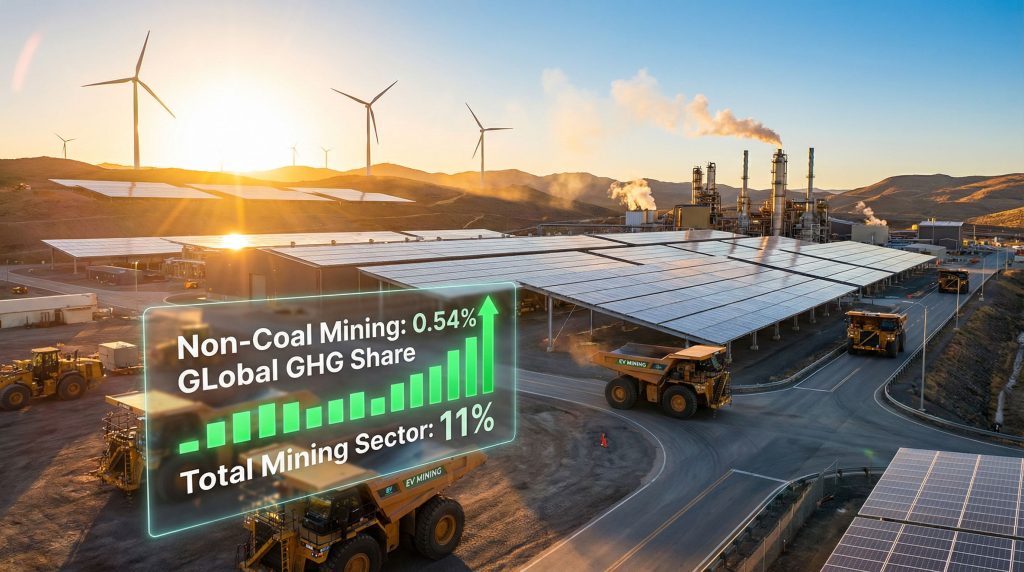
Mining extraction activities contribute approximately 3% of global greenhouse gas emissions, while downstream metal processing operations account for an additional 8%, creating a combined sectoral footprint of 11% of worldwide climate impacts. However, this aggregate figure conceals important operational distinctions that affect investment decisions and regulatory approaches.
When examining non-coal mining operations specifically, the emissions profile drops dramatically to just 0.54% of global totals. This finding fundamentally reshapes discussions about mining's contribution to global GHG emissions for operations extracting copper, lithium, cobalt, and rare earth elements essential for renewable energy technologies.
Coal mining's fugitive methane emissions, by contrast, represent 2.46% of global greenhouse gas outputs, demonstrating how extraction methods for different commodities create vastly different environmental implications. The ICMM research methodology focused on direct emissions from sources owned or controlled by mining operations (Scope 1) and indirect emissions from purchased electricity and energy (Scope 2).
Mining Sector Greenhouse Gas Contributions by Category (2024 Baseline):
| Category | Global GHG Share | Primary Sources |
|---|---|---|
| Mining Extraction Total | 3.0% | Equipment operation, facility energy |
| Metal Processing | 8.0% | Smelting, refining, manufacturing |
| Non-Coal Mining Only | 0.54% | Copper, lithium, rare earth extraction |
| Coal Fugitive Emissions | 2.46% | Methane releases during extraction |
Between 2020 and 2024, greenhouse gas emissions from mining and metal production increased by 3%, driven primarily by expanding global commodity demand and declining ore grades. This growth rate provides context for evaluating whether mining decarbonisation benefits are expanding faster or slower than other industrial sectors.
Identifying the Highest-Impact Mining Operations
Steel production dominates mining and metals sector emissions, representing 55% of all sectoral greenhouse gas outputs. This concentration reflects the carbon intensity of blast furnace processes, which currently handle approximately 70% of global steel production. Furthermore, the prevalence of blast furnace technology indicates that downstream processing methods, rather than raw material extraction activities, drive the majority of sectoral climate impact.
Coal extraction and processing accounts for 23% of mining-related emissions, positioning it as the second-largest component after steel production. Additionally, aluminum production contributes 15% of sectoral emissions, with regional variations reflecting the geographic concentration of energy-intensive smelting operations.
Regional Emission Patterns and Strategic Implications
Asia generates 80% of mining and metals sector greenhouse gas outputs, functioning as both a major extraction center and the dominant processing hub for most commodities. However, regional emission drivers vary substantially:
Europe: Steel production accounts for 93% of mining and metals greenhouse gas output
Africa/Middle East: Aluminum production represents 40% of regional mining emissions
Asia: Diversified across steel, aluminum, and multiple processing activities
These regional patterns inform strategic decisions for mining companies operating across multiple jurisdictions. Moreover, European operations face concentrated decarbonisation pressure in steel processing segments, while African and Middle Eastern operations must address aluminum smelting's energy intensity.
Comparing Commodity-Specific Climate Impacts
Different mining commodities exhibit vastly different emission intensities based on extraction methods, processing requirements, and energy consumption patterns. In addition, understanding these variations enables more targeted decarbonisation strategies and informed investment decisions.
High-Impact Materials
Iron ore processing represents the largest component of mining-related climate costs, driven by the chemical reduction processes required to convert iron oxide into metallic iron. Blast furnace operations generate CO2 as a chemical byproduct, not merely through energy consumption, creating inherent process emissions that require technological substitution rather than efficiency improvements.
Coal extraction operations create climate impacts through multiple pathways:
• Fugitive methane emissions released during excavation
• Equipment energy consumption for extraction activities
• Processing and preparation of coal products
• Transportation to end-use facilities
Aluminum production demonstrates significant regional variations in emission intensity based on electricity grid composition. Consequently, aluminum smelting requires continuous, high-capacity electricity supply (typically 12-15 megawatt-hours per ton of aluminum produced), making smelter locations with access to renewable energy sources substantially lower-emission than those dependent on fossil fuel generation.
Lower-Impact Critical Minerals
Copper extraction shows increasing energy intensity as ore grades decline globally. Chilean copper operations experienced 32-130% increases in energy consumption per unit of metal produced between 2001 and 2017, directly correlating with lower-grade deposits requiring more extensive grinding and processing.
Lithium operations generate minimal direct emissions relative to processing requirements. For instance, lithium extraction methods—whether from hard rock pegmatites or brine evaporation—create limited greenhouse gas outputs compared to the subsequent battery manufacturing processes that utilise lithium compounds.
Rare earth elements exhibit concentrated environmental impact during separation processes. The chemical complexity of separating individual rare earth elements from mixed concentrates requires acid leaching and solvent extraction processes that generate both direct process emissions and substantial indirect emissions from energy consumption.
Understanding Mining's Position Among Global Emission Sources
The mining and metals sector ranks sixth among global emission sources, positioned below electric power generation, transportation, agriculture, industrial manufacturing, and buildings/construction. This ranking provides essential context for policy discussions about sectoral decarbonisation priorities and resource allocation for emission reduction initiatives.
Comparing mining's contribution to global GHG emissions of 11% to other sectors reveals that while mining represents a material climate impact, it does not constitute the primary driver of global greenhouse gas emissions. This perspective influences how investment capital and regulatory attention should be allocated across different economic sectors to achieve maximum emission reduction per dollar invested.
The distinction between mining extraction (3%) and metal processing (8%) within the sectoral total suggests that policy interventions focusing solely on mining sites may miss the majority of sectoral emissions. Processing facilities—often located in different countries from extraction sites—account for the larger portion of climate impact.
Emerging Trends Reshaping Mining's Emission Profile
Several converging factors influence how mining's contribution to global GHG emissions may evolve over the coming decade. Understanding these trends enables more accurate forecasting of sectoral climate impacts and investment requirements.
The Ore Grade Decline Challenge
Declining ore grades across most mineral commodities create compounding emission effects. As higher-grade, easily accessible deposits become depleted, mining operations must process increasing volumes of rock to extract equivalent quantities of metal. Consequently, this trend directly increases energy consumption per unit of output, potentially offsetting efficiency improvements from technological advancement.
Copper provides the clearest example of this dynamic. Average copper ore grades globally have declined from approximately 1.6% in 1900 to less than 0.6% today. Processing lower-grade ores requires additional grinding, flotation, and concentration steps, each consuming energy and generating emissions.
Critical Mineral Demand Surge
Global commitments to triple renewable energy capacity by 2030 create unprecedented demand for critical minerals. Research indicates that achieving climate targets requires:
• Six times more mineral inputs by 2040 compared to current levels
• Copper demand increases of 70% by 2030
• Lithium demand growth exceeding 400% by 2030
• Rare earth element requirements doubling by 2030
This demand growth creates a paradox: the materials essential for global decarbonisation require increased mining activity that may temporarily increase sectoral emissions. However, renewable energy adoption and efficiency improvements should reduce unit emission intensity over time.
Technology Adoption Accelerating Decarbonisation
Mining operations present substantial opportunities for emission reduction through renewable energy integration. Many mining sites possess excellent solar and wind resources due to their remote locations, creating natural synergies between renewable energy deployment and mining operations.
Key decarbonisation opportunities include:
• Wholesale adoption of renewable energy for mining operations
• Electrification of mobile mining equipment and hydrogen-powered trucks
• Implementation of heat recovery systems for processing operations
• Smart grid integration for optimised energy management
Electric vehicle technology specifically offers immediate emission reduction potential for mining operations. Furthermore, AI in mining operations enables optimised energy consumption patterns and predictive maintenance that reduces overall emissions.
The next major ASX story will hit our subscribers first
Investment and Policy Implications
The comprehensive emissions data enables more nuanced investment decisions and policy framework development. For equity investors evaluating mining companies through ESG criteria, the distinction between coal mining (2.46% of global emissions) and non-coal mining (0.54% of global emissions) suggests fundamentally different climate risk profiles.
Portfolio Construction Considerations
Mining companies focused on critical minerals for renewable energy infrastructure present lower direct emission risks than previously assumed in many ESG investment frameworks. This finding may influence sectoral allocation strategies and screening criteria for climate-conscious investment portfolios.
The regional concentration of emissions (80% in Asia) also creates geographic considerations for portfolio construction. Moreover, mining companies with operations concentrated in regions with cleaner electricity grids may demonstrate superior emission performance relative to peers operating in coal-dependent regions.
Regulatory Framework Development
Accurate emission attribution enables more targeted regulatory interventions. Policy frameworks that apply uniform restrictions to "mining operations" may misallocate resources by treating coal extraction identically to copper or lithium extraction.
Carbon pricing mechanisms, for example, could be calibrated to reflect actual emission intensities rather than applying sector-wide approaches. This approach would avoid penalising low-emission critical mineral operations essential to renewable energy deployment.
Future Pathways for Sectoral Decarbonisation
The path forward for mining sector decarbonisation requires addressing both direct operational emissions and the broader system impacts of increased critical mineral demand. In addition, mining industry innovation enables companies to influence their emission profiles through strategic choices within their operational control.
Technology Substitution Opportunities
Steel production's dominance (55% of sectoral emissions) creates the largest single decarbonisation opportunity through technology substitution. Electric arc furnaces using recycled scrap steel can reduce production emissions by 65-75% compared to blast furnaces, depending on electricity grid composition.
Hydrogen-based direct reduction of iron ore represents a longer-term pathway for eliminating process emissions from steel production. While this technology requires substantial infrastructure development, it offers the potential to address the chemical CO2 generation inherent in current steel production methods.
Operational Efficiency Improvements
Mining companies can reduce emissions through operational optimisation strategies that improve energy efficiency per unit of output:
Process optimisation: Advanced ore sorting technologies reduce processing volumes by rejecting waste rock before energy-intensive grinding and flotation
Equipment efficiency: Next-generation mining equipment offers improved fuel efficiency and reduced maintenance requirements
Logistics optimisation: Route optimisation and fleet management systems reduce transportation-related emissions
Waste heat recovery: Capturing and utilising waste heat from processing operations reduces overall energy requirements
Supply Chain Integration
The separation between mining extraction (3% of global emissions) and metal processing (8% of global emissions) creates opportunities for supply chain integration. Consequently, mining companies that integrate processing operations may achieve superior emission performance by coordinating renewable energy deployment across both extraction and processing phases.
Balancing Production Growth with Climate Commitments
The research reveals a fundamental tension between scaling critical mineral production for renewable energy infrastructure and managing direct mining sector emissions. Global climate commitments require both increased mining output and reduced emission intensity per unit of production.
Resolving this tension requires mining companies to achieve productivity improvements that exceed demand growth rates. For instance, if critical mineral demand increases 300% by 2030 while emission intensity per unit decreases by 200%, absolute mining sector emissions would still increase by approximately 50%.
This dynamic suggests that mining sector decarbonisation success should be measured primarily through emission intensity improvements rather than absolute emission reductions. Furthermore, this approach recognises the sector's essential role in enabling broader economic decarbonisation.
The ICMM baseline data provides the measurement framework necessary for tracking these intensity improvements across different commodities and regions. For mining companies producing materials essential to renewable energy infrastructure, demonstrating continuous improvement in emission intensity per unit of output becomes a key performance indicator for sustainability reporting and investor relations.
Disclaimer: This analysis is based on research from the International Council on Mining and Metals (ICMM) and Wood Mackenzie. Investment decisions should consider multiple factors beyond environmental performance, including market conditions, regulatory changes, and company-specific risks. Emission projections involve assumptions about future technology adoption, demand growth, and policy developments that may not materialise as expected.
Looking to Capitalise on Mining's Evolving Climate Landscape?
As mining companies navigate decarbonisation whilst scaling critical mineral production, Discovery Alert's proprietary Discovery IQ model identifies breakthrough mineral discoveries that could reshape both environmental performance and investment returns. Stay ahead of market movements by exploring Discovery Alert's proven track record with major mineral discoveries and begin your 14-day free trial today to position yourself at the forefront of the critical minerals transition.