June 17, 2026
The mining industry stands at the intersection of massive capital investments and evolving operational demands. Heavy machinery represents one of the largest expenditures for mining operations, with individual haul trucks costing millions of dollars and fleets requiring decades to fully depreciate. Within this capital-intensive environment, retrofit autonomous haulage in mining has emerged as a transformative approach that enables mining companies to modernise their operations without the prohibitive costs of complete fleet replacement.
Retrofit autonomous haulage systems fundamentally alter how mining companies approach fleet modernisation by installing advanced sensor arrays, artificial intelligence algorithms, and drive-by-wire controls onto existing vehicles. This technological integration transforms conventional haul trucks into autonomous units capable of operating without human drivers while maintaining the substantial investments already made in heavy equipment. Furthermore, these systems represent a key aspect of AI in mining technology that is reshaping the industry.
Core Components and Technical Architecture of Retrofit Systems
Modern retrofit autonomous haulage in mining systems integrate multiple sophisticated technologies to achieve safe and efficient unmanned operation. The foundation relies on comprehensive sensor suites that include LiDAR arrays, radar systems, high-resolution cameras, and GPS positioning equipment. These sensors create detailed environmental maps that enable autonomous vehicles to navigate complex mining environments with precision matching or exceeding human operators.
The artificial intelligence decision-making algorithms process sensor data in real-time to make driving decisions, optimise routes, and respond to changing conditions. In addition, these systems must account for variables including:
• Dynamic weather conditions affecting visibility and road surface conditions
• Interaction with other autonomous and manually operated equipment
• Varying load configurations that impact vehicle handling characteristics
• Emergency scenarios requiring immediate response protocols
Drive-by-wire technology replaces mechanical connections between controls and vehicle systems with electronic interfaces. This modification enables computer systems to directly control steering, acceleration, and braking functions with the precision necessary for autonomous operation. Consequently, the retrofit process requires extensive calibration to match the control algorithms with each vehicle's specific mechanical characteristics and operational parameters.
When big ASX news breaks, our subscribers know first
Financial Advantages of Retrofit Implementation Strategies
The economic case for retrofit autonomous haulage in mining centres on capital efficiency and operational optimisation. Mining companies typically operate haul truck fleets valued at hundreds of millions of dollars, with individual vehicles representing 15-20 year investments. Complete fleet replacement with new autonomous vehicles would require massive capital outlays that many operations cannot justify economically.
Retrofit implementations typically cost 20-30% of new autonomous vehicle acquisition while extending the productive lifespan of existing assets. This approach enables mining companies to realise automation benefits without the financial burden of premature asset replacement. Moreover, the phased implementation possible with retrofit systems allows for gradual workforce transition and operational learning curves that reduce implementation risks.
Operational Continuity Benefits
Retrofit autonomous haulage in mining systems provide significant advantages in maintaining operational continuity during technology transitions. Mining operations cannot afford extended downtime for fleet conversion, making the gradual retrofit approach essential for continuous production. Companies can retrofit vehicles during scheduled maintenance windows, minimising production disruption while building autonomous capabilities incrementally.
The ability to operate mixed fleets of autonomous and manually driven vehicles during transition periods provides operational flexibility that complete system replacements cannot match. However, this hybrid approach enables mining companies to validate technology performance, train personnel, and optimise processes before committing to full autonomous operation.
Technology Provider Landscape and Competitive Positioning
The retrofit autonomous haulage market features both established original equipment manufacturers and specialised technology companies developing manufacturer-agnostic solutions. Each approach offers distinct advantages depending on fleet composition and operational requirements, reflecting broader mining industry trends toward technological integration.
Original Equipment Manufacturer Solutions
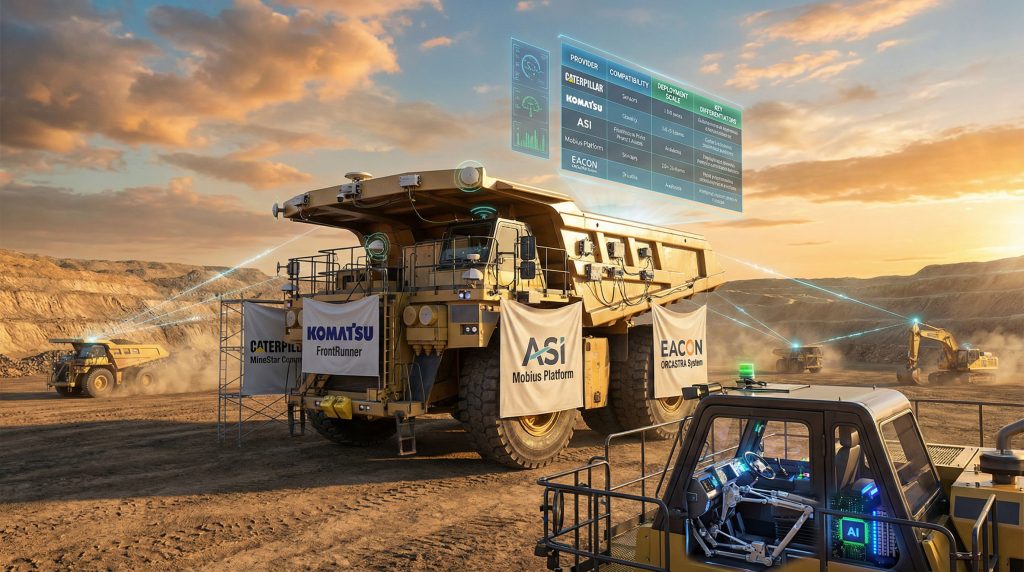
Caterpillar's MineStar Command system represents one of the most established retrofit platforms, with compatibility across multiple truck classes including 190-370 tonne vehicles. The system leverages Caterpillar's extensive knowledge of vehicle characteristics and maintenance requirements to provide integrated autonomous solutions. Global deployments exceed 600 trucks across multiple mining operations, demonstrating the technology's maturity and reliability.
Komatsu's FrontRunner system focuses primarily on the company's existing fleet installations while expanding retrofit capabilities. The system has achieved significant material handling volumes across nine operational sites, with more than 150 trucks in active autonomous service. Furthermore, Komatsu's approach emphasises integration with existing mine planning and fleet management systems to optimise overall operational efficiency.
Independent Technology Specialists
Manufacturer-agnostic platforms like Autonomous Solutions Inc.'s Mobius system offer flexibility for mining operations with mixed fleet compositions. These systems can retrofit vehicles from multiple manufacturers using standardised hardware and software components. The equipment-agnostic approach provides strategic advantages for mining companies operating diverse fleets or seeking to avoid vendor lock-in scenarios.
EACON Mining Technology's recent milestone at Norton Gold Fields' Mulgarrie mine demonstrates the viability of retrofit systems on used equipment. The successful conversion of a Komatsu HD1500 truck with approximately 20,000 operating hours proves that retrofit technology can extend the productive life of aging assets while adding autonomous capabilities.
Implementation Process and Technical Validation
Successful retrofit autonomous haulage implementation requires systematic approaches to technical integration and operational validation. The process begins with comprehensive fleet assessment to determine vehicle compatibility, infrastructure requirements, and regulatory compliance needs. These considerations are increasingly highlighted at events like the innovation expo highlights that showcase emerging technologies.
Pre-Implementation Planning
Fleet compatibility evaluation examines vehicle mechanical condition, existing electronic systems, and modification potential. Not all vehicles are suitable for retrofit, particularly those with significant wear or outdated control systems. Mining companies must assess the remaining productive life of candidate vehicles to ensure adequate return on retrofit investments.
Site infrastructure modifications typically include communication network upgrades, charging stations for increased electronic loads, and maintenance facility adaptations. In addition, the autonomous systems require robust wireless networks capable of handling real-time data transmission and remote monitoring capabilities.
Technical Integration and Testing
The retrofit installation process involves mounting sensor arrays, installing drive-by-wire components, and integrating control computers with existing vehicle systems. Each installation requires extensive calibration to match control algorithms with specific vehicle characteristics and operational parameters.
Validation testing follows structured protocols beginning with supervised operation and progressing through increasingly autonomous phases. Initial testing occurs in controlled environments before advancing to active mining areas with graduated exposure to operational complexities. Consequently, performance benchmarking against manual operation baselines ensures that autonomous systems meet or exceed human operator capabilities.
Real-World Performance and Operational Benefits
Deployed retrofit autonomous haulage systems demonstrate measurable improvements across multiple operational metrics. Safety performance typically improves through elimination of human error factors and consistent adherence to established protocols. Autonomous vehicles maintain optimal following distances, observe speed limits precisely, and execute consistent responses to hazardous conditions.
Productivity and Efficiency Improvements
Autonomous haul trucks operate continuously without shift changes, break periods, or performance variations associated with human factors. This consistency enables predictable cycle times and improved coordination with loading and dumping operations. Route optimisation algorithms reduce fuel consumption by maintaining optimal speeds and selecting efficient pathways based on real-time conditions.
The 24/7 operational capability of autonomous systems provides significant productivity advantages, particularly in operations with multiple shifts or extended production schedules. Furthermore, consistent performance eliminates the productivity variations typically associated with different operator skill levels and working conditions. These advancements align with broader data-driven mining operations that are transforming the industry.
Maintenance and Cost Optimisation
Autonomous operation typically reduces equipment wear through consistent driving patterns and optimal operating parameter adherence. Predictive maintenance capabilities enable proactive component replacement and reduce unexpected breakdowns. The elimination of operator cab requirements also reduces certain maintenance needs while enabling operation in conditions unsuitable for human operators.
Challenges and Risk Management Considerations
Retrofit autonomous haulage implementation presents technical, operational, and regulatory challenges that require careful management. Legacy system integration represents one of the primary technical hurdles, particularly for older vehicles with limited electronic infrastructure. However, sensor calibration and performance validation in varying environmental conditions require extensive testing and ongoing adjustment.
Workforce Transition and Skills Development
The transition to autonomous operations necessitates significant workforce adaptation and retraining programs. Traditional equipment operators must develop skills in system monitoring, remote operation, and troubleshooting autonomous systems. This evolution requires comprehensive change management strategies and ongoing technical education programs, topics often discussed at digital transformation conference events.
Labour relations considerations include union engagement and job security concerns as automation reduces direct operator positions while creating new technical roles. Successful implementations typically involve early stakeholder engagement and gradual transition timelines that allow workforce adaptation.
Cybersecurity and System Reliability
Autonomous systems introduce cybersecurity vulnerabilities that traditional mining operations do not face. Remote operation capabilities and network connectivity create potential attack vectors requiring robust security protocols. System reliability becomes critical as autonomous operations lack immediate human intervention capabilities during equipment failures.
Communication network reliability in remote mining locations presents ongoing challenges for autonomous system operation. Consequently, backup communication systems and autonomous decision-making capabilities during network outages are essential for operational continuity.
The next major ASX story will hit our subscribers first
Future Technology Trends and Market Evolution
The retrofit autonomous haulage market continues evolving with advancing artificial intelligence capabilities, improved sensor technologies, and enhanced integration with broader mine automation systems. Machine learning algorithms increasingly enable predictive maintenance, route optimisation, and adaptive responses to changing operational conditions.
Enhanced geolocation systems provide centimetre-level accuracy for precision navigation and coordination between multiple autonomous vehicles. Advanced haul road monitoring systems detect and respond to surface conditions that could impact equipment performance or safety.
Market Expansion and Standardisation
Industry projections indicate significant growth in autonomous truck deployments from current levels approaching 1,000 vehicles globally toward much larger scales as technology costs decrease and performance improves. Geographic expansion into emerging mining markets will drive additional growth as retrofit solutions prove more accessible than complete fleet replacements.
Standardisation efforts across equipment manufacturers aim to improve interoperability and reduce implementation complexity. Furthermore, these developments will enable mining companies to implement autonomous systems more efficiently while reducing vendor lock-in risks.
Strategic Considerations for Mining Operations
Mining companies evaluating retrofit autonomous haulage must consider multiple strategic factors beyond immediate cost savings. Technology selection should align with long-term operational goals and existing infrastructure investments. Partnership selection with technology providers requires evaluation of ongoing support capabilities, geographic service coverage, and technology roadmap alignment.
Investment Planning and Risk Assessment
Total cost of ownership calculations must include retrofit costs, training expenses, infrastructure modifications, and ongoing maintenance requirements. Payback period projections should account for operational improvements, safety benefits, and potential regulatory advantages of autonomous operation.
Risk assessment frameworks should evaluate technology maturity, regulatory approval processes, and potential operational disruptions during implementation. However, contingency planning for technical challenges and alternative implementation scenarios helps ensure project success despite unforeseen complications. The mining technology landscape continues to evolve, providing increasingly sophisticated solutions for complex operational challenges.
What Does the Future Hold for Autonomous Mining?
The successful implementation of retrofit autonomous haulage technology represents a strategic opportunity for mining operations to modernise capabilities while preserving existing capital investments. As technology continues advancing and costs decrease, retrofit solutions will likely become the preferred path for autonomous adoption across the global mining industry.
In addition, the integration of these systems with broader mining automation initiatives creates synergies that enhance overall operational efficiency. The ability to retrofit existing fleets provides a practical pathway for mining companies to participate in the autonomous revolution without the capital constraints that have historically limited technology adoption.
Disclaimer: This analysis is based on publicly available information and industry reports. Mining companies should conduct comprehensive due diligence and consult with qualified technical specialists before making autonomous haulage investment decisions. Technology performance and implementation costs may vary significantly based on specific operational conditions and equipment configurations.
Ready to Capitalise on Mining Technology Innovation?
Discovery Alert's proprietary Discovery IQ model delivers real-time alerts on significant ASX mineral discoveries, instantly empowering subscribers to identify actionable opportunities in mining technology companies and resource explorers ahead of the broader market. Understand why major mineral discoveries can generate substantial returns by exploring historic examples, then begin your 30-day free trial today to position yourself ahead of the market.