May 23, 2026
Revolutionary Detection Systems Reshape Critical Mineral Extraction
The mining industry stands at a technological crossroads where traditional analytical methods can no longer support the precision demanded by modern rare earth element recovery operations. Advanced mine site sensor for rare earth recovery systems now promise to bridge this divide through quantum-enhanced detection capabilities that deliver immediate, actionable insights directly at extraction sites. Furthermore, as global supply chains face unprecedented pressure and environmental regulations tighten, the gap between laboratory-based analysis and real-time operational needs has become a critical bottleneck for efficient resource extraction.
When big ASX news breaks, our subscribers know first
Understanding Quantum Artificial Intelligence Material Sensing Technology
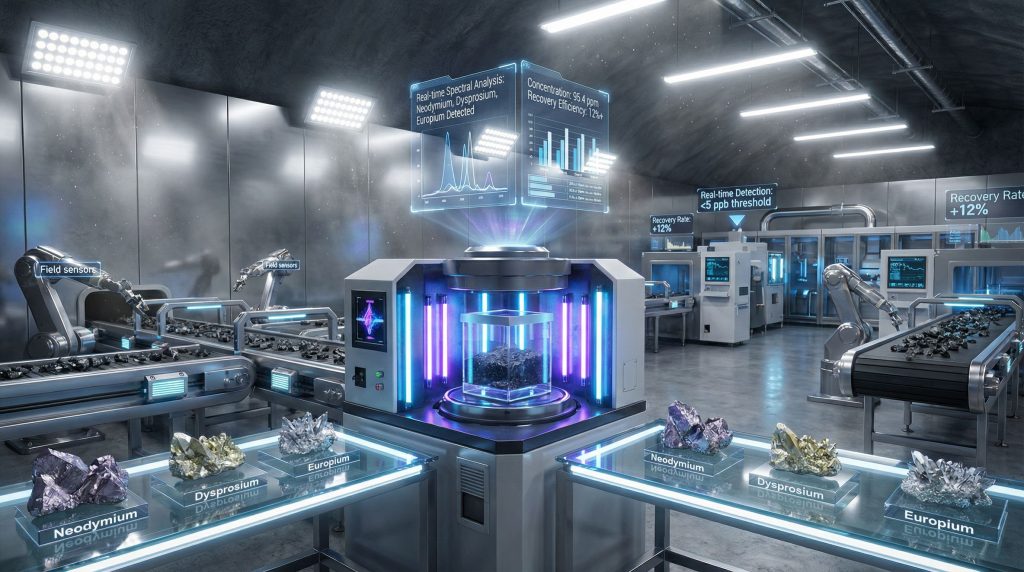
The emergence of quantum artificial intelligence material sensing (QAIMS) represents a fundamental departure from conventional analytical approaches in mineral processing. This technology leverages novel fluorescence mechanisms where multiple wavelength light sources target specific molecular structures within rare earth compounds, generating distinctive spectral signatures that enable real-time identification and quantification.
Core Detection Mechanisms
QAIMS technology operates through sophisticated up-conversion fluorescence processes, also known as anti-Stokes fluorescence. During this process, two or more lower-energy photons undergo sequential absorption, ultimately resulting in the emission of higher-energy photons at shorter wavelengths. This phenomenon creates unique spectral fingerprints that remain consistent across varying environmental conditions commonly encountered in mining operations.
The technology's breakthrough capability lies in its imaging functionality, which extends beyond simple spectral analysis to provide comprehensive morphological data. In addition, it captures particle shape, size distribution, and structural characteristics of target materials.
Performance Comparison Matrix
| Detection Method | Response Time | Sensitivity | Field Deployment | Operational Cost |
|---|---|---|---|---|
| QAIMS Technology | Real-time | Parts per billion | Fully portable | Low-moderate |
| ICP-MS Analysis | 24-48 hours | Parts per trillion | Laboratory only | High |
| XRF Spectroscopy | 2-5 minutes | Parts per million | Semi-portable | Moderate |
| Traditional Assay | 72-96 hours | Variable | Laboratory only | Very high |
Operational Integration for Mine Site Sensor Applications
Modern mine site sensor for rare earth recovery systems integrate seamlessly with existing processing infrastructure through multiple deployment configurations. Consequently, these systems address the critical challenge of maintaining continuous operations while optimising recovery efficiency across diverse geological conditions.
Continuous Monitoring Solutions
Over-Belt Scanning Systems
• Provide uninterrupted analysis of conveyor material streams
• Enable automated grade control decisions without operational delays
• Support immediate diversion of high-value material flows
• Integrate with existing plant control systems
In-Line Processing Analyzers
• Monitor slurry compositions in real-time
• Optimise chemical treatment protocols automatically
• Identify waste stream valorisation opportunities
• Reduce reagent consumption through precise dosing
Portable Field Units
• Validate exploration targets during drilling programmes
• Characterise stockpile compositions for strategic blending
• Support environmental compliance monitoring
• Enable rapid resource definition updates
Advanced Detection Capabilities
The technology demonstrates exceptional performance across the full spectrum of rare earth elements. However, it shows particular strength in detecting materials that traditional methods struggle to identify in field conditions. Clay-hosted deposits, where rare earth elements exist in highly dispersed forms, benefit significantly from this enhanced detection capability.
Technical Insight: Up-conversion fluorescence technology enables detection of rare earth concentrations in complex geological matrices that conventional portable analyzers cannot reliably measure, particularly in clay-dominated environments where target elements occur in ionic form.
Furthermore, data-driven mining operations are increasingly relying on these sophisticated sensor technologies to optimise extraction processes. Moreover, mining industry innovation continues to drive technological advancement in real-time analytical capabilities.
Economic Impact Analysis for Australian Operations
The implementation of real-time sensor technology creates measurable economic benefits across multiple operational dimensions. Additionally, these advantages compound over time as operators develop expertise in data interpretation and process optimisation.
Operational Efficiency Metrics
Traditional Processing Limitations:
• Laboratory turnaround delays: 24-72 hours minimum
• Sample transport logistics: $50-200 per analytical batch
• Decision-making lag: Results in 2-5% recoverable material loss
• Equipment downtime: 4-8 hours daily for sampling protocols
• Quality control verification: Additional 12-24 hour delays
Real-Time Sensor Advantages:
• Immediate processing optimisation decisions
• Waste stream reduction: 15-25% improvement potential
• Recovery rate enhancement: 8-12% achievable gains
• Operational continuity: 95%+ uptime capability
• Reduced reagent consumption: 10-18% savings typical
Investment Return Projections
For medium-scale rare earth operations processing 50,000-100,000 tonnes annually, sensor system implementation typically demonstrates:
| Financial Metric | Year 1 | Year 2 | Year 3-5 |
|---|---|---|---|
| Implementation Cost | $800K-1.2M | $200K-300K | $150K-250K |
| Efficiency Gains | $1.8M-2.8M | $2.3M-4.1M | $3.2M-5.5M |
| Waste Reduction Value | $600K-900K | $800K-1.2M | $1.1M-1.6M |
| Compliance Savings | $100K-200K | $150K-300K | $200K-400K |
| Net Return | $1.7M-2.7M | $3.1M-5.3M | $4.4M-7.3M |
Target Element Optimisation Strategies
Different rare earth elements respond with varying sensitivity levels to quantum detection methods. Consequently, this creates opportunities for specialised extraction strategies based on deposit characteristics and market demands.
High-Value Critical Elements
Technology-Critical Metals:
• Neodymium: Essential for permanent magnets in wind turbines and electric vehicle motors
• Dysprosium: Required for high-temperature magnetic applications in automotive and aerospace
• Terbium: Critical component in LED phosphors and advanced display technologies
• Europium: Specialised applications in security features and solid-state lighting
Detection Sensitivity Rankings
-
Europium: Sub-parts-per-billion detection threshold
-
Terbium: <5 ppb reliable measurement capability
-
Dysprosium: <10 ppb detection with 95% accuracy
-
Samarium: <15 ppb threshold in complex matrices
-
Neodymium: <25 ppb detection in clay environments
Clay-Hosted Deposit Advantages
Australian clay-hosted rare earth deposits present unique characteristics that make them particularly well-suited for real-time sensor deployment. Moreover, AI-powered mining efficiency systems enhance these detection capabilities significantly.
Geological Factors:
• Dispersed mineralisation patterns requiring precise spatial targeting
• Highly variable grade distributions demanding continuous monitoring
• Complex clay mineralogy affecting extraction chemistry
• Low-grade ore bodies where small efficiency improvements create significant value
Processing Benefits:
• Environmental sensitivity necessitating selective extraction approaches
• Processing complexity benefiting from real-time optimisation feedback
• Reagent chemistry requiring precise control for optimal recovery
• Waste minimisation critical for regulatory compliance
Government Investment and Technology Acceleration
The $2.4 million allocation through Australia's Critical Technologies Challenge Programme represents strategic investment in developing domestic capabilities for critical mineral processing technologies. This funding supports TeraGlo's advancement from laboratory prototypes to commercial-scale deployment systems.
Technology Readiness Advancement Framework
Research to Commercial Progression:
• Laboratory validation → Field-deployable systems
• Single-element detection → Multi-element analytical arrays
• Manual operation protocols → Automated integration capabilities
• Research validation → Commercial scalability demonstration
• University partnership → Industry collaboration expansion
Strategic Industry Alignment
The collaboration between TeraGlo and the University of Adelaide's Institute for Photonics and Advanced Sensing creates a foundation for domestic capability development. In addition, interpreting drill results becomes more precise through these advanced sensor technologies.
Domestic Capability Development:
• Advanced manufacturing skills for sensor system production
• Export market opportunities for Australian mining technologies
• Supply chain resilience for critical mineral processing equipment
• Competitive positioning in global rare earth extraction markets
Future Made in Australia Integration:
• Technology sovereignty in critical mineral processing
• High-value manufacturing job creation
• International technology transfer opportunities
• Strategic resource security enhancement
The next major ASX story will hit our subscribers first
Implementation Challenges and Solutions
Successful deployment of mine site sensor for rare earth recovery systems requires addressing specific technical and operational challenges unique to mining environments. Furthermore, mineral processing sensor technologies continue evolving to meet these demanding operational requirements.
Environmental Durability Requirements
Operational Condition Specifications:
• Temperature tolerance: -20°C to +60°C continuous operation
• Dust protection: IP65+ rating for harsh mining environments
• Vibration resistance: Compatibility with heavy mining equipment
• Chemical exposure resistance: Acid/alkaline processing environment tolerance
• Moisture protection: Performance in high-humidity conditions
System Integration Complexity
Technical Integration Requirements:
• Legacy control system compatibility across different equipment manufacturers
• Data management infrastructure supporting real-time analytics
• Comprehensive operator training programmes for effective utilisation
• Preventive maintenance protocols optimised for mining schedules
• Cybersecurity measures protecting operational data
Regulatory Compliance Framework
Quality Assurance Protocols:
• Calibration verification standards meeting industry requirements
• Cross-validation procedures with established laboratory methods
• Documentation systems supporting resource reporting obligations
• Environmental monitoring compliance for regulatory authorities
• Audit trail maintenance for quality certification processes
Market Applications and Industry Transformation
Real-time sensor technology creates value across multiple segments of the rare earth element value chain. Consequently, this spans from exploration through final processing, with AI in drilling and blasting operations benefiting significantly from these advances.
Primary Application Sectors
Active Mining Operations:
• Grade control optimisation reducing ore dilution
• Waste rock characterisation enabling selective mining
• Tailings reprocessing evaluation for legacy material recovery
• Process optimisation reducing energy consumption
Exploration and Resource Development:
• Target prioritisation during drilling programmes
• Resource definition supporting feasibility studies
• Geological model validation through continuous sampling
• Environmental baseline establishment for permitting
Waste Stream Valorisation:
• Historical tailings assessment for reprocessing opportunities
• Coal ash processing for rare earth recovery
• Electronic waste stream evaluation for urban mining
• Industrial byproduct characterisation for value recovery
Additionally, recent research from the Global Mining Review highlights how sensor-based sorting technologies are extending the operational life of critical mineral deposits worldwide.
Global Competitive Positioning
Australia's leadership in sensor technology development positions the nation to:
• Dominate clay-hosted rare earth processing innovation globally
• Export advanced mining technologies to international markets
• Attract foreign investment in domestic mining operations
• Secure critical mineral supply chains for strategic industries
Future Technology Development Pathways
The convergence of quantum sensing, artificial intelligence, and autonomous systems creates unprecedented opportunities for mining industry transformation. However, successful implementation requires careful consideration of technological readiness and operational requirements.
Next-Generation Capabilities
Artificial Intelligence Enhancement:
• Predictive grade modelling using historical sensor data
• Autonomous equipment control based on real-time material analysis
• Machine learning algorithms optimising recovery processes
• Predictive maintenance systems reducing unplanned downtime
Network Integration Expansion:
• Multi-point monitoring arrays providing comprehensive site coverage
• Wireless communication protocols enabling remote operation
• Cloud-based analytics platforms supporting global optimisation
• Digital twin modelling for scenario planning and optimisation
Industry Paradigm Shift
The implementation of comprehensive real-time sensing represents a fundamental transformation toward operational excellence. Moreover, research from the US Department of Energy demonstrates significant potential for rare earth element recovery through advanced sensor technologies.
Operational Excellence:
• Data-driven decision making replacing experience-based intuition
• Sustainable extraction practices minimising environmental impact
• Maximum resource utilisation through precision targeting
• Continuous improvement culture supported by real-time feedback
Strategic Advantages:
• Competitive differentiation through technology leadership
• Market responsiveness enabling rapid strategy adjustments
• Risk mitigation through comprehensive monitoring
• Innovation culture attracting top-tier technical talent
The integration of quantum artificial intelligence material sensing technology with traditional mining operations creates a foundation for Australia to maintain its position as a global leader in critical mineral extraction. Furthermore, mine site sensor for rare earth recovery systems establish new standards for operational efficiency and environmental responsibility in the rare earth element industry.
Disclaimer: Investment returns and performance metrics cited represent projected outcomes based on pilot programme data and industry analysis. Actual results may vary depending on deposit characteristics, operational conditions, and market factors. Investors should conduct independent due diligence before making investment decisions.
Ready to Capitalise on the Next Critical Mineral Discovery?
Discovery Alert's proprietary Discovery IQ model delivers instant notifications on significant ASX mineral discoveries, transforming complex geological data into actionable investment insights before the broader market reacts. Explore why major mineral discoveries have historically generated exceptional returns and begin your 14-day free trial today to position yourself ahead of emerging opportunities in the critical minerals sector.