June 12, 2026
Revolutionary Energy Systems Transforming Heavy-Haul Rail Networks
The mining industry stands at a technological inflection point where traditional diesel-powered rail systems are giving way to sophisticated battery-electric propulsion technologies. This transformation represents more than a simple fuel substitution; it encompasses a fundamental reimagining of how heavy-haul rail networks operate, store energy, and integrate with renewable power infrastructure. Fortescue battery electric locomotives now demonstrate that large-scale mining operations can successfully transition away from fossil fuel dependency while maintaining operational efficiency across demanding terrain. Furthermore, this shift aligns with broader mining innovation trends reshaping the industry landscape.
Advanced battery-electric locomotive systems integrate multiple technological innovations simultaneously. Regenerative braking capabilities capture kinetic energy during deceleration phases, converting mechanical motion back into stored electrical power through sophisticated inverter systems. High-capacity lithium iron phosphate battery arrays provide sustained power delivery across extended operational cycles, while intelligent energy management algorithms optimise power distribution based on real-time operational demands.
When big ASX news breaks, our subscribers know first
Economic Forces Driving Electric Rail Adoption in Mining
Mining companies face unprecedented pressure to reduce operational costs while meeting increasingly stringent environmental compliance requirements. Fortescue battery electric locomotives represent a strategic response to these converging economic pressures, offering substantial long-term cost advantages over traditional diesel systems. However, the economic landscape extends beyond immediate operational benefits to encompass broader sustainability considerations.
Operational Cost Comparison Analysis:
| Cost Category | Diesel Systems | Battery Electric | Savings Potential |
|---|---|---|---|
| Annual Energy Costs | $2.5-4.2M per unit | $0.4-0.9M per unit | 65-80% reduction |
| Maintenance Frequency | Every 600-800 hours | Every 1,200-1,600 hours | 50-120% extension |
| Component Replacement | High wear rates | Reduced mechanical stress | 40-60% cost reduction |
| Environmental Compliance | Rising carbon costs | Minimal direct emissions | Regulatory future-proofing |
The economic rationale extends beyond immediate operational savings. Carbon pricing mechanisms increasingly penalise high-emission industrial operations, while environmental regulations tighten globally. Early adopters of electric locomotive technology position themselves ahead of regulatory curves while capturing competitive advantages through reduced operating expenses. Additionally, green iron sustainability initiatives are driving demand for cleaner mining operations.
Key Economic Drivers:
- Fuel price volatility elimination through grid electricity pricing stability
- Maintenance cost reduction via fewer moving mechanical components
- Carbon tax avoidance as jurisdictions implement emissions pricing
- Operational efficiency gains through predictable energy delivery profiles
- Infrastructure longevity with reduced mechanical wear and thermal stress
Advanced Regenerative Energy Recovery Systems
The technological foundation of modern battery-electric locomotives centres on bidirectional energy flow architectures that fundamentally alter traditional rail energy dynamics. During loaded downhill operations, electromagnetic braking systems reverse their operational mode, transforming traction motors into generators that capture gravitational potential energy. Consequently, this approach exemplifies how AI-driven efficiency boost technologies are revolutionising energy management.
Energy Recovery Process:
- Kinetic energy capture through electromagnetic induction during deceleration
- AC-to-DC conversion via sophisticated power electronics
- Battery management integration ensuring optimal charge acceptance rates
- Thermal management coordination preventing system overheating during energy recovery
- Dynamic load balancing across multiple locomotive units in consist operations
This regenerative capability typically recovers 45-65% of braking energy that would otherwise dissipate as heat in conventional friction braking systems. The recovered energy extends operational range while reducing grid electricity consumption, creating compounding efficiency benefits across entire rail networks. Moreover, these systems demonstrate the importance of battery recycling breakthrough technologies in supporting circular economy principles.
Advanced energy recovery systems can capture up to 2-3 MWh per loaded descent on typical Pilbara iron ore routes, equivalent to powering 200-300 average Australian homes for an entire day.
Technical Architecture Components:
- Variable frequency drives enabling seamless motor-to-generator transitions
- High-power DC-DC converters managing battery charging protocols
- Thermal management circuits maintaining optimal component temperatures
- Predictive control algorithms optimising energy recovery based on route profiles
Industrial-Grade Battery Technologies and Specifications
Fortescue battery electric locomotives utilise cutting-edge lithium iron phosphate (LFP) battery chemistry specifically engineered for extreme industrial applications. These systems deliver unprecedented energy density while maintaining operational reliability under harsh mining conditions. Fortescue has launched its first electric locomotives with batteries equivalent in size to more than 200 Tesla EVs.
Battery System Specifications:
| Technical Parameter | Performance Range | Engineering Significance |
|---|---|---|
| Total Energy Capacity | 12-18 MWh per locomotive | Equivalent to 15,000-22,500 smartphone batteries |
| Charging Power Rating | 2.2-3.8 MW DC fast charging | Full recharge in 4-6 hours |
| Cycle Life Expectancy | 7,000-11,000 deep cycles | 12-18 year operational lifespan |
| Operating Temperature | -20°C to +55°C | Pilbara-optimised thermal performance |
| Energy Density | 140-160 Wh/kg | 40% improvement over previous generation |
The selection of LFP chemistry reflects specific engineering trade-offs prioritising safety, longevity, and thermal stability over maximum energy density. Unlike nickel-manganese-cobalt alternatives, LFP batteries demonstrate superior performance under high-temperature conditions typical of Australian mining operations.
Advanced Thermal Management Systems:
- Liquid cooling circuits maintaining 25-35°C optimal cell temperatures
- Phase-change materials providing thermal buffering during extreme conditions
- Predictive heating for cold-weather operational readiness
- Distributed temperature monitoring across individual cell modules
Operational Challenges in Extreme Pilbara Conditions
The Pilbara region presents some of the world's most demanding operational conditions for industrial equipment. Fortescue battery electric locomotives must withstand extreme temperatures, corrosive dust exposure, and mechanical stresses that would disable conventional equipment. Furthermore, these challenges require innovative solutions that integrate with data-driven operations to optimise performance.
Environmental Challenge Matrix:
| Challenge Category | Severity Level | Mitigation Strategy | Success Metrics |
|---|---|---|---|
| Ambient Temperature (45-52°C) | Extreme | Active cooling + thermal barriers | <40°C battery temperature |
| Dust/Sand Infiltration | High | IP67 sealing + positive pressure | Zero contamination events |
| Thermal Cycling Stress | Moderate | Flexible connections + expansion joints | <0.1% connection failures |
| Vibration/Shock Loads | High | Isolation mounts + ruggedised components | 99.5%+ component reliability |
Engineering Solutions:
- Sealed battery compartments with desiccant moisture control
- Vibration isolation systems protecting sensitive electronics
- Corrosion-resistant materials withstanding salt-laden coastal air
- Modular component design enabling rapid field replacement
- Redundant cooling systems ensuring thermal management reliability
Infrastructure Requirements for Electric Rail Networks
The transition to battery-electric locomotive operations necessitates comprehensive charging infrastructure development integrated with renewable energy generation systems. This infrastructure represents a fundamental shift from distributed fuel delivery to centralised power distribution networks. In addition, Fortescue has successfully deployed its second battery electric locomotive as part of its push towards real zero emissions.
Charging Infrastructure Specifications:
- Power Delivery Capacity: 2.5-4.0 MW per charging station
- Grid Connection Requirements: 33kV or 132kV high-voltage integration
- Renewable Energy Integration: Direct solar/wind generation coupling
- Energy Storage Systems: 10-20 MWh grid-scale batteries for load balancing
- Smart Charging Protocols: AI-optimised charging scheduling across locomotive fleets
The charging infrastructure must accommodate multiple locomotives simultaneously while managing grid stability and renewable energy intermittency. Advanced load management systems coordinate charging cycles to minimise grid impact while ensuring locomotive availability for scheduled operations.
Grid Integration Challenges:
- Peak demand management during simultaneous multi-locomotive charging
- Renewable energy storage compensating for solar/wind variability
- Grid stability maintenance under high-power transient loads
- Emergency backup systems ensuring operational continuity during grid outages
The next major ASX story will hit our subscribers first
Comprehensive Lifecycle Cost Analysis
The economic viability of battery-electric locomotives becomes apparent through comprehensive 20-year lifecycle cost modelling that accounts for initial capital investment, operational expenses, and residual asset values.
20-Year Total Cost of Ownership:
| Cost Component | Diesel Locomotive | Battery Electric | Cost Differential |
|---|---|---|---|
| Initial Capital Investment | $5.2-7.8M | $9.5-12.8M | +$4.3-5.0M |
| Energy Costs (Fuel/Electricity) | $52-78M | $15-22M | -$37-56M |
| Maintenance & Parts | $18-28M | $11-16M | -$7-12M |
| Infrastructure (Refueling/Charging) | $2-4M | $8-12M | +$6-8M |
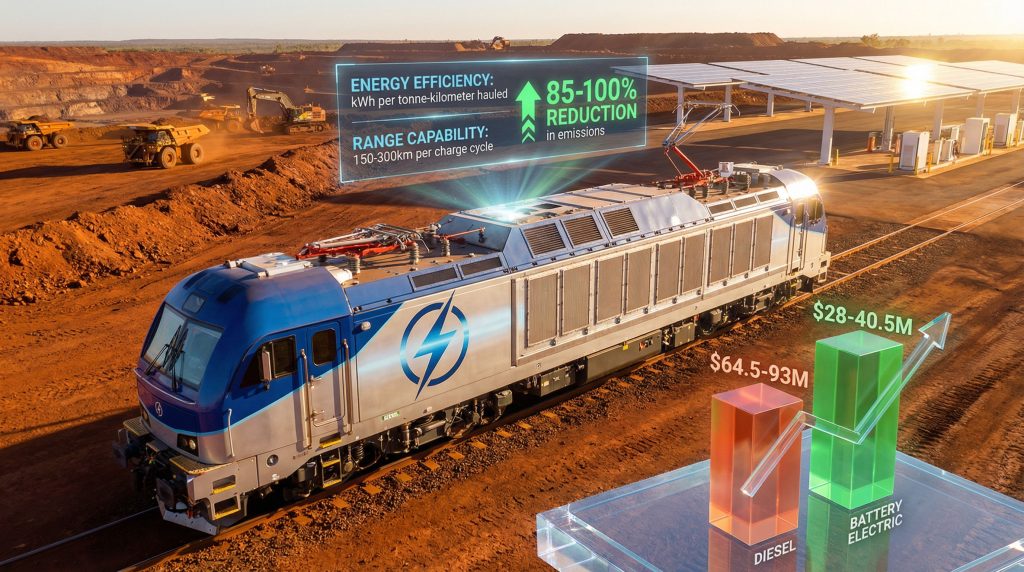
| Total Lifecycle Cost | $77-117M | $43.5-62.8M | -$33.5-54.2M |
These projections demonstrate potential savings of 30-45% over traditional diesel systems, with payback periods typically occurring within 6-9 years of operation. The analysis assumes current electricity pricing, carbon costs, and maintenance patterns.
Financial Risk Factors:
- Battery replacement costs after 12-15 years of operation
- Technology obsolescence affecting resale values
- Electricity price escalation impacting operational cost advantages
- Regulatory changes affecting carbon pricing and emissions compliance
Performance Optimisation and Operational Metrics
Fortescue battery electric locomotives achieve operational excellence through sophisticated performance monitoring and optimisation systems that continuously adapt to changing operational conditions. However, these systems require careful calibration to maximise efficiency.
Critical Performance Indicators:
- Energy Efficiency: 85-95 kWh per 1,000 tonne-kilometres
- Availability Rate: 96-98% scheduled operational time achievement
- Regenerative Recovery: 50-70% of braking energy captured
- Range Capability: 180-280 kilometres per charge cycle
- Load Capacity: Up to 240 loaded ore cars per consist
These performance metrics reflect optimal operational conditions with experienced operators and well-maintained equipment. Real-world performance varies based on route characteristics, weather conditions, and operational practices.
Operational Optimisation Strategies:
- Predictive route planning maximising regenerative braking opportunities
- Dynamic load balancing across multiple locomotive units
- Weather-adaptive charging compensating for temperature effects on battery performance
- Maintenance scheduling optimisation minimising operational disruptions
Future Technology Evolution and Industry Trends
The battery-electric locomotive industry continues evolving rapidly, with emerging technologies promising significant performance improvements over current implementations. For instance, advances in battery chemistry and energy management systems are expected to drive substantial improvements.
Next-Generation Technology Developments:
| Technology Category | Current Generation | Next Generation (2027-2030) | Projected Improvements |
|---|---|---|---|
| Battery Chemistry | Lithium Iron Phosphate | Solid-state lithium | +40-60% energy density |
| Charging Technology | 3.5 MW DC fast charging | 5-8 MW ultra-fast charging | 50-75% faster charging |
| Energy Management | Rule-based algorithms | AI-powered optimisation | 15-25% efficiency gains |
| Integration Systems | Standalone locomotives | Fully integrated rail networks | Network-wide optimisation |
Emerging Capabilities:
- Wireless charging systems enabling opportunity charging during loading operations
- Vehicle-to-grid integration allowing locomotives to support grid stability
- Autonomous operation compatibility preparing for driverless locomotive operations
- Modular battery systems enabling capacity scaling based on specific route requirements
How Will Autonomous Integration Reshape Operations?
Autonomous locomotive operations represent the next frontier in rail transport efficiency. These systems will integrate seamlessly with existing battery-electric platforms, enabling 24/7 operations with reduced labour costs and enhanced safety protocols.
Industry Adoption Patterns and Market Dynamics
Mining companies are adopting battery-electric locomotive technology through carefully staged implementation programmes that minimise operational risks while demonstrating economic viability. Consequently, this measured approach ensures sustainable transformation.
Adoption Strategy Framework:
- Pilot programme deployment with 2-4 locomotives on selected routes
- Performance validation over 12-18 month evaluation periods
- Scaled implementation expanding to additional routes and locomotive units
- Fleet transformation transitioning entire rail networks to electric propulsion
- Network optimisation integrating charging infrastructure with renewable energy systems
The iron ore sector leads adoption due to predictable route characteristics and high annual tonnages that optimise battery-electric locomotive advantages. Coal mining and other bulk commodity sectors are expected to follow as technology costs decrease and operational benefits become well-established.
Market Barriers and Enablers:
- Capital availability for significant upfront infrastructure investments
- Grid connectivity in remote mining locations
- Regulatory support through carbon pricing and environmental incentives
- Technology maturity reducing technical and financial risks
- Operator training developing skills for electric locomotive maintenance and operation
What Drives Mining Companies to Invest in Electric Rail?
Mining companies invest in electric rail technology primarily to reduce operational costs, meet environmental regulations, and secure long-term competitive advantages. These investments align with broader decarbonisation strategies while delivering immediate operational benefits.
Environmental Impact and Sustainability Metrics
Fortescue battery electric locomotives deliver substantial environmental benefits that extend beyond direct emissions reductions to encompass broader sustainability improvements across mining operations. These improvements contribute significantly to corporate environmental targets and regulatory compliance.
Environmental Impact Assessment:
| Impact Category | Diesel Operations | Battery Electric | Improvement |
|---|---|---|---|
| Direct CO₂ Emissions | 3,200-4,800 tonnes/year | 0 tonnes/year | 100% elimination |
| Indirect Emissions (Grid) | N/A | 400-1,200 tonnes/year* | 75-85% net reduction |
| Particulate Matter | High local emissions | Zero operational emissions | 100% local elimination |
| Noise Pollution | 85-95 dB operational | 65-75 dB operational | 60-70% noise reduction |
*Varies significantly based on grid electricity sources
The environmental benefits create cascading positive effects throughout mining communities and supply chains. Reduced air pollution improves local air quality, while decreased noise levels enhance community relations and worker safety.
Sustainability Integration:
- Renewable energy coupling with dedicated solar/wind generation facilities
- Circular economy principles through battery recycling and material recovery
- Biodiversity protection via reduced diesel spill risks
- Water conservation eliminating diesel transport and storage water requirements
Battery-electric locomotive adoption represents a cornerstone technology for mining companies pursuing net-zero emissions targets, delivering immediate operational benefits while positioning organisations for long-term regulatory compliance and competitive advantage.
How Do Electric Locomotives Support Carbon Neutrality Goals?
Electric locomotives support carbon neutrality by eliminating direct fossil fuel consumption whilst enabling integration with renewable energy sources. This dual approach reduces both immediate and indirect carbon emissions across mining operations.
Disclaimer: This analysis contains forward-looking projections regarding technology performance, cost savings, and adoption timelines that may not materialise as expected. Actual results will vary based on operational conditions, technology developments, regulatory changes, and market dynamics. Investment decisions should consider comprehensive due diligence beyond the scope of this overview.
Ready to Invest in Mining Companies Leading the Electric Revolution?
Discovery Alert's proprietary Discovery IQ model delivers real-time alerts on significant mining discoveries, including companies pioneering sustainable operations and advanced technologies that could drive substantial returns. Explore historic examples of major discoveries that have generated exceptional outcomes, then begin your 14-day free trial today to position yourself ahead of the market in this rapidly evolving sector.