August 1, 2026
Deep geological repositories represent one of nuclear energy's most complex engineering challenges, requiring decades of research to validate storage solutions that must remain stable for millennia. As nations worldwide grapple with accumulating radioactive waste from expanding nuclear fleets, underground research facilities have emerged as critical testing grounds for geological disposal technologies. These specialised laboratories must demonstrate not only technical feasibility but also long-term safety in extreme subsurface conditions, particularly as the mining industry innovation continues to advance underground construction capabilities.
Revolutionary Tunnelling Technology Achieves Engineering Breakthrough in Ultra-Hard Rock
China's Beishan Underground Research Laboratory has achieved remarkable construction milestones through innovative tunnelling technology specifically designed for ultra-hard granite formations. The construction milestone at Beishan Underground Research Laboratory represents a significant advancement in underground excavation capabilities. The Beishan No.1 tunnelling machine, an ultra-hard rock specialist developed through international collaboration, has demonstrated exceptional performance metrics that exceed typical underground excavation standards.
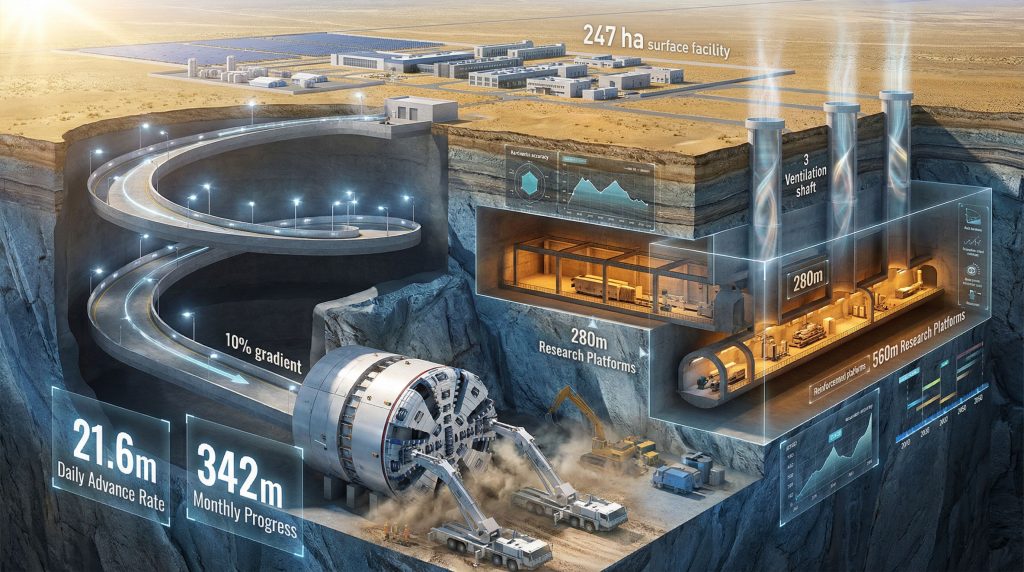
The machine achieved a peak daily advance rate of 21.6 metres, with monthly progress reaching 342 metres during optimal operating conditions. Over more than 1,000 days of continuous operation, the system completed nearly 7,000 metres of cumulative tunnelling while maintaining centimetre-level precision in damage control around excavated rock surfaces.
Furthermore, this engineering achievement resulted from collaborative development between the Beijing Research Institute of Nuclear Geology, China Railway Construction Heavy Industry Group, China Nuclear Fourth Research & Design Engineering, China Railway 18th Bureau Group, and international partners. The machine successfully navigated complex geometric requirements, completing seven small-radius turning sections totalling 255 metres alongside eight straight sections.
Key Performance Indicators:
• Peak daily advance: 21.6 metres
• Peak monthly advance: 342 metres
• Cumulative tunnelling distance: Nearly 7,000 metres
• Operating duration: More than 1,000 continuous days
• Precision control: Centimetre-level rock damage management
The machine's ability to maintain high advance rates while executing precise turning manoeuvres demonstrates sophisticated control systems essential for underground research facility construction. In addition, these AI drilling innovations complement traditional methods to enhance precision for underground research platform construction.
When big ASX news breaks, our subscribers know first
Multi-Level Underground Infrastructure Design Enables Comprehensive Research
The Beishan facility incorporates a sophisticated multi-depth architecture designed to support comprehensive geological disposal research across different subsurface environments. The infrastructure includes two primary technology test platforms positioned at 280 metres and 560 metres depth, connected through an integrated network of tunnels, shafts, and access systems.
The complete underground complex encompasses 13.4 kilometres of tunnels with a total structural volume of 514,200 cubic metres. This extensive network connects through a spiral ramp system, three vertical shafts, and horizontal disposal galleries designed for various research applications and operational scenarios.
Surface infrastructure spans 247 hectares with 2.39 hectares of gross floor space, providing comprehensive support facilities for underground operations. The surface complex houses control systems, research laboratories, equipment maintenance facilities, and administrative functions necessary for sustained research operations.
Infrastructure Specifications:
| Component | Specification |
|---|---|
| Primary test platform depth | 280 metres |
| Secondary test platform depth | 560 metres |
| Total tunnel network | 13.4 kilometres |
| Underground structural volume | 514,200 cubic metres |
| Surface facility coverage | 247 hectares |
| Gross floor space | 2.39 hectares |
The dual-depth configuration enables staged research protocols, with the 280-metre platform serving initial testing phases while the deeper 560-metre platform accommodates longer-term storage simulation and thermal modelling studies. Consequently, the three-shaft ventilation system provides engineered air circulation essential for sustained underground operations and worker safety in deep geological environments, complemented by 3D geological modelling techniques for precision planning.
Scientific Validation Framework Addresses Long-Term Storage Challenges
Deep geological repositories must demonstrate containment effectiveness across extended timeframes that challenge conventional engineering validation approaches. The construction milestone at Beishan Underground Research Laboratory functions as both a testing platform and evidence-gathering mechanism for establishing long-term storage suitability in crystalline granite formations.
The facility operates under a 50-year operational design timeline, providing sufficient duration for comprehensive geological characterisation, thermal response modelling, and containment system validation. Research protocols encompass hydrogeological barrier assessment, rock stability analysis, groundwater flow pattern evaluation, and thermal impact studies from radioactive decay heat.
China National Nuclear Corporation positions the laboratory as a critical component in the country's closed-loop nuclear fuel technology innovation system. The facility addresses the gap in underground field research and development platforms for high-level radioactive waste disposal technology, providing experimental capabilities for overcoming geological disposal challenges.
Research Timeline Framework:
• 2019-2021: Regulatory approval and site preparation
• 2022-2025: Primary excavation and infrastructure development
• 2026-2050: Research operations and site validation
• By 2050: Potential repository establishment if validation successful
The validation framework must demonstrate repository performance across geological timescales extending thousands of years, requiring sophisticated modelling approaches that integrate multiple scientific disciplines including hydrogeology, geochemistry, thermal analysis, and structural geology. Moreover, data-driven operations support these complex analytical requirements through advanced monitoring systems.
Desert Environment Construction Demands Specialised Engineering Solutions
Construction in the Gobi Desert near Jiuquan City, Gansu province, presents unique logistical and environmental challenges that required innovative engineering approaches. The remote location necessitates comprehensive infrastructure development to support sustained construction operations and eventual research activities.
The 247-hectare surface facility required extensive site preparation in desert conditions, including access road construction, utility installation, and environmental protection systems. Equipment transportation and material supply chains must accommodate the isolated location while maintaining construction timeline requirements.
However, temperature control systems become critical for precision excavation work, as desert climate extremes can affect equipment performance and measurement accuracy essential for centimetre-level damage control during tunnelling operations. Water supply systems must address both construction requirements and long-term operational needs in an arid environment.
Environmental Considerations:
• Remote desert location requiring comprehensive infrastructure development
• Extreme temperature variations affecting equipment performance
• Water supply challenges in arid environment
• Environmental protection protocols for desert ecosystem
• Equipment transportation logistics across 247-hectare facility
The facility's design incorporates specialised materials and construction techniques optimised for extreme geological conditions and extended operational requirements. For instance, structural systems must accommodate both immediate construction stresses and long-term operational loads while maintaining containment integrity throughout the 50-year research timeline.
Integrated Nuclear Waste Management Strategy Connects Multiple Facilities
China's nuclear waste management approach integrates the construction milestone at Beishan Underground Research Laboratory with existing operational disposal facilities to create a comprehensive waste handling network. Industrial-scale disposal of low and intermediate-level waste currently operates at three established sites across the country.
The Yumen facility in northwest Gansu province provides regional waste management capabilities in the same geographic area as the Beishan laboratory, potentially enabling operational synergies and shared infrastructure utilisation. The Beilong repository in Guangdong province serves the Daya Bay nuclear plant region, while the Feifengshan facility in Sichuan province addresses waste management needs in western China.
Current Waste Management Network:
| Facility | Location | Waste Type | Operational Status |
|---|---|---|---|
| Yumen | Northwest Gansu Province | Low/Intermediate-Level | Operational |
| Beilong | Guangdong Province (Near Daya Bay) | Low/Intermediate-Level | Operational |
| Feifengshan | Sichuan Province | Low/Intermediate-Level | Operational |
| Beishan | Gansu Province (Under Construction) | High-Level (Research) | Research Phase |
The integrated approach enables China to address different waste categories through specialised facilities while developing high-level waste disposal capabilities through the Beishan research programme. This strategy provides operational continuity during the extended research timeline required for high-level waste repository validation, incorporating advanced waste management solutions throughout the network.
Economic Investment Framework Supports Extended Research Timeline
The Beishan Laboratory represents a substantial financial commitment totalling more than CNY 2.72 billion (USD 380 million) over a seven-year construction timeline. This investment level reflects the complex engineering requirements and extended research protocols necessary for geological disposal validation.
Project approval came through China's 13th Five-Year Plan designation as a major nuclear environmental protection scientific research project, demonstrating national strategic priority for nuclear waste management capabilities. The China Atomic Energy Authority approved the project in 2019, with ground-breaking ceremonies conducted in June 2021.
Financial and Timeline Structure:
• Total investment: CNY 2.72 billion (USD 380 million)
• Construction timeline: Seven years
• Operational design life: 50 years
• Project approval: 2019 (China Atomic Energy Authority)
• Ground-breaking: June 2021
• Tunnelling commencement: November 2022
The 50-year operational design timeline provides sufficient duration for comprehensive geological characterisation and validation studies necessary to support repository licensing decisions. If research proves successful and site suitability is confirmed, an underground repository for high-level waste could be established near the laboratory by 2050.
What Are the Key Economic Benefits of the Project?
The substantial investment creates opportunities for technological advancement and international collaboration. The construction milestone at Beishan Underground Research Laboratory represents not only waste management progress but also potential economic returns through technology export and licensing opportunities.
The next major ASX story will hit our subscribers first
Technology Transfer Potential Creates International Collaboration Opportunities
The engineering achievements at Beishan, particularly the ultra-hard rock tunnelling technology and precision excavation capabilities, represent innovations with broader applications beyond nuclear waste management. The centimetre-level damage control systems and high advance rate capabilities could benefit other underground construction projects requiring similar precision and efficiency.
International collaboration opportunities may emerge through research data sharing protocols with global underground research facilities, equipment licensing arrangements, and joint research programmes with international nuclear agencies. According to World Nuclear News, the project has attracted significant international attention for its technological achievements.
Potential Collaboration Areas:
• Research data sharing with international underground research facilities
• Equipment and methodology licensing for similar projects
• Joint research programmes with international nuclear agencies
• Technical assistance for developing nuclear programmes
• Advanced tunnelling technology applications in other sectors
The deep geology research methodologies developed at Beishan could also benefit mining industry applications, environmental monitoring innovations for long-term projects, and regulatory framework development for other nations pursuing geological disposal programmes. Furthermore, Interesting Engineering highlights the facility's potential to influence global nuclear waste management practices.
Future Implications for Global Nuclear Waste Management
Success at the Beishan Underground Research Laboratory could significantly impact global approaches to nuclear waste management by demonstrating scaled geological disposal technologies in challenging environments. The facility's research outcomes may influence international best practices for repository development and validation protocols.
Site expansion potential beyond the current research phase could accommodate China's growing nuclear fleet waste management requirements. The facility's design allows for integration with national energy security objectives and potential development of regional repository network capabilities.
The advanced monitoring technologies, geological characterisation methods, and containment validation approaches developed during the research phase could establish new standards for repository licensing and regulatory approval processes internationally. Therefore, the project represents a significant milestone in global nuclear waste management evolution.
Disclaimer: This article discusses ongoing research and future projections related to nuclear waste management technology. Actual performance results, timeline achievements, and regulatory approvals may vary from current projections. Repository development timelines and technical specifications remain subject to regulatory approval and validation study outcomes.
Ready to Invest in Advanced Underground Construction Companies?
Discovery Alert's proprietary Discovery IQ model delivers real-time notifications on significant ASX mineral discoveries, instantly empowering subscribers to identify actionable opportunities in companies developing cutting-edge underground technologies ahead of the broader market. Understand why major mineral discoveries can lead to substantial market returns by exploring Discovery Alert's dedicated discoveries page, showcasing historic examples of exceptional outcomes, and begin your 30-day free trial today to position yourself ahead of the market.