August 14, 2026
Revolutionizing Mineral Processing Through Advanced Comminution Systems
The global mining industry faces unprecedented pressure to reduce energy consumption while maintaining operational efficiency. Traditional mineral processing methods consume enormous amounts of power, with comminution processes alone accounting for more than 1% of worldwide energy usage. As mining operations expand into increasingly remote locations and ore grades continue declining, the industry desperately needs technological solutions that address both environmental and economic challenges.
Advanced crushing technologies are emerging as game-changing innovations that promise to transform how mining companies approach particle size reduction. These systems combine multiple force mechanisms to achieve superior processing efficiency while dramatically reducing energy consumption compared to conventional ball mill operations. Furthermore, these emerging crushing technology in mining developments represent a significant shift towards more sustainable mineral processing methods.
When big ASX news breaks, our subscribers know first
What Are the Latest Breakthroughs in Mining Crushing Technology?
Multi-Force Particle Reduction Systems
Modern emerging crushing technology in mining employs sophisticated particle reduction mechanisms that simultaneously apply compression, tension, and shear forces to ore material. This multi-force approach represents a fundamental departure from traditional single-mechanism systems that rely primarily on impact or compression alone.
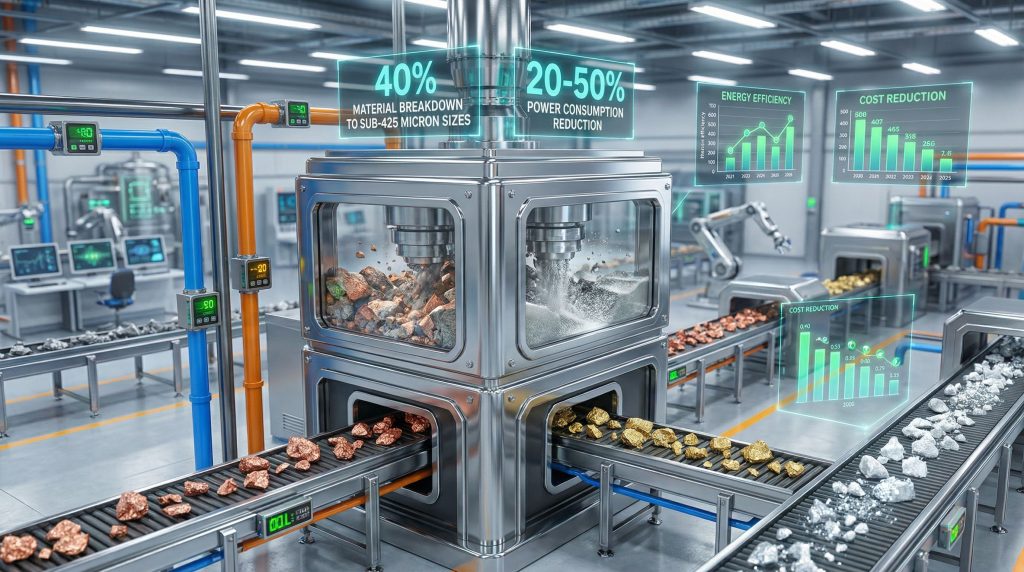
Recent testing at copper-gold operations has demonstrated that these advanced systems can reduce more than 40% of particles to less than 425 microns in a single processing pass. Equally important, ultra-fine particle generation remains controlled at less than 14% for particles smaller than 75 microns, addressing a critical challenge in downstream mineral separation processes.
The technology proves particularly effective when processing finer ore feeds under 2.36 millimeters, expanding operational flexibility for mining companies dealing with varying feed characteristics. This capability becomes increasingly valuable as operations encounter more complex ore bodies that require precise particle size control.
Energy Efficiency Performance Metrics
Operational testing has revealed substantial energy consumption improvements over traditional grinding circuits. Real-world deployment at a New South Wales copper-gold operation achieved a 20% reduction in power consumption compared to parallel traditional grinding operations. This energy reduction directly translates to operational cost savings and reduced environmental impact.
The energy efficiency gains become even more significant when considering that comminution processes typically consume up to 80% of a mine site's total power consumption. A 20% reduction in comminution energy represents approximately 8-12% of total mine site energy consumption reduction for typical hard rock operations.
Scalable Implementation Capabilities
These advanced systems offer remarkable deployment flexibility through multiple configuration options:
- Standalone installations for greenfield mining projects
- Retrofit integration with existing processing circuits
- Modular designs adaptable to varying throughput requirements
- Dry and wet processing modes for different operational contexts
The compact design characteristics enable deployment in remote mining locations where space constraints and infrastructure limitations create challenges for traditional large-scale grinding equipment.
How Do Modern Crushing Technologies Address Critical Industry Challenges?
Tackling the Energy Consumption Crisis
The mining industry's energy intensity has reached critical levels, with comminution processes representing one of the most power-hungry aspects of mineral extraction. Individual mine sites often dedicate 40-60% of total operational energy to crushing and grinding activities, creating substantial operational expenditure burdens.
Rising electricity costs globally compound this challenge, particularly for operations in remote locations where power generation costs escalate significantly. Advanced crushing systems directly address this crisis by eliminating or reducing dependence on traditional ball mill circuits that consume vast amounts of electrical power. In addition, these innovations align perfectly with AI in mining operations that optimise energy usage throughout the entire processing chain.
For perspective, a mid-sized copper operation consuming 50 megawatts of power could achieve 4-6 megawatts of power demand reduction through advanced crushing technology adoption. This reduction equals the power consumption of approximately 3,000-4,500 typical households, illustrating the substantial energy savings potential.
Managing Declining Ore Grade Economics
Global ore grades have declined steadily across major commodity sectors, forcing mining companies to process larger volumes of material to maintain production levels. This trend amplifies the importance of efficient comminution processes, as any energy or cost savings multiply across the increased processing volumes.
Traditional processing methods often struggle with lower-grade materials because they require more aggressive grinding to achieve adequate mineral liberation. Advanced crushing technologies offer enhanced liberation efficiency through controlled particle size distribution, reducing over-grinding while maintaining effective mineral recovery rates.
The ability to process hard porphyry copper-gold ores with significantly reduced energy consumption becomes particularly valuable given that porphyry deposits account for approximately 75% of global copper production.
Remote Operation Optimisation
Modern mining operations increasingly occur in isolated locations with limited infrastructure support. These environments present unique challenges for equipment deployment, maintenance access, and resource availability. Consequently, emerging crushing technology in mining becomes even more critical in these challenging environments.
Advanced crushing systems address remote operation challenges through:
- Reduced power infrastructure requirements
- Lower water consumption in water-scarce regions
- Simplified maintenance protocols with extended component lifecycles
- Compact equipment footprints suitable for challenging terrain
The technology's ability to operate in dry processing mode eliminates water consumption concerns in arid regions where many copper, gold, and lithium deposits are located.
What Economic Benefits Do Advanced Crushing Systems Deliver?
Comprehensive Cost Reduction Analysis
Operational testing has revealed multiple dimensions of cost reduction beyond simple energy savings. A comprehensive analysis of economic benefits includes:
| Cost Category | Traditional Systems | Advanced Technology | Reduction Potential |
|---|---|---|---|
| Energy Consumption | 15-25 kWh per tonne | 8-15 kWh per tonne | 20-50% |
| Grinding Media | $200-400 per tonne annually | Eliminated or reduced | Up to 50% savings |
| Water Treatment | 2-4 cubic metres per tonne | 1-2 cubic metres per tonne | 15-30% reduction |
| Maintenance Costs | High frequency replacement | Extended component life | 25-40% reduction |
Real-world testing at the NSW copper-gold operation achieved nearly 50% reduction in total comminution costs, demonstrating the cumulative impact of multiple cost reduction factors operating simultaneously. This approach works exceptionally well alongside data-driven mining operations that use advanced analytics to optimise performance.
Grinding Media Elimination Savings
Traditional ball mill operations require continuous replacement of steel grinding media, with large mills consuming 200-500 tonnes of steel media annually. At typical steel costs of $200-400 per tonne, annual grinding media expenses range from $40,000-200,000 per mill depending on operation scale.
Advanced crushing systems that eliminate grinding media requirements completely remove this operational expense, contributing significantly to the observed 50% comminution cost reductions.
Water Consumption Economics
In water-scarce mining regions, water acquisition costs can reach $1-3 per cubic metre or higher. A mid-sized processing operation consuming 1,000-2,000 cubic metres daily could realise $150,000-1,100,000 in annual water cost savings through 15-30% consumption reductions enabled by advanced crushing technology.
Capital Investment Considerations
While specific capital equipment costs for advanced crushing systems require detailed engineering analysis, the technology offers potential advantages in infrastructure requirements:
- Reduced circuit complexity compared to traditional grinding installations
- Lower foundation and structural requirements due to compact designs
- Simplified electrical infrastructure resulting from reduced power demands
- Faster installation timelines for both greenfield and retrofit applications
Return on investment calculations become particularly attractive when considering the combination of reduced capital requirements and substantial operational savings.
Which Mining Operations Benefit Most from Advanced Crushing Technology?
Hard Rock Mineral Processing Applications
Operations processing hard rock deposits experience the greatest relative benefits from advanced crushing technology. Hard porphyry copper-gold deposits, which have demonstrated optimal performance characteristics, represent a major segment of global copper production.
Testing has specifically validated effectiveness on hard porphyry copper-gold ores, with results showing significant energy and cost advantages over traditional processing methods. The technology's ability to handle hard materials efficiently addresses the most energy-intensive processing scenarios in mining operations. Moreover, these systems integrate seamlessly with renewable energy solutions to create truly sustainable processing operations.
Iron ore operations focused on energy efficiency improvements also present strong candidates for technology adoption, particularly given the high-volume, low-margin nature of iron ore processing where energy costs significantly impact profitability.
Critical Mineral Extraction Operations
The growing focus on critical minerals for clean energy transition creates compelling applications for advanced crushing technology:
- Lithium processing operations requiring sustainable practices and precise particle control
- Copper extraction classified as critical due to electric vehicle and renewable energy infrastructure demands
- Rare earth element processing involving complex mineralogy requiring efficient liberation
- Battery metal production demanding consistent product specifications
Copper's increasingly critical classification drives particular interest in processing efficiency improvements. The metal's essential role in clean energy transition infrastructure creates strategic importance beyond typical commodity optimisation.
Sustainability-Focused Mining Companies
Organisations with carbon reduction commitments find advanced crushing technology particularly attractive due to substantial greenhouse gas emission reduction potential. The 20% energy consumption reduction demonstrated in operational testing directly translates to proportional emissions reductions.
Companies operating in regions with high electricity costs or carbon pricing mechanisms experience amplified economic benefits from energy efficiency improvements. Operations in jurisdictions requiring environmental impact minimisation gain competitive advantages through adoption of low-energy processing technologies.
How Does Technology Integration Transform Mineral Processing Circuits?
Smart Automation and Control Systems
Advanced crushing systems incorporate sophisticated monitoring and control technologies that optimise performance in real-time:
- Continuous particle size monitoring with automatic adjustment capabilities
- Feed rate optimisation based on ore characteristics and processing conditions
- Predictive maintenance algorithms reducing unplanned downtime risks
- Remote operation management through IoT connectivity
These automation features enable consistent performance optimisation while reducing operator intervention requirements, particularly valuable for remote operations with limited skilled personnel availability. However, the implementation of these systems also requires careful consideration of waste management solutions to handle processing by-products efficiently.
Artificial Intelligence Integration
Machine learning algorithms analyse operational data to identify optimisation opportunities that human operators might miss:
- Ore characteristic recognition for automatic parameter adjustment
- Performance prediction under varying operational conditions
- Maintenance scheduling optimisation based on usage patterns and component wear
- Energy consumption minimisation through intelligent load management
AI-powered systems continuously improve performance through data analysis, creating compounding efficiency gains over traditional static operational approaches.
Digital Twin Implementation
Virtual modelling capabilities enable process optimisation before implementing physical changes:
- Scenario testing for different ore types and processing parameters
- Performance prediction under various operational conditions
- Risk assessment for proposed operational modifications
- Training simulation for equipment operators
Digital twin technology reduces operational risks while enabling continuous improvement through virtual experimentation and optimisation.
The next major ASX story will hit our subscribers first
What Environmental Advantages Do Advanced Crushing Systems Provide?
Carbon Footprint Reduction Potential
The substantial energy consumption reductions achieved through advanced crushing technology directly translate to greenhouse gas emission decreases. A 20% reduction in comminution energy consumption proportionally reduces carbon emissions from power generation.
For mining operations powered by fossil fuel-based electricity grids, this emission reduction becomes particularly significant. Operations transitioning to renewable energy sources amplify environmental benefits by combining clean power generation with efficient processing technology.
Elimination of grinding media requirements also reduces indirect carbon emissions associated with steel production and transportation to remote mine sites. Furthermore, companies are finding that next-generation modular crushing plants offer enhanced sustainability features alongside improved operational flexibility.
Water Conservation Benefits
Advanced crushing systems operating in dry processing mode eliminate water consumption for grinding operations, addressing critical environmental concerns in arid mining regions. Even wet processing configurations demonstrate 15-30% water consumption reductions compared to traditional systems.
Reduced water treatment requirements decrease chemical consumption for water processing, further minimising environmental impact. Lower water discharge volumes reduce environmental monitoring and compliance costs while decreasing ecosystem impact risks.
Waste Stream Minimisation
Precise particle size control reduces over-grinding, which creates unnecessary fine particles that complicate downstream processing and potentially increase tailings generation. Controlled ultra-fine particle generation below 14% improves mineral liberation efficiency while reducing waste production.
Enhanced processing efficiency enables higher recovery rates from existing ore bodies, effectively extending mine life while reducing the environmental impact per unit of mineral production.
How Do Advanced Systems Compare to Traditional Crushing Methods?
Performance Metrics Comparison
Direct operational comparisons reveal substantial performance differences between traditional and advanced crushing systems. Nevertheless, understanding these performance differences through case studies such as those from Mining Alliance Machinery provides valuable insights into implementation benefits:
Traditional Ball Mill Performance:
- Energy consumption: 15-25 kWh per tonne processed
- Grinding media consumption: 200-500 tonnes annually for large mills
- Water requirements: 2-4 cubic metres per tonne
- Maintenance intervals: Liner replacement every 2-5 years
- Particle size control: Variable with tendency toward over-grinding
Advanced Crushing System Performance:
- Energy consumption: 8-15 kWh per tonne processed (20-50% reduction)
- Grinding media consumption: Eliminated or significantly reduced
- Water requirements: 1-2 cubic metres per tonne (15-30% reduction)
- Maintenance intervals: Extended component lifecycles
- Particle size control: Precise with minimal ultra-fine generation
Operational Flexibility Assessment
Advanced crushing systems demonstrate superior adaptability across varying operational conditions:
- Feed size flexibility accommodating coarse to fine materials
- Processing rate adjustments for different ore hardness characteristics
- Integration compatibility with existing infrastructure and circuits
- Dry/wet processing options based on water availability and environmental requirements
This operational flexibility enables mining companies to optimise processing parameters for specific ore characteristics while maintaining consistent performance across varying conditions.
What Implementation Considerations Should Mining Companies Evaluate?
Technical Feasibility Analysis
Successful implementation requires comprehensive evaluation of site-specific factors:
Ore Characteristics Assessment:
- Hardness and abrasiveness testing for equipment sizing
- Mineralogy analysis for liberation behaviour prediction
- Feed size distribution evaluation for optimal processing parameters
- Moisture content considerations for dry/wet processing selection
Infrastructure Integration Requirements:
- Electrical power capacity and distribution modifications
- Structural foundation requirements for equipment installation
- Process flow integration with existing circuits
- Material handling system compatibility
Financial Planning and Analysis
Investment decisions require detailed financial modelling incorporating multiple variables:
- Capital expenditure budgeting for equipment procurement and installation
- Operational expenditure projections including energy, maintenance, and labour costs
- Return on investment calculations over equipment design life (typically 15-20 years)
- Sensitivity analysis for commodity price fluctuations and energy cost variations
The demonstrated 50% reduction in comminution costs provides a strong foundation for financial justification, though site-specific conditions will influence actual performance and payback periods.
Risk Management Considerations
Technology adoption involves multiple risk factors requiring careful evaluation:
Technical Risks:
- Performance validation for specific ore types and processing conditions
- Integration complexity with existing systems and procedures
- Spare parts availability and supplier support infrastructure
- Technology maturity assessment for commercial-scale deployment
Commercial Risks:
- Supplier financial stability and long-term support capabilities
- Intellectual property protection and licensing arrangements
- Performance guarantee terms and conditions
- Training and technical support requirements
What Does the Future Hold for Mining Crushing Technology?
Market Adoption Trends and Projections
Industry adoption of advanced crushing technology appears positioned for acceleration driven by multiple converging factors:
- Increasing energy costs making efficiency improvements more economically attractive
- Stricter environmental regulations requiring emissions and water consumption reductions
- Critical mineral demand growth driving processing optimisation priorities
- Remote deposit development requiring efficient, low-maintenance processing solutions
Early adopters in copper and gold processing operations are likely to demonstrate commercial viability, encouraging broader industry acceptance and technology refinement.
Technology Development Pipeline
Ongoing research and development efforts focus on expanding technology capabilities and applications:
Enhanced Automation Integration:
- Advanced AI algorithms for autonomous operation optimisation
- Predictive analytics for preventive maintenance scheduling
- Real-time ore characterisation for automatic parameter adjustment
- Integrated quality control systems for consistent product specifications
Improved Material Science Applications:
- Advanced wear-resistant materials extending component lifecycles
- Specialised surface treatments reducing maintenance requirements
- Enhanced particle breakage mechanisms for specific ore types
- Optimised force application patterns for maximum efficiency
Industry Transformation Potential
Widespread adoption of emerging crushing technology in mining could fundamentally reshape mineral processing approaches:
- Simplified processing flowsheets reducing operational complexity and capital requirements
- Standardised processing modules enabling faster project development and deployment
- Integrated renewable energy systems for carbon-neutral processing operations
- Enhanced automation capabilities reducing skilled labour requirements in remote locations
The technology's potential for commercialisation in the upcoming year, supported by government funding initiatives, indicates accelerating development timelines and increasing industry confidence in the technology's viability.
Investment and Commercial Outlook
Advanced crushing technology development is receiving targeted funding support, with AU$300,000 in South Australian Government Seed-Start grants supporting commercialisation efforts. This funding level suggests technology readiness approaching commercial deployment while requiring additional development for full-scale market introduction.
The relatively modest government investment indicates early-stage commercialisation status rather than established market presence. Mining companies considering adoption should evaluate technology maturity levels and supplier support capabilities as part of implementation planning.
Commercial success will depend on demonstrating consistent performance across diverse ore types and operating conditions while maintaining the substantial cost reduction benefits observed in initial testing. The mining industry's conservative approach to new technology adoption suggests that successful commercial deployment will require extensive validation and reference site development.
Disclaimer: This analysis is based on available technical information and industry research. Mining companies should conduct detailed feasibility studies and consult with qualified engineers before making technology adoption decisions. Performance results may vary based on specific ore characteristics, operational conditions, and implementation approaches. Financial projections and cost savings estimates are illustrative and should not be considered guaranteed outcomes.
Want to Capitalise on the Next Wave of Mining Innovation?
Discovery Alert's proprietary Discovery IQ model delivers instant alerts on significant ASX mineral discoveries, helping investors identify companies developing revolutionary technologies like advanced crushing systems before the broader market recognises their potential. Visit Discovery Alert's discoveries page to explore how major technological breakthroughs have historically driven exceptional returns, and begin your 14-day free trial today to position yourself ahead of emerging opportunities in mining innovation.