August 13, 2026
Europe's Hidden Logistics Vulnerability: When a River Stops Working
Every major industrial economy has a single-point vulnerability buried somewhere in its logistics architecture. For Central Europe, that vulnerability flows through a 1,230-kilometre ribbon of water connecting the Swiss Alps to the North Sea. The Rhine River is not merely a geographic feature; it is the circulatory system through which Germany, Switzerland, and their industrial neighbours receive the raw materials that keep factories, fuel depots, and power stations operational. When that system falters, the consequences ripple outward with a speed and scale that surface transport networks simply cannot absorb.
Understanding the current Rhine low water shipping disruption requires more than tracking a gauge reading. It demands a grasp of hydrological physics, freight economics, and the deeply embedded dependency relationships that have made barge transport the backbone of Central European commodity logistics for generations.
When big ASX news breaks, our subscribers know first
Why the Rhine Functions as Europe's Industrial Lifeline
The Scale of What Moves Through the Corridor
The Amsterdam-Rotterdam-Antwerp (ARA) hub is Europe's largest port complex and the origin point for the vast majority of Rhine barge traffic. Imported crude oil, refined petroleum products, industrial chemicals, coal, fertilisers, and agricultural commodities all enter the Rhine corridor through ARA before being distributed inland across hundreds of kilometres to industrial facilities in Germany, Switzerland, and beyond.
The economic rationale for barge dependency is straightforward. A single large Rhine barge can carry cargo volumes equivalent to dozens of heavy goods vehicles or multiple freight train consists, at a fraction of the cost per tonne-kilometre. For bulk commodities with thin margins, this cost differential is not merely convenient; it is the difference between viable and unviable supply chain economics.
| Transport Mode | Cost Index (relative) | Capacity per Unit | Environmental Impact | Flexibility |
|---|---|---|---|---|
| Rhine Barge | Lowest | Very High | Lowest CO₂/tonne-km | Low (weather-dependent) |
| Rail Freight | Medium | Medium | Low | Medium |
| Road (HGV) | Highest | Low | Highest | High |
Key industrial clusters positioned along the Rhine corridor include petrochemical plants at Ludwigshafen and Leverkusen, fuel storage terminals at Frankfurt, Mannheim, and Karlsruhe, coal-receiving facilities serving power stations, and steel mill supply chains across the Ruhr region. Each of these facilities was deliberately sited near the river to exploit low-cost barge delivery, creating a structural dependency that cannot be easily unwound when water levels fall. Furthermore, commodity price impacts on steel and coal inputs are amplified when this corridor is compromised.
Key Insight: When Rhine barge capacity is disrupted, shippers face a structural cost shock. Road and rail alternatives can cost multiples of normal barge rates, and capacity is rarely available at short notice to absorb displaced volumes. The system was built around the river, not around alternatives to it.
What Does Rhine Low Water Actually Mean for Commercial Navigation?
The Kaub Chokepoint and Why It Controls Everything South
The Rhine's most critical navigational constraint sits at the Kaub gauge, located in the Upper Middle Rhine Valley where the river narrows significantly and the natural riverbed rises closer to the surface. This geological feature means that vessels heading south toward the Upper Rhine must pass through a section where available depth is minimised regardless of conditions elsewhere on the river.
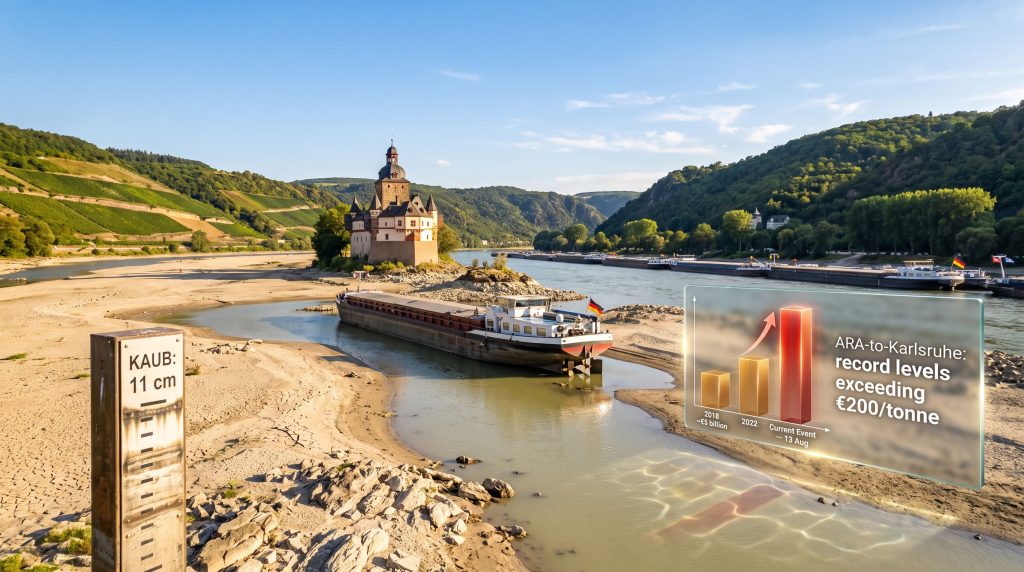
Water levels at Kaub are measured in centimetres, and commercial viability declines sharply as the gauge drops. Standard commercial barge operations begin to face meaningful restrictions below approximately 75 to 100 centimetres. On 13 August, the Kaub gauge recorded 11 centimetres, representing an extreme historic low. Germany's Federal Waterways and Shipping Administration subsequently forecast a further decline to 6 centimetres by the following weekend — a reading that would represent a new all-time low and render the passage effectively impassable for all practical commercial traffic. Barge operators confirmed that at this level, only a small number of highly specialised shallow-draft vessels could attempt passage under exceptionally difficult conditions.
According to Reuters, shipping disruption on the Rhine during previous low-water events continued to worsen as levels fell again, underscoring the persistent nature of these episodes.
The Physics of Shallow-Water Operations: Why Capacity Collapses Non-Linearly
The operational mechanics of shallow-water barge navigation are poorly understood outside the freight industry, yet they explain why low-water events cause such disproportionate disruption. A barge's draft — meaning the depth of hull below the waterline — must remain above the riverbed with an adequate safety margin. As water depth decreases, operators must reduce cargo load to bring the vessel higher in the water.
At the extreme low levels recorded during the current event, barges operating through the Kaub section were reported to be navigating at approximately 15 to 20 percent of maximum cargo capacity. This means that delivering a given volume of product requires five or more barge transits instead of one, multiplying:
- Vessel deployment costs
- Crew hours per tonne delivered
- Fuel consumption per tonne delivered
- Transit time for the entire cargo programme
- Port handling operations at both origin and destination
The capacity compression is non-linear because vessel fixed costs do not reduce proportionally with load. A barge carrying 15 percent of its normal cargo still requires a full crew, full fuel for the transit, and the same port slot. The per-tonne economics deteriorate catastrophically as a result.
Compounding this problem is the acute scarcity of specialised shallow-draft barges within the European inland fleet. These vessels, purpose-built for low-water navigation, exist in small numbers. When a severe low-water event strikes, demand for these specialised assets vastly exceeds supply, creating an additional scarcity premium on top of the underlying capacity shortage.
Navigability Status Across Rhine Sections
| Rhine Section | Key Locations | Navigability Status During Extreme Low Water |
|---|---|---|
| Lower Rhine (North) | Duisburg, Dortmund, Neuss | Restricted but partially operational |
| Middle Rhine | Cologne terminals, Kaub | Severely restricted; some terminals inaccessible |
| Upper Rhine | Karlsruhe, Mannheim, Kehl | Effectively isolated from ARA |
| High Rhine and Main | Frankfurt, Hanau, Basel | Near-impossible for standard commercial traffic |
Storage sites along the Main River, including Frankfurt, Hanau, and Aschaffenburg, were confirmed as effectively cut off from ARA supply. Upper Rhine depots at Karlsruhe, Mannheim, Kehl in Germany, and Basel in Switzerland reached the same isolated status. A secondary constraint at the Maxau gauge south of Karlsruhe further restricted southbound traffic toward Basel even when Kaub was marginally passable.
Of the Cologne terminal cluster, only Köln-Molenkopf retained theoretical conventional barge access. Köln-Niehl, Godorf, and Wesseling became too shallow for regular commercial operations. Duisburg, Dortmund, and Neuss on the Lower Rhine remained accessible from ARA, though at sharply diminished capacity loads, with vessels able to carry only approximately 15 percent of normal cargo volumes on that leg.
Critical Threshold Alert: The Duisburg gauge stood at 136 centimetres on 13 August, itself a historic low for that location. If the reading drops below 130 centimetres, inland shipping disruption extends into the Lower Rhine, converting a regional Upper Rhine problem into a systemic supply crisis affecting Germany's entire industrial heartland.
How Freight Rate Shocks Transmit Through Commodity Markets
The Rate Escalation Mechanism
Rhine freight rate dynamics during low-water events follow a predictable but severe escalation pattern. As navigable capacity contracts and the available pool of operable barges shrinks, shippers competing for limited transport capacity bid rates upward rapidly. The inelastic nature of demand for essential commodities — particularly fuels and chemical feedstocks — means that buyers absorb escalating freight costs rather than suspending procurement.
The Argus-assessed ARA-to-Karlsruhe freight rate reached €215 per tonne during the current event, a record high for that benchmark route. However, the market reality was even more complex than this figure suggests. Barge operators noted that quoted spot rates for ARA-Karlsruhe cargoes had become largely theoretical because volumes were too thin to allow genuine price discovery.
Urgent cargoes that did move to the Upper Rhine on specialised vessels commanded individually negotiated lump-sum rates that exceeded even the published benchmark. This breakdown in price discovery represents an advanced stage of market dysfunction. When a benchmark rate becomes theoretical, it signals that the market has transitioned from expensive-but-functional to effectively non-operational for the affected corridor. Consequently, commodity volatility and hedging strategies become critically important for operators exposed to these corridors.
Commodity Sectors Facing the Sharpest Exposure
Petroleum Products and Regional Fuel Supply
Fuel depots and petroleum storage terminals along the Upper Rhine and Main River depend on ARA barge deliveries for routine replenishment. When those deliveries are severed, operators must choose between drawing down existing stocks or activating road tanker delivery at substantially higher cost. Either path eventually feeds through into regional fuel pricing and availability. In extended low-water events, localised fuel supply stress can emerge at retail and commercial levels across southern Germany and Switzerland.
Petrochemicals and Industrial Chemical Feedstocks
Germany's chemical industry, the largest in Europe, is disproportionately concentrated along the Rhine corridor. Major production sites operate on supply chains calibrated around regular barge delivery of feedstocks from ARA. Companies running just-in-time inventory models face the sharpest immediate exposure when delivery continuity is broken. Producers with greater buffer stock capacity can absorb short disruptions, but extended events force more fundamental supply chain responses.
Coal and Power Generation Security
Coal-fired power stations and industrial heat facilities relying on Rhine barge delivery for fuel supply face drawdown pressure on operating stockpiles during low-water periods. Sourcing alternative supply at short notice involves accepting spot market premiums and navigating logistics constraints that exist precisely because the market is responding to the same disruption simultaneously. Moreover, the China steel and iron ore market indirectly influences global coal demand, adding another layer of complexity to European energy procurement during Rhine disruptions.
Agricultural Commodities and Fertiliser Logistics
Seasonal grain and fertiliser movements through the Rhine system are interrupted, disrupting farm input supply chains and harvest logistics at periods when timing is operationally critical.
The Hydroclimatic Engine Behind Low-Water Events
Why River Levels Fall and Why Recovery Takes Weeks, Not Days
Rhine water levels are governed by a combination of Alpine snowmelt timing, precipitation volumes across the Swiss and German catchment basin, and seasonal evapotranspiration rates from vegetation. Extended periods of below-average rainfall across the Rhine basin, particularly in the Swiss Alps and Black Forest headwater regions, are the primary driver of severe summer low-water events.
A mechanism that receives insufficient attention in public discussion is the role of soil moisture deficit in delaying river level recovery. When an extended dry period has parched soils across the catchment basin, localised rainfall events are absorbed by the ground rather than running off into watercourses. The soil must first reach saturation before meaningful runoff reaches the river.
This means that even moderate rainfall following a drought period provides little relief to gauge readings. Forecasts at the time of the August 2026 event indicated that while localised thunderstorms were possible, dry soil conditions across the basin meant these events were unlikely to produce meaningful gauge recovery. Only sustained, widespread rainfall across the entire catchment basin over multiple weeks could realistically reverse a low-water episode of this severity. Recovery timelines from severe low-water events typically extend across weeks to months — this is not a problem that resolves within a trading week.
The Intensifying Frequency of Severe Low-Water Events
Hydrological research increasingly frames Rhine low-water events not as rare anomalies but as recurring structural features of Central European climate risk. The 2018 Rhine low-water event caused an estimated €5 billion in economic damage across the German economy, establishing a reference benchmark for systemic disruption costs. The 2022 event, with Kaub reaching approximately 32 centimetres in August of that year, caused significant but shorter-duration disruption to energy and chemical supply chains.
As DW reported, ships were literally left high and dry as water ran short on the Rhine, vividly illustrating the physical reality that lies behind the freight rate data. The current event, with Kaub at 11 centimetres and forecast to reach 6 centimetres, represents a potential new extreme in the modern navigability record.
| Event Year | Minimum Kaub Level | Economic Impact Estimate | Key Affected Sectors |
|---|---|---|---|
| 2018 | ~25cm (October) | ~€5 billion (Germany GDP impact) | Chemicals, coal, petroleum |
| 2022 | ~32cm (August) | Significant, shorter duration | Energy, chemicals |
| 2026 | 11cm (13 Aug); forecast 6cm | TBD, potentially record severity | Petroleum, chemicals, coal, agriculture |
Analytical Note: A Kaub reading of 6 centimetres would likely surpass 2018 as the most severe navigability event in the modern record. The economic transmission effects would be felt most acutely in Germany's chemical and energy sectors, both of which are already navigating elevated input costs from broader geopolitical supply disruptions in 2026.
How Operators Respond When the River Stops Working
Immediate Tactical Adaptations
Industrial operators and logistics managers facing Rhine low water shipping disruption deploy a hierarchy of responses depending on the severity and expected duration of the event:
- Load reduction on barges still able to transit, accepting lower per-trip revenue in exchange for continued connectivity
- Modal shift to rail for time-sensitive or high-value cargoes, accepting per-tonne cost increases that can reach multiples of normal barge rates
- Road tanker activation for petroleum and chemical distribution to isolated depots, accepting both higher cost and road network congestion
- Inventory acceleration in the period preceding forecast low-water conditions, building buffer stocks at accessible storage points upstream of the Kaub constraint
Medium and Longer-Term Resilience Strategies
Beyond immediate crisis response, industrial operators have developed more structured approaches to managing Rhine exposure. In addition, the broader challenges of trade wars and supply chains in 2025 and beyond have accelerated corporate interest in supply chain diversification and resilience planning:
- Strategic stock build programmes initiated during spring and early summer as a forward hedge against summer low-water risk
- Alternative supply routing via pipeline where infrastructure exists, shifting product flows away from barge-dependent corridors
- Spot market procurement from geographically diversified sources when primary Rhine-linked supply chains are interrupted
- Contractual low-water provisions within freight agreements, allowing rate renegotiation or delivery obligation suspension during navigability events
At the policy and infrastructure level, proposals for Rhine deepening have circulated for decades but face significant regulatory and environmental obstacles, particularly within the protected Upper Middle Rhine Valley UNESCO World Heritage corridor. Investment in parallel intermodal infrastructure, including expanded rail capacity and pipeline networks running alongside the Rhine corridor, is receiving increasing attention within German industrial planning.
The next major ASX story will hit our subscribers first
Rhine Low Water as a Systemic European Industrial Risk
Germany's Structural Dependency and Its Competitive Implications
Germany's manufacturing and chemical sectors did not develop their Rhine dependency by accident. Barge logistics historically offered the lowest delivered cost for bulk commodity inputs, and industrial facilities were sited to exploit that advantage over generations. The embedded nature of this dependency means that supply chain transformation in response to climate-driven low-water risk is a multi-decade challenge, not a near-term adjustment.
Extended Rhine disruptions contribute to industrial production slowdowns, supply chain cost inflation, and in severe cases, temporary output curtailments at facilities unable to maintain input supply through alternative transport modes. These effects compound with other concurrent supply pressures, making the Rhine's vulnerability a material factor in assessments of European industrial competitiveness. Furthermore, green steel pricing trends in Europe are increasingly sensitive to logistics cost shocks of precisely this kind.
The Freight Rate as a Leading Economic Indicator
A perspective worth examining for supply chain analysts and commodity market participants is the informational role of Rhine freight surcharges. When ARA-to-Upper-Rhine benchmark rates reach record levels, they function as a real-time stress indicator for the entire Central European industrial supply chain, not merely a logistics cost. Elevated Rhine freight rates precede regional energy price increases, chemical feedstock cost inflation, and in prolonged events, consumer price effects across southern Germany and Switzerland.
Procurement managers, commodity traders, and risk analysts monitoring Rhine gauge data as a leading indicator of regional price pressure are applying a fundamentally sound framework. The gauge reading at Kaub today is a predictor of delivered commodity costs in the Upper Rhine region within days to weeks. The insurance and risk management sectors are responding to the increasing frequency of severe events by developing more sophisticated Rhine low water shipping disruption risk products, reflecting a market-level acknowledgment that this exposure is structural rather than exceptional.
Frequently Asked Questions: Rhine Low Water Shipping Disruption
What Water Level Makes the Rhine Unnavigable at Kaub?
Standard commercial barge operations face meaningful restrictions below approximately 75 to 100 centimetres at Kaub. Below 30 centimetres, conventional commercial operations are effectively impossible, with only specialised shallow-draft vessels able to attempt passage under extreme conditions. Levels below 10 centimetres represent a functional navigational closure for all practical bulk commodity transport purposes.
How Long Do Rhine Low-Water Events Typically Last?
Duration depends heavily on catchment-wide rainfall patterns and antecedent soil moisture conditions. Moderate events may resolve within two to four weeks. Severe events, such as the 2018 episode, persisted for two to three months, causing extended disruption across multiple industrial sectors.
Which Commodities Face the Greatest Exposure to Rhine Low Water?
Petroleum products, industrial chemicals, coal, and agricultural commodities carry the highest exposure. Upper Rhine and Main River facilities are most acutely affected, given their dependence on ARA barge supply and the limited feasibility of alternative transport for bulk volumes.
Why Do Freight Rates Spike So Dramatically During Low-Water Events?
Reduced per-vessel cargo capacity, acute scarcity of specialised shallow-draft assets, and inelastic shipper demand for essential commodities combine to create a severe supply-demand imbalance. Shippers competing for minimal available capacity bid rates sharply higher, while alternative transport modes set an elevated cost ceiling that further anchors rate expectations upward.
What Is the ARA Hub and Why Does It Matter for Rhine Shipping?
The Amsterdam-Rotterdam-Antwerp complex is Europe's largest port system and the primary gateway through which imported commodities enter the Rhine inland waterway distribution network. Virtually all Rhine barge freight originates from or transits through ARA before moving inland toward Germany, Switzerland, and beyond.
Can the Rhine Be Engineered to Prevent Low-Water Disruptions?
River deepening proposals have been debated for decades but face robust regulatory and environmental constraints, particularly within the Upper Middle Rhine Valley, which carries UNESCO World Heritage status. The natural geology of the riverbed and the ecological sensitivity of the Rhine ecosystem impose limits on engineering interventions that remain politically and technically unresolved.
For ongoing coverage of Rhine shipping conditions and European inland waterway freight rate developments, Argus Media publishes continuous market intelligence at argusmedia.com.
This article contains forward-looking assessments of freight market conditions, economic impacts, and hydrological forecasts. Such assessments are subject to material uncertainty and should not be relied upon as the basis for commercial or investment decisions without independent verification.
Want to Stay Ahead of Commodity Supply Shocks Driven by Events Like Rhine Disruptions?
When logistics crises compress margins and reshape commodity markets, identifying the right resource opportunities early can be decisive — Discovery Alert's proprietary Discovery IQ model scans ASX announcements in real time, delivering instant alerts on significant mineral discoveries across coal, petroleum feedstocks, and over 30 other commodities, so subscribers are positioned ahead of the broader market. Explore historic discoveries and their market returns, then begin a 14-day free trial to secure your market-leading advantage.