July 14, 2026
Argentina's Fiscal Engineering Experiment and What It Means for Lithium Capital
Long-duration mining investments have always been hostage to a fundamental contradiction: the economics demand decade-spanning stability, while sovereign governments are inherently transient. This tension is nowhere more acute than in Argentina, a country with a documented history of policy reversals, capital controls, and currency crises. Understanding how Argentina is attempting to resolve that contradiction through legislative architecture is the essential starting point for evaluating the RIGI Zijin lithium expansion in Argentina and what it signals for the broader Lithium Triangle investment thesis.
When big ASX news breaks, our subscribers know first
What RIGI Actually Does and Why Its Design Is Structurally Different
The Régimen de Incentivo a las Grandes Inversiones, commonly abbreviated as RIGI, was enacted as part of President Javier Milei's omnibus economic reform legislation in 2024. It is not a tax holiday in the conventional sense. Instead, it operates as a 30-year statutory stability guarantee, meaning that once a project achieves formal adherence under the regime, the fiscal, customs, and foreign exchange conditions applicable at the time of registration are legally frozen for the duration of that period, regardless of future legislative changes.
To qualify, a project must commit a minimum investment threshold that places it firmly in the large-scale infrastructure and resource development category. Qualifying sectors include mining, energy, forestry, and technology infrastructure. What distinguishes RIGI from Argentina's previous project-by-project negotiation approach is that the protections are legislatively anchored rather than politically brokered, meaning they theoretically survive changes in administration.
The regime's most commercially significant provisions include:
- Customs duty exemptions on imported capital equipment, directly reducing upfront construction costs for projects requiring specialised mining and processing machinery
- Income tax and royalty stability across the full 30-year horizon, protecting internal rate of return models from fiscal drift
- Structured foreign exchange liberalisation allowing qualifying projects to repatriate a defined portion of export revenues, addressing Argentina's most historically problematic deterrent to foreign direct investment
- Accelerated depreciation provisions that improve early-stage cash flow profiles for capital-intensive operations
| Policy Dimension | Pre-RIGI Environment | Post-RIGI Framework |
|---|---|---|
| Fiscal Stability | Project-by-project negotiation | 30-year statutory guarantee |
| FX Repatriation | Restricted; capital controls applied | Structured liberalisation for qualifying projects |
| Customs Duties | Standard import tariffs on equipment | Exemptions for approved large investment projects |
| Regulatory Certainty | Politically variable | Legislatively anchored |
| Depreciation Treatment | Standard schedule | Accelerated provisions available |
For Chinese state-linked mining enterprises operating under dual-currency balance sheet pressures and offshore debt obligations, the foreign exchange provisions may represent the single most commercially decisive element of the entire regime. Tax stability matters, but the ability to reliably extract and repatriate returns in hard currency is what makes billion-dollar project financing actually viable in the Argentine context.
Argentina's Position in the Lithium Triangle: Gaining Ground Through Regulatory Divergence
The Lithium Triangle, encompassing Argentina, Chile, and Bolivia, holds the majority of the world's economically recoverable lithium brine resources. However, resource endowment alone has never determined investment outcomes in this region. Regulatory architecture, processing infrastructure, and sovereign risk profiles have been equally determinative of where capital actually flows.
Chile, while possessing some of the highest-grade lithium salars in the world, has historically constrained new entrants through state-controlled concession structures and policy debates around nationalisation. Bolivia has held enormous resource potential largely untapped for decades due to a combination of state monopoly preferences and underdeveloped processing infrastructure.
Argentina has pursued a markedly different path. Its federal structure allows individual provinces to negotiate directly with mining companies, and the country's historically more open private-sector framework has resulted in a faster ramp in commercially active operations. As of 2025, Argentina hosts seven commercially producing lithium operations, a figure that positions it as the most dynamically expanding lithium producer in the triangle. Furthermore, the Argentina lithium brine market continues to attract significant international capital as a result of this regulatory openness.
Catamarca province, located in the northwestern Andean highlands, has emerged as the operational centrepiece of this expansion. The province sits atop multiple high-quality brine salars and has developed the provincial regulatory and infrastructure capacity to support large-scale extraction, making it a natural concentration point for new capital.
The Tres Quebradas Salar: Geological Profile and Asset Quality
The Tres Quebradas salar, known operationally as 3Q, sits in the Fiambalá basin of Catamarca at an elevation of approximately 4,300 metres above sea level. High-altitude brine operations present specific operational challenges, including reduced equipment performance due to lower atmospheric oxygen levels and more extreme weather variability. However, they also frequently correlate with highly concentrated lithium brines that reduce processing costs per tonne of lithium carbonate equivalent produced.
The asset carries confirmed lithium carbonate equivalent reserves of 8.3 million tonnes, with a projected mine life extending through 2043. This duration is critical context for evaluating the RIGI protection window. A 30-year fiscal stability guarantee maps almost precisely onto the productive life of the resource, meaning the regulatory shield is sized to cover the entire economically meaningful period of the investment rather than just its capital-intensive early years.
Key Insight: The alignment between 3Q's projected mine life and RIGI's 30-year protection horizon is not coincidental. Long-duration assets require long-duration regulatory certainty, and RIGI's design appears calibrated to match the investment lifecycle of exactly this type of project.
How Zijin Structured Its Capital Deployment Across Phases
Zijin Mining, the Chinese multinational with a diversified global portfolio spanning copper, gold, and battery metals, acquired its controlling interest in the Tres Quebradas project and has structured its development in distinct phases, each with separate capital commitments and RIGI implications. The Zijin global expansion strategy positions Argentina as a cornerstone jurisdiction within its broader battery metals ambitions.
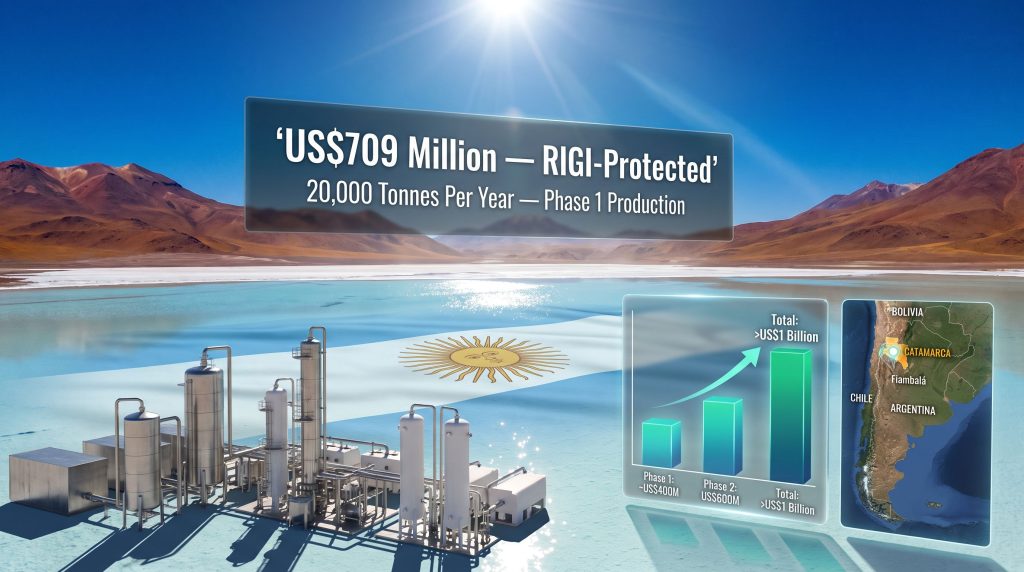
Phase 1 reached commercial production on September 12, 2025, making it one of Argentina's newest operational lithium assets. The phase delivers a nameplate capacity of 20,000 tonnes per year of lithium carbonate, supported by approximately US$400 million in construction capital. The workforce supporting Phase 1 operations comprises 565 direct employees, of whom roughly 80% were recruited from within Catamarca province, a localisation rate that carries both social licence and RIGI compliance significance.
Phase 2 represents the transformational scaling event. With a capital commitment of US$600 million and a targeted capacity addition of 40,000 tonnes per year, Phase 2 would bring the combined operational output to between 60,000 and 80,000 tonnes per year of lithium carbonate equivalent. The combined Phase 1 and Phase 2 investment surpasses US$1 billion, making 3Q one of the largest single mining investment programs in Argentine history.
The US$709 million RIGI-protected tranche represents the Phase 2 expansion capital registered under the formal RIGI adherence filing. This figure specifically identifies the investment tranche that benefits from the regime's full suite of fiscal, customs, and foreign exchange protections. Tres Quebradas is notable as only the second Catamarca project to formally adhere to the RIGI framework, giving it a degree of first-mover credibility within the provincial regulatory ecosystem. Notably, Lithium Argentina received RIGI approval for its Cauchari-Olaroz Stage 2 expansion under the same legislative framework, further validating the regime's operational viability.
Phase 3 and the Direct Lithium Extraction Horizon
Beyond the confirmed two-phase structure, a conceptual Phase 3 has been outlined that would add approximately 50,000 tonnes per year of additional capacity using direct lithium extraction technology. DLE represents the most significant technological evolution in lithium brine processing and warrants careful explanation given how frequently it is misunderstood in mainstream coverage.
Conventional solar evaporation pond processing, the dominant method used across most of the Lithium Triangle for decades, works by pumping lithium-bearing brine into large shallow ponds and allowing solar energy to evaporate water content over a period of 12 to 18 months, concentrating the lithium before chemical processing. This approach is low in capital intensity but extremely high in water consumption, slow in response to market demand, and produces relatively lower recovery rates of the available lithium.
| Extraction Method | Phase Application | Recovery Rate | Water Intensity | Capital Intensity | Processing Timeline |
|---|---|---|---|---|---|
| Solar Evaporation | Legacy baseline | 40-60% | Very High | Low | 12-18 months |
| Adsorption-Based | Phase 1 and 2 | 70-85% | Moderate | Medium | Weeks |
| Direct Lithium Extraction | Phase 3 (proposed) | 85-95% | Low | High | Hours to days |
Phases 1 and 2 at 3Q deploy adsorption-based brine extraction, a meaningful technological step forward. This method uses ion-selective adsorbent materials that preferentially bind lithium ions from the brine stream, allowing faster processing cycles measured in days or weeks rather than months. Furthermore, lithium brine extraction methods using adsorption technology deliver meaningfully lower water consumption than evaporation ponds, which is a significant advantage at high-altitude environments where water scarcity remains a real ecological and regulatory constraint.
DLE as proposed for Phase 3 takes these efficiency gains further still, using advanced membrane or ion-exchange mechanisms capable of achieving recovery rates approaching 85 to 95% of available lithium from the brine stream, with dramatically reduced water usage. The capital intensity is substantially higher, with Phase 3 estimates suggesting a capital requirement that could roughly double the combined Phase 1 and Phase 2 investment, though exact figures remain subject to feasibility outcomes and prevailing lithium price conditions at the time of commitment.
Zijin's Global Lithium Ambition and 3Q's Portfolio Role
Zijin has publicly articulated a corporate target of reaching 250,000 to 300,000 tonnes of lithium carbonate equivalent per year across all its controlled assets by 2028. At full Phase 2 capacity, 3Q's contribution of up to 80,000 tonnes per year would represent a substantial and strategically meaningful share of that total. Consequently, the RIGI Zijin lithium expansion in Argentina cements the country as a cornerstone jurisdiction within Zijin's global battery metals strategy.
This context matters for understanding the RIGI adherence decision not merely as a tax optimisation exercise but as a strategic balance sheet choice. By anchoring the Phase 2 investment under a 30-year statutory protection regime, Zijin is structuring the long-duration financing that Phase 2 requires against a legally defined risk floor. This makes the project bankable to offshore lenders and internal capital allocation committees in ways that would be significantly more difficult without the RIGI shield.
Risk Factors That RIGI Cannot Fully Neutralise
Analytical honesty requires acknowledging that RIGI, however well-designed, does not eliminate all investment risk in Argentina. Several residual risk categories warrant careful monitoring.
Sovereign continuity risk is the most frequently cited concern. RIGI's 30-year stability guarantee is only as durable as the political and constitutional environment in which it was enacted. While the regime has legislative status, Argentina's history includes instances where statutory commitments were effectively renegotiated under economic duress. A future administration hostile to the Milei-era reform framework could seek to challenge RIGI provisions through regulatory reinterpretation even without formal legislative reversal.
Commodity price cyclicality represents a separate and arguably more immediate risk dimension. Lithium carbonate prices reached extraordinary peaks near US$80,000 per tonne in late 2022 before collapsing through 2023 and into 2024, with spot prices falling below US$10,000 per tonne at points during the correction. The economics of a US$1 billion-plus capital program are genuinely sensitive to where prices stabilise across the project's multi-decade life. In the context of the broader global lithium market, current price levels in the US$12,000 to US$15,000 per tonne range mean high-quality low-cost brine operations like 3Q remain economic, but the margin for error is considerably narrower than it appeared at peak pricing.
Environmental and social licence risk at high-altitude brine operations deserves particular attention. Andean brine systems share aquifer connectivity with surface water sources used by downstream agricultural and indigenous communities. Argentine law requires free, prior, and informed consent processes with affected indigenous communities, and international project finance lenders typically apply additional ESG screening criteria. The shift to adsorption-based technology at 3Q partially addresses this concern through reduced water consumption, but ongoing community engagement remains a genuine operational variable rather than a resolved compliance checkbox.
Investor Consideration: The combination of a depressed lithium price environment and high capital intensity for Phase 3 DLE implementation means that the Phase 3 commitment decision will be highly sensitive to price recovery trajectory. Investors tracking the RIGI Zijin lithium expansion in Argentina should monitor lithium carbonate spot and contract prices as a leading indicator of Phase 3 timing.
The next major ASX story will hit our subscribers first
What 3Q's RIGI Adherence Communicates to the Broader Market
The significance of Tres Quebradas' formal RIGI adherence extends considerably beyond the project's own economics. It functions as a live demonstration of the regime's credibility, testing whether the legislative protections actually translate into accelerated capital deployment in practice. Zijin's willingness to commit US$709 million under the framework, and to commence Phase 1 production on that basis, provides the most meaningful real-world validation that RIGI can attract large-scale, sophisticated foreign capital.
For other mining groups evaluating Argentine lithium opportunities, the 3Q case study provides a concrete reference point for how RIGI adherence is structured, what the documentation process involves, and what fiscal outcomes the regime actually delivers. This demonstration effect is likely to be consequential for the pipeline of projects currently in feasibility or development stages across Catamarca, Jujuy, and Salta provinces. Indeed, Argentina's lithium output is projected to grow 150% by 2030 on the back of the RIGI scheme, underscoring the regime's transformative potential for the sector.
Argentina has articulated an ambition to become the world's second-largest lithium producer. Achieving that outcome requires not just resource endowment but the policy architecture to convert resources into production at pace. RIGI represents the most serious attempt in Argentine history to build that architecture on a durable legislative foundation, and the RIGI Zijin lithium expansion in Argentina at Tres Quebradas is its most visible current proof point.
Key Takeaways for Investors and Industry Observers
- RIGI provides 30-year statutory protection covering fiscal conditions, customs duties, and foreign exchange repatriation rights for qualifying large-scale investments
- Zijin's US$709 million RIGI-protected Phase 2 expansion at Tres Quebradas is among the largest single mining investment tranches in Argentine history
- Phase 1 commenced production on September 12, 2025 at 20,000 tonnes per year LCE capacity, with US$400 million in construction capital deployed
- Combined Phase 1 and Phase 2 output targets of 60,000 to 80,000 tonnes per year LCE would make 3Q a globally significant lithium operation
- The shift from solar evaporation to adsorption-based extraction in Phases 1 and 2 represents a meaningful water efficiency and recovery rate improvement over legacy processing methods
- A conceptual Phase 3 using DLE technology could add a further 50,000 tonnes per year, contingent on price recovery and feasibility outcomes
- 8.3 million tonnes of confirmed LCE reserves and a mine life through 2043 provide the long-duration asset base that justifies RIGI's 30-year protection window
- Residual risks including political succession, commodity price cyclicality, and environmental social licence require ongoing monitoring despite the RIGI framework's protections
This article contains forward-looking statements and analysis relating to investment projections, production targets, lithium price scenarios, and regulatory frameworks. These involve inherent uncertainties and should not be construed as financial advice. Readers should conduct independent due diligence and consult qualified advisers before making investment decisions. Phase 3 technology and capital estimates are conceptual and subject to feasibility confirmation.
Want to Identify the Next Major Mineral Discovery Before the Broader Market Does?
Discovery Alert's proprietary Discovery IQ model delivers real-time alerts on significant ASX mineral discoveries — turning complex resource data into actionable investment insights for both short-term traders and long-term investors. Explore historic discoveries and the substantial returns they generated, then begin your 14-day free trial at Discovery Alert to position yourself ahead of the market.