July 15, 2026
The Infrastructure Bottleneck That Has Defined Canada's Most Storied Mineral District
For decades, the economics of northern resource development have been shaped less by what lies beneath the ground and more by what sits above it: infrastructure, or the absence of it. In remote boreal regions, the difference between a world-class mineral deposit and a stranded asset often comes down to a single variable: whether a truck can reach the site in July. This fundamental constraint has defined the Ring of Fire story in Ontario longer than most analysts care to admit, and it explains why Ring of Fire road construction in Ontario carries weight that extends far beyond any single groundbreaking ceremony.
Understanding what is actually changing, why it matters now, and what remains unresolved requires looking at this project through several lenses simultaneously: geological, economic, geopolitical, and social.
When big ASX news breaks, our subscribers know first
Why Decades of Planning Have Only Just Produced a Shovel in the Ground
The Seasonal Road Problem and Its Cascading Economic Effects
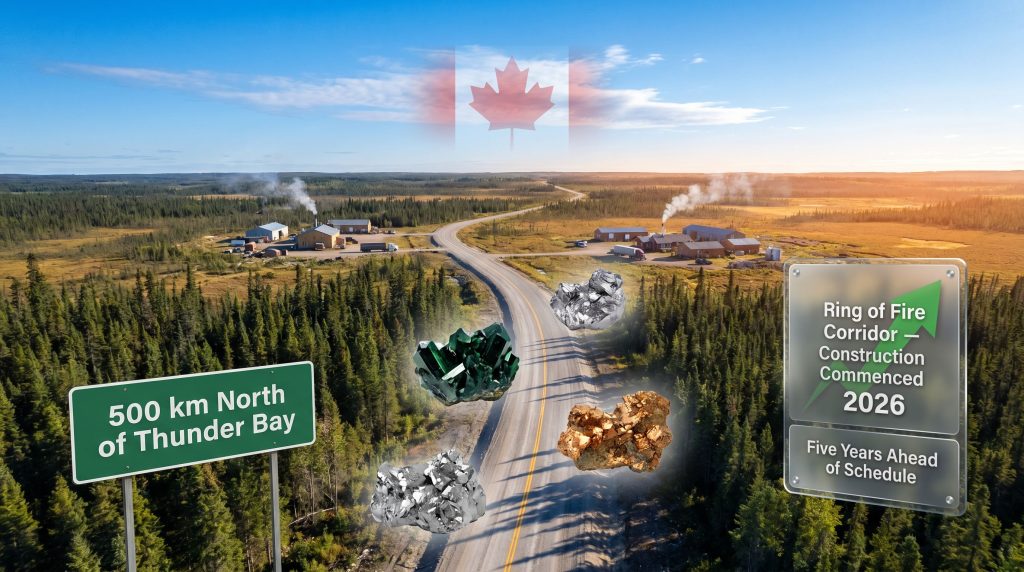
Roughly 500 kilometres north of Thunder Bay, nestled within the James Bay Lowlands of Ontario's Far North, the Ring of Fire mineral district has long presented a paradox. The region contains some of the most geologically compelling mineral endowments on the continent, yet for generations it has remained effectively inaccessible for large-scale, continuous resource development.
The reason is structural. Communities and explorers in this region have depended on seasonal winter roads built across frozen muskeg and lake ice. These routes typically operate for only a narrow window during the coldest months, making sustained industrial logistics virtually impossible. The cascading effects on project economics are severe:
- Year-round mining operations cannot be sustained without permanent road access
- Equipment mobilisation and demobilisation costs consume a disproportionate share of project capital
- Workforce management on fly-in/fly-out schedules inflates operating costs per tonne of ore processed
- Supply chain unpredictability introduces risk premiums that erode investor confidence and elevate discount rates in project valuations
For junior and mid-tier mining companies evaluating Ring of Fire assets, these logistics costs have historically functioned as an invisible tax, one large enough to render otherwise viable projects economically marginal.
What the Geology Actually Contains
The strategic significance of this region is not abstract. The Ring of Fire hosts one of North America's most substantial concentrations of chromite, with deposit scales that place Ontario in rare global company. Outside of southern Africa, particularly Zimbabwe and South Africa's Bushveld Complex, significant chromite concentrations of this magnitude are uncommon in politically stable jurisdictions.
Beyond chromite, the district contains:
- Nickel and copper sulphide mineralisation, relevant to battery cathode chemistry and industrial applications
- Platinum group elements (PGEs), which carry both industrial and investment-grade significance
- Vanadium and other battery-critical minerals that are increasingly tied to grid-scale energy storage development
The chromite story deserves particular attention from an industry-specific lens. Chromite is the sole commercial source of chromium, which is essential for stainless steel production, high-temperature alloys used in jet engines and gas turbines, and emerging applications in hydrogen fuel cell technology. Canada currently imports the vast majority of its chromium requirements, and the rising critical minerals demand from the energy transition makes the Ring of Fire's potential all the more significant.
Geological Note: The chromite deposits in the Ring of Fire are hosted within a mafic-ultramafic intrusive complex, geologically analogous to layered intrusions found in major global PGE and chromite provinces. This geological setting is characteristic of high-tonnage, potentially bulk-minable mineralisation styles.
Breaking Down What Ring of Fire Road Construction in Ontario Actually Involves
The Geraldton Groundbreaking: First Milestone in a Multi-Stage Buildout
Construction activity commenced in Geraldton, Ontario, within the Municipality of Greenstone, with the Geraldton Main Street Rehabilitation Project representing the first completed on-the-ground work in what Ontario has described as a corridor to prosperity. While this initial phase may appear modest relative to the full vision, its symbolic and practical significance should not be underestimated.
Infrastructure projects of this complexity rarely fail in their engineering phase. They fail in their initiation phase, when political will dissipates, funding negotiations stall, or stakeholder alignment collapses. The fact that physical construction has commenced represents the crossing of a threshold that many industry observers had come to view with scepticism after years of announcements without action.
The Accelerated Timeline: What Five Years Earlier Actually Means
Ontario has publicly committed to delivering road access five years ahead of previously projected timelines. This compression of schedule reflects genuine political urgency but also introduces execution risk that deserves careful scrutiny. Delivering complex northern infrastructure ahead of schedule in environments characterised by:
- Permafrost-adjacent and muskeg terrain requiring specialised geotechnical engineering
- River crossings and wetland corridors with strict environmental management requirements
- Extreme seasonal weather windows that constrain productive construction months
- Remote contractor logistics where mobilisation costs and supply chain lead times are substantial
…is genuinely difficult. The five-year acceleration target will require sustained execution discipline, adequate contractor capacity in the northern Ontario market, and stable access to construction materials across multiple seasons.
Infrastructure Components and Their Strategic Functions
| Infrastructure Element | Primary Function | Secondary Benefit |
|---|---|---|
| All-season road corridor | Year-round mining and community logistics | Reduces emergency response times for remote communities |
| Broadband connectivity | Digital access for First Nations communities | Enables remote workforce participation and telehealth |
| Utility infrastructure upgrades | Energy and services delivery | Supports economic development beyond resource extraction |
| Supply chain integration nodes | Reduces per-tonne logistics costs | Catalyses regional small business development |
The Indigenous Partnership Dimension: Beyond Consultation
Marten Falls and Webequie First Nations as Infrastructure Partners
Two First Nations communities sit at the geographic and relational centre of this project: Marten Falls First Nation and Webequie First Nation. For both communities, permanent all-season road access would represent a transformation in daily lived reality, not merely an economic opportunity.
Currently, residents depend on seasonal ice roads and expensive air access for everything from medical supplies to construction materials. The implications of permanent road connectivity extend across virtually every dimension of community life:
- Healthcare access improves when emergency transport is no longer weather-dependent
- Education infrastructure can be upgraded when construction materials are deliverable year-round
- Economic participation broadens when communities are connected to regional supply chains
- Food security improves when reliable supply chains reduce the cost and scarcity of goods
Critically, Ontario has structured formal agreements with both communities as a precondition for advancing construction. Both First Nations have been positioned as active participants in the infrastructure buildout itself, not passive recipients of provincial decision-making.
Structural Insight: The shift from consultation-as-compliance to communities-as-construction-partners represents a meaningful evolution in how northern infrastructure deals are structured in Canada. Whether this model scales and proves durable will be closely watched by Indigenous groups and resource developers across the country.
This dynamic also intersects with a broader legal environment that is actively evolving. The Supreme Court of Canada is set to hear British Columbia's appeal of a lower court ruling involving that province's Declaration on the Rights of Indigenous Peoples Act and Indigenous mineral rights, in a case brought by the Gitxaała and Ehattesaht First Nations challenging B.C.'s mineral claims framework. The outcome of that case is expected to have significant implications for mining project approvals and Indigenous consultation frameworks nationwide, adding further complexity to how northern resource development agreements are structured.
What Remains Unresolved: The Outstanding Variables
Federal Participation: The Largest Outstanding Question
Provincial construction momentum is real, but the full scope of the Ring of Fire road network requires federal funding commitments and regulatory approvals that remain outstanding as of mid-2026. The project sits at the intersection of provincial resource jurisdiction and federal responsibilities for Indigenous affairs, environmental assessment, and northern infrastructure investment.
Without confirmed federal participation, the complete buildout remains contingent. This represents the single largest variable in project delivery timelines and should be understood as a material risk factor by any stakeholder modelling outcomes on the basis of the current provincial groundbreaking alone.
Environmental Complexity in Ontario's Far North
The James Bay Lowlands constitute one of the largest intact boreal wetland ecosystems remaining in North America. Road construction through this environment involves navigating:
- The Far North Act and associated land-use planning requirements
- Federal environmental assessment obligations for projects crossing jurisdictional boundaries
- Ecological sensitivity of peatland and muskeg terrain that stores significant carbon stocks
- Cumulative effects considerations given the scale of potential future mining development
The tension between Ontario's accelerated timeline commitment and the thoroughness required by environmental review processes is not easily resolved. These are not competing priorities that can simply be managed away through project governance. They reflect genuine complexity that will shape both the pace and design of what gets built.
How This Compares to Other Canadian Northern Infrastructure Initiatives
| Project | Region | Primary Minerals | Current Status |
|---|---|---|---|
| Ring of Fire Corridor | Northern Ontario | Chromite, nickel, battery minerals | Construction commenced 2026 |
| Grays Bay Road and Port | Nunavut | Copper, cobalt | Feasibility and planning stage |
| Yukon Resource Corridors | Yukon Territory | Gold, copper, critical minerals | Partial existing network |
| Quebec Plan Nord | Northern Quebec | Iron, lithium, rare earths | Ongoing multi-decade buildout |
Canada's northern infrastructure deficit is systemic. The Ring of Fire project has historically been cited as a cautionary example of how jurisdictional overlap, financing complexity, and consultation failures can stall even the highest-priority resource opportunities. Furthermore, as a strategic mining jurisdiction, northern Ontario's trajectory will be closely watched by resource developers evaluating comparable remote projects across the country. The commencement of physical construction in 2026 begins to rewrite that narrative, though the project's ultimate delivery will determine whether this becomes a model or a warning for future initiatives.
The next major ASX story will hit our subscribers first
What Road Access Does to Project Economics
The Discount Rate Argument
For resource company analysts and investors, the commencement of Ring of Fire road construction in Ontario matters for a specific financial reason: it begins to compress the infrastructure risk premium embedded in project discount rates. When a mineral project lacks permanent access, financial models must account for the possibility that access may never arrive, or may arrive on a timeline that fundamentally alters project economics.
All-season road access does not merely reduce operating costs. It restructures the entire risk profile of projects in the region:
- Capital expenditure estimates become more reliable when logistics assumptions are grounded in permanent infrastructure
- Operating cost models improve when fly-in/fly-out premiums and seasonal supply constraints are removed
- Project financing conversations change when infrastructure risk is partially transferred from the project balance sheet to public infrastructure
- Timeline confidence increases, which directly affects net present value calculations across the project lifecycle
Completing a definitive feasibility study for any Ring of Fire asset becomes a substantially more credible exercise once permanent road access can be assumed as a baseline condition rather than treated as a probabilistic variable.
The Regional Multiplier Effect
Infrastructure economists have long documented that permanent road access in remote regions generates economic activity well beyond its primary stated purpose. For northern Ontario, this translates to:
- Regional supply chain development serving multiple resource projects simultaneously
- Small and medium enterprise growth in Greenstone and surrounding communities
- Increased property and business tax bases for northern municipalities
- Reduced per-capita cost of delivering government services to remote First Nations
The long-term GDP multiplier effects of permanent northern road corridors typically exceed the initial capital outlay in present value terms over a 30 to 50-year horizon, though the timeline to realising those returns demands patient capital and sustained political commitment.
Frequently Asked Questions: Ring of Fire Road Construction in Ontario
What minerals does the Ring of Fire region contain?
The Ring of Fire hosts one of North America's largest known chromite concentrations, alongside nickel, copper, zinc, vanadium, platinum group elements, and a range of minerals directly relevant to battery technology and electric vehicle manufacturing supply chains.
Where exactly is the Ring of Fire located?
The district sits within the James Bay Lowlands of northern Ontario, approximately 500 kilometres north of Thunder Bay, in ecologically sensitive boreal terrain that includes extensive peatlands and muskeg.
When did road construction officially begin?
Physical construction commenced in Geraldton, Ontario in 2026, with the Geraldton Main Street Rehabilitation Project in the Municipality of Greenstone representing the first completed segment of the broader access corridor buildout. Construction on the supply road is expected to advance significantly in the coming seasons as contractor capacity scales up.
Which First Nations communities will be connected by this road network?
The network is specifically designed to provide permanent all-season road connections to Marten Falls First Nation and Webequie First Nation, both of which currently rely on seasonal ice roads and air access for essential goods and services.
Has federal funding been confirmed for the full road network?
As of mid-2026, provincial construction has commenced, but federal funding and approvals for the full road network scope remain under active negotiation, representing a significant outstanding variable in complete project delivery.
What is the projected timeline for completing the Ring of Fire road?
Ontario has committed to delivering road access five years ahead of previously projected schedules, though the full timeline remains dependent on federal approvals, environmental assessment outcomes, and multi-season construction execution.
The Signal Behind the Groundbreaking
What the Geraldton groundbreaking ultimately represents is a transition from policy aspiration to executable reality. For a project that has spent more than a decade cycling through announcements, studies, negotiations, and delays, the presence of active construction carries a qualitative significance that transcends any single kilometre of road built.
Canada's credibility as a reliable critical minerals supplier to allied nations, particularly the United States, European Union member states, Japan, and South Korea, is increasingly tied to its ability to demonstrate that it can actually deliver the infrastructure required to move minerals from deposit to market. Bilateral supply chain partnerships and critical minerals agreements are negotiated on the basis of realistic timelines, not geological potential alone.
Ring of Fire road construction in Ontario does not resolve all of the outstanding complexity. Federal approvals remain pending. Environmental processes continue. The full corridor is years from completion. However, the shift from planning to building represents a measurable change in the project's probability-weighted trajectory, and that change has real implications for every stakeholder in the region's future: communities, investors, resource companies, and allied governments watching Canada's northern development capacity from abroad.
Readers seeking ongoing coverage of Canadian mining infrastructure, Ring of Fire developments, and critical minerals policy can explore in-depth reporting through CIM Magazine, published by the Canadian Institute of Mining, Metallurgy and Petroleum.
Want to Capitalise on the Next Major Mineral Discovery Before the Market Catches On?
Discovery Alert's proprietary Discovery IQ model delivers real-time alerts on significant ASX mineral discoveries, transforming complex geological and commodity data into actionable investment insights for both short-term traders and long-term investors. Explore Discovery Alert's dedicated discoveries page to see how historic mineral discoveries have generated substantial returns, and begin your 14-day free trial today to position yourself ahead of the market.