
June 23, 2026
The Structural Forces Reshaping North American Aluminum Supply
The global aluminum industry has always been a study in geographic concentration. Smelting capacity clusters where electricity is cheap, logistics are dependable, and political risk is manageable. For decades, that calculus produced a stable, predictable trade map. However, when two simultaneous supply shocks collide with protectionist trade policy, even the most entrenched trade corridors can fracture overnight, and then, under the right price conditions, snap back just as quickly.
That is precisely what is unfolding in North American aluminum markets in 2026. Rio Tinto aluminum exports to US rebound to pre-tariff levels, and the mechanics behind that recovery reveal far more about the structural realities of the market than any single policy announcement ever could.
When big ASX news breaks, our subscribers know first
Why the US Aluminum Market Faces an Unusual Combination of Pressures
Two Supply Shocks, One Tight Market
Understanding the current aluminum environment requires separating two distinct but reinforcing disruptions that arrived in close succession.
The first was policy-driven. The Trump administration raised the import tariff on aluminum to 50%, effective June 4, 2025, a dramatic escalation from the previous 25% rate. The stated objective was to incentivise domestic US production by making foreign-sourced metal less price-competitive. The immediate effect, however, was to redirect Canadian supply away from US buyers and toward European buyers who faced no such levy. Understanding the full scope of US aluminium tariffs helps contextualise why that redirection unfolded so rapidly.
The second shock was geopolitical. The Iran conflict created severe disruption to shipping through the Strait of Hormuz, effectively taking offline an estimated 2.5 million tonnes of Gulf-region smelting capacity. Producers across Gulf Cooperation Council states idled smelters as both infrastructure damage and the inability to move raw materials and finished product through the strait made operations commercially and logistically impossible.
These two pressures combined to create a supply environment in North America that no single tariff schedule could have anticipated. The result has been a sharp tightening of regional aluminum availability at exactly the moment when downstream demand, driven by data centre construction, electric vehicle manufacturing, and aerospace procurement, was accelerating.
The US Midwest Premium as a Diagnostic Tool
Commodity traders and industrial procurement specialists pay close attention to the US Midwest premium, a regional surcharge applied on top of the global London Metal Exchange benchmark price to reflect the actual delivered cost of physical aluminum in the US Midwest. When the premium rises, it signals that regional supply is insufficient to meet demand at prevailing global prices.
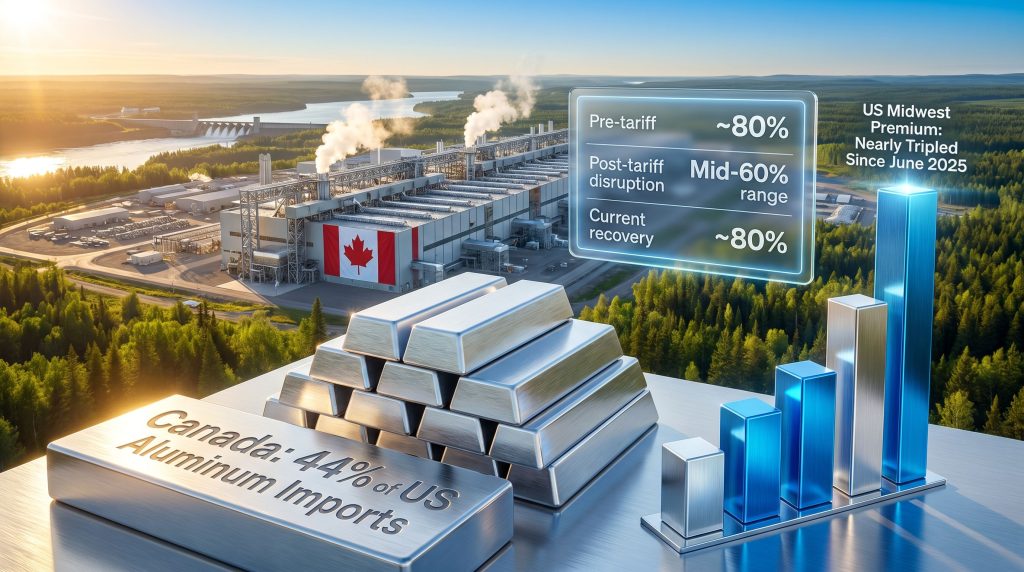
Since early June 2025, the US Midwest premium has nearly tripled. That kind of movement is historically unusual and typically reflects a combination of demand growth, supply contraction, or logistical bottleneck. In this case, all three are present simultaneously.
A near-tripling of the US Midwest premium over a twelve-month period is not a market aberration. It is a market verdict: North American aluminum supply is critically undersupplied relative to industrial demand, and the gap cannot be closed quickly regardless of tariff policy.
For industrial buyers in automotive, packaging, aerospace, and construction, the premium surge has increased effective input costs materially, yet demand has remained resilient. This demand inelasticity is a key feature of the current market: aluminum is not easily substituted in critical manufacturing processes, regardless of its cost trajectory. Furthermore, the broader aluminum and steel tariff impact across North American supply chains has compounded these pressures considerably.
How Rio Tinto's Export Volumes Recovered to Pre-Tariff Levels
The Three-Phase Trade Flow Disruption and Recovery
Rio Tinto's North American shipment trajectory from its Quebec operations provides a textbook illustration of how price signals can override tariff barriers when the premium differential is large enough. According to reporting from Bloomberg, this recovery has unfolded in three distinct phases.
| Phase | North American Shipment Share | Primary Driver |
|---|---|---|
| Pre-tariff baseline (pre-June 2025) | ~80% | Standard trade economics |
| Post-tariff disruption trough | Mid-60% range | 50% US import tariff redirected volumes to Europe |
| Current recovery (May 2026) | ~80% | Midwest premium surge absorbs tariff burden |
When the 50% tariff took effect, Rio Tinto's aluminum division redirected a meaningful portion of its Canadian production to European buyers, where no punitive levy applied. North American shipments fell to the mid-60% range as a result.
The reversal has been driven entirely by market economics. The Midwest premium surge has effectively neutralised much of the financial burden imposed by the 50% tariff for Canadian producers. US buyers, facing constrained domestic supply and elevated spot prices, have become willing to absorb the tariff-inclusive cost of Canadian aluminum because it remains more accessible, more competitively priced on a delivered basis, and more reliably logistically available than alternatives sourced from further afield.
Jérôme Pécresse, the head of Rio Tinto's aluminum business, confirmed that North American flows had progressively returned to the pre-tariff situation, with the United States representing the vast majority of Canadian sales once again.
Why Canadian Producers Hold Structural Pricing Power
The reason Rio Tinto's Quebec operations can absorb a 50% US import tariff and still export competitively into the United States comes down to one fundamental advantage: hydroelectric power.
Quebec's electricity grid is predominantly powered by hydro generation, producing electricity at a cost that is substantially below the industrial power rates prevailing in most US states. This cost differential provides Quebec-based smelters with a structural production cost advantage that neither tariff policy nor short-term commodity price swings can easily erase.
Rio Tinto's head of aluminum operations has noted that the reason production is based in Quebec rather than the United States is the competitiveness of hydropower costs, with data centres currently able to pay two to three times the electricity price threshold that would make a competitive US-based aluminum smelter viable.
This is a critical insight that often goes underappreciated in policy discussions. Tariffs can change the relative economics of trade flows at the margin, but they cannot change the underlying cost of kilowatt-hours. When the power cost gap between Quebec and the US industrial grid is wide enough, Canadian producers retain pricing power even after absorbing a significant import levy.
Canada's Structural Position in US Aluminum Supply
Why 44% Import Dependency Cannot Be Unwound Quickly
Canada supplied 44% of all US aluminum imports in 2025, making it comfortably the largest single foreign source of the metal. This figure is not simply a reflection of geographic proximity. It is the product of decades of investment in Quebec's hydropower infrastructure, smelting technology, and logistics connectivity to US manufacturing centres.
Approximately one-third of Rio Tinto's entire global aluminum output originates from Quebec's eastern smelter network. That concentration reflects a deliberate strategic orientation toward a production base that combines low-cost power, political stability, environmental credentials, and proximity to the world's largest aluminum-consuming market. In addition, the strategic pivots being made by Rio Tinto aluminium operations elsewhere in the world further underscore the company's long-term commitment to low-carbon production.
Displacing a 44% import dependency on Canadian aluminum is not a matter of tariff policy alone. It requires building new primary smelting capacity, securing competitively priced power, hiring specialised workforces, and operating through the full capital cycle, a process that, even under optimistic assumptions, takes more than a decade.
For US manufacturers with aluminum procurement requirements that cannot wait a decade, the practical reality is a continued reliance on Canadian supply, tariff or no tariff.
The Low-Carbon Dimension: A Competitive Advantage Beyond Price
Quebec's hydropower advantage is also an emissions advantage, and that dimension of the trade equation is becoming increasingly commercially significant.
Industrial buyers across automotive, aerospace, and technology hardware supply chains face tightening scope 3 emissions scrutiny. Procurement teams are increasingly required to document the carbon intensity of input materials. Aluminum produced using coal-fired or gas-fired electricity, which describes a substantial portion of global primary production capacity in Asia and the Middle East, carries a carbon footprint that is multiples higher than Quebec's hydropower-backed output.
The Strait of Hormuz disruption has inadvertently clarified this dynamic. By removing a large volume of carbon-intensive Gulf production from global supply, the crisis has made the relative sustainability premium of North American and Australasian supply more visible to European and US buyers alike.
The AP60 Expansion and Rio Tinto's Long-Term North American Commitment
A $1.5 Billion Statement of Strategic Intent
In May 2026, Rio Tinto commenced operations at its AP60 smelter expansion in Quebec's Saguenay-Lac-Saint-Jean region. The $1.5 billion capital investment is designed to replace production capacity lost through the decommissioning of older, less energy-efficient smelting pot rooms in the same regional complex.
The broader Saguenay-Lac-Saint-Jean industrial cluster operated by Rio Tinto includes:
- One alumina refinery
- Four primary aluminum smelters
- Six dedicated hydroelectric power plants
This vertically integrated configuration, from alumina processing through to finished primary aluminum, underpinned by captive renewable power generation, represents one of the most complete and cost-competitive aluminum production ecosystems in the world.
AP60 is not simply a capacity replacement. It is a technology upgrade. The AP60 smelting process is recognised as among the lowest-carbon aluminum production technologies operating at commercial scale globally. For buyers facing sustainability procurement mandates, this distinction matters considerably.
| Factor | Rio Tinto Quebec (AP60) | EGA-Century Oklahoma Project |
|---|---|---|
| Power source | Dedicated hydroelectric (low cost, low carbon) | Grid power (higher cost) |
| Carbon intensity | Among the lowest globally at commercial scale | To be determined |
| Current operational status | Expanding, AP60 online May 2026 | Construction expected late 2026 |
| First production | Ongoing | Post-2028 (estimated) |
| US tariff exposure | 50% import tariff applies | None (domestic) |
| Proximity to US market | Cross-border logistics mature | Domestic |
Why Rio Tinto Is Not Building US Smelters
The Trump administration's tariff strategy rested on a logical premise: make imported aluminum expensive enough and domestic production will follow. The premise has encountered an unexpected obstacle in the form of the US electricity market.
The artificial intelligence infrastructure buildout, particularly the large-scale construction of hyperscale data centres across the US, has created extraordinary demand for industrial power. Data centre operators are willing to pay electricity prices at two to three times the cost threshold required to operate a cost-competitive primary aluminum smelter. That premium has made it effectively impossible for aluminum producers to secure power contracts at rates that would justify the multi-billion-dollar capital expenditure required for a new US smelter.
Rio Tinto has confirmed it has no plans to construct primary aluminum smelting capacity inside the United States. The economics simply do not support it in the current energy market.
The sole exception to the domestic production stagnation is the joint venture between Emirates Global Aluminum and Century Aluminum Co., which confirmed plans for the first new US primary aluminum smelter since 1980, to be located in Oklahoma. Century Aluminum joined as a project partner in January 2026, with construction expected to commence by the end of 2026. First production remains a post-2028 prospect at the earliest. Consequently, broader joint venture activity across the sector, such as the Alcoa Ignis EQT joint venture, signals that capital is seeking more creative structures to navigate the current tariff environment.
The Geopolitical Wildcard: Middle Eastern Capacity and Global Trade Rebalancing
Scale of the Gulf Smelting Disruption
The offshore consequences of the Iran conflict extend well beyond regional geopolitics. The Gulf Cooperation Council states, including the UAE, Saudi Arabia, and Bahrain, collectively represent a meaningful share of global primary aluminum production. The Strait of Hormuz closure has disrupted both the inbound flow of raw materials, including alumina and caustic soda, and the outbound shipping of finished metal.
Approximately 2.5 million tonnes of smelting capacity across the region is currently offline. To contextualise that figure, global primary aluminum production runs at roughly 70 million tonnes annually. A 2.5 million tonne supply gap represents a material disruption to the global supply balance, particularly given that Gulf aluminum was disproportionately supplied to Asian and European buyers.
The ripple effects of that supply withdrawal have included:
- Increased purchases of Canadian and Australian aluminum by European buyers seeking to replace lost Gulf supply
- A reduction in European competition for Canadian volumes, which indirectly made US-bound shipments from Quebec more viable
- Upward pressure on LME aluminum futures, currently trading at approximately $3,314 per tonne, reflecting the tightened global supply environment
What the Supply Disruption Reveals About Procurement Strategy
The Gulf disruption has demonstrated something that supply chain analysts have argued for years but procurement teams have been slow to internalise: geographic proximity and supply chain resilience carry real commercial value that is not captured in spot price comparisons alone.
Canadian aluminum, shipped across a stable, well-infrastructured land border to US manufacturers, carries a logistics reliability premium over supply sourced from the Middle East or Asia that only becomes fully visible during a disruption event. The current crisis is making that premium tangible in a way that contract negotiations rarely do.
The next major ASX story will hit our subscribers first
Frequently Asked Questions: Rio Tinto, US Tariffs, and the Aluminum Market
Why did the US raise aluminum tariffs to 50%?
The escalation, which took effect in June 2025, was part of a broader metals protectionism agenda aimed at making imported aluminum less price-competitive relative to domestically produced metal, with the stated goal of reviving US primary production capacity.
Why haven't the tariffs stopped Canadian aluminum from entering the US market?
The near-tripling of the US Midwest premium has effectively offset much of the 50% tariff cost for Canadian producers. When US buyers are paying a large regional premium above LME prices, the economics of Canadian supply remain viable even after absorbing the import levy.
What is the US Midwest aluminum premium and why does it matter?
It is a regionally specific surcharge added to the global LME aluminum benchmark to reflect the cost of physically delivering aluminum to US Midwest buyers. It functions as a real-time indicator of regional supply tightness. When the premium rises sharply, it signals that available supply is insufficient relative to demand.
What makes the AP60 technology significant?
AP60 is a commercially scaled smelting technology that produces primary aluminum with among the lowest carbon emissions of any process currently operating at industrial scale. That distinction is increasingly commercially important as industrial buyers face scope 3 emissions obligations.
Why won't Rio Tinto build smelters inside the United States?
The data centre construction boom has driven US industrial electricity prices to levels that are two to three times the cost threshold required to operate a competitive primary aluminum smelter. Without access to power at Quebec-comparable rates, the capital case for US-based smelting does not stack up.
Is Canada's 44% import share likely to decline?
Not in the near to medium term. Building replacement domestic capacity takes years and requires resolution of the energy cost problem that currently prevents economic smelting in the US. In the meantime, Canadian supply, particularly Quebec's hydropower-backed, low-carbon output, remains structurally irreplaceable for US buyers.
What the Export Rebound Tells Investors and Industry Strategists
The broader lesson from watching Rio Tinto aluminum exports to US rebound to pre-tariff levels is that market economics operate on a different timeline than policy objectives. Tariffs can redirect trade flows temporarily and create short-term pain for established suppliers. However, when the underlying supply fundamentals are tight enough, and when the cost advantages of incumbent producers are structural rather than cyclical, price signals will eventually restore the trade corridors that make economic sense.
Among the top aluminium companies operating globally, Rio Tinto's Quebec-based model stands out as one of the most resilient precisely because its competitive advantages are rooted in geography and energy infrastructure rather than policy preference.
Key takeaways for investors and procurement strategists include:
- The export rebound is price-driven, not policy-driven, and reflects the premium surge and Middle East disruption rather than any change in tariff treatment
- Canada's 44% import share is structurally entrenched and cannot be displaced by domestic US production within any realistic near-term window
- The $1.5 billion AP60 expansion signals a long-term capital commitment to Canadian production as the primary supply base for North American markets
- US domestic smelting revival faces a structural electricity cost barrier that tariffs alone cannot resolve
- Low-carbon aluminum from Quebec is gaining strategic importance beyond price competitiveness as sustainability procurement requirements tighten across global industrial supply chains
- The Middle East disruption has added a supply security dimension to the aluminum market that reinforces the commercial value of North American production proximity
Disclaimer: This article is intended for informational purposes only and does not constitute financial or investment advice. Commodity prices, trade flows, and geopolitical conditions referenced in this article are subject to rapid change. Readers should conduct independent research and seek professional advice before making investment decisions. Forward-looking statements and market projections involve inherent uncertainty and should not be relied upon as predictions of future outcomes.
Want to Capitalise on the Next Major Commodity Discovery Before the Market Moves?
Discovery Alert's proprietary Discovery IQ model scans ASX announcements in real time, instantly identifying significant mineral discoveries across aluminium and over 30 other commodities — turning complex data into actionable investment insights for both traders and long-term investors. Start your 14-day free trial today and explore historic discoveries that have delivered extraordinary returns to understand why getting in early can make all the difference.