May 21, 2026
Rio Tinto AP60 low-carbon aluminium technology sits at the forefront of industrial transformation, where traditional smelting technologies face mounting pressure from both regulatory frameworks and market demands for reduced carbon intensity. The sector's transformation toward sustainable operations has accelerated dramatically as automakers, construction companies, and infrastructure developers prioritise supply chain decarbonisation. Within this evolving landscape, advanced smelting cell designs represent a critical technological pathway for maintaining competitive production economics while achieving meaningful emissions reductions.
The convergence of high-amperage electrolytic processes with renewable energy integration has emerged as a defining factor in next-generation aluminium production strategies. Furthermore, companies deploying these sophisticated technologies are positioning themselves to capture premium pricing in low-carbon metal markets while establishing operational advantages that extend beyond environmental compliance. Understanding the technical mechanisms, deployment challenges, and market implications of these innovations provides essential context for evaluating the sector's trajectory toward net-zero targets.
Revolutionary Smelting Technology Transforming Energy Efficiency
Rio Tinto AP60 low-carbon aluminium technology represents a fundamental departure from conventional electrolytic reduction processes that have dominated the industry for decades. The technology operates at 600+ kiloamperes, compared to traditional smelting cells running at 200-400 kiloamperes, enabling significantly higher throughput per production unit while optimising energy conversion efficiency.
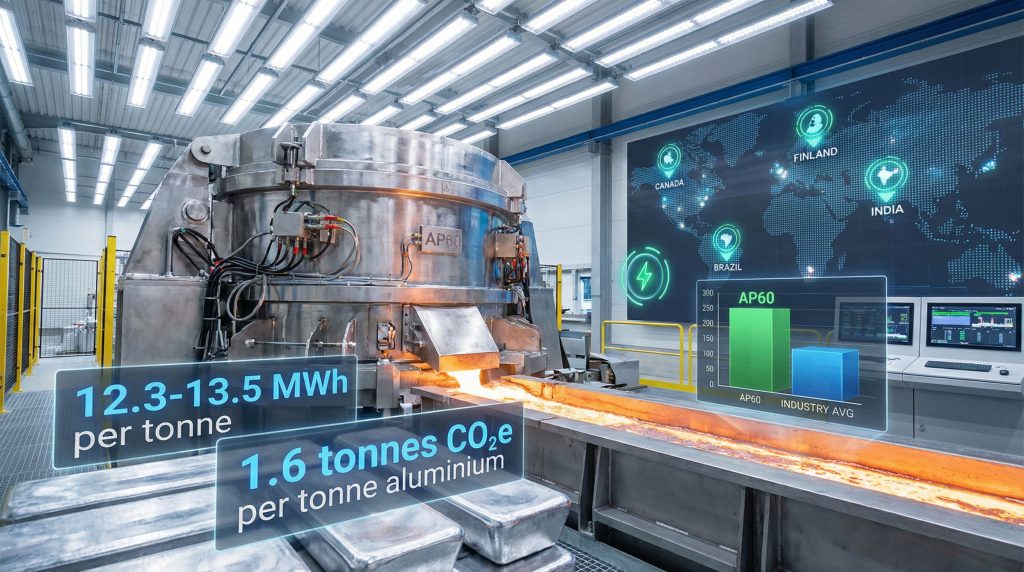
The enhanced amperage capacity allows for improved electromagnetic field management within the smelting pot, reducing electrical resistance losses that typically account for substantial energy waste in conventional operations. This technological advancement enables energy consumption of 12.3-13.5 MWh per tonne when integrated with hydroelectric power sources, compared to industry averages of 15-16 MWh per tonne.
Heat management optimisation plays a crucial role in AP60's superior performance characteristics. In addition, the high-amperage design generates more consistent thermal profiles across the electrolytic bath, reducing temperature variations that cause energy inefficiencies in traditional cells. Advanced electromagnetic field optimisation ensures uniform current distribution, minimising localised heating effects that contribute to increased power consumption and reduced anode life.
Carbon Footprint Reduction Mechanisms
The emissions performance of Rio Tinto AP60 low-carbon aluminium technology achieves approximately 1.6 tonnes CO₂e per tonne of aluminium when powered by hydroelectric sources, representing roughly one-seventh of the industry average emissions profile exceeding 12 tonnes CO₂e per tonne. This dramatic reduction stems from both improved process efficiency and strategic integration with renewable energy infrastructure.
Energy conversion efficiency improvements over legacy technologies result from optimised electrolyte chemistry and enhanced current density management. However, the AP60 design minimises waste heat generation through improved thermal management systems, reducing auxiliary cooling requirements and associated energy consumption. Process optimisation extends to byproduct emission reduction, with advanced off-gas treatment systems capturing and processing volatile compounds more effectively than conventional installations.
Integration with renewable hydropower infrastructure creates synergistic benefits beyond simple clean electricity sourcing. For instance, the technology's enhanced electrical efficiency characteristics align better with variable renewable energy profiles, enabling more flexible grid integration and improved capacity utilisation during peak renewable generation periods.
When big ASX news breaks, our subscribers know first
Strategic Global Deployment Across Key Markets
Canada's Proven Commercial Operations
The Arvida facility in Jonquière, Quebec, serves as the primary validation site for AP60 technology's commercial viability and operational performance. The 2023 expansion added 96 pots to the existing smelter infrastructure, increasing annual capacity by 160,000 tonnes while demonstrating scalability from pilot-phase testing to full commercial deployment.
Integration with Quebec's extensive hydroelectric grid provides the renewable energy foundation necessary for achieving superior emissions performance. Consequently, the province's hydropower infrastructure offers stable, low-carbon electricity supply with sufficient capacity to support expanded aluminium production without compromising grid reliability or requiring fossil fuel backup generation.
The facility's production capability translates to material sufficient for approximately 400,000 electric vehicle battery housings annually, illustrating the technology's relevance to rapidly expanding electrification markets. This calculation assumes typical battery pack aluminium content of 400 kilograms per vehicle, though actual requirements vary significantly across manufacturers and battery chemistries.
Operational data from the Arvida expansion indicates AP60 produces roughly 50% of the emissions compared to older technology deployed at the same location, providing direct performance comparison under identical grid conditions and regulatory frameworks. This real-world validation supports broader deployment strategies across similar renewable energy environments.
Finland's European Market Entry Strategy
The proposed Kokkola project represents Europe's first continental primary aluminium plant in more than 30 years, positioning Rio Tinto AP60 low-carbon aluminium technology as the cornerstone for European supply chain localisation. The project structure involves partnerships with Arctial, Vargas, and Mitsubishi, though specific ownership percentages and investment commitments remain subject to regulatory approval processes.
Non-fossil fuel power integration strategy for the Finnish facility will likely combine multiple renewable energy sources given the region's wind, hydroelectric, and potential nuclear power options. Furthermore, Finland's commitment to carbon neutrality by 2035 creates supportive policy frameworks for low-carbon industrial development, though specific regulatory approval timelines remain uncertain.
The strategic rationale extends beyond emissions reduction to encompass supply chain resilience and geopolitical risk mitigation. European demand for locally produced aluminium has intensified following supply disruptions in Middle Eastern trade routes and increasing awareness of carbon border adjustment mechanisms that will penalise high-carbon imports.
Market positioning within European energy transition strategies aligns with industrial decarbonisation policies and green recovery investment programmes. The facility would serve automotive manufacturing clusters across Germany, France, and Scandinavia where electric vehicle production scaling requires substantial low-carbon aluminium supplies.
India's Integrated Smelter Development Vision
Rio Tinto's proposed Indian operations envision massive scale integration with 1 million tonnes annual aluminium capacity and 2 million tonnes alumina capacity, representing one of the largest greenfield developments in the global industry. However, the project's export market focus reflects India's strategic positioning as a manufacturing hub for global supply chains requiring low-carbon materials certification.
Renewable energy sourcing requirements present both opportunities and challenges given India's rapidly expanding solar and wind capacity alongside existing hydropower infrastructure. The proposed facility's power demand would require dedicated renewable energy agreements or captive generation facilities to ensure consistent low-carbon electricity supply.
Export market dynamics favour Indian production due to competitive labour costs and proximity to Asian manufacturing centres, though transportation emissions and logistics complexity must be carefully managed to maintain overall carbon footprint advantages. In addition, integration with existing Indian alumina refining capacity could provide feedstock security and cost optimisation benefits.
Infrastructure development challenges include water availability for cooling and processing, transportation connectivity for raw material inputs and finished product exports, and skilled workforce development for advanced smelting technology operations. Environmental clearance processes in India typically require extensive impact assessments and community consultation procedures.
Brazil's Strategic Market Access Through Partnership
The January 2026 announcement of Rio Tinto and Chalco's joint acquisition of Companhia Brasileira de Alumínio (CBA) establishes a 33% Rio Tinto and 67% Chalco ownership structure focused on secondary aluminium production capabilities. This partnership provides immediate access to Brazilian markets while avoiding the extended development timelines associated with greenfield primary smelting projects.
CBA's specialisation in secondary aluminium production complements Rio Tinto's primary production expertise, creating opportunities for integrated circular economy operations. Furthermore, the recycling facilities offer established scrap collection networks and processing capabilities that could be enhanced through AP60 technology integration for combined primary-secondary operations.
Regional market penetration strategy leverages Brazil's position as Latin America's largest aluminium market while providing export access to North American automotive and construction sectors. The transaction remains subject to regulatory approvals as of March 2026, with Brazilian competition authorities reviewing market concentration implications.
Secondary aluminium production typically requires 95% less energy than primary production, making CBA's operations inherently lower-carbon regardless of electricity sources. For instance, integration with Rio Tinto's technological capabilities could further optimise energy efficiency and expand market applications for recycled products.
Advanced Technology Competitive Landscape Analysis
| Technology | Energy Consumption (MWh/t) | CO₂ Emissions (tonnes/t Al) | Commercial Status |
|---|---|---|---|
| AP60 | 12.3-13.5 | 1.6 | Commercial deployment |
| Industry Average | 15-16 | 12+ | Widespread |
| ELYSIS® (Rio-Alcoa) | 13-14 | 0 (direct emissions) | Pilot scale |
| APXe (Rio Tinto) | 12.3 | <1.6 | Development |
The competitive landscape reveals Rio Tinto AP60 low-carbon aluminium technology's positioning against both conventional industry practices and emerging low-carbon alternatives. While ELYSIS® technology promises zero direct emissions through oxygen-producing cell design, its pilot-scale status limits immediate commercial deployment compared to AP60's proven operational track record.
APXe technology represents Rio Tinto's next-generation development programme, targeting further energy efficiency improvements while maintaining emissions performance comparable to current AP60 systems. The technology pipeline suggests continued innovation focus on optimising both energy consumption and carbon footprint characteristics.
Energy consumption comparisons demonstrate significant advantages over industry averages, though the gap narrows when comparing against other advanced technologies. However, the 12.3-13.5 MWh/t range for AP60 approaches theoretical efficiency limits for conventional electrolytic reduction processes, suggesting diminishing returns from further optimisation within existing technological frameworks.
Commercial deployment status provides AP60 with first-mover advantages in capturing premium markets demanding low-carbon certification. While competing technologies may offer superior theoretical performance, proven operational reliability and scalability represent critical factors for large-scale industrial adoption.
Secondary Aluminium Integration Strategy
Rio Tinto's December 2023 acquisition of 50% stake in Matalco business provides 900,000 tonnes annual recycling capacity across six remelting and casting facilities in the United States plus one Canadian operation. This secondary production capability complements primary smelting operations while addressing circular economy objectives.
The integration strategy recognises that optimal low-carbon aluminium supply chains require both efficient primary production and maximised recycling utilisation. Furthermore, secondary aluminium typically requires only 5% of the energy needed for primary production, making recycling operations inherently advantageous for overall carbon footprint reduction.
Scrap collection and processing optimisation presents opportunities for technological innovation beyond traditional melting and casting operations. Advanced sorting technologies, quality control systems, and alloy management capabilities could enhance recycled product specifications while reducing contamination losses.
Government policy frameworks increasingly recognise aluminium scrap as strategic material requiring dedicated collection and processing infrastructure. Consequently, regulatory support for scrap classification could facilitate investment in enhanced recycling technologies and expanded collection networks.
Market Demand Drivers and End-Use Applications
What Are the Key Automotive Sector Requirements?
Electric vehicle manufacturing drives substantial aluminium demand through battery housing applications, structural components, and lightweighting initiatives aimed at maximising driving range per battery charge. Low-carbon certification requirements from major automotive manufacturers create premium market segments where AP60 technology's emissions advantages translate to pricing benefits.
Battery housing applications require high-strength aluminium alloys with specific thermal management properties and electromagnetic compatibility characteristics. The consistent quality profiles achievable through AP60's optimised production processes align well with automotive industry requirements for precision manufacturing and quality assurance.
OEM sustainability commitments increasingly mandate supply chain decarbonisation targets, creating procurement policies that favour certified low-carbon materials regardless of modest cost premiums. In addition, supply chain auditing requirements extend to Scope 3 emissions accounting, making aluminium carbon content a measurable factor in automotive manufacturer environmental reporting.
Production volume projections through 2030 suggest global electric vehicles impact could require 2-3 million tonnes of additional aluminium annually, with significant portions demanding low-carbon certification. This demand growth provides substantial market opportunities for advanced smelting technologies capable of meeting both volume and environmental requirements.
Data Center Infrastructure Expansion
Cable applications requiring low-carbon certification represent growing market segments as data center operators prioritise environmental performance metrics. Power transmission efficiency improvements achievable through high-conductivity aluminium products align with industry objectives for minimising energy losses in electrical distribution systems.
Digital infrastructure expansion driving global internet capacity growth creates sustained demand for electrical conductors, with aluminium offering cost advantages over copper in many high-voltage applications. Furthermore, the consistent electrical properties achievable through advanced smelting processes enhance product reliability in critical infrastructure applications.
Telecommunications infrastructure development in emerging markets provides additional demand drivers, particularly where grid integration requires efficient power transmission over long distances. Low-carbon certified products support infrastructure investment programmes aligned with climate commitments in developing economies.
Construction and Green Building Integration
Green building certification programmes increasingly incorporate embodied carbon assessments that favour low-carbon materials in structural and architectural applications. Building codes evolution toward sustainability requirements creates regulatory demand drivers beyond voluntary certification programmes.
Architectural applications prioritising embodied carbon reduction benefit from AP60 technology's superior emissions profile while maintaining structural performance characteristics required for building applications. However, the technology's consistent quality outputs support precision manufacturing requirements for architectural components.
Structural engineering advantages of high-strength alloys produced through optimised smelting processes enable lightweighting strategies that reduce overall building material requirements. These design optimisation benefits complement direct carbon footprint advantages in comprehensive sustainability assessments.
Economic and Strategic Implementation Analysis
Financial Performance and Investment Returns
Capital expenditure requirements for AP60 technology deployment typically exceed conventional smelting infrastructure due to advanced electrical systems and specialised equipment specifications. However, operating cost advantages through energy efficiency improvements provide measurable returns over facility operational lifespans extending 20-30 years.
Energy efficiency benefits translate to approximately 2.5-3.5 MWh reduced consumption per tonne compared to industry averages, generating operational savings of $75-150 per tonne depending on local electricity pricing. With typical smelter capacities of 200,000-500,000 tonnes annually, these efficiency gains produce substantial cumulative cost advantages.
Premium pricing potential for low-carbon certified products varies significantly across market segments and geographic regions. Current market premiums range from $50-200 per tonne for certified low-carbon aluminium, though pricing sustainability depends on supply-demand dynamics as additional low-carbon capacity enters production.
Return on investment calculations must incorporate both operational efficiency benefits and potential premium pricing, balanced against higher capital costs and technology deployment risks. Consequently, payback periods typically range from 7-12 years depending on energy costs, carbon pricing policies, and market premium sustainability.
Geopolitical Risk Mitigation Strategies
Supply chain diversification beyond traditional Australia-Canada-New Zealand operations addresses strategic vulnerabilities exposed by recent geopolitical tensions and trade disruptions. Regional production capabilities reduce transportation risks and currency exchange exposures while improving supply chain resilience.
European energy security considerations favour local low-carbon production capabilities over imports from regions with uncertain political stability or supply chain reliability. Furthermore, aluminum tariff exemptions and carbon border adjustment mechanisms under development in the European Union will create additional cost advantages for local low-carbon production.
Middle East supply disruption mitigation through diversified global production networks reduces exposure to regional conflicts and transportation route vulnerabilities. Recent shipping delays and security concerns in critical maritime corridors highlight the strategic value of geographically distributed production capabilities.
Trade policy implications of carbon border adjustments and environmental regulations increasingly favour production locations with strong renewable energy access and advanced emission reduction technologies. These regulatory trends support investment in low-carbon technologies regardless of current cost premiums.
Technical Integration and Innovation Pipeline
Complementary Technology Development
Carbon capture integration opportunities exist for further emissions reduction beyond current AP60 performance levels, though economic viability requires continued technology development and supportive policy frameworks. Pilot programmes exploring post-combustion capture from smelter off-gases could achieve near-zero emissions profiles.
ELYSIS® oxygen-producing cell technology integration could complement AP60 operations by eliminating direct process emissions while producing valuable oxygen byproducts for industrial applications. However, the combination of high-amperage efficiency with zero-emission electrolytic processes represents the theoretical optimum for sustainable aluminium production.
Process automation and artificial intelligence integration enhance operational efficiency through predictive maintenance systems, quality control optimisation, and energy consumption management. Advanced monitoring systems reduce downtime risks while maximising production consistency and resource utilisation.
Predictive maintenance capabilities utilising sensor networks and machine learning algorithms extend equipment lifespans while minimising unplanned outages that compromise production efficiency and increase unit costs. These technological enhancements provide competitive advantages independent of direct emissions benefits.
Future Development Pathways
Research and development priorities focus on further energy efficiency improvements and alternative reduction chemistry that could eliminate remaining carbon emissions from primary aluminium production. Hydrogen-based reduction processes represent long-term technological possibilities, though commercial viability remains uncertain.
Integration with emerging renewable energy sources including offshore wind and advanced solar technologies could expand geographical deployment options beyond traditional hydroelectric regions. In addition, energy storage integration enables production flexibility that optimises renewable energy utilisation patterns.
Circular economy optimisation through design for recycling initiatives ensures primary production technologies remain compatible with enhanced secondary production capabilities. Material flow optimisation across primary and secondary operations maximises overall system efficiency.
Net-zero target achievement by 2050 requires continued technological innovation beyond current AP60 capabilities, necessitating sustained research investment and breakthrough technology development. Industry innovation trends suggest the pathway toward complete decarbonisation may require fundamental changes to electrolytic reduction chemistry rather than incremental efficiency improvements.
The next major ASX story will hit our subscribers first
Investment Considerations and Market Outlook
Technology Risk Assessment Framework
Commercial readiness metrics for Rio Tinto AP60 low-carbon aluminium technology indicate proven operational capability through multi-year commercial deployment at Arvida facility, reducing technology adoption risks compared to pilot-stage alternatives. However, scaling challenges and site-specific adaptation requirements present ongoing implementation risks.
Market penetration timelines depend heavily on regulatory approval processes, financing availability, and renewable energy infrastructure development in target deployment regions. Conservative estimates suggest 5-7 year development cycles for new facility construction, while brownfield retrofits could achieve faster deployment.
Competitive positioning advantages from first-mover status in commercial low-carbon smelting may erode as alternative technologies achieve commercial scale and additional suppliers enter premium market segments. Rio Tinto's broader aluminium expansion strategy requires sustained technology leadership through continued innovation investment and operational excellence.
Capital allocation priorities within integrated mining portfolios must balance aluminium expansion opportunities against investments in other commodities with different risk-return profiles and market dynamics. Portfolio optimisation considerations extend beyond individual project economics to encompass strategic positioning and market diversification benefits, particularly in regions with global bauxite production capabilities.
ESG Investment Integration
Environmental, social, and governance investment criteria increasingly prioritise measurable decarbonisation progress over conventional financial metrics alone. AP60 technology deployment directly addresses environmental performance requirements while supporting social licence objectives through local employment and community development.
Governance standards for technology deployment require transparent reporting of emissions performance, operational metrics, and community impact assessments. Furthermore, investor expectations for comprehensive sustainability reporting create additional operational requirements beyond technical performance optimisation.
Social licence considerations encompass workforce development, community engagement, and local economic development contributions that extend beyond direct facility operations. Indigenous consultation requirements and environmental justice considerations influence project approval processes and operational sustainability.
Disclaimer: This analysis contains forward-looking statements and projections based on current market conditions and technological assessments. Actual performance, market developments, and financial returns may differ materially from projections due to technological, regulatory, market, and operational factors beyond current prediction. Investment decisions should consider comprehensive due diligence and professional financial advice appropriate to individual circumstances.
Ready to Position Yourself for the Next Major Mining Discovery?
Discovery Alert's proprietary Discovery IQ model delivers instant notifications on significant ASX mineral discoveries, empowering investors to identify actionable opportunities in sectors experiencing rapid transformation like low-carbon aluminium production. With the mining industry evolving toward sustainable technologies and premium market segments, subscribers gain the critical advantage of real-time discovery alerts that could signal the next breakthrough in resource development.