July 29, 2026
The Invisible Treadmill: Why Iron Ore Giants Must Run Faster Just to Stay Still
Every large-scale mining operation faces an uncomfortable mathematical reality. No matter how efficiently a deposit is extracted, the ore body is finite. Production curves that appear stable on annual reports are often the product of enormous capital investment simply offsetting natural depletion from mines that have been operating for decades. This dynamic, rarely discussed outside specialist mining circles, is what drives the scale of Rio Tinto's current Pilbara investment cycle.
It explains why billions of dollars in capital are being deployed not to grow production dramatically, but to defend it.
Understanding this replacement treadmill is essential context for interpreting Rio Tinto Australian iron ore mine projects. The company is not expanding from a position of underinvestment. It is executing a generational portfolio refresh across one of the world's most productive mining districts, with multiple simultaneous construction programmes designed to carry Pilbara output through the late 2020s and into the following decade.
When big ASX news breaks, our subscribers know first
The Geological Foundation: Why the Pilbara Cannot Be Replicated
Western Australia's Pilbara region holds a geological distinction that few comparable iron ore provinces can match. The iron ore deposits of the Hamersley Basin formed predominantly from Precambrian banded iron formations, with supergene enrichment processes over hundreds of millions of years concentrating iron grades to levels that make them economically and logistically superior to most alternative supply sources globally.
What makes the Pilbara particularly valuable is not just the grade of individual deposits but their physical distribution. The proximity of high-grade ore bodies to one another allows Rio Tinto to operate an integrated hub-and-spoke system rather than managing isolated standalone mines. This system currently encompasses 18 iron ore mines, rail corridors spanning thousands of kilometres, and 4 port terminals, creating a production and logistics network that functions as a single optimised machine rather than a collection of discrete assets.
The operational leverage this creates is profound. When a new mine is added to the network, it does not simply generate its own production volumes in isolation. It feeds into shared rail and port infrastructure, spreading fixed costs across a larger volume base and improving the unit economics of the entire system. Competitors attempting to replicate this kind of infrastructure integration would face capital costs and permitting timelines measured in decades, not years.
Furthermore, Australia's iron ore advantage in this context stems directly from this geological and logistical convergence, making the Pilbara a genuinely difficult asset base to challenge from the outside.
Hub Architecture: A Less-Discussed Competitive Moat
One aspect of Rio Tinto's Pilbara system that receives less public attention than headline production figures is the hub structure underlying its operations. Rather than operating each mine as a standalone facility, Rio Tinto clusters mines into processing hubs, each with shared crushing, screening, and ore handling infrastructure.
Hubs such as Greater Hope Downs, West Angelas, Greater Paraburdoo, Greater Nammuldi, and Tom Price/Marandoo allow individual mines within a cluster to share processing capacity, reducing per-tonne capital intensity for incremental additions.
This architecture also creates an important geological hedging mechanism. Because different ore bodies within a hub can have varying chemical profiles, blending across multiple sources allows Rio Tinto to consistently deliver product specifications that meet customer requirements, even when individual deposits drift in grade or chemistry. For steelmakers, consistency of supply chemistry is often as commercially important as price.
Rio Tinto Australian Iron Ore Mine Projects: The Full Pipeline
The current development pipeline represents the most intensive construction period in Rio Tinto's Pilbara history in recent memory, with projects at different stages of advancement collectively targeting well over 150 Mtpa of new or replacement capacity.
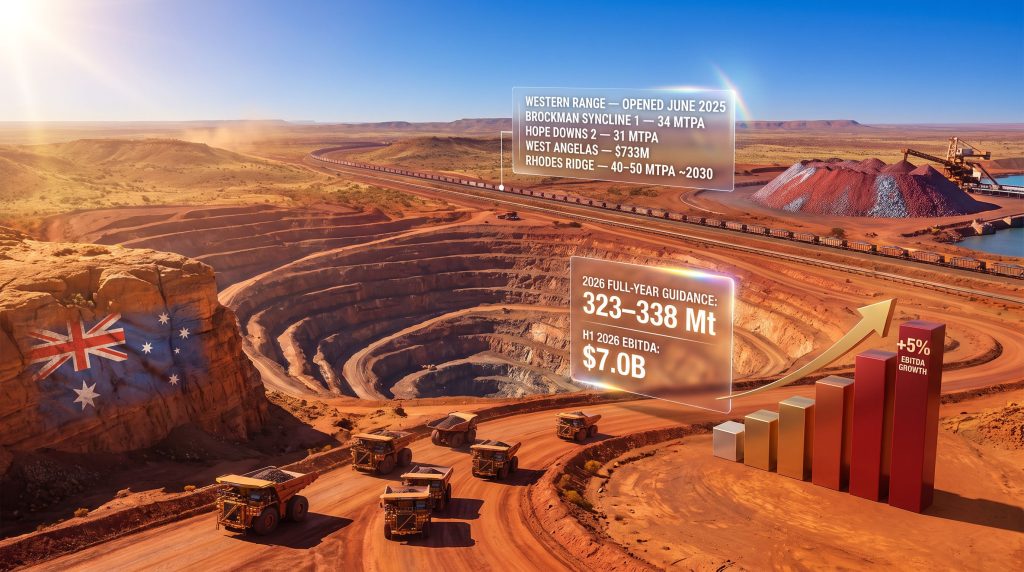
| Project | Capacity (Mtpa) | Approval | First Ore Target | Capital Commitment |
|---|---|---|---|---|
| Western Range | 25 | Pre-2025 | Opened June 2025 | Ramping through 2026 |
| Brockman Syncline 1 | 34 | March 2025 | 2027 | Under construction |
| Hope Downs 2 | 31 | June 2025 | 2027 | Under construction |
| West Angelas Sustaining | 35 (hub capacity) | Approved | 2027 | $733 million committed |
| Rhodes Ridge Phase 1 | 40-50 | Feasibility approved | ~2030 | JV feasibility stage |
Western Range: Proof of Concept for the Renewal Programme
Commissioned in June 2025, Western Range marked the opening chapter of Rio Tinto's Pilbara renewal cycle. At 25 Mtpa, the mine entered ramp-up immediately after commissioning and is expected to reach full operational rates through 2026. Beyond its production contribution, Western Range carries strategic significance as a demonstration that Rio Tinto's project delivery machine is functioning effectively.
In an industry where cost overruns and schedule slippage are endemic, on-time commissioning of a major new mine provides meaningful de-risking for subsequent projects in the pipeline.
Brockman Syncline 1: The Pipeline's Largest Near-Term Addition
Approved in March 2025 and currently under active construction, Brockman Syncline 1 is the highest-capacity project in Rio Tinto's immediate development horizon at 34 Mtpa. The project targets first ore in 2027 and is designed specifically to offset declining output from older mines within the Brockman geological formation, which has historically been one of the most productive iron ore regions within the Pilbara.
The Brockman ore type is notable for its relatively high iron content and favourable gangue mineralogy, characteristics that have made Brockman-sourced ore a preferred feedstock for Chinese blast furnace operators over several decades. Sustaining access to this ore type through Brockman Syncline 1 preserves Rio Tinto's ability to deliver product quality profiles that command customer loyalty and, in many cases, price premiums above benchmark indices.
Hope Downs 2: Leveraging Existing Infrastructure to Reduce Development Risk
Approved in June 2025, Hope Downs 2 adds 31 Mtpa of capacity to the Greater Hope Downs hub, with first ore targeted for 2027. The strategic rationale for hub extensions like this is straightforward but often underappreciated by observers focused solely on greenfield development.
Building within an established hub dramatically reduces per-tonne capital intensity because processing facilities, power infrastructure, accommodation, and logistics connections already exist. The incremental capital required per tonne of new capacity is materially lower than what a comparable standalone development would require.
West Angelas Sustaining Project: The $733 Million Defence of Existing Capacity
Committing $733 million to preserve rather than grow capacity at the West Angelas hub might appear counterintuitive, but it reflects a critical insight about mature mining systems: sustaining existing throughput at ageing hubs is often more complex and capital-intensive than building new capacity from scratch.
The West Angelas Sustaining Project ensures the hub maintains its 35 Mtpa throughput capability, with first ore from the sustaining works targeted for 2027, perfectly aligning with the broader wave of new capacity entering the system.
Rhodes Ridge: The Long-Duration Growth Option
Rhodes Ridge represents a category of its own within the pipeline. With a joint venture feasibility study approved for a first phase targeting 40 to 50 Mtpa, Rhodes Ridge is the largest undeveloped iron ore resource in Rio Tinto's Pilbara portfolio and potentially one of the largest undeveloped iron ore deposits globally by contained metal.
First ore is currently targeted for approximately 2030, positioning it as a medium-to-long-term growth catalyst rather than a near-term production driver.
The scale of the Rhodes Ridge resource means that a successful development could anchor Pilbara production volumes well into the 2040s, making the project's feasibility trajectory one of the most consequential capital allocation decisions in global iron ore mining over the next several years. Note: Project timelines and investment decisions remain subject to feasibility outcomes and market conditions.
Financial Performance: Reading Behind the EBITDA Headline
Rio Tinto's Pilbara iron ore division generated $7.0 billion in underlying EBITDA during the first half of 2026, a 5% increase compared with the equivalent period in 2025. The headline improvement, while meaningful, understates the operational achievement when placed in the context of simultaneous cost headwinds.
| Financial Metric | H1 2026 | H1 2025 | Change |
|---|---|---|---|
| Pilbara Iron Ore EBITDA | $7.0 billion | ~$6.67 billion | +5% |
| Realised price (61% Fe) | $105/dmt cfr China | $101/dmt cfr China | +$4/dmt |
| Realised price (65% Fe) | $122/dmt cfr China | $113/dmt cfr China | +$9/dmt |
| Unit production cost | $25/wmt fob | ~$24.30/wmt | +$0.70/t |
| Pilbara capex growth (YoY) | +34% | N/A | Driven by project pipeline |
The cost structure tells an important story. The $0.70/t net increase in unit costs disguises the fact that gross cost pressures were considerably larger. A $2.10/t headwind from Australian dollar appreciation and a $0.80/t impact from elevated diesel costs combined to create nearly $3 per tonne of upward cost pressure.
The fact that unit costs rose by only $0.70/t reflects a substantial underlying productivity achievement, with optimised plant scheduling and throughput improvements absorbing the majority of those external headwinds.
Unit costs of $25/wmt fob sit at the upper boundary of Rio Tinto's full-year 2026 guidance range of $23.50 to $25/wmt, leaving little margin for further cost escalation in the second half without a guidance revision. This is a metric worth monitoring closely, particularly given ongoing Australian dollar strength and the logistical complexity of running three simultaneous construction programmes.
The H1 2026 result also represented Rio Tinto's highest half-year iron ore production result in eight years, a benchmark that underscores how effectively productivity initiatives have translated into volume gains rather than purely cost savings.
Iron Ore Grade Economics: Why the 65% Fe Premium Matters
One of the more technically nuanced aspects of Rio Tinto's commercial positioning is its ability to market both standard 61% Fe fines and premium 65% Fe product grades. The price differential between these two specifications is not incidental. It reflects fundamental steelmaking economics.
Higher-grade iron ore contains less gangue material, meaning steelmakers can achieve the same iron input per heat of steel while consuming less total ore and generating less slag. For blast furnace operators, this translates directly into reduced coke consumption, lower energy costs, higher productivity per unit of furnace capacity, and reduced emissions intensity per tonne of crude steel produced.
As Chinese steel mills face progressively tighter environmental operating standards, the economic case for purchasing higher-grade feedstock strengthens even when the absolute price premium appears elevated.
In the first half of 2026, Rio Tinto received $122/dmt cfr China for its 65% Fe product, compared with $105/dmt for 61% Fe ore, a premium of approximately $17/dmt. As assessed by Argus Media on 28 July 2026, the benchmark 61% Fe index stood at $97.10/dmt cfr Qingdao, with 65% Fe fines assessed at $113.75/dmt cfr Qingdao, representing a grade premium of approximately $16.65/dmt in the spot market at that date.
This grade premium structure creates a commercially differentiated revenue stream for Rio Tinto that partially insulates overall realised prices from benchmark index volatility, since the premium tends to be relatively sticky even when base prices soften.
Competitive Positioning Within the Pilbara
Rio Tinto's scale within the Pilbara creates a structural position that is difficult for any competitor to replicate in the short to medium term.
| Company | Pilbara Production Scale | Key Differentiator |
|---|---|---|
| Rio Tinto (ASX: RIO) | 323-338 Mt/yr guidance (2026) | Largest integrated network; 18 mines, 4 port terminals |
| BHP (ASX: BHP) | ~260-280 Mt/yr (WA Iron Ore) | South Flank ramp-up; WAIO system expansion |
| Fortescue (ASX: FMG) | ~190 Mt/yr | Lower-grade ore; green iron development strategy |
| Mineral Resources (ASX: MIN) | Smaller scale; growing | Onslow Iron project ramp-up |
Three structural advantages underpin Rio Tinto's competitive position in this context:
- Network integration that distributes fixed infrastructure costs across a larger volume base than any competitor in the region.
- Product grade diversification across both 61% and 65% Fe specifications, providing pricing resilience and customer base breadth.
- Pipeline sequencing that ensures no single year represents a production cliff, with staggered first-ore dates from 2025 through approximately 2030 providing continuity across market cycles.
The next major ASX story will hit our subscribers first
Risk Framework: What Could Disrupt the Expansion Timeline?
Currency Exposure: The Structural AUD/USD Mismatch
Perhaps no risk factor is more persistent or less controllable for Rio Tinto's Pilbara operations than the Australian dollar exchange rate. The fundamental mismatch between AUD-denominated costs and USD-denominated revenues means that any sustained period of Australian dollar strength directly compresses margins without any corresponding operational failure.
The $2.10/t currency headwind recorded in H1 2026 illustrates that this is not a theoretical risk but an active earnings drag at current exchange rate levels.
Productivity initiatives serve as a partial offset, but there is a practical ceiling on how much operational efficiency can be extracted before diminishing returns set in. If the Australian dollar remains elevated through the second half of 2026, unit cost guidance may come under pressure even if operational performance remains strong.
Concurrent Construction Risk: The 2027 Convergence Problem
Running three major construction programmes simultaneously toward a shared 2027 first-ore target creates a concentration of demand for skilled labour, specialised mining equipment, and construction services that may exceed what Western Australia's mining services sector can comfortably supply.
Western Australia's tight labour market for mining construction has been a persistent feature of the industry over the past several years, and the simultaneous ramp-up of multiple major projects across the Pilbara more broadly could amplify competitive pressure for these resources.
Long-Term Demand: The Steel Transition Wild Card
The iron ore demand outlook is structurally tied to blast furnace steelmaking, which uses iron ore and metallurgical coal as primary inputs. The gradual global shift toward electric arc furnace steelmaking, which uses steel scrap as its primary input and significantly less iron ore, represents a long-duration structural headwind for iron ore demand.
The China steel market is navigating both a slowing property market and incremental policy pressure toward lower-emission steelmaking pathways, adding further complexity to the demand picture. In addition, iron ore surplus risks remain a consideration that investors and producers must factor into long-range planning.
Paradoxically, the green iron transition via direct reduced iron and electric arc furnace routes actually increases demand for high-grade iron ore rather than reducing it. DRI-grade iron ore typically requires 67% Fe or higher, which lies above even Rio Tinto's premium 65% Fe product grade.
However, as the technology matures and ore beneficiation capabilities improve, high-grade Pilbara ore could find an expanding addressable market in the decarbonising steel sector, partially compensating for any demand erosion from the property cycle.
Scenario Projections: Production Pathways to 2030
The following scenarios are analytical constructs based on current project timelines and market conditions. They represent plausible outcomes, not forecasts, and actual results may differ materially based on factors including commodity prices, exchange rates, regulatory approvals, and operational performance.
Scenario 1: Full Pipeline Delivery
All three 2027-target projects achieve first ore on schedule. Combined with the Western Range ramp-up, Rio Tinto sustains Pilbara output above 330 Mt/yr through 2028. Rhodes Ridge progresses toward a final investment decision by 2027-2028.
Scenario 2: Partial Schedule Slippage
One or two projects experience 6-12 month delays due to labour availability or regulatory processing. Pilbara output holds broadly flat at 320-330 Mt/yr through 2027 as incremental production offsets legacy mine depletion. Rhodes Ridge timeline extends toward 2031-2032.
Scenario 3: Price-Driven Capital Conservatism
A sustained decline in iron ore prices below $85/dmt causes Rio Tinto to moderate discretionary capital deployment. Rhodes Ridge investment is deferred. Sustaining capital is prioritised. Pilbara output gradually contracts as depletion outpaces replacement.
Full-Year 2026 Guidance and Production Outlook
Rio Tinto has held its full-year 2026 Pilbara iron ore sales guidance steady at 323 to 338 million tonnes, a signal of confidence in sustaining the operational momentum established in the record first half. Maintaining the upper end of this range through the second half of the year would require consistent plant performance across the existing mine network while managing the construction activity associated with three simultaneous development projects, a non-trivial operational challenge.
Pilbara capital investment increased by 34% year-on-year in the first half of 2026, directly reflecting the simultaneous construction activity across the replacement project pipeline. This elevated capital intensity is an expected feature of the current cycle rather than a signal of cost overruns, but it does mean that free cash flow conversion will be somewhat compressed relative to EBITDA until the new mines reach full production and capital requirements moderate.
Frequently Asked Questions: Rio Tinto Australian Iron Ore Mine Projects
How many iron ore mines does Rio Tinto operate in Australia?
Rio Tinto's Pilbara system comprises 18 operating mines connected via an integrated rail network to 4 port terminals. Mines are organised into hub clusters including Greater Hope Downs, Greater Nammuldi, Greater Paraburdoo, West Angelas, Robe Valley, Tom Price/Marandoo, and Yandicoogina.
What is Rio Tinto's newest iron ore mine in Australia?
Gudai-Darri is described by Rio Tinto as its most technologically advanced Pilbara operation. Western Range, commissioned in June 2025, is the most recently completed mine addition to the network and is currently ramping toward full capacity.
When will Brockman Syncline 1 start production?
Brockman Syncline 1, a 34 Mtpa project approved in March 2025, targets first ore production in 2027 and is currently under active construction.
What is the Rhodes Ridge iron ore project?
Rhodes Ridge is Rio Tinto's largest undeveloped Pilbara resource. A joint venture feasibility study has been approved for an initial phase targeting 40 to 50 Mtpa, with first ore currently projected for approximately 2030.
What is Rio Tinto's iron ore production guidance for 2026?
Full-year 2026 Pilbara iron ore sales guidance is maintained at 323 to 338 million tonnes.
How much capital is Rio Tinto investing in its Pilbara projects?
Pilbara capital investment grew by 34% year-on-year in the first half of 2026. The West Angelas Sustaining Project alone carries a committed capital cost of $733 million, with additional investment flowing into Brockman Syncline 1, Hope Downs 2, and Western Range ramp-up activities.
Key Takeaways at a Glance
- Rio Tinto Australian iron ore mine projects represent the most intensive Pilbara portfolio renewal in nearly a decade, with three projects targeting 2027 first ore and one longer-duration option targeting approximately 2030
- H1 2026 Pilbara EBITDA of $7 billion, up 5% year-on-year, demonstrates financial resilience despite a $2.10/t currency headwind and elevated diesel costs
- The 65% Fe grade premium of approximately $16-17/dmt above benchmark provides a structurally differentiated revenue stream that partly insulates earnings from index price volatility
- Full-year 2026 sales guidance of 323-338 Mt reflects near-record production confidence, supported by the highest half-year output result in eight years
- Currency exposure, concurrent construction labour demand, and the long-term trajectory of Chinese blast furnace steelmaking remain the primary variables that investors and industry observers should monitor closely
This article is intended for informational purposes only and does not constitute financial advice. Forecasts, scenarios, and projections discussed herein involve assumptions and uncertainties, and actual outcomes may differ materially from those described. Readers should conduct their own independent research before making any investment decisions.
Want to Capitalise on the Next Major ASX Mineral Discovery Before the Market Moves?
Discovery Alert's proprietary Discovery IQ model delivers real-time alerts on significant ASX mineral discoveries, transforming complex geological and market data into actionable investment insights for both short-term traders and long-term investors. Explore how historic discoveries have generated substantial returns on Discovery Alert's dedicated discoveries page, and begin your 14-day free trial today to position yourself ahead of the broader market.