July 31, 2026
The Hidden Architecture of a Mining Giant's Earnings Shift
Few investors pay close attention to commodity revenue mix until a dividend cheque arrives that is materially larger than the year before. That is precisely the moment when the underlying architecture of a diversified miner's earnings profile becomes impossible to ignore. For Rio Tinto, the first half of 2026 delivered exactly that kind of inflection point, and understanding the Rio Tinto dividend raise and copper prices requires looking well beyond a single commodity price move.
When big ASX news breaks, our subscribers know first
Why Copper and Aluminium Now Drive Rio Tinto's Earnings Story
The Portfolio Rebalancing That Took Years to Materialise
For most of the past two decades, Rio Tinto was understood by the market as an iron ore company with diversified interests on the side. That framing is no longer accurate. Copper and aluminium together generated more than 56% of first-half 2026 underlying EBITDA, with copper alone accounting for approximately 36% and aluminium contributing around 20%. In the prior full year, the combined figure sat at roughly 45%, meaning this is a material compositional shift, not a rounding error.
Iron ore remains a significant earnings pillar, but with the benchmark price broadly stable at approximately USD 100 per metric ton, its relative contribution has compressed as other segments surged. The shift reflects both volume growth and price appreciation across copper and aluminium simultaneously, which is an unusual confluence that amplifies the earnings impact. Furthermore, China iron ore demand patterns are evolving in ways that make this diversification increasingly strategic.
Copper's Extraordinary First-Half Performance
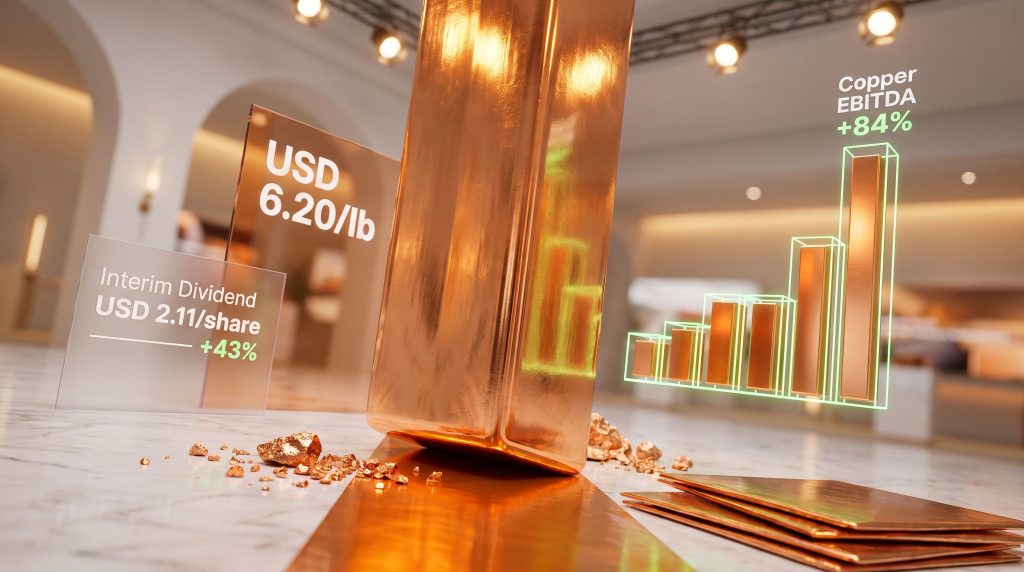
The numbers within the copper segment are difficult to overstate. The average realised copper price surged approximately 35% to 591 US cents per pound, copper segment EBITDA rose around 84% year-on-year, and free cash flow from the copper division more than trebled compared to the prior corresponding period. Copper is currently trading near all-time highs at approximately USD 6.20 per pound.
Copper's contribution to Rio Tinto's earnings is no longer a secondary story. It is rapidly becoming the primary growth engine, with compounding implications for how investors should model the company's long-term cash generation capacity.
What Is Actually Driving the Copper Price to Near-Record Highs?
Structural Demand: The Three Pillars That Matter
The copper market is being reshaped by three simultaneous structural forces that distinguish the current cycle from prior commodity booms driven largely by Chinese infrastructure spending.
-
Artificial intelligence infrastructure — Data centre construction has accelerated dramatically, and AI-optimised facilities require significantly higher copper intensity per square metre than traditional commercial real estate. Power delivery systems, cooling infrastructure, and fibre-to-copper interconnects all demand substantial volumes of refined copper.
-
Energy transition investment — Grid upgrades, utility-scale battery storage, wind and solar generation, and EV charging networks are collectively creating a demand profile that is durable and multi-decade in nature. The International Energy Agency has previously noted that a typical electric vehicle contains roughly four times the copper of a conventional internal combustion engine vehicle.
-
Industrial electrification — Beyond transport, the electrification of industrial heating, manufacturing processes, and building systems compounds annual copper consumption at rates that have not been seen in prior commodity cycles.
Why Supply Cannot Simply Fill the Gap
On the supply side, structural constraints are amplifying the price signal considerably. New copper mine development carries a typical lead time of 10 to 20 years from discovery to commercial production, meaning the investment decisions made (or not made) during the 2010s are now defining available supply in the mid-2020s. Grade decline at existing operations is also increasing the unit cost of production globally.
Geopolitical risk in key copper-producing regions, particularly parts of South America and Central Africa, continues to constrain greenfield development pipelines. The ongoing copper supply crunch is reinforcing the case for assets like Rio Tinto's Oyu Tolgoi underground mine in Mongolia, which stands out as one of the few substantial new copper supply additions expected in the near term globally.
Copper Price Outlook: A Framework for Different Time Horizons
| Timeframe | Price Outlook | Key Drivers |
|---|---|---|
| Near-term (2026) | ~USD 6.20/lb (near record highs) | AI infrastructure demand, energy transition, tight supply |
| Mid-cycle (from 2030) | Estimated ~USD 3.80/lb long-run cost support | New supply entering market, demand normalisation |
| Long-term structural floor | Above USD 3.50/lb | Electrification megatrend, higher structural production costs |
Critical Caveat for Investors: The current copper price is materially above long-run cost support estimates. Distinguishing between cyclical price elevation and genuine structural demand growth is the most important analytical task when assessing Rio Tinto's valuation at current levels.
Breaking Down Rio Tinto's 2026 Interim Financial Results
The Headline Numbers: A 43% Surge in Underlying Profit
Rio Tinto's interim 2026 underlying net profit after tax reached USD 6.9 billion, representing a 43% increase on the prior corresponding period. Earnings per share came in at USD 4.21, reflecting both the earnings uplift and a relatively stable share count. According to Rio Tinto's official results release, this performance was underpinned by strong copper equivalent production and sharper cost discipline.
A meaningful portion of the upside surprise relative to prior expectations came from an effective tax rate of 25% for the half, well below previous guidance of approximately 30%. Management has since updated full-year guidance to approximately 25% for 2026, before a return to around 30% from 2027 onward. This tax rate revision contributed to a roughly 5% upgrade in consensus EPS and DPS estimates for the full year.
Aluminium's Geopolitical Tailwind
Aluminium's contribution to first-half EBITDA at approximately 20% was meaningfully supported by supply disruptions linked to the conflict involving Iran, which affected global aluminium supply chains. While this geopolitical factor provides a real near-term earnings tailwind, it carries higher uncertainty than the structural copper demand story and should be modelled as a temporary rather than permanent input.
Rio Tinto Dividend Raise and Copper Prices: What the Numbers Signal
The Interim Dividend in Detail
The Rio Tinto dividend raise and copper prices are directly connected in a way that is arithmetically transparent. Rio Tinto declared a USD 2.11 per share fully franked interim dividend for the first half of 2026, representing a 43% increase on the prior year's interim dividend of USD 1.48 per share. The total interim ordinary dividend payment equates to approximately USD 3.4 billion. The payout ratio remained at 50% of underlying earnings, consistent with the company's established dividend policy.
Rio Tinto's Dividend Policy Framework
| Metric | Detail |
|---|---|
| Dividend policy target range | 40% to 60% of underlying earnings |
| H1 2026 payout ratio | 50% (midpoint of range) |
| Typical full-year payout (historical) | ~60% average over past decade |
| Full-year 2026 DPS estimate | ~USD 4.66 (up ~16% on 2025) |
| Implied forward yield | ~4% at current share price |
| Second-half payout assumption | Higher than first half historically |
What a 43% Dividend Increase Actually Communicates
The magnitude of this dividend raise reflects one simple mechanical reality: the payout ratio was not changed. Rio Tinto's dividend rose because underlying earnings rose by exactly the same proportion. This is an important distinction. The company did not increase its generosity or signal a structural change in capital allocation philosophy. It maintained the midpoint of its 40–60% target range.
The message this sends is confidence in the sustainability of current earnings, rather than a decision to distribute more of what it earns. The Rio Tinto copper expansion strategy is therefore central to understanding why these dividend levels may be more durable than prior cycles suggested.
The fully franked nature of the dividend adds particular value for Australian domestic investors and superannuation funds seeking tax-effective income. For self-managed superannuation funds in pension phase, imputation credits can generate tax refunds that materially elevate the effective after-tax yield above the headline ~4% forward yield implied by the current share price. Market Index notes that Rio Tinto's strong cash flow and healthy balance sheet were the primary drivers pushing the dividend to this elevated level.
Is Rio Tinto Overvalued at Current Prices?
The Valuation Framework: Price vs. Fundamental Value
Rio Tinto carries a no-moat classification under fundamental equity research frameworks, reflecting its status as a price-taker in commodity markets. As a commodity producer, it cannot influence the prices it receives for its output, meaning earnings are inherently cyclical and tend to mean-revert through the cycle.
Morningstar's fair value estimate for Rio Tinto sits at AUD 125, compared to a share price of approximately AUD 168, implying a meaningful premium above assessed intrinsic value. That premium is directionally explained by the market pricing in a sustained period of elevated copper and aluminium prices that analytical models discount back toward long-run cost support levels. Consequently, understanding commodity price impact on miners is essential before drawing any firm valuation conclusions.
Bull and Bear Cases Laid Out Clearly
Bull Case Arguments:
- Structural copper demand from AI data centres and energy transition infrastructure is not cyclical in the traditional sense
- Rio Tinto's low-cost, long-life asset base positions it as one of the few miners capable of generating positive free cash flow across the full commodity cycle
- Capital allocation discipline has improved materially since the China boom-era missteps, most notably the overpayment for Alcan
- The Arcadium lithium acquisition in 2025 adds portfolio optionality to the battery materials thematic at a modest relative cost
- The company's practice of targeting a higher payout in the second half than the first creates the potential for total annual dividends to approach the upper end of the 40–60% policy range
Bear Case Arguments:
- Copper at USD 6.20/lb is materially above the long-run cost support estimate of approximately USD 3.80/lb from 2030, implying significant downside risk to earnings as new supply enters the market
- Iron ore faces structural demand headwinds as China's property and infrastructure investment cycle matures
- Governments in resource-rich jurisdictions may increase royalties and taxation to capture windfall commodity profits, compressing operating margins
- Elevated commodity prices historically increase the temptation to pursue aggressive capital deployment, which has been a recurring source of value destruction in the mining sector
The next major ASX story will hit our subscribers first
Rio Tinto's Strategic Portfolio: Beyond the Headlines
Commodity Earnings Composition and Outlook
| Commodity | Share of H1 2026 EBITDA | Outlook |
|---|---|---|
| Copper | ~36% | Strong near-term; long-run price risk from 2030 |
| Aluminium (incl. bauxite/alumina) | ~20% | Elevated due to geopolitical supply disruption |
| Iron Ore | ~Majority of remainder | Stable at ~USD 100/t; long-term demand softening risk |
| Lithium | Immaterial (2026) | Long-term optionality via Arcadium acquisition |
| Minerals (sands, borates, diamonds) | Minor | Niche, stable contribution |
Major Capital Projects on the Horizon
- Oyu Tolgoi underground mine (Mongolia): One of the world's largest new copper developments by contained metal, expected to reach full production capacity within the coming years. This asset alone materially underpins Rio Tinto's medium-term copper volume growth story.
- Simandou iron ore project (Guinea): Expected to become one of the highest-grade iron ore sources in the world when operational, with ore quality significantly above typical Pilbara benchmark grades. Its entry into the seaborne market will reshape pricing dynamics.
- Pilbara capacity expansion: Targeting an increase from 330 million metric tons per annum to between 345 and 360 million metric tons through debottlenecking and productivity initiatives, representing a capital-efficient approach to volume growth.
The China Variable That Never Disappears
Approximately 60% of Rio Tinto's 2025 revenue was derived from Chinese customers, making it the single most important demand variable in the company's financial model. The transition of China's economy away from infrastructure and real estate-led growth toward consumption and services represents a structural headwind for iron ore demand specifically.
Partially offsetting this is copper demand from China's renewable energy manufacturing sector and its rapidly expanding EV production base. However, investors should recognise that China's commodity demand profile is shifting in composition, not just in volume, and this asymmetric impact favours copper while disadvantaging iron ore. In addition, commodity prices and mining equities tend to move in correlated patterns during periods of broad commodity strength, which reinforces the importance of monitoring China's policy settings closely.
How the Dividend Compares Against ASX Mining Peers
Sector Benchmarking
| Company | Forward Dividend Yield (approx.) | Payout Policy | Moat Rating |
|---|---|---|---|
| Rio Tinto (RIO) | ~4% | 40–60% of underlying earnings | No moat |
| BHP Group (BHP) | Comparable range | Progressive plus special dividends | No moat |
| South32 (S32) | Variable | Minimum 40% payout | No moat |
Sector-Wide Reminder: Dividend yields in the mining sector are inherently cyclical. Elevated yields during commodity price peaks should always be assessed against through-the-cycle earnings normalisation, not prevailing spot prices.
Frequently Asked Questions: Rio Tinto Dividend Raise and Copper Prices
Why did Rio Tinto raise its dividend by 43% in 2026?
The 43% increase in the interim dividend directly mirrors a 43% rise in underlying net profit after tax. Rio Tinto's dividend policy targets a payout of 40–60% of underlying earnings, and the payout ratio was held at 50% for the half. The earnings uplift was driven primarily by the surge in copper and aluminium prices, supplemented by a lower-than-expected effective tax rate of 25%.
What is Rio Tinto's current dividend yield?
Based on a full-year 2026 DPS estimate of approximately USD 4.66 and the current share price, the forward dividend yield is approximately 4%. The dividend is fully franked, which increases the effective after-tax yield for eligible Australian investors through the franking credit system.
Why is the copper price so high in 2026?
Copper is trading near all-time highs at approximately USD 6.20 per pound, supported by structural demand from AI data centre construction, global energy transition investment, and the electrification of transport. Supply growth has not kept pace with these emerging demand sources, keeping the market structurally tight.
What is the long-run copper price forecast?
Long-run cost support for copper is estimated at approximately USD 3.80 per pound from around 2030, as new supply projects come online and demand growth moderates from current elevated rates. This represents a significant potential decline from current spot prices and is the most important risk factor for Rio Tinto's earnings trajectory beyond the near term.
What is Rio Tinto's no-moat classification and why does it matter?
A no-moat classification in fundamental equity analysis reflects the absence of durable competitive advantages that would allow a company to generate returns above its cost of capital over an extended period. As a commodity producer and price-taker, Rio Tinto cannot command premium pricing for its output regardless of operational efficiency. This means earnings are inherently subject to commodity price cycles, which is the central risk investors must price when assessing the shares against their intrinsic value.
Key Takeaways: What the Rio Tinto Dividend Raise Tells Investors About Copper Markets
- Copper is now Rio Tinto's primary growth engine, accounting for approximately 36% of first-half EBITDA and delivering an 84% increase in segment earnings year-on-year
- The dividend raise is a direct mechanical function of earnings growth, not a change in payout philosophy. The 50% payout ratio was maintained at the midpoint of the 40–60% target range
- Near-term earnings are supported by multiple simultaneous tailwinds: record copper prices, elevated aluminium prices from geopolitical supply disruptions, and a one-off tax rate benefit dropping to 25% for 2026
- Long-run valuation risk is real and quantifiable: copper at USD 6.20/lb versus a long-run cost support estimate of approximately USD 3.80/lb implies material earnings compression risk from 2030 as new supply enters the market
- Australian investors benefit disproportionately from fully franked dividends through the imputation system, with grossed-up yields materially above the headline 4% for eligible superannuation investors
- China remains the dominant single demand variable, accounting for approximately 60% of sales, and any sustained slowdown in Chinese commodity consumption remains the largest individual risk to the earnings outlook
- The no-moat classification is the correct analytical lens: Rio Tinto is an exceptionally well-run price-taker, and the current share price premium to fair value reflects optimism about commodity prices that may not be sustained through the full cycle
This article is intended for informational purposes only and does not constitute financial advice. Forecasts, fair value estimates, and price projections are inherently uncertain and subject to change. Past dividend levels are not a reliable guide to future payments. Investors should seek independent financial advice before making investment decisions.
Want to Track the Next Major Copper or Mineral Discovery Before the Market Does?
Discovery Alert's proprietary Discovery IQ model scans ASX announcements in real time, instantly identifying significant mineral discoveries across copper and more than 30 other commodities — turning complex data into actionable investment insights the moment they emerge. Explore historic examples of exceptional discovery returns and begin your 14-day free trial at Discovery Alert to position yourself ahead of the broader market.