June 19, 2026
The global mining sector stands at a critical inflection point, where traditional extraction economics clash with unprecedented demand for energy transition metals. Mining companies worldwide face escalating capital requirements for exploration and development, while copper supply deficits threaten to constrain the renewable energy infrastructure buildout essential for artificial intelligence and clean technology deployment. This convergence of factors creates powerful consolidation pressures that extend far beyond typical market cycles, fundamentally reshaping how major mining enterprises position themselves for the next decade of resource extraction.
Within this strategic landscape, the emergence of Rio Tinto Glencore merger talks represents more than conventional M&A activity. The discussions signal a systematic response to structural commodity market shifts that require unprecedented scale and operational integration to navigate successfully.
Why Mining Giants Are Pursuing Scale in Today's Market Environment
The strategic drivers behind large-scale mining consolidation trends reflect fundamental changes in global commodity demand patterns that extend well beyond traditional cyclical fluctuations. Energy transition metal requirements now dominate long-term planning considerations, with copper demand projected to increase 50% by 2040 according to S&P Global analysis. This dramatic growth trajectory stems from renewable energy infrastructure needs, electric vehicle adoption, and artificial intelligence data center expansion, all requiring substantial copper-intensive electrical systems.
Modern mining operations demand extraordinary capital intensity that smaller entities struggle to finance independently. Exploration and feasibility studies require $50-500 million depending on project scale, while major mine development and construction can exceed $1-10 billion for world-class operations. These capital requirements necessitate processing infrastructure, environmental compliance systems, and remediation capabilities that justify consolidation through economies of scale.
Geopolitical supply chain risks accelerate vertical integration strategies as mining companies seek to control complete value chains from extraction through processing and distribution. Supply deficit projections exceeding 10 million metric tons annually for copper alone create urgency around securing long-term production capacity, while infrastructure bottlenecks limit new mine development timelines to decades rather than years.
Furthermore, the artificial intelligence infrastructure buildout specifically drives copper demand through data center construction, power distribution networks, and cooling systems. Copper's thermal and electrical conductivity properties make it irreplaceable in these applications, creating sustained demand growth independent of traditional construction cycles.
Strategic Positioning for Critical Mineral Control
Major mining enterprises increasingly recognise that controlling diversified portfolios of energy transition metals provides competitive advantages beyond traditional commodity trading. Lithium, cobalt, and nickel supply concentration risks create opportunities for vertically integrated producers to capture premium pricing through reliable supply chain partnerships with battery manufacturers and technology companies.
When big ASX news breaks, our subscribers know first
How a $207 Billion Combined Entity Would Transform Global Mining
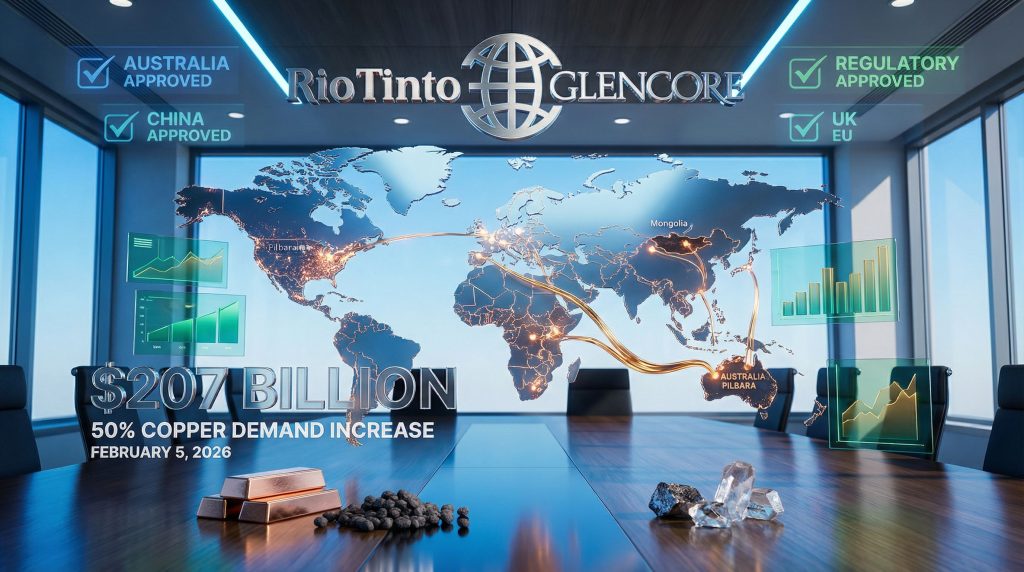
The proposed Rio Tinto Glencore merger talks centre around creating a $207 billion combined market value entity through an all-share transaction structure, potentially forming the world's largest mining company by market capitalisation. This valuation combines Rio Tinto's approximately $142 billion market value with Glencore's $65 billion valuation as of January 2026.
Market concentration analysis reveals the transformative scale implications of such a combination:
| Company | Market Capitalisation | Global Position | Key Commodities |
|---|---|---|---|
| Rio Tinto-Glencore Combined | $207 billion | #1 Global Miner | Iron ore, copper, base metals |
| BHP Group | $161 billion | #2 Position | Iron ore, copper, petroleum |
| Vale S.A. | ~$85 billion | #3 Position | Iron ore, base metals |
The all-share transaction structure minimises immediate cash requirements while creating significant shareholder dilution considerations for existing Rio Tinto investors. This approach allows both entities to maintain operational liquidity while combining complementary asset portfolios without substantial debt financing requirements.
Initial market reactions demonstrate investor uncertainty about deal terms and integration complexity. Glencore shares gained 6% following confirmation of renewed discussions, while Rio Tinto's Australian-listed shares declined as much as 6.4% in the largest intraday fall since July 2022, according to market data.
According to Jefferies analysts, while the proposed merger structure presents complexity, there exists a pathway to significant value creation for both entities, indicating professional confidence in strategic rationale despite structural integration challenges.
Operational Synergy Framework
The combined entity would control market-leading positions across critical commodity segments:
- Iron ore dominance: Rio Tinto's Pilbara operations represent approximately 60% of global seaborne supply
- Diversified copper portfolio: Geographic asset distribution across multiple continents
- Integrated trading platform: Glencore's commodity marketing capabilities combined with Rio Tinto's direct production
- Base metals leadership: Combined zinc, nickel, and aluminium production capacity
Complementary geographic portfolios reduce operational risks through diversified mining licences across Australia, South America, Africa, and Asia-Pacific regions. Shared logistics networks could optimise transportation costs through coordinated shipping schedules and port terminal utilisation.
Combined technology platforms would accelerate automation deployment across mining operations, while integrated commodity trading capabilities enhance price realisation through sophisticated hedging and marketing strategies that individual entities cannot achieve independently.
Critical Regulatory and Antitrust Challenges Ahead
The regulatory approval pathway for Rio Tinto Glencore merger talks involves complex multi-jurisdictional review processes with varying approval criteria and timeline requirements. UK Takeover Panel regulations establish a February 5, 2026 deadline for Rio Tinto to announce either a formal offer or intention not to proceed, creating definitive decision pressure.
China's dominant position as the primary buyer of industrial metals provides significant leverage in approval decisions through the State Administration for Market Regulation (SAMR). RBC analyst Kaan Peker identified this regulatory pathway as likely presenting the most substantial antitrust hurdles, given China's role as the dominant demand driver for copper, iron ore, and base metals.
Multi-Jurisdictional Approval Requirements
United Kingdom Regulation:
- February 5, 2026 decision deadline under UK Takeover Panel rules
- Standard 28-day consultation period following formal offer announcement
- Panel authority to extend timelines for additional due diligence requirements
- Shareholder approval threshold requirements for transaction completion
Australian Competition Assessment:
- Australian Competition and Consumer Commission (ACCC) review focusing on domestic market concentration
- Particular scrutiny of iron ore market dominance given Rio Tinto's existing position
- Potential asset divestiture requirements in overlapping commodity segments
- Supply security considerations for Australian industrial consumers
European Commission Analysis:
- Critical raw materials supply security versus competitive market balance
- Heightened scrutiny under EU critical materials regulations
- Potential remedies including supply commitments or asset divestitures
- Integration with European Green Deal commodity requirements
Chinese Regulatory Leverage:
- No formal approval timeline creating deal completion uncertainty
- Dominant buyer position providing substantial negotiating leverage
- Supply security considerations for Chinese industrial manufacturing
- Potential conditions on pricing mechanisms or supply allocation
Asset Divestiture Expectations
Industry observers anticipate substantial asset rationalisation requirements, particularly regarding coal operations. John Ayoub, Portfolio Manager at Wilson Asset Management and Rio Tinto shareholder, indicated that coal asset divestiture would be essential to secure Australian shareholder base support, reflecting institutional investor expectations around environmental, social, and governance positioning.
Historical precedent exists for coal asset divestiture, as Rio Tinto previously sold its last coal operations to Glencore in 2018, establishing a framework for potential reversal through financial buyers or existing coal-focused operators.
Regulatory Complexity Warning: Approval probability depends heavily on willingness to divest overlapping assets, particularly coal operations and certain copper mining licences, with Chinese regulatory position remaining the primary uncertainty factor.
Asset Portfolio Integration and Value Creation Opportunities
The strategic asset combination in Rio Tinto Glencore merger talks would create complementary geographic and commodity portfolios that address key supply chain risks while optimising operational efficiencies. Rio Tinto's strategic holdings include the Pilbara iron ore operations representing 60% of global seaborne supply, the Oyu Tolgoi copper-gold mine in Mongolia, aluminium smelting networks, and lithium development projects in Argentina.
Glencore's complementary portfolio provides diversified base metals operations including zinc, nickel, and cobalt production, a global commodity trading platform with sophisticated marketing capabilities, African copper mining operations for geographic diversification, and thermal plus metallurgical coal assets currently under strategic review.
Leadership and Cultural Integration Considerations
Rio Tinto's recent leadership transition creates favourable conditions for large-scale transaction consideration. CEO Simon Trott, selected in August 2025, was chosen partly because company leadership expressed preference for a leader more receptive to substantial deals than his predecessor, who was leading Rio Tinto when it declined Glencore's initial approach in late 2024.
Under Trott's leadership, Rio Tinto focuses on becoming leaner through non-core asset reduction, suggesting M&A strategy emphasises disciplined portfolio optimisation rather than expansion for growth sake alone.
Andy Forster, Senior Investment Officer at Argo Investments and Rio Tinto shareholder, identified cultural integration as the primary transaction risk factor. Glencore's trading background creates opportunistic and results-focused operational characteristics that could benefit Rio Tinto if managed appropriately, though integration complexity remains substantial.
Asset Rationalisation Framework
Copper Operations Consolidation:
- South American mining licence overlap creating processing facility sharing opportunities
- African copper operations providing geographic risk diversification
- Coordinated marketing reducing customer negotiating leverage
- Integrated logistics networks optimising transportation costs
Trading Platform Integration:
- Internal transfer pricing mechanisms between production and marketing
- Risk management alignment across commodity exposure
- Market positioning optimisation through information access
- Potential antitrust complications regarding market intelligence sharing
Iron Ore Infrastructure Optimisation:
- Port terminal capacity utilisation across customer relationships
- Supply chain coordination to major steel producers
- Bulk commodity handling efficiency improvements
- International shipping schedule optimisation
Coal Asset Exit Strategy:
- Divestiture to financial buyers or coal-focused operators
- Environmental liability transfer negotiations
- Employee transition and community impact management
- Regulatory approval facilitation through proactive divestiture
Market Reactions and Deal Structure Implications
Investor sentiment analysis reveals mixed reception to Rio Tinto Glencore merger talks, with market reactions highlighting concerns about deal structure, premium levels, and integration complexity. Glencore shareholders demonstrated positive reception with 6% share price gains following confirmation of renewed discussions, indicating confidence in potential premium realisation and strategic benefits.
Rio Tinto investor concerns manifested through significant share price declines, with Australian-listed shares falling as much as 6.4% in the largest single-day decline since July 2022. Hugh Dive, Chief Investment Officer at Atlas Funds Management and Rio Tinto shareholder, characterised market reactions as demonstrating clear investor dissatisfaction with transaction prospects.
Shareholder Value Considerations
Tim Hillier, analyst at Allan Gray and Rio Tinto investor, articulated shareholder risk concerns around potential overpayment scenarios. The risk analysis centres on premium levels relative to strategic value creation, with Allan Gray noting Rio Tinto maintains a robust pipeline of internal high-growth projects that may provide superior returns compared to external acquisition opportunities.
John Ayoub, Portfolio Manager at Wilson Asset Management, characterised Rio Tinto as representing a relatively straightforward investment thesis focused on iron ore, copper, aluminium, and lithium. Adding additional commodity exposures through acquisition potentially dilutes this focused narrative unless significant operational synergies offset complexity increases.
Share exchange ratio negotiations will reflect relative valuations using both asset-based methodologies and earnings multiple approaches. The $77 billion valuation gap between Rio Tinto and Glencore suggests substantial premium expectations from Glencore shareholders, while Rio Tinto shareholders face corresponding dilution concerns.
All-Share Structure Implications
The proposed all-share buyout structure provides several strategic advantages while creating specific risk considerations:
Advantages:
- Minimal cash requirement preserving Rio Tinto's financial flexibility
- Shared ownership in combined entity upside for both shareholder bases
- Reduced debt financing complexity and associated interest costs
- Ability to complete transaction without major asset liquidations
Risk Factors:
- Significant shareholder dilution for existing Rio Tinto investors
- Share exchange ratio sensitivity to market volatility during negotiation period
- Integration execution risk affecting combined entity performance
- Regulatory approval uncertainty creating deal completion risk
Long-Term Strategic Implications for Global Commodity Markets
The potential completion of Rio Tinto Glencore merger talks would establish unprecedented market concentration in critical commodity segments, fundamentally altering supply chain dynamics across multiple industrial sectors. Supply chain concentration risks emerge when single entities control substantial portions of essential mineral production, particularly given the combined entity's control over approximately 60% of global seaborne iron ore supply plus significant copper and base metals production capacity.
Pricing power implications for downstream industries include enhanced ability to influence commodity pricing cycles, though regulatory oversight and alternative supplier development efforts would likely constrain extreme price manipulation strategies. The combined entity's integrated trading platform would provide sophisticated market positioning capabilities unavailable to traditional mining-only operations.
However, the broader mining industry evolution suggests increased scrutiny of such consolidation, particularly given growing concerns about supply security in strategic minerals.
Innovation and Technology Integration Opportunities
Combined research and development capabilities would accelerate mining automation deployment across larger operational networks, creating economies of scale in technology development that individual companies cannot achieve independently. Shared environmental, social, and governance initiatives could establish industry-leading sustainability standards through resource consolidation and best practice implementation.
Integrated sustainability reporting frameworks would provide transparency across broader commodity portfolios, while technology transfer opportunities between operations could accelerate productivity improvements and environmental performance gains across geographic regions.
Alternative Supplier Development Acceleration
Enhanced market concentration typically accelerates alternative supplier development as consuming industries seek supply chain diversification. Strategic stockpiling initiatives by major consuming nations, particularly in critical minerals essential for energy transition and defence applications, could emerge as policy responses to increased concentration.
Mid-tier mining companies may benefit from increased acquisition interest as industrial consumers seek to secure alternative supply sources independent of the dominant combined entity. Private equity involvement in mining sector investments could increase as financial buyers recognise strategic value in supplying industries seeking supply chain diversification.
The next major ASX story will hit our subscribers first
Alternative Scenarios if Rio Tinto Glencore Merger Talks Fail
Should the current Rio Tinto Glencore merger talks not proceed, both entities face distinct strategic pathway options that reflect their individual operational strengths and market positions. Rio Tinto's standalone growth strategy could emphasise targeted copper asset acquisitions in geographically strategic locations, lithium project development acceleration in Argentina, and technology partnership expansion to maintain competitive positioning without large-scale M&A complexity.
Shareholder return optimisation through increased dividend distributions and share buyback programmes could address investor concerns about capital allocation efficiency, while maintaining focus on core iron ore, copper, aluminium, and lithium operations that provide clear investment thesis simplicity.
Glencore's Independent Strategic Options
Coal business separation and potential public listing could unlock value for shareholders whilst addressing environmental, social, and governance concerns that complicate integration with other mining entities. The coal operations divestiture or spin-off would create focused entities optimised for distinct investor bases and regulatory environments.
Commodity trading platform monetisation through strategic partnerships or partial divestiture could provide capital for mining operations expansion while maintaining competitive advantages in commodity marketing. The trading business represents unique capabilities that command premium valuations from financial buyers seeking commodity market exposure.
Regional consolidation opportunities in African copper operations or base metals production could provide growth without the regulatory complexity of mega-merger transactions. Private equity partnership models could provide capital for expansion whilst maintaining operational flexibility.
Industry Consolidation Cascade Effects
Failed Rio Tinto Glencore merger talks could trigger alternative consolidation scenarios across the mining sector, particularly given ongoing pressure from iron ore price trends and the broader US-China trade impact on global commodity markets.
BHP Group Response Strategies:
- Opportunistic acquisition targeting of mid-tier copper producers
- Technology partnership expansion to maintain competitive positioning
- Direct investment in energy transition metal development projects
- Strategic alliance formation with commodity trading entities
Mid-Tier Mining Positioning:
- Enhanced acquisition premiums from multiple potential buyers
- Strategic partnership opportunities with major consuming industries
- Technology sharing agreements with larger operational entities
- Geographic expansion through joint venture structures
Financial Sector Involvement:
- Private equity targeting of distressed or undervalued mining assets
- Sovereign wealth fund direct investment in critical mineral projects
- Infrastructure fund participation in mining transportation networks
- Commodity trading fund expansion into physical asset ownership
Investment Analysis and Market Outlook
The Rio Tinto Glencore merger talks create significant investment implications across multiple sectors and asset classes, extending well beyond direct mining industry exposure. Mining equipment manufacturers stand to benefit from integration capital expenditures required for operational optimisation and technology harmonisation across combined entity operations.
Transportation and logistics providers could capture substantial synergy implementation opportunities through optimised shipping schedules, port terminal utilisation, and bulk commodity handling efficiency improvements. The combined entity's enhanced scale would justify infrastructure investments that individual companies might delay or avoid entirely.
Sector Rotation and Portfolio Positioning
Alternative metal suppliers gain strategic importance as industrial consumers seek supply chain diversification independent of the dominant combined entity. Smaller copper producers, lithium development companies, and specialty metals operations could command premium valuations as strategic alternatives to concentrated supply sources.
Technology companies supporting digital transformation in mining operations benefit from larger-scale deployment opportunities and longer-term contract visibility. Automation system providers, data analytics platforms, and environmental monitoring technology suppliers could experience accelerated revenue growth through integrated operational networks.
Energy transition investment themes receive validation through the merger's focus on copper and other critical minerals essential for renewable energy infrastructure and artificial intelligence systems deployment.
Risk Framework and Scenario Planning
Investors should consider multiple outcome scenarios when evaluating exposure to Rio Tinto Glencore merger talks:
Successful Completion Scenario (Probability: Moderate):
- Enhanced pricing power in critical commodity segments
- Operational efficiency gains through scale optimisation
- Technology deployment acceleration across integrated operations
- Potential regulatory remedies reducing combined entity scope
Regulatory Rejection Scenario (Probability: Moderate-High):
- Alternative consolidation opportunities emerging across mining sector
- Continued fragmentation supporting alternative supplier premiums
- Individual entity strategic flexibility maintained
- Potential for alternative partnership structures
Partial Approval with Significant Divestitures (Probability: High):
- Reduced synergy realisation compared to full integration
- Asset divestiture creating opportunities for other market participants
- Regulatory precedent affecting future large-scale mining M&A
- Focus on core commodity segments with strategic importance
Environmental, Social, and Governance Considerations
The combined entity's enhanced scale would provide unprecedented ability to implement comprehensive sustainability initiatives across broader operational networks. Climate commitment implementation benefits from resource consolidation that enables larger-scale renewable energy deployment, carbon capture technology investment, and environmental remediation programme coordination.
Community engagement improvements could emerge through resource consolidation that allows more substantial local investment programmes and coordinated stakeholder relationship management across geographic regions. The combined entity's financial capacity would support community development initiatives that individual companies might struggle to finance independently.
Technology deployment for environmental performance acceleration includes automated monitoring systems, water management optimisation, and waste reduction programmes that benefit from economies of scale impossible for smaller operations to achieve.
Stakeholder pressure for responsible mining practices would intensify given the combined entity's market prominence, creating both reputational risks and opportunities to establish industry-leading standards that competitors must follow to maintain market access.
Disclaimer: This analysis contains forward-looking statements and market projections that involve substantial risks and uncertainties. Past performance does not guarantee future results. Commodity markets are subject to significant volatility, and mining industry investments carry specific risks including regulatory changes, environmental factors, and operational challenges. Readers should conduct independent research and consult qualified financial advisors before making investment decisions.
Ready to Capitalise on the Next Major Mining Discovery?
Discovery Alert's proprietary Discovery IQ model delivers real-time alerts on significant ASX mineral discoveries, instantly empowering subscribers to identify actionable opportunities ahead of the broader market. Understand why historic discoveries can generate substantial returns by visiting Discovery Alert's dedicated discoveries page and begin your 30-day free trial today to position yourself ahead of the market.