August 24, 2026
Rio Tinto's landmark achievement in commercial Rio Tinto lithium export from Rincon represents a pivotal moment in global lithium markets as mining companies navigate the complex interplay between resource scarcity, geopolitical tensions, and accelerating electric vehicle adoption. The traditional supply chain dependencies that defined battery material sourcing for decades are being rewritten by new producers entering commercial operations across previously underexplored regions. These developments represent more than incremental capacity additions; they signal fundamental changes in how critical minerals transition from extraction sites to manufacturing centers, with implications extending far beyond quarterly production figures.
Strategic Positioning in Argentina's Lithium Triangle Evolution
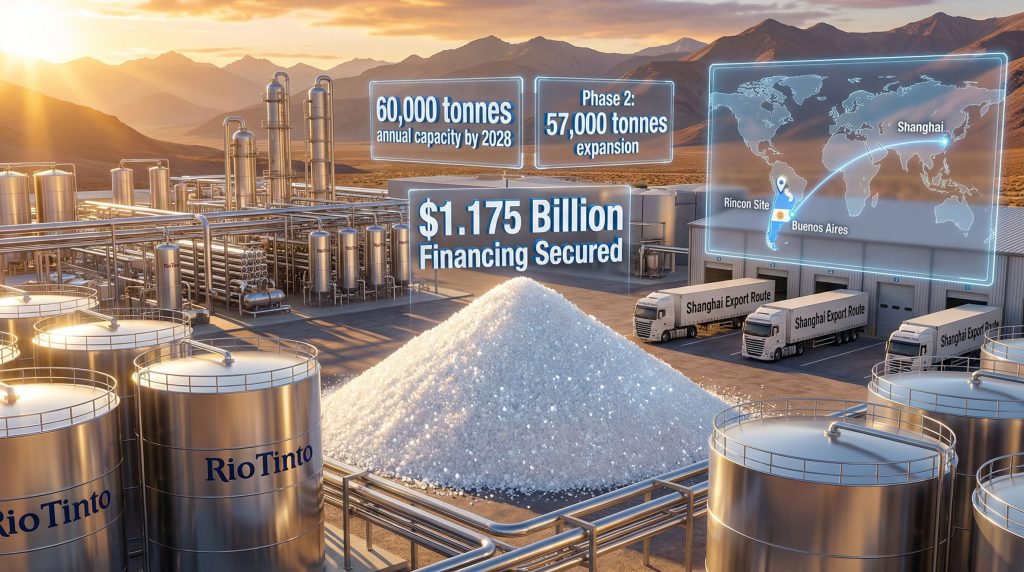
Rio Tinto's commercial lithium export from Rincon represents a calculated entry into one of the world's most contested mineral extraction zones. The company's March 2026 shipment of 200 tonnes of battery-grade lithium carbonate from Buenos Aires to Shanghai marks the operational debut of what has become their flagship South American lithium asset following the Jadar project suspension in Serbia during 2025.
The timing of this market entry reflects broader industry dynamics within the lithium triangle, where Argentina's regulatory environment has increasingly favoured large-scale international mining operations. Furthermore, the Rincon project's location in Salta province positions Rio Tinto within a geographic cluster that concentrates significant global lithium resources across Argentina, Chile, and Bolivia.
Current Production Infrastructure:
- Initial plant capacity: 3,000 tonnes annually
- Expansion plant under construction: 57,000 tonnes annually
- Target combined capacity: 60,000 tonnes by 2028
- Projected operational life: 40 years
- Total expansion investment: $2.5 billion
The production scaling strategy reveals Rio Tinto's approach to risk management in volatile commodity markets. Rather than pursuing immediate maximum capacity, the phased development allows operational optimisation and market responsiveness while the company builds processing expertise in direct lithium extraction technologies.
This measured approach contrasts with more aggressive expansion strategies employed by established lithium triangle producers. Consequently, it suggests Rio Tinto's confidence in long-term demand growth rather than capturing immediate market share premiums.
When big ASX news breaks, our subscribers know first
Export Infrastructure and Supply Chain Architecture
The routing of Rincon's inaugural lithium shipment through Buenos Aires reveals strategic logistics considerations extending beyond immediate cost optimisation. The selection of this export corridor over alternative Chilean port options reflects Rio Tinto's assessment of infrastructure reliability, handling capacity, and long-term scalability requirements for sustained commercial operations.
Buenos Aires provides multimodal transportation advantages for inland Salta province operations, with established rail and trucking networks capable of handling large-volume mineral exports. In addition, the port infrastructure has been upgraded to accommodate increasing lithium carbonate shipments from Argentina's expanding production base, offering dedicated storage facilities and specialised handling equipment.
Shanghai Destination Analysis:
- Direct access to China's battery manufacturing hub
- Proximity to major cathode material producers
- Established lithium carbonate trading markets
- Processing capability for further purification if required
The Chinese destination selection indicates Rio Tinto's initial customer base and supply agreement structure. Shanghai serves as a distribution point for battery material supply chains extending throughout Asia, providing market flexibility beyond single-customer dependencies.
Transportation cost economics favour the Buenos Aires-Shanghai route for large-volume shipments. However, container shipping infrastructure optimised for bulk commodity movements supports Rio Tinto's production scaling timeline, ensuring export capacity matches expanding output from both operational and planned facilities.
Multi-Institution Financing Framework Analysis
The $1.175 billion financing package assembled for Rincon's expansion demonstrates sophisticated risk distribution across development finance institutions with complementary strategic mandates. This funding architecture reflects current market conditions where traditional mining finance has become increasingly complex due to environmental scrutiny and geopolitical considerations.
| Institution | Type | Regional Focus | Strategic Mandate |
|---|---|---|---|
| International Finance Corporation (IFC) | World Bank Group | Global emerging markets | Private sector development |
| IDB Invest | Inter-American Development Bank | Latin America | Regional infrastructure |
| Export Finance Australia | Government export credit | Australian corporate expansion | Critical minerals supply |
| Japan Bank for International Cooperation (JBIC) | Development finance | Supply chain security | Energy transition materials |
This consortium structure provides Rio Tinto with capital cost advantages while distributing political and currency risks across institutions with established relationships in Argentine mining sectors. Each lender brings specific expertise in project finance, regulatory navigation, and risk mitigation that individual bank financing typically cannot provide.
The participation of multiple development finance institutions suggests project alignment with broader policy objectives around critical mineral supply chain diversification and Latin American economic development. Furthermore, these institutional relationships potentially provide operational advantages beyond pure financing, including regulatory support and stakeholder management capabilities.
Risk Mitigation Mechanisms:
- Currency diversification across four institutional sources
- Political risk distribution through multilateral lenders
- Environmental and social compliance frameworks
- Long-term operational stability through development finance backing
The financing timeline, coinciding with first commercial shipments, indicates successful completion of technical due diligence and operational readiness assessments by all participating institutions.
Production Economics and Technology Selection
Rincon's production economics reflect Rio Tinto's strategic emphasis on operational efficiency and environmental sustainability within Argentine regulatory frameworks. The company's investment in direct lithium extraction (DLE) technology represents a significant departure from traditional evaporation pond methods that have dominated South American lithium production.
DLE technology offers several operational advantages in Salta province's arid environment, including reduced water consumption, faster processing times, and higher recovery rates from brine sources. These factors contribute to lower operational costs per tonne while minimising environmental impact in water-scarce regions.
Production Capacity Analysis:
- Phase 1 operational: 3,000 tonnes annually
- Phase 2 construction: 57,000 tonnes annually (2028)
- Total investment per tonne capacity: $41,667
- Processing technology: Direct lithium extraction
- Recovery efficiency: Higher than traditional evaporation methods
The capital intensity of $41,667 per annual tonne of capacity positions Rincon competitively within industry benchmarks for greenfield lithium developments. This metric includes infrastructure, processing equipment, and operational facilities necessary for sustained production over the 40-year project life.
Operational cost structure benefits from DLE technology's reduced energy requirements and water consumption compared to traditional processing methods. Moreover, the technology selection enables consistent production output regardless of seasonal weather variations that can impact evaporation pond operations.
"The project's 60,000-tonne annual capacity could theoretically supply lithium for over one million electric vehicles annually, assuming average battery lithium content of 50-60 kilograms per vehicle."
RIGI Framework and Investment Climate Dynamics
Argentina's Régimen de Incentivo para Grandes Inversiones (RIGI) provides the regulatory foundation supporting Rio Tinto's expansion investment decision. This framework offers 30-year tax stability guarantees, foreign exchange access protections, and import duty exemptions specifically designed to attract large-scale mining investments.
The RIGI regime addresses historical concerns about Argentine currency volatility and regulatory unpredictability that previously deterred international mining investment. For projects exceeding $200 million in investment, RIGI provides legal protections that effectively insulate operations from domestic policy changes.
RIGI Benefits for Mining Operations:
- Tax rate stability for three decades
- Guaranteed access to foreign currency for imports and profit repatriation
- Accelerated depreciation on capital investments
- Import duty exemptions on mining equipment
- Regulatory approval streamlining
These protections significantly improve project economics by reducing political risk premiums in financing costs and providing operational certainty for long-term planning. The framework has been particularly attractive to lithium developers given the strategic importance of battery materials in global energy transition policies.
Rio Tinto's RIGI application represents confidence in Argentina's commitment to maintaining investor-friendly policies despite historical precedents of policy reversals. The 40-year operational timeline requires regulatory stability extending well beyond typical political cycles.
Regional Asset Portfolio Integration Strategy
Rincon's operational debut positions Rio Tinto to leverage synergies across its broader South American lithium portfolio, which includes the Fénix project in Catamarca province and Olaroz development in Jujuy province. This geographic clustering strategy enables shared infrastructure, technical expertise, and operational efficiency gains.
The portfolio approach allows Rio Tinto to optimise resource allocation across projects at different development stages while building regional expertise in lithium brine processing. Shared services including logistics, procurement, and technical support reduce per-project operational costs.
Portfolio Positioning Benefits:
- Diversified geological risk across multiple salars
- Shared technical and operational expertise
- Economies of scale in equipment procurement and maintenance
- Integrated logistics and export infrastructure
- Regional workforce development and retention
The timing of Rincon's commercial production provides operational experience applicable to advancing the Fénix and Olaroz projects. Technical learning from DLE implementation and brine processing optimisation can be transferred across the portfolio, reducing development risks and capital requirements for subsequent projects.
This integrated approach reflects Rio Tinto's long-term commitment to South American lithium production rather than single-project exposure. Consequently, the strategy provides production flexibility and market responsiveness as demand patterns evolve across different battery chemistry applications.
The next major ASX story will hit our subscribers first
Market Entry Timing and Demand Alignment
The 2026 commencement of commercial Rio Tinto lithium export from Rincon aligns strategically with projected lithium market dynamics, as industry analysts forecast significant supply deficits emerging by 2027-2028. This timing provides Rio Tinto with favourable market entry conditions as electric vehicles impact mining and adoption accelerates globally.
Current lithium market fundamentals support the expansion timeline, with battery manufacturers increasingly seeking supply diversification away from concentrated production sources. Argentine lithium offers geographic and political risk diversification for battery supply chains heavily dependent on Chinese and Chilean production.
Market Timing Advantages:
- Entry during projected supply shortage period
- Rising battery manufacturer demand for supply security
- Premium pricing for battery-grade lithium carbonate
- Limited new production capacity from competing projects
- Established customer relationships through Shanghai export hub
The 2028 timeline for full 60,000-tonne capacity aligns with electric vehicle production scaling across major automotive manufacturers. This synchronisation between supply availability and demand growth provides pricing power and contract negotiation advantages.
Global lithium demand projections indicate annual growth rates of 20-25% through 2030, driven primarily by electric vehicle battery production and energy storage system deployment. Rincon's production profile matches this demand trajectory, supporting sustained high utilisation rates throughout the operational life.
What Makes DLE Technology a Game Changer?
Rio Tinto's selection of direct lithium extraction technology for Rincon represents a significant technological bet within the South American lithium industry, where traditional evaporation pond methods have dominated production for decades. DLE technology offers operational advantages particularly relevant to the project's location and environmental considerations.
The technology enables continuous processing independent of seasonal weather patterns that affect evaporation operations, providing production consistency and improved capacity utilisation. Processing times are significantly reduced from the 12-18 month evaporation cycles to continuous extraction and processing systems.
DLE Technology Advantages:
- Water consumption reduction of 80-90% compared to evaporation ponds
- Processing time reduction from months to hours
- Higher lithium recovery rates from brine sources
- Reduced environmental footprint and land use requirements
- Consistent production output regardless of weather conditions
The technology selection supports Rio Tinto's broader sustainability commitments while providing operational efficiency gains in water-scarce environments. Salta province's arid conditions make water conservation particularly important for long-term operational viability.
Implementation risks include technology scaling challenges and operational complexity compared to proven evaporation methods. However, Australia lithium innovations and Rio Tinto's technical expertise and partnership with technology providers mitigate these risks while positioning the company at the forefront of lithium processing innovation.
Critical Minerals Portfolio Strategic Context
Rincon's role within Rio Tinto's global operations extends beyond lithium production to support the company's strategic evolution toward critical minerals essential for energy transition technologies. This positioning reflects broader industry transformation as mining companies adapt to changing commodity demand patterns.
The project provides Rio Tinto with exposure to battery-grade lithium refinery markets exhibiting fundamentally different dynamics from traditional bulk commodities. Lithium demand is primarily driven by technological adoption rather than infrastructure development or industrial production cycles.
Portfolio Diversification Impact:
- Critical minerals exposure complementing traditional commodities
- Energy transition technology material positioning
- Geographic expansion into South American mining markets
- Technology innovation capabilities in processing and extraction
- Customer base diversification into battery and automotive sectors
The integration of lithium production with Rio Tinto's existing copper operations creates potential synergies in exploration, logistics, and market development. Both commodities are essential for electrification infrastructure, providing integrated exposure to energy transition themes.
Long-term strategic value extends beyond current production economics to positioning within evolving global supply chains for critical minerals. Government policies increasingly prioritise supply chain security for battery materials, potentially providing regulatory advantages for established producers.
How Will This Impact Global Lithium Supply Chains?
The successful launch of Rio Tinto lithium export from Rincon operations signals a fundamental shift in global lithium supply chain dynamics. This development introduces a new major player into markets previously dominated by Chinese and Chilean producers, providing much-needed supply diversification for battery manufacturers worldwide.
The project's 60,000-tonne annual capacity represents approximately 5-7% of current global lithium carbonate production, making it a significant factor in market supply balance. Furthermore, the Rio Tinto's operational milestone demonstrates that Argentine lithium projects can achieve commercial viability despite complex regulatory and logistical challenges.
For battery manufacturers, Rincon provides an alternative supply source with established logistics infrastructure and proven production capabilities. This diversification reduces dependence on concentrated supply sources and provides negotiating leverage in long-term supply agreements.
The success of Rio Tinto's Argentine operations may encourage other international mining companies to accelerate their lithium projects in the region. This could lead to increased competition and potentially more favourable pricing for battery manufacturers in the medium term.
Disclaimer: This analysis is based on publicly available information and industry reports. Commodity prices, production timelines, and project economics are subject to significant uncertainty and risk factors that could materially affect outcomes. Readers should conduct independent due diligence and consult qualified professionals before making investment decisions.
Ready to Identify the Next Major Lithium Discovery?
Discovery Alert's proprietary Discovery IQ model delivers real-time alerts on significant ASX mineral discoveries, instantly empowering subscribers to identify actionable opportunities ahead of the broader market. Discover why historic mineral discoveries can generate substantial returns and begin your 14-day free trial today to position yourself ahead of the market.