June 22, 2026
The Hidden Geography Behind the World's Cleanest Aluminium
The global aluminium industry sits at a crossroads rarely seen in heavy manufacturing. On one side lies a vast majority of production capacity still reliant on coal-fired electricity and ageing smelting infrastructure, generating nearly 11 tonnes of CO₂-equivalent for every tonne of metal produced. On the other side, a narrow but growing band of producers is demonstrating that the physics of aluminium smelting can be fundamentally reimagined when the right technology meets the right energy source. The Rio Tinto low-carbon aluminium smelter expansion in Québec stands as one of the most compelling examples of this shift.
That intersection is not theoretical. It exists in a specific geography, in the Saguenay–Lac-Saint-Jean region of Québec, Canada, where Rio Tinto's Complexe Arvida has just completed the commissioning of one of the most carbon-efficient primary aluminium smelting operations ever built at commercial scale. Understanding why this matters requires looking beyond the project itself and into the structural forces that made it possible.
When big ASX news breaks, our subscribers know first
Why Québec Has Become the Global Benchmark for Low-Carbon Aluminium Production
The Convergence of Hydropower, Advanced Smelting Technology, and Industrial Policy
Aluminium smelting is among the most electricity-intensive industrial processes on earth. The Hall-Héroult process, which underpins virtually all primary aluminium production globally, requires continuous high-voltage direct current to dissolve aluminium oxide in molten cryolite and deposit pure aluminium at the cathode. The carbon footprint of the resulting metal is therefore almost entirely a function of the electricity source powering that electrochemical reaction.
This is where Québec's geography becomes a decisive industrial variable. The province commands an extraordinary endowment of run-of-river and reservoir hydroelectric capacity, delivering clean, dispatchable electricity at some of the most competitive industrial tariffs in North America. Unlike wind or solar generation, hydro provides the stable, high-load baseload power that aluminium smelters require around the clock. This combination of scale, reliability, and carbon-free generation creates a structural moat that most competing jurisdictions simply cannot replicate through energy policy alone.
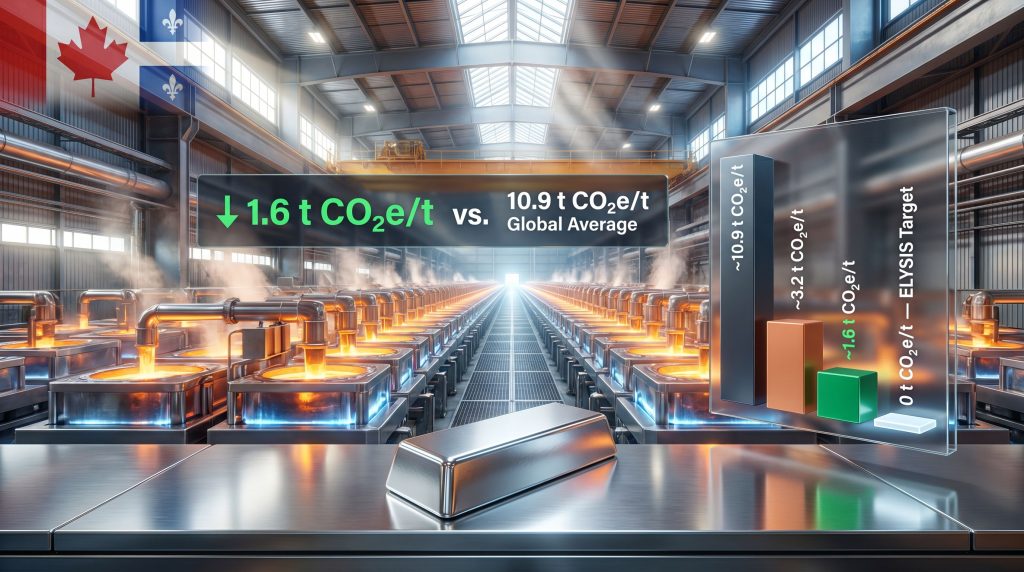
When Rio Tinto's AP60 smelting technology is layered onto this hydropower foundation, the resulting carbon intensity falls to approximately 1.6 tonnes of CO₂-equivalent per tonne of aluminium produced. That figure represents roughly one-sixth of the global industry average and half the emissions of the older Arvida smelter technology it is progressively replacing.
How Canada's Energy Geography Creates a Structural Competitive Advantage in Green Metals
The significance of this advantage deserves quantification. Furthermore, Canada's energy transition challenges highlight just how rare a combination of affordable, reliable, and carbon-free industrial electricity truly is. Consider the emissions comparison across production pathways:
| Technology / Benchmark | CO₂e per Tonne of Aluminium |
|---|---|
| Global Industry Average | ~10.9 t CO₂e/t |
| Older Arvida Smelter Technology | ~3.2 t CO₂e/t |
| AP60 + Hydropower (Québec) | ~1.6 t CO₂e/t |
| ELYSIS (Carbon-Free Target) | 0 t CO₂e/t (oxygen by-product) |
The majority of global aluminium output, dominated by Chinese and other Asian producers drawing heavily on coal-fired grids, operates at or near the 10.9 t CO₂e/t benchmark. European smelters using renewable-heavy grids typically achieve somewhere between 4 and 8 t CO₂e/t depending on their specific energy mix. Québec's AP60 operations, however, sit in an entirely different category, closer to the theoretical minimum achievable with current commercial technology.
What Is AP60 Technology and Why Does It Matter for the Future of Aluminium Smelting?
A Technical Overview of Advanced Pot Technology at Commercial Scale
The AP60 designation refers to an advanced electrolytic pot design developed internally by Rio Tinto's research and development teams. The number 60 broadly reflects the approximate amperage range (in kiloamperes) at which each pot operates, though the precise configuration involves sophisticated electrode geometry, improved thermal management, and enhanced current distribution to maximise aluminium yield per unit of energy consumed.
In practical terms, AP60 pots are larger, more thermally stable, and more energy-efficient than the designs they supersede. They are capable of sustaining higher current densities while maintaining tighter control over the bath chemistry, which reduces variability in metal quality and lowers the frequency of operational disruptions that can spike emissions.
How AP60 Differs from Conventional Hall-Héroult Smelting Processes
Conventional Hall-Héroult smelters, many of which were designed in the 1960s through 1980s, operate with carbon anodes that are consumed during the electrolysis process, releasing CO₂ as a direct by-product alongside the aluminium. This anode consumption is an inherent chemical feature of the process, not merely an energy problem. Older pot designs also tend to run at lower amperages with less precise thermal control, resulting in more variable bath conditions and higher rates of anode effect, a phenomenon where perfluorocarbon gases with very high global warming potentials are released.
AP60 technology addresses several of these issues simultaneously:
- Higher amperage efficiency reduces the electrical energy required per tonne of aluminium
- Improved bath stability minimises the frequency and duration of anode effects
- Better pot geometry limits heat losses and supports more consistent operational parameters
- Reduced fine particulate matter emissions expected to be up to 90% lower than the legacy Arvida potrooms being replaced
That last point is frequently overlooked in carbon-focused discussions. Particulate emissions from older smelters carry meaningful implications for community air quality in the surrounding Saguenay–Lac-Saint-Jean region. The reduction delivered by AP60 technology consequently represents a genuine public health dividend alongside the headline carbon benefits.
How Large Is the Complexe Arvida AP60 Expansion and What Does It Deliver?
Project Scale, Capital Commitment, and Construction Timeline
The Complexe Arvida AP60 expansion represents one of the most significant capital commitments to primary aluminium production in the Western world in recent memory. Rio Tinto's official announcement outlines the full scope of the project.
Project Snapshot:
- Total capital investment: US$1.5 billion
- New AP60 pots commissioned: 96
- Additional annual production capacity: ~160,000 metric tonnes
- Total AP60 annual output at Arvida (post-expansion): ~220,000 metric tonnes
- Start-up commenced: March 2026
- Full commissioning target: End of 2026
Start-up of the first pots commenced in March 2026, with the full fleet of 96 pots targeted for complete commissioning by the close of 2026. The sequential pot start-up approach is standard practice in smelter expansions, allowing operational teams to stabilise each section of the potline before introducing additional load to the electrical busbar system.
Production Transition Strategy: Closing Old Potrooms While Scaling New Capacity
The expansion has been designed around a deliberate phase-in, phase-out production architecture. As the new AP60 potline reaches full output, the legacy Arvida potrooms are being progressively decommissioned, with closure expected to complete in June 2026. The transition is structured so that the combination of the new AP60 output and a planned aluminium recycling centre at Arvida more than offsets the production volumes lost from retiring the older technology.
This approach reflects a sophisticated understanding of operational risk. Smelter startups carry meaningful technical exposure, particularly around pot heat-up sequences and initial bath chemistry establishment. Overlapping the new capacity build with the legacy closure schedule therefore provides a buffer against commissioning delays while maintaining supply continuity to downstream customers.
What "First Major Primary Aluminium Project in the West in Over a Decade" Means for Supply Security
The characterisation of this project as the first major primary aluminium development in the Western world in more than ten years is not marketing language. It reflects a genuine reality of chronic capital underinvestment across North American and European smelting capacity since the mid-2010s, driven by high energy costs, regulatory uncertainty, and the difficulty of competing with low-cost Asian production.
The result has been a gradual erosion of Western smelting capacity and a corresponding increase in import dependence at precisely the moment when manufacturers across transportation, defence, and clean energy sectors are seeking verifiably low-carbon domestic supply. In this context, the use of renewable power in mining and primary metals is no longer optional but strategically essential.
What Is the Economic and Employment Impact of the Arvida AP60 Expansion?
Direct and Indirect Job Creation Across the Québec Economy
| Employment Category | Figures |
|---|---|
| Permanent high-quality jobs created | ~100 |
| Peak construction workforce | 1,500+ |
| Economic benefit to Québec (contractors and suppliers) | CAD$1 billion+ |
Beyond the headline numbers, the economic significance runs deeper. Smelter construction projects of this scale tend to generate substantial multiplier effects through local procurement of civil, mechanical, electrical, and instrumentation services. The concentration of spending within the Saguenay–Lac-Saint-Jean region means that much of the CAD$1 billion in contractor and supplier activity flows through an economy that has historically been tied to industrial anchors of exactly this type.
Why Industrial Anchors Like This Matter for Resource-Dependent Regional Economies
Saguenay–Lac-Saint-Jean has been home to aluminium smelting for more than a century. The local workforce carries deep institutional knowledge of smelter operations, and the regional supply chain has developed around servicing that industrial base. Regions that have lost primary smelting capacity, such as parts of the Pacific Northwest in the United States where energy cost pressures forced closures, have found it extremely difficult to rebuild that industrial ecosystem once it dissipates.
Québec's hydropower cost advantage provides structural insulation against the energy cost dynamics that have driven closures elsewhere. The decision to invest US$1.5 billion in expanding AP60 capacity at Arvida is, among other things, a statement about the long-term viability of that cost advantage as a competitive foundation.
How Does the AP60 Expansion Connect to Rio Tinto's Broader Decarbonisation Roadmap?
The ELYSIS Partnership: A Pathway to Zero-Direct-Emission Aluminium Smelting
AP60 represents the current state of the art in commercial aluminium smelting, but the trajectory of Rio Tinto's decarbonisation strategy extends further. ELYSIS, a joint development initiative in which Rio Tinto is a partner, is targeting the complete elimination of direct greenhouse gas emissions from the aluminium electrolysis process itself. This ambition sits alongside broader industry efforts such as the low-carbon alumina partnership that signals growing momentum across the aluminium value chain.
The fundamental innovation in ELYSIS technology lies in the replacement of consumable carbon anodes with inert anode materials. Because conventional anodes are made of carbon and are chemically oxidised during electrolysis, they release CO₂ as an unavoidable direct emission. Inert anodes do not oxidise in the same way. Instead of releasing carbon dioxide, an ELYSIS cell produces oxygen as its primary gaseous by-product, a remarkable inversion of the conventional emissions profile.
The Government of Canada has provided support for ELYSIS demonstration infrastructure through the Strategic Innovation Fund, a federal program supporting advanced technology development. Investissement Québec is partnering in the construction of a demonstration plant in the Saguenay–Lac-Saint-Jean region. It is important to note that this government involvement relates specifically to the ELYSIS demonstration program and does not constitute confirmed government backing for the AP60 commercial expansion itself.
Carbon Abatement at Scale: Quantifying the Emissions Avoided
Emissions Reduction Metric: The expanded AP60 smelter is projected to avoid approximately 290,000 tonnes of CO₂-equivalent per year compared to the older Arvida technology it is replacing. To contextualise that figure, removing a typical passenger vehicle from the road eliminates roughly 4.6 tonnes of CO₂ annually, meaning the AP60 expansion delivers an annual abatement equivalent to taking more than 63,000 vehicles off the road, every year, indefinitely.
This is not a marginal improvement. It is a structural step-change in the emissions profile of a single industrial facility, achieved without reducing output and while maintaining full commercial competitiveness.
The next major ASX story will hit our subscribers first
Which End Markets Benefit Most from Low-Carbon Aluminium Supply Expansion?
Transportation, Construction, Electrical, and Consumer Goods: Demand Drivers Explained
The expansion of verified low-carbon aluminium supply from Québec arrives at a moment of intensifying demand from several key end markets simultaneously:
-
Automotive and electric vehicles: Lightweighting requirements for battery electric platforms are driving higher aluminium content per vehicle. Automakers facing Scope 3 emissions scrutiny are increasingly specifying low-carbon aluminium in procurement contracts.
-
Construction: Embodied carbon standards in green building frameworks are creating purchasing pressure toward lower-emission structural and cladding materials, including aluminium.
-
Electrical infrastructure: Grid expansion programmes, including transmission upgrades, transformer manufacturing, and conductor production, are creating sustained demand for primary aluminium with verifiable carbon credentials.
-
Consumer electronics and packaging: Premium brands facing consumer and regulatory pressure on product lifecycle emissions are auditing upstream material carbon intensity with growing rigour.
The Premium Market for Certified Low-Carbon Aluminium
A commercially important dynamic is emerging in aluminium markets: buyers are increasingly willing to pay a price premium for metal carrying verified low-carbon certification. This premium reflects both the genuine scarcity of sub-2 t CO₂e/t primary aluminium and the economic value that low-carbon supply creates for manufacturers managing Scope 3 emissions reporting obligations.
The Québec AP60 output, combined with traceability tools that Rio Tinto has been developing across its aluminium business, positions Complexe Arvida as a premium supply source for manufacturers seeking both North American origin and leading carbon credentials simultaneously. These two attributes together are genuinely rare in global primary aluminium supply. Furthermore, advances in clean energy metals processing across allied industries are reinforcing the commercial case for verified low-carbon credentials throughout the metals supply chain.
How Does Rio Tinto's Québec Strategy Compare to Global Aluminium Decarbonisation Efforts?
A Comparative Framework: Western Low-Carbon Aluminium Initiatives
| Initiative / Producer | Technology Pathway | Carbon Intensity | Status |
|---|---|---|---|
| Rio Tinto AP60 (Québec) | Advanced pot + hydropower | ~1.6 t CO₂e/t | Commissioned 2026 |
| ELYSIS (Québec) | Inert anode electrolysis | 0 t CO₂e/t (target) | Demonstration phase |
| European smelters (renewable grid) | Conventional + renewable energy | ~4–8 t CO₂e/t | Operational |
| Global average (coal-powered) | Conventional Hall-Héroult | ~10.9 t CO₂e/t | Dominant globally |
Why Hydropower Is the Critical Variable That Most Competitors Cannot Replicate
The table above reveals a structural truth that deserves emphasis: the gap between AP60 performance in Québec and European smelters using renewable energy is not primarily a technology gap. European producers running conventional pot technology on renewable grids still typically achieve only 4 to 8 t CO₂e/t, a multiple of the Québec figure. The difference is not just the pot design; it is the combination of AP60 efficiency with the reliability, load-following capability, and cost structure of dedicated hydroelectric supply.
Intermittent renewables like wind and solar cannot power aluminium smelters directly without storage or backup, creating complexity and cost. Hydro delivers the continuous, stable megawatt-hours that smelting demands. This combination of geographic endowment and technological investment is not something that policy alone can manufacture in other jurisdictions. It took over a century of infrastructure investment in Québec to create the conditions that now constitute a genuine global competitive advantage in low-carbon primary metal production. Rio Tinto's Gladstone aluminium shift further illustrates how the company is applying similar thinking across its global smelting portfolio.
Navigating US Tariff Uncertainty While Maintaining Long-Term Industrial Investment
One dimension of the Rio Tinto low-carbon aluminium smelter expansion in Québec that deserves specific attention is the trade policy environment in which it was commissioned. Québec's Premier Christine Fréchette acknowledged publicly that the project's inauguration proceeds despite ongoing economic uncertainty linked to US tariff policy. The decision by both the provincial government and Rio Tinto to proceed reflects a conviction that the long-term strategic value of low-carbon industrial capacity in Québec outweighs near-term trade disruption risk.
This is a meaningful signal. Large-scale primary metals investments typically have capital lives measured in decades. The decision to commit US$1.5 billion to an AP60 expansion in 2026 implies a view that:
- North American demand for low-carbon primary aluminium will remain structurally robust regardless of tariff fluctuations
- Hydropower-based production in Québec carries inherent cost advantages that provide resilience against trade-related demand volatility
- Carbon credentials may themselves function as a partial hedge, as carbon border adjustment mechanisms mature in major export markets
Frequently Asked Questions: Rio Tinto AP60 Smelter Expansion in Québec
What is the AP60 smelter expansion at Complexe Arvida?
A US$1.5 billion capital project adding 96 new AP60 electrolytic pots at Rio Tinto's Complexe Arvida facility in Québec, increasing annual primary aluminium output by approximately 160,000 metric tonnes to a total of 220,000 metric tonnes using AP60 technology.
When will the AP60 expansion be fully operational?
Start-up commenced in March 2026, with full commissioning of all 96 pots targeted for completion by the end of 2026.
How does AP60 technology reduce carbon emissions?
When powered by Québec's hydroelectric grid, AP60 produces approximately 1.6 tonnes of CO₂-equivalent per tonne of aluminium, roughly one-sixth of the global industry average of 10.9 t CO₂e/t and half the emissions intensity of the older Arvida smelter technology it is replacing.
What is ELYSIS and how does it relate to the AP60 expansion?
ELYSIS is a next-generation carbon-free aluminium electrolysis technology under development in Québec, with the Government of Canada providing support through the Strategic Innovation Fund and Investissement Québec partnering in demonstration plant construction. AP60 represents the current commercial-scale bridge technology while ELYSIS aims to eliminate all direct greenhouse gas emissions from smelting, producing oxygen as a by-product instead.
How many jobs does the project create?
The expansion supports approximately 100 permanent positions and generated more than 1,500 jobs at peak construction, with over CAD$1 billion in economic activity flowing to Québec contractors and suppliers.
Why is this project significant for North American aluminium supply?
It represents the first major primary aluminium project commissioned in the Western world in more than a decade, providing North American manufacturers with expanded access to domestically produced, verifiably low-carbon aluminium at a time when supply chain resilience and decarbonisation credentials are both at a premium. For further context, Reuters coverage of the commissioning provides a useful overview of the broader industry significance.
Key Takeaways: What the Arvida AP60 Expansion Signals for the Low-Carbon Metals Industry
Five Strategic Implications for Investors, Policymakers, and Industrial Buyers
The Rio Tinto low-carbon aluminium smelter expansion in Québec carries implications that extend well beyond a single facility. In summary, here are five strategic takeaways:
-
Technology leadership at commercial scale is now a genuine competitive differentiator in primary metals, with AP60 demonstrating that sub-2 t CO₂e/t aluminium is achievable today, not in some future demonstration scenario.
-
Hydropower geography is emerging as one of the most strategically valuable industrial assets a jurisdiction can possess, with its combination of cost, reliability, and carbon-free output creating conditions that renewable energy policy alone cannot replicate.
-
The inert anode pathway represented by ELYSIS is narrowing the gap between current best practice and zero-direct-emission smelting faster than most market participants anticipated, with commercial demonstration now underway rather than confined to laboratory settings.
-
Western supply chain resilience in aluminium is being rebuilt around carbon intensity credentials alongside volume, shifting the competitive dynamic away from pure cost competition with coal-powered Asian producers.
-
Long-duration industrial capital is returning to primary metals in the West, signalling that investors and operators see sufficient long-term demand certainty in low-carbon aluminium to justify decade-spanning infrastructure commitments despite near-term trade policy uncertainty.
Disclaimer: This article contains forward-looking statements, production targets, and emissions projections that are subject to change based on operational, regulatory, and market conditions. Nothing in this article constitutes financial or investment advice. Readers should conduct independent research before making investment decisions.
Want to Capitalise on the Next Major Resource Discovery Before the Market Does?
The shift toward low-carbon metals like the aluminium being produced at Complexe Arvida signals growing institutional demand for resource security — and that demand is quietly reshaping ASX exploration investment. Discovery Alert's proprietary Discovery IQ model delivers real-time notifications the moment significant ASX mineral discoveries are announced, translating complex geological data into actionable insights for investors at every level — explore historic discovery returns to see what early positioning can mean, then begin a 14-day free trial to stay ahead of the next major find.