July 3, 2026
The Global Race for Green Aluminium and Why Location Is Everything
Aluminium production accounts for roughly 2% of global greenhouse gas emissions, a figure that understates its strategic weight in the net-zero transition. Unlike steel or cement, aluminium's carbon intensity is almost entirely determined by its electricity source rather than its chemistry. This single fact transforms energy geography into competitive destiny, and no region on earth has exploited that reality more deliberately than Quebec.
Understanding the Rio Tinto low-carbon smelter expansion in Quebec requires more than reading a project announcement. It demands a grasp of electrolysis physics, hydropower economics, evolving trade policy, and the multi-decade technology roadmap that connects today's AP60 pots to tomorrow's carbon-free smelting cells.
When big ASX news breaks, our subscribers know first
Why Quebec Has Become the Global Benchmark for Low-Carbon Aluminium Production
The Structural Advantage of Hydropower-Dependent Smelting
Aluminium is produced through the Hall-Heroult process, an electrochemical reaction that dissolves aluminium oxide in molten cryolite and passes electrical current through the bath to deposit pure metal. The process is extraordinarily electricity-intensive, consuming roughly 13 to 15 megawatt-hours per tonne of aluminium produced. That electricity demand means the carbon intensity of the grid supplying a smelter is essentially the carbon intensity of the metal itself.
Quebec's hydroelectric system, operated primarily through Hydro-Quebec, delivers one of the cleanest large-scale electricity grids anywhere in the world. With approximately 99% of provincial electricity generation coming from hydropower, the emissions embedded in Quebec-produced aluminium are structurally lower than in virtually any competing jurisdiction. Coal-dependent smelters in parts of Asia or Eastern Europe face an insurmountable physics-based disadvantage in any low-carbon comparison.
How Canada's Energy Grid Enables Emissions Intensity That Rivals No Other Region
When AP60 technology operates on Quebec's hydroelectric grid, the resulting aluminium carries a carbon footprint approximately one-sixth of the global industry average. That differential is not a marginal improvement; it is a categorical repositioning of the product in global supply chains where downstream manufacturers face growing pressure to account for Scope 3 emissions. Automakers, aerospace firms, and consumer electronics producers increasingly require documented low-carbon metal inputs, and Quebec-sourced aluminium sits at the top of that procurement hierarchy.
The Role of Provincial Industrial Policy in Attracting Decarbonisation Capital
Quebec's provincial government has historically maintained competitive industrial electricity pricing for large energy users, creating a durable cost structure that supports capital-intensive smelting operations. This combination of clean power and cost stability has made the province a recurring destination for reinvestment by aluminium majors. The Complexe Arvida site in Saguenay has operated in various forms for decades, and the current expansion represents a continuation of that long industrial relationship rather than a greenfield bet. Furthermore, among the top aluminium mining companies globally, Quebec-based operations consistently rank among the most emissions-efficient.
What Is AP60 Technology and How Does It Redefine Aluminium Electrolysis?
Breaking Down the AP60 Smelting Process
AP60 refers to a family of electrolytic reduction cell technology developed through Rio Tinto's aluminium research program. The number 60 refers to the approximate amperage class, with AP60 cells operating at around 600 kiloamperes, a significant increase over earlier generation cells that typically ran at 300 to 400 kiloamperes. Higher amperage cells produce more metal per pot but require more sophisticated magnetic field management and thermal control to maintain stable operation.
Key technical characteristics of AP60 cells include:
- Higher per-pot productivity, reducing the number of cells required for a given output volume
- Lower energy consumption per tonne compared to legacy Soderberg or older prebake cell designs
- Reduced anode effect frequency, which directly cuts perfluorocarbon (PFC) emissions, a class of potent greenhouse gases
- Improved aluminium fluoride management, contributing to lower overall process emissions
Emissions Performance Compared to Conventional Smelting Methods
The combination of AP60 cell design and Quebec hydropower creates an emissions intensity roughly one-sixth of the global aluminium industry average, a benchmark that fundamentally repositions Canadian aluminium within low-carbon industrial supply chains.
Beyond direct CO₂ equivalents, the fine particulate matter reduction associated with AP60 versus legacy potroom infrastructure is substantial. Rio Tinto has reported particulate reductions of up to 90% relative to the older Arvida potrooms being retired, a figure with direct implications for local air quality in the Saguenay region.
Why AP60 Represents an Intermediate Step Toward Carbon-Free Electrolysis
AP60 still uses carbon anodes, which react with oxygen during electrolysis to produce CO₂. Even with clean electricity, this anode oxidation is an irreducible source of direct emissions under conventional Hall-Heroult chemistry. The technology therefore represents a major improvement over older designs but retains a structural emissions floor that can only be eliminated through fundamentally different cell chemistry.
The Relationship Between AP60 and Next-Generation ELYSIS Technology
ELYSIS is a joint venture between Rio Tinto and Alcoa that is developing inert anode technology capable of replacing carbon anodes with materials that produce oxygen rather than CO₂ during electrolysis. If successfully commercialised at scale, ELYSIS cells would generate zero direct process emissions, making truly carbon-free primary aluminium production possible for the first time. AP60 infrastructure serves as the industrial learning environment and operational platform from which ELYSIS scale-up can draw engineering expertise and workforce capability. In addition, the Alcoa IGNIS joint venture represents a parallel industry effort to advance low-carbon aluminium production through strategic partnerships.
How Large Is Rio Tinto's US$1.5 Billion Complexe Arvida Expansion?
Capacity Metrics and Production Scale at a Glance
| Metric | Detail |
|---|---|
| Total Capital Investment | US$1.5 billion |
| New Smelting Pots Commissioned | 96 |
| Annual Capacity Added | ~160,000 metric tonnes |
| Total AP60 Annual Output (Post-Expansion) | ~220,000 metric tonnes |
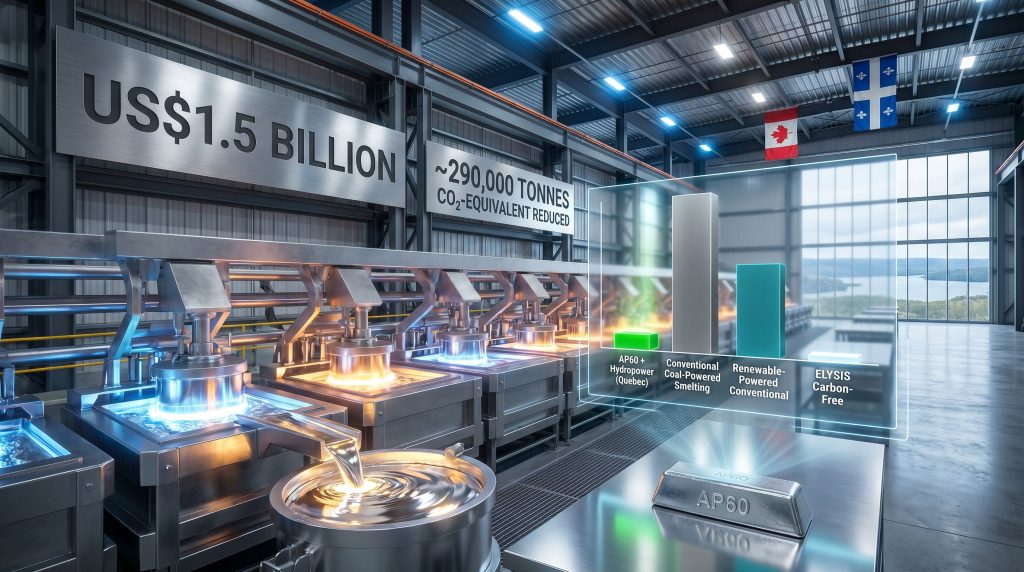
| Projected Annual Emissions Reduction | ~290,000 tonnes CO₂-equivalent |
| Fine Particulate Matter Reduction | Up to 90% |
| Construction Jobs Created | More than 1,500 |
| Economic Benefit to Quebec (Construction Phase) | More than C$1 billion |
| Ongoing Permanent Local Employment | ~100 jobs |
What 96 New Pots Actually Means in Operational Terms
Each reduction pot in an AP60 potline functions as an individual electrochemical reactor. Commissioning 96 new pots is not a simultaneous process; cells are typically brought online in sequences to manage thermal stability, electrical load distribution, and the gradual bedding-in of cell lining materials. Early-stage pots operate at reduced amperage before reaching full design current, meaning the ramp to full production capacity extends across months rather than days.
The complexity of this process explains why full commissioning at Complexe Arvida is projected to be completed by the end of 2026 despite commissioning having already begun.
Timeline: From Construction to Full Commissioning by End-2026
The construction phase mobilised over 1,500 workers at peak activity and generated more than C$1 billion in regional economic value across the Saguenay-Lac-Saint-Jean region. The transition from construction to operational commissioning marks the shift from capital expenditure intensity to the longer-term operational and environmental value delivery phase of the project.
What Environmental Gains Does the Arvida Expansion Deliver?
Quantifying the Emissions Reduction: Legacy Potrooms vs. AP60 Infrastructure
The projected annual reduction of approximately 290,000 tonnes of CO₂-equivalent is not simply an additive figure from new capacity. It reflects the net improvement achieved by replacing older, higher-intensity Arvida potroom infrastructure with AP60 technology. Legacy Soderberg cells and early prebake designs carry substantially higher energy consumption per tonne and generate more anode effects, each of which releases perfluorocarbons with global warming potentials hundreds to thousands of times greater than CO₂.
Fine Particulate Matter and Local Air Quality Improvements
The up to 90% reduction in fine particulate matter is a local public health outcome that sits alongside the climate benefit. Aluminium smelting produces particulates from anode baking, bath crust breaking, and metal tapping operations. Modern potroom enclosure designs, advanced fume capture systems, and the inherent cleanliness of AP60 cell technology combine to dramatically cut these emissions compared to older open or partially enclosed potroom designs.
How the Retirement of Legacy Potrooms Amplifies the Net Benefit
The environmental case for this expansion is compounded by the simultaneous decommissioning of older Arvida smelting infrastructure, meaning the net emissions improvement captures both the output of new low-carbon capacity and the elimination of higher-intensity legacy operations running in parallel.
This compounding effect is a critical distinction. New capacity alone at a brownfield site would deliver partial benefit. The combination of new AP60 output and legacy retirement creates a step-change in the site's overall environmental profile. Consequently, Rio Tinto's broader green steelmaking technology initiatives demonstrate a consistent strategic commitment to physically reducing industrial emissions rather than relying on offsets.
Where Does ELYSIS Fit Into Rio Tinto's Long-Term Decarbonisation Strategy?
Understanding the ELYSIS Joint Venture
ELYSIS was established as a joint venture between Rio Tinto and Alcoa, with initial backing provided when the technology was still at laboratory demonstration scale. The venture's technical objective is to develop inert anode materials that can withstand the highly corrosive molten salt environment of an aluminium reduction cell while producing oxygen rather than CO₂ as the primary anode gas. The materials science challenge involved is considerable, as no commercially available inert anode material has yet survived the operational lifetime demands of industrial-scale cells.
The C$100 Million Federal Investment in ELYSIS Technology Deployment
Canada's federal government announced a C$100 million (approximately US$72.55 million) investment directed toward the ELYSIS technology deployment project. This commitment was framed within a broader policy rationale around reinforcing domestic industrial capacity and strengthening supply chain resilience amid elevated trade uncertainty. The federal government's support reflects the strategic value placed on advancing ELYSIS from pilot demonstration toward commercial readiness.
How AP60 Commissioning Creates the Foundation for ELYSIS Scale-Up
AP60 potlines provide the operational infrastructure, engineering workforce, and process management systems that a future ELYSIS transition would build upon. Smelter workers trained on high-amperage AP60 cells accumulate expertise directly transferable to inert anode cell operation. The Arvida complex therefore functions as both a near-term production asset and a long-term platform investment in the human and physical capital required for carbon-free electrolysis at scale.
The next major ASX story will hit our subscribers first
Is the Arvida Expansion a Response to Trade Pressures as Much as Climate Goals?
Tariff Environments and the Strategic Case for Domestic Capacity
Canada's aluminium industry has navigated recurring trade friction with the United States, including periods of tariff application on Canadian aluminium exports. These episodes have periodically disrupted pricing, dampened investment confidence, and highlighted the vulnerability of cross-border industrial supply chains. Strengthening domestic production capacity in a period of elevated trade uncertainty reduces exposure to cross-border policy risk and enhances the resilience of Canadian industrial output.
Canada's Industrial Policy Pivot Toward Sovereign Green Manufacturing
Federal commentary accompanying the ELYSIS investment explicitly identified rising tariff pressures and trade uncertainty as drivers of the decision to reinforce domestic aluminium production capacity. This framing positions green aluminium not merely as a climate initiative but as an economic sovereignty priority, where clean industrial capacity and national supply chain resilience are treated as complementary objectives rather than competing ones.
The policy implication is significant: investment in low-carbon smelting infrastructure now carries dual justification, both decarbonisation and economic self-sufficiency, making it more durable against political headwinds than climate-only projects. Furthermore, Rio Tinto's approach to global taxes and royalties reflects how the company navigates the broader fiscal landscape within which these strategic investments are made.
How Does Rio Tinto's Quebec Strategy Compare to Global Aluminium Decarbonisation Efforts?
The Global Aluminium Industry's Emissions Challenge
Global aluminium production generates roughly 1.1 billion tonnes of CO₂-equivalent annually when accounting for both direct process emissions and the electricity used in smelting. China accounts for the majority of global output and operates a smelting fleet heavily dependent on coal-fired power, setting a high baseline against which cleaner producers are measured.
Comparing Low-Carbon Aluminium Initiatives Across Producing Regions
| Approach | Emissions Intensity | Scalability | Technology Maturity |
|---|---|---|---|
| AP60 + Hydropower (Quebec) | ~1/6 of global average | High | Commercially proven |
| Conventional coal-powered smelting | Industry baseline | High | Mature but carbon-intensive |
| Renewable-powered conventional smelting | Moderate reduction | Moderate | Emerging |
| ELYSIS carbon-free electrolysis | Near-zero | Pilot scale | Pre-commercial |
Where Rio Tinto's Integrated Model Stands Relative to Competitors
The combination of proprietary high-amperage cell technology, captive hydroelectric power, and an active next-generation technology development program gives Rio Tinto's Quebec aluminium operations a multi-layered competitive position. Competitors pursuing renewable-powered conventional smelting face intermittency challenges that hydropower does not. Those investing in inert anode research lack the operational scale and smelter infrastructure that Rio Tinto brings to the ELYSIS deployment program. However, Rio Tinto's zero carbon steel partnership in Austria signals that the company's decarbonisation ambitions extend well beyond aluminium alone.
What Does This Investment Signal for Rio Tinto as a Major Global Miner?
Capital Allocation Priorities and ESG Positioning
A US$1.5 billion commitment to a single brownfield decarbonisation project reflects a capital allocation philosophy that treats low-carbon industrial assets as long-duration value generators rather than compliance expenses. Institutional investors applying ESG screens to mining sector portfolios increasingly differentiate between operators that reduce emissions intensity of existing production and those that simply purchase offsets. Physical decarbonisation of smelting operations at this scale represents the former, and is likely to influence how portfolio managers assess the risk-adjusted attractiveness of Rio Tinto equity.
The Strategic Value of Aluminium in a Net-Zero Industrial Transition
Aluminium's lightweighting properties make it indispensable to electric vehicle manufacturing, where reducing vehicle mass directly extends battery range. Wind turbine construction, solar panel mounting systems, and grid infrastructure all depend on aluminium at scale. As these demand drivers accelerate through the 2030s, the premium commanded by verifiably low-carbon aluminium in supply chain procurement is expected to widen, strengthening the long-term revenue case for the Rio Tinto low-carbon smelter expansion in Quebec.
Frequently Asked Questions: Rio Tinto Low-Carbon Smelter Expansion in Quebec
What is the Complexe Arvida AP60 expansion?
It is a US$1.5 billion investment by Rio Tinto to add 96 new AP60 electrolytic reduction cells at its Complexe Arvida aluminium smelting facility in Saguenay, Quebec, increasing low-carbon aluminium production capacity by approximately 160,000 metric tonnes per year.
How much will the expansion increase Rio Tinto's aluminium output?
The expansion brings total AP60 annual output at Complexe Arvida to approximately 220,000 metric tonnes, incorporating both the new capacity and existing AP60 production.
What makes AP60 aluminium considered low-carbon?
AP60 cells consume less electricity per tonne than legacy smelting technologies, generate fewer anode effects, and therefore produce lower perfluorocarbon emissions. When powered by Quebec's near-entirely hydroelectric grid, the resulting metal carries a carbon footprint roughly one-sixth of the global industry average.
When will the Arvida expansion be fully operational?
Rio Tinto expects full commissioning of all 96 new pots to be completed by the end of 2026.
What is ELYSIS and how is it connected to this project?
ELYSIS is a joint venture between Rio Tinto and Alcoa developing inert anode technology that would eliminate direct process CO₂ emissions from aluminium smelting entirely. The AP60 expansion at Arvida creates the operational and workforce platform from which ELYSIS technology deployment can scale.
How much has the Canadian government invested in ELYSIS?
Canada's federal government announced a C$100 million investment in the ELYSIS technology deployment project, framed as part of a broader effort to reinforce domestic industrial capacity and supply chain resilience.
How many jobs has the Arvida expansion created in Quebec?
The construction phase employed more than 1,500 workers and generated over C$1 billion in regional economic value. The expanded operation supports approximately 100 ongoing permanent positions at the site.
Key Takeaways: The Strategic Significance of Rio Tinto's Quebec Smelter Expansion
-
Scale: A US$1.5 billion capital commitment adding 160,000 metric tonnes of annual low-carbon aluminium capacity, lifting total AP60 output to 220,000 metric tonnes
-
Emissions: Projected annual reduction of approximately 290,000 tonnes of CO₂-equivalent versus the legacy operations being retired
-
Technology pathway: AP60 serves as the operational bridge toward fully carbon-free ELYSIS electrolysis, with workforce and infrastructure continuity between the two technology generations
-
Economic footprint: Over C$1 billion in regional economic value generated during construction, more than 1,500 construction jobs at peak, and approximately 100 permanent ongoing roles
-
Dual policy alignment: The investment simultaneously advances decarbonisation objectives and domestic supply chain resilience goals, giving it durability across both climate and trade policy frameworks
-
Investor signal: Physical emissions reduction at this scale differentiates Rio Tinto from offset-dependent peers and strengthens the asset's long-term positioning in ESG-screened institutional portfolios
Disclaimer: This article contains forward-looking statements regarding production capacity, emissions projections, and technology development timelines. These statements are based on publicly available information and corporate announcements as of the date of publication. Actual outcomes may differ materially from projections due to operational, regulatory, technological, or market factors. Nothing in this article constitutes financial or investment advice.
Want to Stay Ahead of the Next Major Mineral Discovery on the ASX?
Discovery Alert's proprietary Discovery IQ model delivers real-time alerts on significant ASX mineral discoveries, transforming complex geological and market data into actionable investment insights for both short-term traders and long-term investors — explore historic discovery returns on Discovery Alert's dedicated discoveries page to see the potential, and begin your 14-day free trial at Discovery Alert to position yourself ahead of the broader market.