August 8, 2026
The global lithium sector remains trapped in a cyclical downturn, yet mining conglomerates with substantial capital reserves are positioning themselves for the inevitable market recovery. This strategic timing allows established operators to acquire distressed assets, refine operational methodologies, and build competitive advantages while smaller players struggle with financing constraints. For Rio Tinto, this environment presents an opportunity to establish what industry analysts describe as a Rio Tinto low-cost lithium platform that could dominate future supply chains. Furthermore, this development comes at a time when Argentinian lithium insights reveal significant opportunities in the South American brine market.
Traditional lithium development has followed predictable patterns: lengthy feasibility studies, bespoke engineering solutions, and extended construction timelines that often stretch beyond initial projections. However, Rio Tinto's integrated approach fundamentally challenges these conventions through vertical integration, technological innovation, and standardized development templates that compress both timelines and capital requirements.
What Makes Rio Tinto's Lithium Strategy Different from Traditional Mining Approaches?
Integrated Value Chain Architecture
Rio Tinto's $6.7 billion acquisition of Arcadium Lithium, completed in late 2024, transformed the mining giant from a lithium outsider into a fully integrated producer spanning extraction, processing, and battery-grade material production. This vertical integration eliminates third-party processing margins that traditionally erode mining company profitability.
The integrated platform encompasses operations across four continents, providing geographic diversification that reduces single-jurisdiction risk. Unlike pure-play lithium companies that rely on external processing partners, Rio Tinto's architecture enables complete margin capture across the entire value chain.
Key Geographic Assets:
• Salar del Hombre Muerto (Argentina): 40,000+ tonnes LCE annually from brine extraction
• Rincon Project (Argentina): 60,000 tonnes planned expansion capacity
• Quebec Hard-rock Operations (Canada): 35,000+ tonnes from spodumene processing
• Jadar Project (Serbia): Underground mining facility in development
Technology-Driven Cost Optimization Framework
Direct Lithium Extraction (DLE) technology represents Rio Tinto's most significant operational differentiator. Traditional brine processing requires 12-18 months for lithium carbonate conversion through evaporation ponds, tying up substantial working capital and creating lengthy inventory cycles.
Rio Tinto's DLE implementation compresses this timeline from months to days or weeks, creating what Citi research estimates as "hundreds of millions" in working capital release. This acceleration dramatically improves cash conversion cycles while reducing financing requirements for expansion projects. Additionally, Australia lithium innovations continue to drive technological advancements in the sector.
DLE Technology Advantages:
• Water efficiency: Reduced consumption compared to evaporation methods
• Land footprint: Minimal surface area requirements
• Environmental impact: Lower regulatory compliance costs
• Processing speed: Days versus months for conversion
The technology enables Rio Tinto to process multiple lithium feedstock types including both brine and hard-rock spodumene through unified infrastructure. Consequently, this provides operational flexibility across commodity price cycles.
When big ASX news breaks, our subscribers know first
How Does Rio Tinto's "30 in 30" Template Revolutionise Lithium Project Development?
Capital Efficiency Metrics
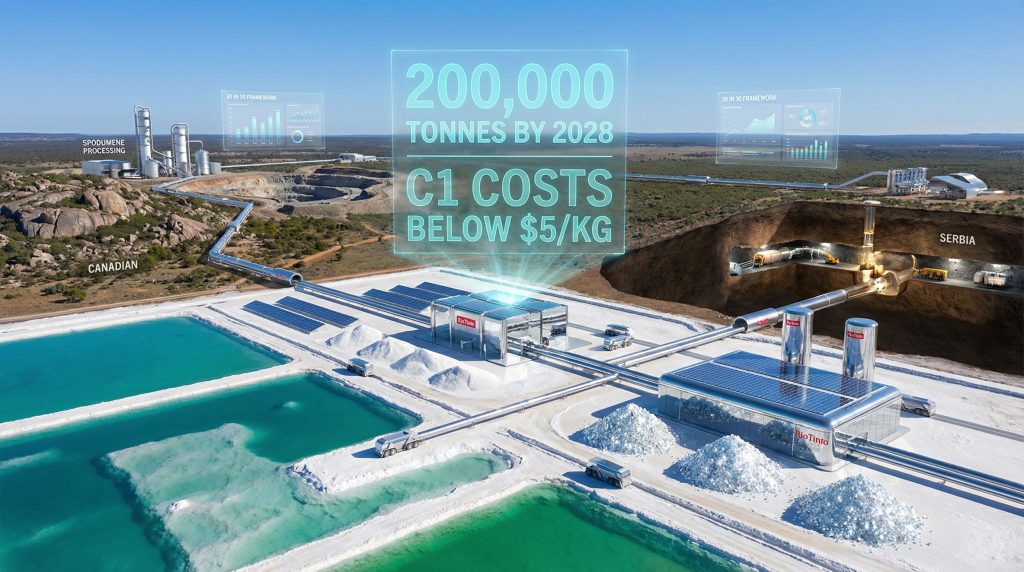
Rio Tinto's "30 in 30" template establishes ambitious benchmarks for future lithium developments: capital intensity below $30 per kilogram, development timelines under 30 months, and C1 operating costs below $5 per kilogram. These targets represent substantial improvements over industry standards where traditional greenfield projects often require 4-6+ years from feasibility to production.
Template Performance Targets:
| Metric | Rio Tinto Target | Industry Average | Improvement |
|---|---|---|---|
| Capital Intensity | <$30/kg | $40-80+/kg | 40-60% reduction |
| Development Timeline | <30 months | 48-72+ months | 50%+ faster |
| C1 Operating Costs | <$5/kg | $12-15/kg | 60%+ lower |
Scalability and Replication Framework
The template's standardisation philosophy eliminates the custom engineering approach typical in mining project development. By establishing repeatable infrastructure modules, procurement frameworks, and operational procedures, Rio Tinto reduces both engineering risk and cost overrun potential inherent in first-of-a-kind projects.
Standardisation Components:
• Modular design approach: Repeatable infrastructure reduces custom engineering costs
• Supply chain optimisation: Established vendor relationships and bulk procurement
• Regulatory pathways: Pre-constructed permitting and environmental approval processes
• Risk mitigation: Template-based approach minimises contingency requirements
This standardised methodology provides Rio Tinto with strategic flexibility during market downturns. Furthermore, it enables rapid acceleration when demand conditions improve while maintaining capital discipline during weak pricing environments.
What Production Capacity Targets Define Rio Tinto's Lithium Platform Ambitions?
Near-Term Production Scaling (2025-2028)
Rio Tinto's production roadmap targets 200,000 tonnes LCE annually by 2028, representing a 167% increase from the current 75,000 tonnes baseline established through the Arcadium acquisition. This aggressive scaling requires coordinated development across multiple jurisdictions and resource types. Meanwhile, India's lithium supply strategy demonstrates the global demand that will drive this expansion.
Production Capacity Timeline:
| Year | Target Capacity | Cumulative Increase |
|---|---|---|
| 2025 | 75,000 tonnes LCE | Baseline (post-Arcadium) |
| 2028 | 200,000 tonnes LCE | +125,000 tonnes (+167%) |
Asset Portfolio Optimisation
The 200,000-tonne target requires optimisation across Rio Tinto's diversified asset base. In addition, this balances brine extraction in Argentina with hard-rock processing in Canada and planned European operations in Serbia.
Asset Contribution Breakdown:
• Argentina Operations (Brine): ~100,000 tonnes from Salar del Hombre Muerto and Rincon combined
• Canadian Hard-rock: ~35,000 tonnes from Quebec spodumene processing
• Serbian Jadar Project: ~65,000 tonnes from underground mining (pending final development)
This geographic distribution provides supply chain security for both North American EV manufacturing and European battery production. Consequently, it reduces dependence on Asian processing networks that dominate current lithium supply chains.
The Jadar Project in Serbia represents potentially 25-35% of Rio Tinto's 2028 production target. However, specific capacity and timeline details remain subject to regulatory approval and final investment decisions. This project's strategic importance extends beyond production volume to include European Union supply chain security objectives.
How Does Rio Tinto's Cost Structure Compare to Industry Benchmarks?
Operating Cost Positioning Analysis
Rio Tinto targets C1 operating costs of $5-8 per kilogram, positioning the company in the bottom quartile of the global lithium cost curve. This represents a 40-50% cost advantage compared to the industry average of $12-15 per kilogram for established operations.
Global Cost Curve Positioning:
• Bottom quartile (Rio Tinto target): $4-8/kg C1 costs
• Industry average: $12-15/kg
• Top quartile: $14-20+/kg
Working Capital Efficiency Improvements
Traditional brine processing creates substantial working capital requirements through extended inventory conversion cycles. Conventional operations maintain 12-18 months of product inventory during evaporation and processing stages, requiring hundreds of millions in tied-up capital for large-scale operations.
Rio Tinto's DLE technology compresses conversion timelines to days or weeks, enabling dramatic working capital optimisation. This improvement provides several competitive advantages:
• Reduced financing costs: Lower capital requirements for working capital facilities
• Improved cash conversion: Faster inventory turnover and cash generation
• Enhanced flexibility: Ability to respond quickly to market demand changes
• Capital reallocation: Freed capital available for expansion or shareholder returns
Moreover, the integration with a battery-grade lithium refinery approach ensures maximum value capture throughout the supply chain.
Cost Structure Advantages:
- Integrated processing margins: Elimination of third-party processing fees
- DLE operational efficiency: Reduced water, land, and processing costs
- Scale economies: Fixed cost absorption across 200,000-tonne production base
- Geographic optimisation: Strategic positioning in low-cost jurisdictions
The combination of technological efficiency and operational scale creates what industry analysts view as sustainable competitive advantages. These should persist through multiple commodity cycles.
What Market Positioning Strategy Balances Risk and Upside Exposure?
Commercial Risk Management Framework
Rio Tinto employs a dual-track commercial strategy designed to provide downside protection while maintaining upside exposure during market recovery. This approach allocates 40% of production to long-term contracts with price floors above current spot levels. Furthermore, it dedicates 60% to spot market exposure.
Risk Management Structure:
• Contract protection: 40% of production secured through long-term agreements
• Price floors: Contract pricing above current spot market levels
• Upside capture: 60% spot market exposure for recovery participation
• Portfolio balance: Risk mitigation with growth optionality
This commercial framework enables Rio Tinto to maintain operational stability during market downturns. Additionally, it positions for maximum profit capture when lithium demand recovers.
Market Timing and Flexibility Strategy
The current market environment allows Rio Tinto to build production capacity during weak pricing conditions. This positioning enables accelerated returns when demand improves. This counter-cyclical investment approach leverages the company's balance sheet strength to gain competitive advantages unavailable to smaller operators.
Strategic Flexibility Elements:
• Phased development: Measured capital deployment during market weakness
• Acceleration capability: Rapid ramp-up potential for demand recovery
• Portfolio optionality: Multiple asset types and geographic locations
• Technology leadership: Advanced processing methods for cost advantages
The "30 in 30" template provides particularly valuable optionality by enabling rapid project deployment when market conditions warrant accelerated development. Furthermore, this approach aligns with broader lithium mining operations trending towards efficiency and sustainability.
How Do Sustainability and Technology Integration Drive Platform Competitiveness?
Environmental Performance Differentiation
Rio Tinto's DLE technology implementation provides significant environmental advantages compared to traditional lithium extraction methods. Conventional evaporation pond operations require extensive land areas and substantial water consumption, creating regulatory and community acceptance challenges.
Environmental Benefits:
• Reduced land footprint: Minimal surface area requirements compared to evaporation ponds
• Water efficiency: Lower consumption through direct extraction processes
• Permitting advantages: Enhanced environmental approval prospects
• Community acceptance: Reduced visual and environmental impact
These environmental improvements translate into competitive advantages through faster permitting processes and reduced compliance costs. Consequently, they support the "30 in 30" timeline objectives.
Supply Chain Security and Geopolitical Positioning
Rio Tinto's Western Hemisphere production base addresses growing concerns about supply chain security in critical mineral sectors. The company's operations in Argentina, Canada, and planned Serbian facilities provide alternatives to Asian-dominated processing networks.
Geopolitical Advantages:
• North American proximity: Direct supply to U.S. and Canadian EV manufacturing
• European access: Serbian operations serve EU battery manufacturing
• Trade security: Reduced exposure to China-related trade disruptions
• Critical mineral alignment: Support for Western critical mineral security initiatives
This geographic positioning becomes increasingly valuable as governments implement policies supporting domestic supply chain development. These policies include tax incentives and procurement preferences.
The next major ASX story will hit our subscribers first
What Investment Implications Emerge from Rio Tinto's Lithium Platform Strategy?
Capital Allocation Philosophy Under New Leadership
Rio Tinto's approach emphasises operational efficiency over aggressive expansion, reflecting lessons learned from previous commodity cycle experiences. The company prioritises completion of existing projects before initiating new development phases. Furthermore, it maintains capital discipline during volatile market conditions.
Investment Priorities:
• Existing project completion: Focus on Arcadium integration and optimisation
• Technology implementation: DLE rollout across asset base
• Template development: "30 in 30" methodology refinement
• Market timing: Measured approach to new project commitments
This disciplined capital allocation contrasts with historical mining industry patterns of procyclical investment. These patterns often create capacity oversupply during market peaks.
Competitive Positioning Assessment
Rio Tinto's Rio Tinto low-cost lithium platform represents a first-mover advantage in integrated Western Hemisphere production. The combination of technological leadership, scale advantages, and geographic diversification creates multiple barriers to competitive replication. According to Rio Tinto's latest strategic announcements, the company is committed to delivering leading returns through this focused approach.
Competitive Moats:
• Technology integration: DLE implementation across multiple asset types
• Scale economies: 200,000-tonne production target enables fixed cost absorption
• Geographic diversification: Risk mitigation and market access advantages
• Balance sheet strength: Capital availability during market downturns
The integrated platform approach would require substantial capital and time for competitors to replicate. This is particularly challenging for smaller lithium specialists lacking Rio Tinto's financial resources and technical capabilities. Additionally, key market analysis indicates Rio Tinto's stock performance reflects these strategic advantages.
Investment Risk Considerations:
While Rio Tinto's strategy appears well-positioned for market recovery, several factors could impact execution success. Regulatory approval timelines for the Jadar Project remain uncertain, potentially affecting 2028 production targets. Additionally, lithium market recovery timing remains unpredictable, potentially extending the current weak pricing environment beyond current expectations.
Disclaimer: This analysis contains forward-looking statements and market projections that involve inherent uncertainties. Lithium market conditions, regulatory approvals, and project execution timelines may differ materially from current expectations. Readers should conduct independent research and consider professional financial advice before making investment decisions.
FAQ: Understanding Rio Tinto's Lithium Platform Strategy
Why is Rio Tinto focusing on cost reduction during a market downturn?
Building low-cost production capability during weak market conditions positions the company for maximum profitability when lithium demand recovers. The current environment allows Rio Tinto to acquire distressed assets at attractive valuations while refining operational methodologies. This ensures competitive advantages when market conditions improve. This counter-cyclical investment approach leverages the company's balance sheet strength to build market-leading positions during periods when smaller competitors face financing constraints.
How does the Arcadium acquisition transform Rio Tinto's lithium business?
The $6.7 billion acquisition provides immediate scale with 75,000 tonnes LCE annual baseline production. Furthermore, it establishes operations across multiple jurisdictions and proven DLE technology platforms. This acquisition eliminates the decades-long timeline that organic development would require. It provides Rio Tinto with operational expertise and infrastructure that serves as the foundation for expansion to 200,000 tonnes by 2028. The integrated processing capabilities enable complete value chain control from extraction through battery-grade material production.
What makes Rio Tinto's approach different from other lithium producers?
Unlike pure-play lithium companies, Rio Tinto combines mining expertise, substantial financial resources, and integrated processing capabilities with advanced DLE technology. This spans multiple resource types and geographic locations. The company's "30 in 30" template approach to standardised development represents a fundamental departure from the bespoke, custom-engineered projects typical in the industry. This combination of technological leadership, operational scale, and capital strength creates competitive advantages that smaller lithium specialists cannot easily replicate.
Looking to Capitalise on Strategic Moves in the Lithium Sector?
Discovery Alert's proprietary Discovery IQ model instantly identifies significant mineral discoveries across the ASX, including strategic developments in the lithium sector that could impact investor portfolios. With Rio Tinto and other major players making calculated moves during market downturns, staying informed about emerging opportunities becomes crucial for positioning ahead of potential market recoveries through real-time ASX discovery alerts.