May 13, 2026
Australia's industrial landscape stands at a critical inflection point where energy-intensive manufacturing must adapt to survive. The convergence of renewable energy cost reductions, government policy frameworks, and international competitiveness pressures is reshaping fundamental assumptions about heavy industry viability. For Rio Tinto renewable energy aluminium smelting operations that consume massive quantities of electricity around the clock, this transformation represents both existential risk and unprecedented opportunity.
Energy Economics Driving Industrial Transformation
Primary aluminium production demands approximately 12,000-16,000 kilowatt-hours of electricity per tonne, making energy costs the largest operational expense for smelting operations. Traditional coal-fired baseload power historically provided the consistent supply needed for continuous operations, but economic dynamics have fundamentally shifted.
Renewable energy costs have experienced dramatic reductions over the past decade. Solar photovoltaic electricity generation costs decreased by 89% between 2010 and 2020, while onshore wind costs fell 70% during the same period. Furthermore, Australian solar electricity now costs AUD$47-63 per megawatt-hour, with onshore wind ranging from AUD$56-74 per megawatt-hour.
The continuous nature of aluminium smelting operations, operating at 85-95% capacity factors year-round, creates unique advantages for renewable energy integration. Unlike intermittent industrial processes, smelters provide predictable baseline demand that enables long-term power purchase agreements with renewable generators. Consequently, this load profile certainty allows renewable developers to secure project financing and achieve economies of scale.
Battery Storage Integration Challenges
Addressing renewable energy intermittency requires sophisticated energy storage solutions. Modern industrial-scale battery systems typically provide 4-6 hour discharge durations, bridging daily solar generation gaps during evening peak demand periods. The battery recycling breakthrough demonstrates technological innovation advancing storage capabilities.
Battery chemistry selection becomes critical for industrial applications. Lithium-ion systems provide rapid response capabilities for frequency regulation, while emerging technologies like iron-air batteries offer longer discharge durations suitable for seasonal renewable variability. However, grid integration requires dedicated interconnection points and certification for ancillary services provision.
Smart grid technologies enable demand response capabilities that benefit both smelting operations and grid stability. In addition, high-load industrial consumers can provide valuable grid services through flexible demand management during peak renewable generation periods, creating additional revenue streams while supporting system reliability.
When big ASX news breaks, our subscribers know first
Government Investment Frameworks Accelerating Decarbonisation
The Queensland-Commonwealth partnership represents a sophisticated risk-sharing model that addresses market failures in industrial decarbonisation. Combined government investment of AUD$2 billion over 10 years through 2040 demonstrates long-term policy commitment extending beyond electoral cycles, reflecting the critical minerals transition imperative.
This multi-tiered funding approach distributes financial risk across public and private sectors while maintaining commercial incentives. Government investment focuses on grid integration infrastructure, transmission system upgrades, and storage facility development, enabling private renewable generators to connect projects to industrial off-takers efficiently.
| Investment Category | Amount (AUD Million) | Primary Focus | Timeline |
|---|---|---|---|
| Infrastructure Development | 1,200 | Grid stability, transmission upgrades | 2026-2030 |
| Technology Integration | 500 | Storage systems, smart grid capabilities | 2026-2028 |
| Workforce Transition | 300 | Skills development, regional employment | 2026-2035 |
The Future Made in Australia initiative provides broader policy context for this investment, prioritising critical minerals processing and energy-intensive manufacturing retention. This framework recognises that maintaining domestic aluminium production capabilities requires coordinated support during the energy transition period.
Long-Term Contract Structures
Power Purchase Agreements signed by Rio Tinto establish multi-decade commitments totaling AUD$7.5 billion in renewable energy and storage contracts. These agreements typically include:
• Fixed or inflation-indexed pricing mechanisms protecting against energy volatility
• Capacity reservation clauses ensuring reliable power supply during peak demand
• Interconnection and transmission cost allocation between parties
• Performance guarantees and termination provisions managing operational risks
International precedents demonstrate the viability of government-supported industrial transitions. Quebec's partnership with Alcan combined hydroelectric infrastructure development with long-term smelting commitments, creating one of the world's lowest carbon-intensive aluminium production regions. Similarly, Iceland's collaboration with Alcoa on geothermal-powered expansions leveraged public energy infrastructure investment with private operational expertise.
Regional Economic Clustering and Replication Potential
Queensland's integrated aluminium value chain creates unique advantages for renewable energy transition. The state concentrates bauxite mining, alumina refining, and aluminium smelting operations within a connected supply network, reducing transportation costs and enabling coordinated infrastructure development.
The Gladstone industrial precinct benefits from established transmission infrastructure, deepwater port facilities, and skilled workforce concentrations. Consequently, these existing assets reduce the capital requirements for renewable energy integration compared to greenfield development scenarios.
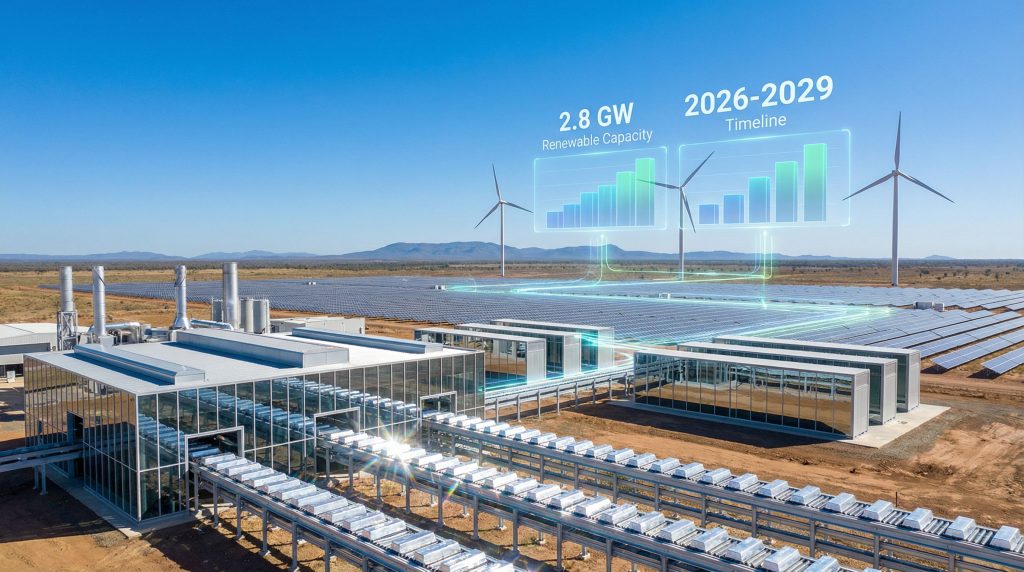
Rio Tinto renewable energy contracted capacity exceeds 2.8 gigawatts across Queensland, representing one of Australia's largest industrial renewable energy portfolios. This scale enables diversified generation sources combining solar, wind, and storage technologies to manage seasonal and daily variability patterns.
Infrastructure Requirements for Replication
Similar renewable energy hubs in other Australian states face different resource and infrastructure constraints. The evolution of industry innovation trends influences these regional development patterns:
New South Wales: Central Coast industrial zones possess existing transmission connections but limited large-scale renewable resources compared to Queensland's solar irradiance levels.
Victoria: Latrobe Valley offers industrial site availability and transmission infrastructure from coal plant retirements, but lower average wind capacity factors reduce economic competitiveness.
Western Australia: Pilbara region provides excellent solar resources but lacks transmission infrastructure to connect renewable generation with industrial load centres.
Water availability considerations also impact smelting operations, as primary aluminium production requires significant cooling water supplies. For instance, Queensland's coastal location provides seawater cooling access not available to inland industrial sites.
Strategic Scenario Analysis: Transition Pathways
Three distinct pathways emerge for Australia's aluminium smelting industry transformation, each presenting different risk-return profiles and investment requirements.
Scenario 1: Accelerated Renewable Transition (2025-2030)
Complete fossil fuel phase-out by 2030 requires aggressive renewable capacity deployment and grid integration. Current power contract completion in 2029 creates natural transition timing, with secured renewable capacity exceeding 2.8 gigawatts providing baseload replacement.
Investment requirements focus on transmission interconnection completion and operational integration of battery storage systems with smelting load management. However, grid stability management during the transition from coal-backed to renewable-backed baseload supply presents technical challenges requiring sophisticated control systems.
Competitive positioning benefits emerge from first-mover advantages in clean aluminium production. Furthermore, carbon border adjustment mechanisms increasingly favour low-emissions manufacturing, potentially providing price premiums for renewable-powered aluminium in international markets.
Scenario 2: Hybrid Energy Approach (2025-2035)
Gradual transition maintaining gas backup systems provides risk mitigation during renewable capacity ramp-up. This pathway preserves existing thermal generation infrastructure while incrementally increasing renewable penetration.
Cost-benefit analysis suggests hybrid approaches may optimise capital deployment timing, allowing renewable costs to decline further while maintaining operational reliability. However, stranded asset risks increase for fossil fuel infrastructure as carbon pricing mechanisms strengthen.
Scenario 3: Technology Breakthrough Integration (2025-2040)
Next-generation smelting technologies could revolutionise energy requirements and process efficiency. Inert anode technology development shows potential for reducing electricity consumption per tonne while eliminating carbon anode consumption entirely.
Hydrogen integration possibilities in aluminium production could enable renewable energy storage through chemical processes, creating industrial flexibility benefits. Revolutionary battery storage developments using solid-state or iron-air technologies may enable 8-12 hour discharge durations, supporting full renewable operations without backup generation.
"The timeline for commercial deployment of breakthrough technologies typically spans 10-15 years from laboratory demonstration to industrial scale implementation, suggesting 2035-2040 commercial availability."
Power Purchase Agreement Market Transformation
Industrial-scale PPAs fundamentally alter renewable energy project economics by providing long-term revenue certainty that enables project financing without merchant market exposure. Rio Tinto's commitment to offtake agreements totaling AUD$7.5 billion creates substantial market demand supporting renewable energy sector growth.
The Lower Wonga project exemplifies this transformation, with Rio Tinto contracting 40% of generation from Lightsource bp's hybrid facility. This arrangement provides:
• Revenue certainty for renewable developers enabling competitive financing terms
• Price stability for industrial consumers protecting against energy market volatility
• Capacity allocation efficiency across multiple industrial and commercial users
• Risk distribution between generation, transmission, and consumption stakeholders
Investment Attraction and Market Development
Large industrial PPAs attract international clean energy developers seeking stable, creditworthy off-takers. Queensland's industrial demand concentration creates economies of scale for renewable project development, reducing per-megawatt development costs compared to distributed commercial arrangements. The broader context of Australia's green metals leadership reinforces this competitive advantage.
Regional economic development benefits extend beyond direct energy sector investment. Construction activity, ongoing operations and maintenance employment, and supply chain development create multiplier effects throughout Central Queensland communities.
Critical Minerals Strategy Integration
Aluminium smelting operations play strategic roles in Australia's critical minerals value chains. Domestic aluminium production capabilities support renewable energy infrastructure manufacturing, energy storage system production, and electric vehicle supply chains.
Global aluminium demand projections indicate continued growth driven by renewable energy deployment, with solar panel mounting systems, wind turbine components, and electrical transmission infrastructure requiring substantial aluminium inputs. Consequently, maintaining domestic smelting capacity ensures supply chain resilience for Australia's clean energy transition.
International Competitiveness Factors
Clean energy credentials increasingly influence global aluminium purchasing decisions as manufacturers seek to reduce scope 3 emissions in their supply chains. Renewable-powered Australian aluminium may command premium pricing compared to coal-fired alternatives from other regions.
Carbon border adjustment mechanisms being implemented by major economies create additional competitive advantages for low-emissions aluminium production. For instance, European Union and United Kingdom policies increasingly favour imports from renewable-powered facilities over high-carbon alternatives.
Global Renewable Smelting Comparison
| Region | Renewable Capacity (GW) | Technology Focus | Implementation Timeline |
|---|---|---|---|
| Australia (Queensland) | 2.8 | Solar/Wind/Battery | 2026-2029 |
| Norway | 4.5 | Hydroelectric | Established (1950s-1970s) |
| Canada (Quebec) | 3.2 | Hydro/Inert Anode | 2024-2030 |
| Iceland | 2.1 | Geothermal/Hydro | Established (1960s-1990s) |
The next major ASX story will hit our subscribers first
Risk Assessment and Mitigation Frameworks
Technical risks centre on renewable energy intermittency management and grid stability during high-demand periods. Battery storage systems require careful sizing to handle both daily solar generation gaps and longer-term seasonal variations in renewable output.
Grid stability challenges emerge during periods of low renewable generation when industrial demand remains constant. However, backup systems, whether gas-fired generation or grid imports, must maintain reliability standards while minimising emissions impact.
Financial Risk Considerations
Long-term contract performance under changing market conditions presents ongoing risks for both government and private sector participants. Energy market evolution, commodity price volatility, and currency exchange rate fluctuations affect project economics over multi-decade timeframes.
Government funding continuity across political cycles requires bipartisan support for industrial policy frameworks. The commitment by Australian governments to the project provides policy stability, but implementation consistency depends on sustained political commitment beyond individual electoral terms.
International commodity price volatility affects project viability through both aluminium prices and input costs for renewable energy systems. Global trade policy changes, including tariff adjustments and trade agreement modifications, influence export competitiveness for Australian aluminium products.
Technology Roadmap: Future Innovation Pathways
Inert anode technology represents the most significant potential breakthrough for aluminium smelting energy efficiency. This innovation eliminates carbon anode consumption while reducing electricity requirements per tonne of production by approximately 15-20%.
Commercial deployment timelines for inert anode systems suggest pilot plant operations beginning in the late 2020s, with full-scale implementation possible by the mid-2030s. Research programmes in Canada, Iceland, and Norway demonstrate international collaboration on this technology development.
Grid Integration Innovations
Industrial-scale battery systems continue advancing toward longer discharge durations and improved cycle life performance. Solid-state battery technology may enable 8-12 hour storage capability, supporting complete renewable energy operations without backup generation requirements.
Microgrids and energy independence strategies allow individual smelting operations to manage their renewable energy supply autonomously. Furthermore, advanced control systems optimise battery discharge timing, demand response participation, and grid service provision to maximise economic returns.
Carbon capture and utilisation in existing smelting processes offers potential pathways for further emissions reduction. Direct air capture technologies powered by excess renewable generation could offset process emissions while creating valuable carbon-based products.
Investment Analysis and Financial Modelling
Capital allocation across the renewable energy transition involves complex interactions between public and private sector contributions. Government investment of AUD$2 billion over 10 years leverages private sector commitments exceeding AUD$7.5 billion in renewable energy and storage infrastructure.
Private Sector Investment Breakdown:
• Renewable energy project financing: AUD$5.2 billion
• Energy storage systems deployment: AUD$1.8 billion
• Grid integration and transmission upgrades: AUD$0.5 billion
Return on investment calculations must account for multiple value streams including electricity cost savings, carbon credit revenues, grid service payments, and potential premium pricing for low-emissions aluminium products. These align with comprehensive investment strategy components for industrial transformation.
Employment and Regional Economic Impact
Direct employment in aluminium smelting operations maintains approximately 1,000 full-time positions at the Boyne facility through 2040 and beyond. Indirect employment in renewable energy construction, operations, and maintenance creates additional regional economic activity.
Skills transition requirements focus on electrical systems, battery technology, and advanced manufacturing processes. Consequently, workforce development programmes supported by government investment ensure existing employees can adapt to changing technology requirements.
Community development outcomes extend beyond direct employment effects. Infrastructure improvements including transmission upgrades, road access, and port facilities benefit broader Central Queensland economic development initiatives.
Future Outlook: 2030-2040 Strategic Implications
Complete fossil fuel phase-out represents the ultimate objective for Australian Rio Tinto renewable energy aluminium smelting operations, with current commitments securing operations through at least 2040. Technology advancement trajectories suggest full renewable operations become increasingly viable as battery storage costs decline and discharge durations extend.
New market opportunities in clean aluminium products emerge from growing environmental awareness and regulatory requirements. Automotive manufacturers, construction companies, and renewable energy equipment producers increasingly prioritise low-emissions material sourcing.
Integration with circular economy principles creates additional value streams through aluminium recycling, waste heat recovery, and byproduct utilisation. However, renewable energy-powered operations can support energy-intensive recycling processes, further reducing lifecycle emissions for aluminium products.
Policy Evolution and International Integration
Carbon pricing mechanisms will likely strengthen over the 2030-2040 period, increasing competitive advantages for renewable-powered aluminium production. Furthermore, international trade agreements incorporating clean energy standards may create preferential market access for Australian products.
The Queensland government's commitment to securing industrial futures demonstrates sustained policy support for this transformation. Regional development strategies beyond traditional mining focus on value-added manufacturing, renewable energy equipment production, and technology development. Queensland's renewable energy hub model provides a foundation for diversified industrial development supporting long-term economic resilience.
Investment decisions in industrial decarbonisation involve significant risks including technology performance, market conditions, and policy changes. Readers should conduct independent research and seek professional advice before making investment decisions. This analysis reflects current publicly available information and may not account for all relevant factors affecting project outcomes.
Interested in the Next Major Mineral Discovery?
Discovery Alert instantly alerts investors to significant ASX mineral discoveries using its proprietary Discovery IQ model, turning complex mineral data into actionable insights. Understanding why historic discoveries can generate substantial returns by exploring Discovery Alert's dedicated discoveries page showcasing exceptional outcomes, then begin your 14-day free trial today to position yourself ahead of the market.