
July 2, 2026
The Metal at the Heart of Every Major Global Trend
Before a single share price is mentioned, before a production figure is cited, it is worth stepping back and asking a more fundamental question: what kind of commodity cycle is the world currently navigating?
Previous mining supercycles were largely mono-directional. The early 2000s boom was powered almost entirely by China's industrialisation hunger. The 2021 commodity surge was a post-pandemic supply chain dislocation. Both were powerful, but both were essentially single-variable events.
The current environment is structurally different. Demand for the metals that underpin energy transition infrastructure is not coming from one geography or one policy impulse. It is converging simultaneously from artificial intelligence infrastructure buildouts, the electrification of global transport networks, renewable energy grid expansion, and industrial decarbonisation mandates across multiple continents. For mining companies with the right commodity mix and production scale, this convergence creates a rare earnings environment where volume growth and price expansion occur at the same time.
Rio Tinto sits at the intersection of that convergence.
When big ASX news breaks, our subscribers know first
Rio Tinto Shares All-Time High: Understanding the Scale of the Move
From March Lows to Record Territory: The 32% Re-Rating in Context
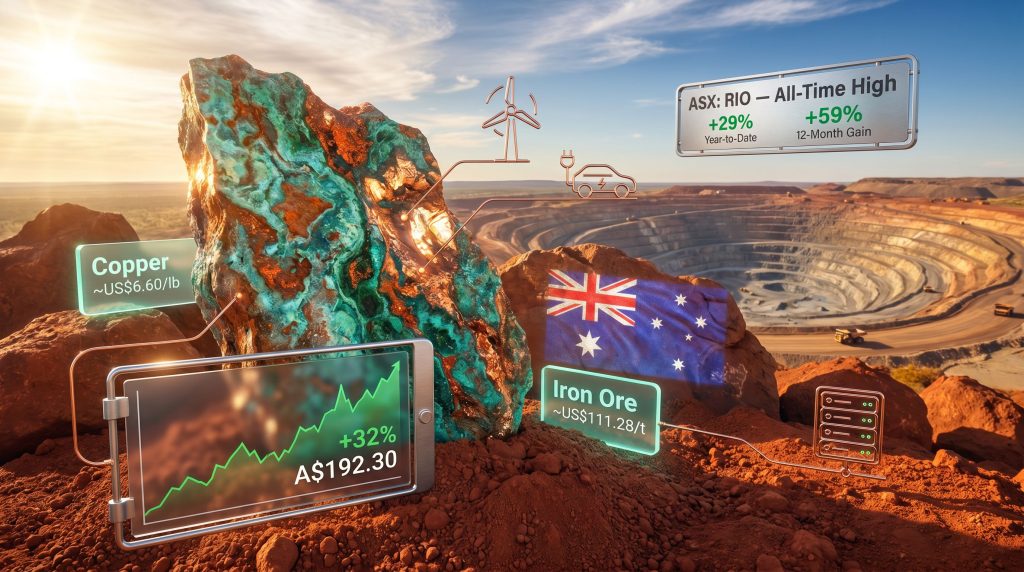
The magnitude of the recovery that Rio Tinto shares all-time high levels have delivered since March 2026 is not easily explained by routine market sentiment shifts. A 32% rally from a cycle low of A$144.41 to an all-time intraday high of A$192.30 in the space of roughly ten weeks reflects a genuine re-rating of intrinsic value, not simply speculative momentum.
At the time of writing on May 14, 2026, Rio Tinto shares were trading at approximately A$191.57, representing the highest closing price in the company's ASX-listed history. The following table captures the full scope of the price performance:
| Metric | Figure |
|---|---|
| All-Time Intraday High | A$192.30 |
| Current Trading Price (May 14, 2026) | A$191.57 |
| 2026 Low (March) | A$144.41 |
| Recovery from March Low | +32% |
| Year-to-Date Gain | +29% |
| 12-Month Gain | +59% |
| ASX 200 Market Cap Rank | 8th |
A 59% gain over 12 months for a company of Rio Tinto's size is genuinely extraordinary. Large-cap miners are not typically associated with that magnitude of return over a single year, which is precisely why this cycle warrants deeper examination. For further context on Rio Tinto's stock price history, long-run price data illustrates just how significant the current move is relative to prior cycles.
How This Rally Compares to Previous Rio Tinto Bull Cycles
Context matters considerably when evaluating whether Rio Tinto shares at current levels represent continuation or exhaustion. The 2008 China industrialisation boom drove peak Rio Tinto ASX pricing to approximately A$129.35, a level that was considered exceptional at the time. The 2021 commodity supercycle pushed the stock to multi-year highs but did not breach the record territory reached today.
The 2026 rally is different in character across three dimensions:
| Cycle | Primary Driver | Peak ASX Price (approx.) | Duration | Key Risk |
|---|---|---|---|---|
| 2008 China Boom | Chinese industrialisation | ~A$129.35 | 3-4 years | Single-market dependency |
| 2021 Supercycle | Post-COVID stimulus, supply disruption | ~A$135+ | 12-18 months | Inflation and rate shock |
| 2026 Green Transition Rally | Multi-polar energy transition demand | A$192.30 (current record) | Ongoing | Demand assumption validation |
The critical structural difference in 2026 is the breadth of demand catalysts. Unlike prior cycles, the current commodity strength is not dependent on a single policy decision or a single national growth trajectory. That multi-polar demand base arguably provides a more durable floor beneath commodity prices than either of the two preceding cycles could claim.
What Commodity Fundamentals Are Driving Rio Tinto Shares Higher
Copper: The Metal Underpinning the AI and Electrification Revolution
Copper's role in the current commodity cycle deserves careful unpacking, because the demand thesis is substantially more complex than simple industrial usage. According to Trading Economics data, copper futures reached approximately US$6.60 per pound in mid-May 2026, establishing their own all-time highs. The broader copper supply crunch adds further upward pressure to an already strained market.
Three distinct structural forces are converging to drive copper demand simultaneously:
-
AI data centre infrastructure requires extensive copper wiring for power distribution, networking, and liquid cooling systems. As hyperscale data centre construction accelerates globally, the copper intensity per facility represents a meaningful new demand vector that did not exist at scale in previous commodity cycles.
-
Electric vehicle electrification creates a pronounced copper intensity premium. Each battery electric vehicle requires approximately three to four times more copper than a conventional internal combustion engine vehicle, according to industry estimates. As EV penetration scales across passenger and commercial fleets, the cumulative demand uplift compounds substantially.
-
Renewable energy grid upgrades encompassing wind turbines, solar farms, high-voltage transmission lines, and battery storage systems all require significant copper content. Grid modernisation programmes across North America, Europe, and Southeast Asia represent multi-decade demand commitments.
On the supply side, an important and less widely discussed dynamic has entered the equation. Disruptions to sulphuric acid availability, linked to geopolitical tensions in the Middle East, have introduced upstream processing risk for copper operations globally. Constraints on sulphuric acid supply create bottlenecks in copper production capacity that are not immediately visible in ore production data, but which can meaningfully tighten refined copper availability. Furthermore, Rio Tinto's copper expansion strategy is directly aligned with these demand tailwinds, positioning the company to capitalise on structural tightness in global supply.
Copper is increasingly characterised by institutional analysts as the single most critical material input for the global energy transition, drawing comparisons to oil's role in the twentieth century industrial economy. Rio Tinto's expanding copper portfolio places it at the centre of this structural demand story.
Iron Ore's Quiet Resurgence: More Than Just China
While copper has attracted much of the narrative attention, iron ore has also reached a meaningful milestone. According to Trading Economics data, iron ore prices climbed to approximately US$111.28 per tonne, representing a 5.6% gain over the prior month and a 10% increase on a year-over-year basis.
China's steel and iron ore sector recovery and infrastructure stimulus activity have contributed to the iron ore price rebound, but a longer-term demand vector is emerging that has significant implications for Rio Tinto's positioning. Green steel production, using hydrogen-based direct reduction processes rather than traditional blast furnace technology, is gaining traction among major European steelmakers committed to industrial decarbonisation.
This matters for a specific technical reason. Hydrogen-based direct reduction processes require higher-grade iron ore inputs than conventional blast furnaces. Rio Tinto's Pilbara operations, while producing in large volumes, have historically been associated with mid-grade ores. The green steel transition may therefore create both an opportunity and a quality management imperative for the company as it seeks to position its iron ore as a preferred feedstock for next-generation steelmaking. In addition, Rio Tinto's zero-carbon steel partnership with an Austrian steelmaker signals the company's commitment to securing its role in this emerging supply chain.
| Commodity | Current Price | 1-Month Change | 1-Year Change | Key Demand Driver |
|---|---|---|---|---|
| Copper | ~US$6.60/lb | Record high | Structural bull | AI infrastructure, EVs, renewables |
| Iron Ore | ~US$111.28/t | +5.6% | +10% | China stimulus, green steel transition |
Rio Tinto's Operational Performance: The Production Story Behind the Share Price
Q1 FY2026: Simultaneous Volume and Price Growth
Rio Tinto's first quarter FY2026 production results are significant not just for their absolute numbers, but for the timing and context in which they were delivered. The company reported a 9% year-on-year increase in copper equivalent production, while Pilbara iron ore output climbed 13% year-on-year, achieving the second-best Q1 production result since 2018.
What makes this particularly noteworthy is that the result was achieved despite weather disruptions and reduced shipment windows during the period. For Pilbara operations, cyclone season represents a recurring operational risk that can materially impact quarterly output. Delivering near-record production through that constraint signals genuine operational improvement rather than simply favourable external conditions.
Management confirmed during the period that the company's focus remains on production expansion across core commodity assets, which provides a multi-year volume growth runway that extends beyond current spot price tailwinds.
Why Operational Leverage Matters Most at This Stage of the Cycle
There is a specific financial dynamic that amplifies investor returns when commodity price rises coincide with production volume growth. The concept is called operating leverage, and it functions in an asymmetric way that is not always intuitive.
When a mining company's commodity price rises, the additional revenue from that price increase flows almost entirely to the bottom line, because the cost of mining the ore has not changed. Rio Tinto's Pilbara iron ore operations carry one of the lowest cost structures in the global industry, which means that at iron ore prices above US$100 per tonne, the margin expansion relative to cost is disproportionately large. Add a 13% volume increase on top of that price expansion, and the earnings leverage becomes substantial.
This is the mathematical underpinning of why Rio Tinto shares can move 32% in roughly ten weeks when commodity prices and production volumes move higher in parallel.
Insider Activity as a Confidence Signal
One data point that investors in momentum situations often overlook is the behaviour of company insiders. A recent on-market share purchase by a Rio Tinto board member contributed to a single-day share price move of approximately 3.4% on the transaction date.
Insider buying at or near all-time high prices is statistically unusual behaviour. The base rate expectation is that insiders become more inclined to sell into strength, not add to positions at record valuations. When a director purchases shares on-market at a price that already represents a historic peak, it typically reflects a view that the market has not yet fully priced the company's earnings potential. This is a qualitative signal, not a quantitative one, and it should be weighed alongside other evidence rather than treated as definitive. However, in the context of a company where most analyst price targets currently imply downside, it is a notable counterpoint.
Analyst Views on Rio Tinto Shares at Current Levels
Consensus Breakdown: A Divided Picture
The current analyst consensus on Rio Tinto shares reflects the genuine uncertainty that exists when a stock reaches territory well beyond consensus price targets. TradingView data covering 15 analysts presents the following distribution:
| Analyst Stance | Number of Analysts | Proportion of Coverage |
|---|---|---|
| Buy or Strong Buy | 7 | ~47% |
| Hold | 7 | ~47% |
| Strong Sell | 1 | ~6% |
Market Index data similarly shows the average broker target price sitting at approximately A$166.26 to A$166.35, which at the current trading price of around A$191.57 implies a 13% downside over a 12-month horizon. The maximum analyst target across coverage sits at approximately A$193.78, implying roughly 1% further upside from current levels. Consequently, investors assessing whether Rio Tinto shares can sustain these valuations must weigh commodity price durability carefully alongside consensus data.
The Data Lag Problem: Why These Targets May Mislead
There is a critical caveat that significantly alters how these figures should be interpreted. The majority of broker models captured in consensus databases were last updated when Rio Tinto shares were trading approximately A$20 lower than they are today. This means the apparent 13% downside implied by consensus targets may be substantially a data lag artefact rather than a genuine forward-looking bearish call.
When equity prices move rapidly through consensus price targets, there is typically a 4 to 8 week lag before analyst models are formally revised and published. Investors relying on stale consensus data in a fast-moving commodity cycle risk misinterpreting dated forecasts as current views.
This is a well-documented phenomenon in resources sector investing. Commodity equity analysts typically update their models following quarterly production reports, earnings releases, or explicit commodity price assumption changes. With Rio Tinto's next scheduled reporting event approaching, a wave of price target revisions is likely, which could alter the consensus picture substantially.
What Would Prompt Analyst Upgrades
Several conditions would plausibly trigger formal target price revisions upward from current consensus levels:
- Sustained copper pricing above US$6.50 per pound across two or more consecutive quarters, providing analysts with grounds to revise their long-run copper price assumptions
- Iron ore holding above US$105 per tonne through the second half of 2026, validating the demand recovery thesis in Rio Tinto's earnings models
- Additional production expansion announcements at Oyu Tolgoi or the Pilbara operations confirming the volume growth runway beyond FY2026
- Formal contracted supply agreements for green steel pricing feedstock, providing long-term revenue visibility that analysts can model with higher confidence
Is This the Beginning of a New Australian Mining Boom?
A Multi-Polar Demand Wave Unlike Previous Cycles
Some market observers have suggested that Australia is entering the early stages of a new mining boom, with the energy transition serving as the primary structural catalyst. The important distinction from prior booms is the geographic and thematic breadth of the demand sources.
The 2000s China boom was, at its core, a single-country infrastructure buildout story. When Chinese growth rates moderated and steel intensity peaked, the commodity cycle turned with it. The current demand wave is structurally different:
- North American clean energy investment, driven by substantial domestic policy frameworks incentivising electrification and battery storage deployment
- European industrial decarbonisation mandates requiring steelmakers, automakers, and energy utilities to structurally reduce their carbon intensity, creating sustained demand for transition metals
- Southeast Asian electrification and grid modernisation programmes connecting hundreds of millions of additional energy consumers to modern power infrastructure
This multi-polar demand structure reduces the single-point-of-failure risk that made previous mining boom investments vulnerable to a change in one government's policy settings or one economy's growth trajectory.
Rio Tinto's Strategic Positioning Within the Transition
Rio Tinto's commodity portfolio alignment with the energy transition is not accidental. Copper's role as the foundational conductive material for every electrification application positions the company as an indirect beneficiary of virtually every major capital spending theme in the global economy right now. Iron ore's evolution toward green steel feedstock provides a secondary optionality layer. The company's longer-term portfolio diversification into battery materials and critical minerals adds a third tier of exposure to the energy transition investment theme.
Three Scenarios for Rio Tinto Over the Next 12 to 24 Months
| Scenario | Core Assumptions | Implied Share Price Direction |
|---|---|---|
| Bull Case | Copper sustains above US$6.50/lb; iron ore holds above US$105/t; production expansion proceeds on schedule | Continued re-rating higher; analyst target upgrades likely to close the gap with market pricing |
| Base Case | Commodity prices consolidate near current levels; steady production growth continues | Sideways to modest appreciation; dividend yield supports total return for patient investors |
| Bear Case | Chinese demand softens; copper retreats below US$5.50/lb; Middle East supply disruptions ease | Correction toward A$160-A$170 range; prior support levels tested |
The next major ASX story will hit our subscribers first
Key Risks That Could Interrupt the Record Run
Commodity Cyclicality: The Structural Risk That Never Goes Away
Record commodity prices, by definition, price in optimistic demand assumptions. Copper at US$6.60 per pound and iron ore above US$111 per tonne reflect markets that believe current demand trajectories are durable. If Chinese economic activity deteriorates, if the pace of EV adoption disappoints, or if AI infrastructure capital spending cycles through an investment pause, the demand assumptions underlying current prices could soften rapidly.
There is also a supply-side response risk on copper that operates on a longer lag. Prices at current levels incentivise new mine development and recycling capacity expansion globally. New copper supply from projects currently in development could begin impacting the market within a three to five year horizon, gradually eroding the supply deficit that is partially underpinning today's pricing.
Operational and Geopolitical Considerations
Several specific operational risks deserve consideration:
- Pilbara weather disruptions are a recurring seasonal reality. The fact that Q1 FY2026 achieved second-best production despite weather challenges is positive, but the underlying exposure remains
- Sulphuric acid supply chain disruptions linked to Middle East geopolitical tensions represent an input cost and availability risk for copper processing operations that could compress margins even in a high copper price environment
- Sovereign and regulatory risk across Rio Tinto's diverse operational jurisdictions including Australia, Mongolia, Guinea, and Canada creates a portfolio of country-specific risk factors that are difficult to model collectively
Valuation Risk at Historic Highs
With most analyst targets implying downside at current prices, the margin of safety for investors entering the position today is narrow. Momentum-driven rallies in mining stocks can reverse quickly when commodity price sentiment shifts, and the speed of the recent move from A$144 to A$192 means there is limited technical support in the A$170-A$190 range if a reversal occurs.
Currency dynamics also introduce a translation risk. Rio Tinto's revenues are largely denominated in US dollars, while the ASX-listed shares are priced in Australian dollars. AUD/USD movements affect the translated value of those earnings, adding a foreign exchange dimension to the commodity price risk.
Frequently Asked Questions: Rio Tinto Shares All-Time High
What is Rio Tinto's all-time high share price on the ASX?
Rio Tinto reached an all-time intraday high of A$192.30 on May 14, 2026, before settling to approximately A$191.57 at the time of reporting. This surpasses any previous price level in the company's ASX listing history and reflects a convergence of record copper prices, multi-year iron ore highs, and strong first-quarter production results.
Why are Rio Tinto shares rising so strongly in 2026?
The rally reflects multiple simultaneous tailwinds: copper futures reaching all-time highs of approximately US$6.60 per pound driven by AI infrastructure, EV electrification and renewable energy demand; iron ore recovering to around US$111.28 per tonne; Q1 FY2026 production delivering a 9% copper equivalent increase and 13% Pilbara iron ore increase year-on-year; and growing conviction that the green energy transition represents a structural multi-decade demand cycle rather than a temporary commodity price event. Analysts covering ASX shares hitting record highs more broadly note that Rio Tinto's fundamental backing distinguishes it from momentum-only rallies seen elsewhere in the market.
Is Rio Tinto a buy at all-time high prices?
This article does not constitute financial advice and readers should seek professional guidance suited to their personal circumstances. From an analytical perspective, the investment case balances strong commodity fundamentals and improving production momentum against a consensus analyst price target that currently implies approximately 13% downside, noting that most targets were set when the share price was around A$20 lower. The maximum analyst target of A$193.78 implies only modest further near-term upside. Investors should weigh commodity price outlook, currency exposure, and their personal risk tolerance carefully.
What is Rio Tinto's ASX market capitalisation ranking?
As of May 14, 2026, Rio Tinto ranked 8th on the S&P/ASX 200 Index by market capitalisation, reflecting the substantial increase in its market value following the year-to-date appreciation of approximately 29%.
How does the 2026 rally compare to previous Rio Tinto bull markets?
The 2008 China boom produced peak ASX pricing around A$129.35. The 2021 post-COVID supercycle pushed the stock to multi-year highs but did not reach current levels. The 2026 rally is structurally distinct because it is driven by multi-polar demand across AI, electrification, and decarbonisation themes across multiple continents, rather than dependence on a single geographic or policy driver.
What commodities does Rio Tinto produce and why do they matter now?
Rio Tinto's two core commodities are copper and iron ore. Copper is the foundational conductive material for every major electrification application from EVs to data centres to renewable energy grids, making it central to the global energy transition. Iron ore remains the primary raw material for steelmaking, with an emerging role as feedstock for hydrogen-based green steel processes. Both commodities are currently at elevated price levels supported by structural demand drivers extending well beyond a single economic cycle.
What Investors Should Monitor Going Forward
Several data points will be instrumental in determining whether the Rio Tinto shares all-time high represents a sustainable new baseline or the peak of a momentum-driven cycle:
- Monthly copper futures pricing and warehouse inventory data from the London Metal Exchange, which provide the most real-time signal on physical supply-demand balance
- Chinese steel production figures and property sector activity indicators, which remain the single largest variable in iron ore demand modelling
- Broker price target revision activity in the weeks following Rio Tinto's half-year FY2026 results, which will confirm whether the commodity price tailwind is translating into the earnings growth the current share price implies
- Progress updates on production expansion projects including Oyu Tolgoi copper operations in Mongolia, where underground mine development has been a multi-year capital story
- Any developments in Middle East geopolitical tensions that could either worsen or ease the sulphuric acid supply disruptions currently tightening global copper processing capacity
The structural investment thesis for Rio Tinto rests on three durable pillars: commodity demand driven by forces that transcend any single economic cycle, operational momentum demonstrated even through adverse seasonal conditions, and strategic portfolio alignment with the energy transition themes attracting the largest long-term capital flows in the global economy. Whether the current share price fully reflects those pillars, or has run ahead of them, is the central question that the coming reporting periods will answer.
This article contains general information only and does not constitute financial advice. Past performance is not indicative of future returns. Investors should consider their personal circumstances and seek independent financial advice before making investment decisions. All figures cited are sourced from publicly available data including Trading Economics, TradingView, and Market Index as reported by Motley Fool Australia on May 14, 2026.
Want to Know When the Next Major ASX Mineral Discovery Gets Announced?
Discovery Alert's proprietary Discovery IQ model delivers real-time alerts on significant ASX mineral discoveries, instantly cutting through complex data to surface actionable opportunities across copper, iron ore, and over 30 other commodities — the very materials driving the current energy transition supercycle. Explore how major mineral discoveries have historically generated substantial returns on Discovery Alert's dedicated discoveries page, and begin your 14-day free trial today to position yourself ahead of the broader market.