June 26, 2026
When Commodity Cycles and Operational Momentum Align: The Rio Tinto Story
Every few years, global commodity markets enter a phase where multiple resource prices rise in tandem, creating a compounding effect on the earnings of diversified miners that single-commodity producers simply cannot replicate. This phenomenon, sometimes called a multi-commodity bull cycle, is relatively rare in its breadth and intensity. When it does occur, the miners best positioned to capture it tend to generate share price returns that appear almost implausible compared to the broader equity market. Rio Tinto shares performance over the past 12 months is a textbook illustration of this dynamic playing out in real time.
When big ASX news breaks, our subscribers know first
Rio Tinto Shares Performance vs. The Broader Market: Unpacking a 61-Point Gap
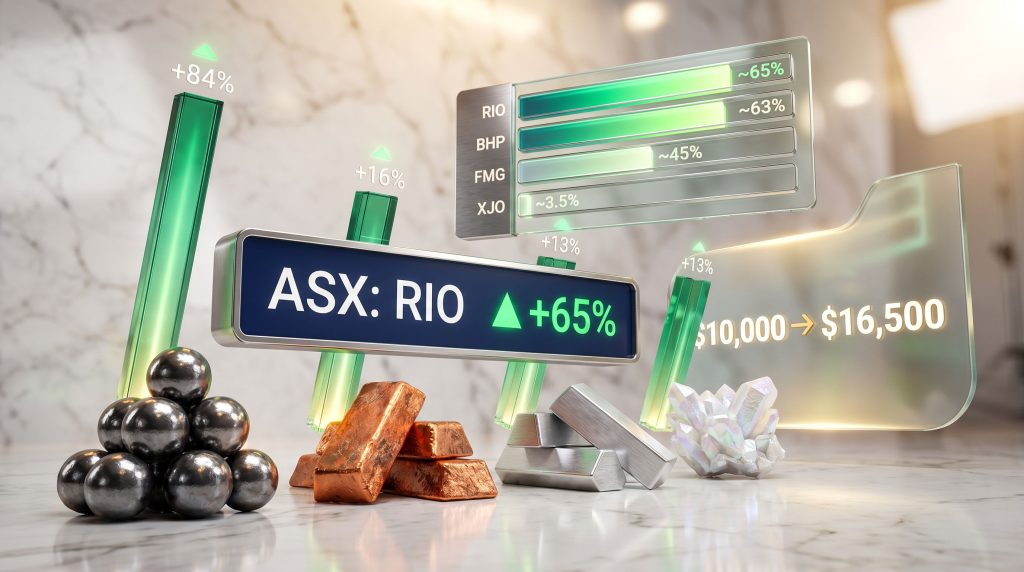
Over the trailing 12-month period, Rio Tinto (ASX: RIO) has delivered approximately 65% share price appreciation at the time of writing, compared to just 3.5% for the S&P/ASX 200 Index (ASX: XJO). That represents a performance gap of more than 61 percentage points, a divergence that is genuinely unusual for a large-cap blue-chip stock operating in a sector historically prone to volatility.
To contextualise this in dollar terms, a $10,000 investment placed in Rio Tinto shares 12 months ago would now be worth approximately $16,500, representing a capital gain of $6,500 before the effect of any dividends received or applicable taxes. You can track current and historical pricing data directly on the ASX company page.
Importantly, this outperformance extends across the peer group as well:
| Company | ASX Ticker | 12-Month Share Price Return |
|---|---|---|
| Rio Tinto | RIO | ~65% |
| BHP Group | BHP | ~63% |
| Fortescue | FMG | ~45% |
| ASX 200 Index | XJO | ~3.5% |
While all three major diversified miners comfortably outpaced the index, Rio Tinto's return was the strongest in the group. The roughly 2-percentage-point advantage over BHP and the 20-point gap versus Fortescue are not incidental. They reflect Rio Tinto's distinct commodity mix and the specific production growth narrative that has unfolded over recent quarters.
The Multi-Commodity Architecture Behind the Rally
It would be a misreading of the situation to attribute Rio Tinto shares performance purely to iron ore strength. The more precise explanation involves the simultaneous appreciation of four distinct commodity streams, each contributing to earnings uplift through a different mechanism.
Comparing Q1 2026 average prices to Q4 2025 averages:
| Commodity | Price Movement (Q4 2025 to Q1 2026 Average) |
|---|---|
| Iron Ore | Marginally higher |
| Copper | +16% |
| Aluminium | +13% |
| Lithium Carbonate | +84% |
The copper price surge of 16% carries particular weight for earnings forecasts. Copper operates at higher margin per tonne than iron ore for most large producers, meaning volume growth in copper is disproportionately accretive to the bottom line. The structural drivers behind copper demand, including grid infrastructure expansion, electric vehicle manufacturing, and the construction of large-scale data centres, have created a demand profile that analysts increasingly describe as durable rather than cyclical. Furthermore, Rio Tinto copper expansion initiatives are positioned to capture this demand over the medium term.
The 84% rise in lithium carbonate prices is the most dramatic single-commodity movement in the dataset, and its timing relative to Rio Tinto's entry into lithium production carries significant strategic implications. In addition, the broader lithium carbonate market dynamics suggest this momentum could extend further, which are explored below.
Aluminium's 13% gain is often underappreciated in commentary focused on copper and lithium. Because aluminium contributes a broad, reliable earnings floor across multiple product streams including packaging, construction, and automotive applications, its price improvement provides an important cushion against volatility elsewhere in the portfolio.
Why Iron Ore Is No Longer the Singular Driver
Iron ore remains Rio Tinto's largest revenue contributor by volume, and Q1 2026 global production of 82.8 million tonnes represents 12% year-over-year growth, a genuinely strong operational result. However, the relatively modest price movement in iron ore compared to copper and lithium during this period introduces an important analytical nuance.
The share price re-rating appears to reflect investor recognition of Rio Tinto's diversification optionality as much as iron ore fundamentals. When a miner of this scale begins generating meaningful revenue from copper, aluminium, and lithium simultaneously, the market often applies a valuation premium beyond the sum of individual commodity price moves. Consequently, China steel and iron ore trends remain a key variable to monitor, even as Rio Tinto's revenue mix broadens.
Q1 2026 Production Results: Operational Credibility Meets Commodity Tailwind
Production results do not move share prices in isolation, but when volume growth across multiple commodities coincides with price appreciation in those same commodities, the earnings leverage effect is amplified significantly.
Rio Tinto's Q1 2026 operational update demonstrated simultaneous volume growth across all major commodity segments, a rare alignment that multiplies earnings sensitivity when commodity prices are also rising.
Q1 2026 production summary:
- Iron Ore: 82.8mt, up 12% year-over-year
- Copper: 229kt, up 9% year-over-year
- Alumina: 2mt, up 6% year-over-year
- Lithium (LCE): 12.7kt, representing first meaningful commercial production
The copper figure deserves particular attention. Growth of 9% to 229kt at a time when the copper price itself rose 16% creates a situation where both volume and price are working in the same direction. In mining economics, this is sometimes described as positive operational leverage, a condition where a fixed cost base allows incremental revenue from higher volumes and prices to flow through to earnings at an accelerating rate.
Lithium Entry: A New Earnings Dimension With Long-Term Implications
The reporting of 12.7kt of lithium carbonate equivalent (LCE) marks Rio Tinto's formal commercial entry into the lithium market. This is a watershed moment for the company's strategic positioning, and understanding why requires some background on how lithium pricing and production economics work.
Lithium carbonate equivalent is the standard unit of measurement for lithium production across battery supply chains. The conversion from raw spodumene ore or brine extraction to LCE involves significant processing, and reaching commercial-scale output represents the culmination of years of capital investment.
Unlike iron ore, where pricing is driven heavily by Chinese steel demand, lithium carbonate pricing is more directly tied to battery manufacturing capacity growth and electric vehicle adoption rates globally. With lithium carbonate prices rising 84% quarter-on-quarter, Rio Tinto's entry into production at this specific moment is favourable from a margin capture standpoint.
However, investors with a longer time horizon should note that lithium markets are known for sharp price cycles, and the 84% quarterly gain is exceptional by historical standards. Sustaining that price level would require continued acceleration in battery manufacturing demand without proportional supply growth, a scenario that is possible but not certain.
If Rio Tinto's lithium project pipeline continues on schedule, this segment has the potential to become a material earnings contributor within a medium-term investment horizon, potentially transforming how analysts classify the company's commodity exposure profile.
Dual-Listed Structure: How the London Market Reflects the Same Trend
Rio Tinto operates as a dual-listed company (DLC), with shares trading on the ASX in Australian dollars and on the London Stock Exchange (LSE) in British pence (GBX). Both listings represent economic ownership of the same underlying business, but minor price differences can emerge due to currency conversion, time zone trading gaps, and market-specific liquidity dynamics. For reference, historical share price data offers useful context when evaluating long-term performance trends.
Recent London market data shows Rio Tinto shares trading in the GBX 7,925 to 8,003 range, with the stock positioned above key short-term moving averages, reflecting a technically constructive trend broadly consistent with the ASX performance trajectory.
Current valuation snapshot (London market reference):
| Metric | Value |
|---|---|
| Price-to-Earnings (P/E) Ratio | ~15.93x |
| Dividend Yield | ~3.77% |
| Technical Trend | Above key moving averages |
| Intraday Direction | Modest positive movement |
A P/E of approximately 15.93x for a diversified miner with demonstrated multi-commodity production growth is a valuation data point that warrants comparison against sector peers and historical averages. Mining sector P/E ratios tend to compress during commodity bull phases as earnings growth outpaces price appreciation, which can create the optical illusion of cheapness even as absolute prices reach elevated levels.
The Income Dimension: Rio Tinto as a Dividend Investment
Rio Tinto shares performance over the past 12 months has been primarily discussed as a capital appreciation story, but the income component adds meaningful depth to the total return picture.
A dividend yield of approximately 3.77% combined with the roughly 65% capital gain over the period produces a total return profile that is uncommon for large-cap resources companies operating through a commodity cycle. Income-oriented investors, including those holding Rio Tinto through self-managed superannuation funds (SMSFs), would have experienced both yield delivery and capital growth simultaneously.
However, several sustainability considerations apply:
- Mining dividends are inherently cyclical and tied to free cash flow generation, which fluctuates with commodity prices
- Strong Q1 2026 results across copper, aluminium, and lithium support near-term cash flow, but forward payout ratios depend on price sustainability
- Expanding into lithium and growing copper operations require ongoing capital expenditure, and management's capital allocation priorities between dividends and project investment will shape future yield outcomes
- Iron ore price stability provides a baseline earnings floor, but any significant deterioration in Chinese steel demand would pressure the largest revenue stream
Dividend sustainability in the mining sector is best assessed against forward earnings estimates and capital expenditure commitments, not trailing performance. A strong historical yield does not guarantee future distributions at equivalent levels.
The next major ASX story will hit our subscribers first
Key Risk Factors After a 65% Rally: Recalibrating Forward Expectations
When a blue-chip mining stock appreciates 65% in 12 months, the analytical framework must shift from identifying upside catalysts to assessing whether the conditions that drove the re-rating are durable. Understanding how commodity prices and miners interact over full cycles is essential context for this evaluation.
Key risks investors should monitor:
- Lithium price mean reversion: An 84% quarterly gain in lithium carbonate is historically exceptional and difficult to sustain without continued demand acceleration outpacing new supply
- Iron ore demand sensitivity: Any deterioration in Chinese construction activity or steel demand would pressure Rio Tinto's largest revenue stream disproportionately
- Currency headwinds: AUD/USD fluctuations affect reported earnings for Australian shareholders, and a strengthening Australian dollar erodes the value of USD-denominated commodity revenues when translated back
- Capital expenditure escalation: Expanding lithium and copper operations requires sustained investment that may reduce free cash flow available for dividends or buybacks
- Valuation recalibration risk: After a significant re-rating, the margin of safety against earnings disappointments narrows; a single quarterly miss can generate outsized negative share price reactions in highly-rated mining stocks
Comparing opportunity cost against peers, BHP's 63% return with a similarly diversified commodity mix provides a useful benchmark for assessing whether Rio Tinto's slight premium is justified by its specific production growth trajectory or whether it represents modest overextension relative to an equivalent risk profile.
Frequently Asked Questions: Rio Tinto Shares Performance
How much would $10,000 invested in Rio Tinto shares 12 months ago be worth today?
Based on the approximately 65% share price appreciation recorded over the trailing 12-month period, a $10,000 investment would now be worth approximately $16,500. This figure reflects capital gains only and does not include any dividends received during the holding period, which would increase the total return further.
Why have Rio Tinto shares risen so strongly over the past year?
The rally reflects a convergence of strong production volume growth across iron ore (+12%), copper (+9%), and alumina (+6%), combined with significant commodity price increases including copper (+16%), aluminium (+13%), and lithium carbonate (+84%). The commencement of lithium production at commercial scale also introduced a new revenue stream that expanded Rio Tinto's strategic commodity profile and attracted incremental investor interest.
How does Rio Tinto's performance compare to BHP and Fortescue?
Over the 12-month period, Rio Tinto (+65%) outperformed both BHP (+63%) and Fortescue (+45%), as well as the S&P/ASX 200 Index (+3.5%), making it the strongest performer among the three major diversified miners listed on the ASX.
What is Rio Tinto's current dividend yield and P/E ratio?
Based on London Stock Exchange market data, Rio Tinto's dividend yield is approximately 3.77% and its price-to-earnings ratio sits at approximately 15.93x. These figures are subject to change with share price movements and earnings updates.
Does Rio Tinto produce lithium?
Yes. Rio Tinto reported 12.7kt of lithium carbonate equivalent (LCE) in Q1 2026, marking its entry into commercial-scale lithium production. With lithium carbonate prices up 84% quarter-on-quarter at the time of reporting, this new segment represents a potentially meaningful future earnings contributor if project development continues as planned.
What is the difference between ASX: RIO and LSE: RIO?
Rio Tinto operates as a dual-listed company with shares traded on the Australian Securities Exchange in Australian dollars and on the London Stock Exchange in British pence (GBX). Both listings represent ownership of the same underlying business. Minor price differences between listings can occur due to currency conversion, time zone trading gaps, and market-specific liquidity conditions. The Rio Tinto unification debate remains a recurring topic in shareholder discussions given these structural nuances.
The Structural Investment Lesson From Rio Tinto's 12-Month Run
Rio Tinto shares performance over the past year encapsulates a broader principle in resources sector investing: when production volume growth and commodity price appreciation occur simultaneously across multiple segments, the earnings leverage effect for a diversified miner can produce returns that significantly exceed what any single-commodity analysis would predict.
The emergence of lithium as a new revenue pillar reflects a structural repositioning that goes beyond a single quarterly result. Large diversified miners are actively evolving their commodity exposure to capture energy transition demand, and Rio Tinto's Q1 2026 lithium production marks a tangible step in that direction rather than a purely aspirational strategy.
For investors evaluating the stock at current levels, the central analytical question is whether the valuation already fully prices in the commodity tailwinds that drove the re-rating, or whether there remains a structural case based on Rio Tinto's evolving commodity mix and production growth pipeline. That determination requires a careful assessment of forward commodity price assumptions, capital expenditure commitments, and the sustainability of production growth rates across all four major commodity segments.
This article contains general information only and does not constitute personal financial advice. Past performance is not indicative of future results. Investors should consider their own financial circumstances and seek professional advice before making investment decisions. Commodity prices, production volumes, and share prices are subject to change.
Want to Catch the Next Major Mineral Discovery Before the Broader Market Does?
Discovery Alert's proprietary Discovery IQ model delivers real-time alerts on significant ASX mineral discoveries, instantly transforming complex mineral data into actionable insights for both short-term traders and long-term investors — explore historic discoveries and their exceptional returns to understand the opportunity, then begin your 14-day free trial to position yourself ahead of the market.