June 25, 2026
The Commercial Gap That Billions Cannot Simply Buy
Shipping hundreds of millions of tonnes of iron ore across the world's oceans each year sounds like a logistical triumph. And in many respects, it is. But for large-scale bulk commodity producers, the ability to move product efficiently is only half the equation. The other half — managing the cost of doing so — has long separated the world's most commercially sophisticated mining companies from their peers.
Freight is not a footnote in mining economics. For iron ore exporters operating on thin per-tonne margins, the difference between a well-hedged shipping programme and an unhedged one can translate directly into hundreds of millions of dollars in annual earnings variance. This is the largely invisible battleground where the world's largest miners are now competing, and it is precisely this terrain that sits at the centre of the Rio Tinto Vitol freight and logistics joint venture discussions.
When big ASX news breaks, our subscribers know first
Understanding the Scale of Rio Tinto's Freight Exposure
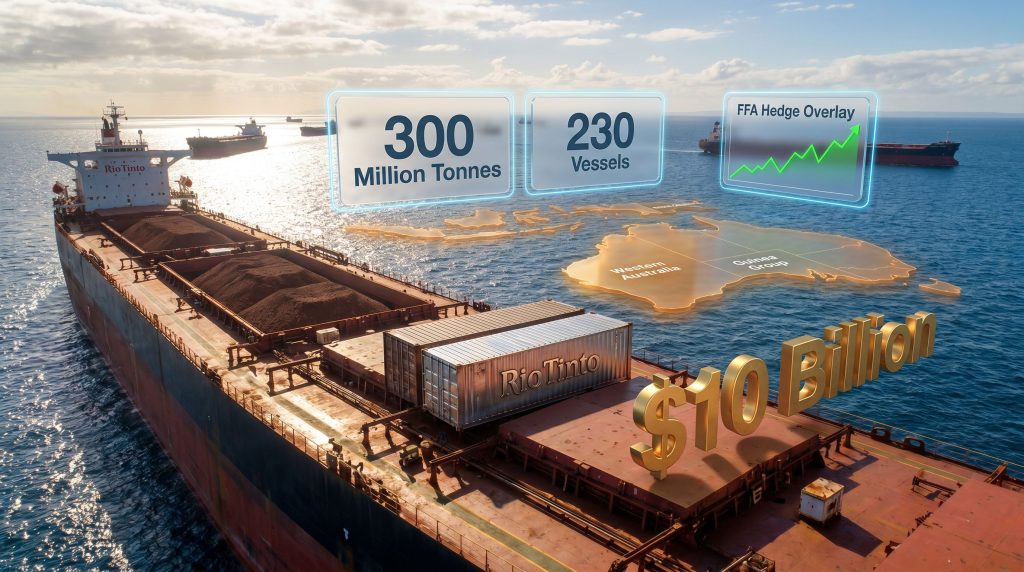
Rio Tinto global operations span one of the most extensive private shipping programmes on the planet. With a fleet exceeding 230 vessels and annual cargo volumes surpassing 300 million tonnes, the company's logistics footprint rivals small national shipping industries. The bulk of this activity involves iron ore exported from Western Australia to steelmakers in China, a trade route that is both Rio Tinto's commercial backbone and its most significant source of freight cost variability.
For context, the Baltic Dry Index, which tracks dry bulk shipping rates across major global routes, has swung by more than 400% in a single calendar year during periods of market stress. Each percentage point movement in average freight rates across Rio Tinto's shipping programme carries material implications for the company's delivered cost-per-tonne and, by extension, its realised iron ore margin.
Why Freight Volatility Has Intensified
The structural drivers behind freight rate volatility have multiplied over the past five years. Several compounding forces have reshaped dry bulk shipping markets in ways that are unlikely to normalise quickly:
| Risk Factor | Mechanism of Impact |
|---|---|
| Red Sea and Middle East Conflict | Extended routing requirements, increased vessel utilisation, higher daily rates |
| China Demand Fluctuations | Reduced cargo volumes and rate compression on key Australian routes |
| Port Congestion Events | Effective fleet capacity reduction through vessel queuing and delays |
| Bunker Fuel Price Volatility | Direct escalation of voyage costs, particularly for non-hedged operators |
| Trade Route Disruptions | Insurance cost increases, route diversions, scheduling uncertainty |
The result is that freight has evolved from a manageable operational variable into a genuine earnings risk factor — one that sophisticated commodity trading houses hedge systematically while most mining companies continue to absorb as a cost of doing business. Furthermore, the commodity hedging strategies employed by leading traders have become increasingly complex, creating a widening capability gap between miners and specialist trading firms.
The Rio Tinto Vitol Freight and Logistics Joint Venture: What Is Known
Rio Tinto and Vitol Group are engaged in preliminary, confidential discussions regarding the establishment of a freight and logistics joint venture. The talks remain at an early stage, and the structure, ownership split, and operational mandate of any formal entity have not yet been determined. Importantly, there is no guarantee that a binding agreement will be reached.
What is known is that one of the core areas under discussion involves Vitol providing Rio Tinto with risk management tools for freight, potentially including access to freight derivative instruments such as Forward Freight Agreements (FFAs). These derivative contracts allow participants to lock in future shipping rates, effectively converting a variable cost into a predictable one across a defined period.
The Boundaries of the Proposed Arrangement
It is equally important to understand what this joint venture is not intended to be. The proposed arrangement explicitly excludes any role for Vitol in marketing or trading Rio Tinto's physical commodities. This is a freight and logistics play, not a commodities trading alliance. The distinction matters because it defines the commercial ceiling of the partnership and separates it conceptually from the far more expansive capabilities that a Glencore acquisition would have delivered.
Both Rio Tinto and Vitol declined to comment publicly on the discussions.
Why Vitol Is a Strategically Coherent Partner for Rio Tinto
Vitol is the world's largest independent energy trading company, processing approximately 8 million barrels per day of crude oil and petroleum products. That scale alone commands attention, but it is the company's track record in logistics-focused joint ventures that makes it a particularly relevant partner for Rio Tinto's specific needs.
Vitol has a documented history of forming collaborative logistics and trading structures with large resource producers. Its joint ventures with national oil companies in Oman and Mozambique demonstrate a proven institutional capability to design and operate partnership models with counterparties that have very different commercial DNA. The company also established Leopard Tankers in partnership with Grindrod, and built a coal trading venture with the same counterparty.
In 2025, Vitol traded approximately 25 million tonnes of coal and 15 million tonnes of ferrous and non-ferrous metals — figures that position it as a genuine participant in dry bulk freight markets rather than a peripheral observer. The company has been actively pursuing expansion in metals trading, targeting segments such as aluminium and copper that have historically been dominated by commodity trading giants such as Glencore and Trafigura.
An Existing Commercial Relationship
A detail that deserves more attention than it typically receives is that Vitol and Rio Tinto are not strangers. Vitol already functions as a major fuel supplier to Rio Tinto's Simandou iron ore project in Guinea — one of the largest undeveloped iron ore deposits on Earth — as well as to Rio's Australian iron ore operations. This pre-existing commercial relationship is not merely symbolic. It means the two organisations already share operational interfaces, contractual frameworks, and institutional familiarity, all of which reduce the friction costs typically associated with forming a new joint venture.
The Glencore Acquisition That Reshaped Rio Tinto's Strategy
To fully appreciate why the Rio Tinto Vitol freight and logistics joint venture discussions are significant, it is necessary to understand what Rio Tinto was attempting to acquire when it entered merger talks with Glencore in early 2026.
A combined entity would have been valued at approximately $80 billion, making it the largest mining merger in history. Glencore's copper mining portfolio was the headline attraction, but underneath the copper narrative lay a second, equally compelling strategic rationale. Glencore's globally integrated commodity marketing and trading division represents one of the most valuable commercial platforms in the resources industry — an operation capable of capturing margin at every point in the supply chain from mine gate to end customer.
Rio Tinto has historically lacked this capability. The two parties ultimately failed to agree on valuation, and talks were formally ended in February 2026. However, the strategic imperative that drove Rio Tinto to the negotiating table in the first place did not disappear when those talks collapsed.
A Lower-Risk Path to Commercial Capability
The Vitol discussions represent a structurally lighter pathway toward a subset of the capabilities that Glencore would have delivered. Rather than absorbing an $80 billion counterparty with all the integration complexity, regulatory scrutiny, and capital commitment that entails, Rio Tinto is exploring a targeted logistics partnership that addresses one specific and quantifiable commercial gap: the management of freight cost risk.
This approach aligns with the strategic direction articulated by CEO Simon Trott, who took the top role last year and has outlined a programme of business simplification, asset sales, and selective commercial partnerships. The broader restructuring initiative targets up to $10 billion in proceeds from asset divestments, with logistics infrastructure among the categories under review.
Strategic framing: The Vitol discussions are best understood not as a replacement for Glencore, but as evidence that Rio Tinto is pursuing its commercial capability agenda through a more targeted, modular approach — building specific functions rather than buying an entire integrated trading platform.
Freight Derivatives: The Technical Mechanism at the Core of the Discussion
For readers less familiar with commodity trading mechanics, Forward Freight Agreements merit explanation. An FFA is a financial contract between two counterparties that sets a future shipping rate for a defined route, vessel class, and time period. If actual market rates rise above the agreed level, the buyer of the FFA receives the difference. If rates fall below it, the seller benefits.
For a company like Rio Tinto, which operates a continuous, high-volume shipping programme with limited ability to pause or reroute cargo flows, FFAs offer a mechanism to convert unpredictable freight expenditure into a planned cost. Furthermore, the challenge is that sophisticated FFA trading requires market intelligence, derivative trading infrastructure, risk management expertise, and counterparty relationships that mining companies do not organically develop.
This is precisely where Vitol's competency in energy derivatives becomes directly applicable. The methodologies used to hedge crude oil and natural gas price exposure through financial derivatives translate readily to freight derivative structures. Vitol's institutional knowledge in this area represents a transferable commercial asset that Rio Tinto currently lacks at any meaningful scale.
The next major ASX story will hit our subscribers first
Scenario Analysis: How the Partnership Could Develop
Given the early-stage nature of the discussions, multiple structural outcomes remain plausible. Three broad scenarios frame the range of possibilities:
Scenario A: Narrow Freight Hedging Overlay
Vitol provides Rio Tinto with access to derivative trading tools, risk management advisory services, and market intelligence without a formal joint entity being established. This is the lowest-commitment outcome and the most easily reversible if the commercial results disappoint.
Scenario B: Formal Logistics Joint Venture
A jointly owned entity is created to manage a defined portion of Rio Tinto's vessel chartering, freight scheduling, and derivative hedging — modelled on Vitol's existing logistics joint venture structures in energy markets. This would represent a meaningful institutional commitment from both parties.
Scenario C: Expanded Commercial Partnership
The initial freight focus expands progressively to include broader supply chain optimisation, potentially covering fuel procurement integration, port logistics coordination, and third-party dry bulk freight services. This outcome would most closely approximate the commercial depth that a Glencore acquisition would have delivered, albeit through a slower and more incremental path.
The Broader Industry Shift: Mining Companies and the Logistics Profit Centre
The Rio Tinto Vitol freight and logistics joint venture discussions do not exist in isolation. They reflect a structural evolution underway across the global mining industry, where the most commercially sophisticated operators are treating logistics not as a necessary cost but as a potential source of competitive advantage and incremental margin.
BHP has similarly invested in freight optimisation capabilities, while Glencore's vertically integrated mining-and-trading model has long demonstrated the earnings benefits of capturing value at multiple points in the supply chain. Moreover, the growing influence of China iron ore demand on global shipping routes, combined with increasing geopolitical complexity in key shipping corridors, is intensifying the commercial case for freight risk management investment across the sector.
In addition, the broader context of China steel and iron ore market pressures in 2025 has reinforced the urgency with which major producers are seeking to protect their delivered margins through more sophisticated logistics structures.
What Investors Should Monitor
Several indicators will signal how this developing story evolves. Investors and analysts should pay close attention to the following:
- A formal announcement confirming the joint venture's structure, ownership proportions, and operational mandate
- The inclusion or exclusion of logistics infrastructure assets within Rio Tinto's broader $10 billion divestment programme
- Measurable freight cost improvements in Rio Tinto's quarterly earnings disclosures once any venture becomes operational
- Vitol's pace of expansion in metals trading, which will determine how strategically aligned the two companies' commercial interests become over time
- Whether the joint venture framework is eventually extended beyond freight derivatives into broader supply chain functions
For those seeking further context, Rio Tinto's marine operations page provides useful background on the scale of the company's existing shipping programme and the complexity of the logistics infrastructure now potentially under discussion.
Disclaimer: This article contains forward-looking analysis, scenario projections, and commentary on early-stage commercial discussions. Readers should be aware that no formal agreement between Rio Tinto and Vitol has been confirmed as of the time of publication. Nothing in this article constitutes financial or investment advice. All financial figures and operational statistics are sourced from publicly available reporting and should be independently verified before being relied upon for investment decisions.
Want to Capitalise on Major ASX Mineral Discoveries Before the Broader Market?
Discovery Alert's proprietary Discovery IQ model delivers real-time alerts on significant ASX mineral discoveries, transforming complex geological and market data into actionable investment insights for both short-term traders and long-term investors. Explore historic discoveries and their remarkable returns on Discovery Alert's dedicated discoveries page, and begin your 14-day free trial today to secure a genuine market-leading edge.