June 11, 2026
The Hidden Complexity Behind Mining Stock Returns
Most investors instinctively reach for the share price chart when sizing up a stock's performance. In the resources sector, that instinct can be deeply misleading. The Australian mining industry operates on a fundamentally different return architecture than most other sectors, where dividends are not a secondary consideration but often the primary engine of total wealth creation.
Understanding how Rio Tinto vs BHP vs Fortescue shares returns truly compare requires a multi-layered analytical framework, one that accounts for capital appreciation, dividend income, franking credit value, commodity cycle positioning, and investor risk tolerance simultaneously. Strip out any one of those variables, and the comparison becomes distorted.
This analysis examines the five-year total shareholder return (TSR) record of all three ASX mining giants, then layers in structural business characteristics, valuation considerations, and investor profile matching to deliver a genuinely complete picture.
When big ASX news breaks, our subscribers know first
What the Five-Year Performance Data Actually Reveals
Breaking Down the Total Return Scorecard (May 2021 to May 2026)
The raw performance numbers across a full five-year cycle tell a story that diverges sharply depending on whether dividends are included in the calculation.
| Metric | Rio Tinto (RIO) | BHP Group (BHP) | Fortescue (FMG) |
|---|---|---|---|
| Entry Price (May 2021) | $122.12 | $42.52 | $22.30 |
| Recent Share Price | $184.48 | $59.82 | $21.63 |
| Capital Gain (%) | +51.1% | +40.1% | -3.0% |
| Total Dividends Per Share | $40.09 | $14.92 | $9.62 |
| Accumulated Value Per Share | $224.57 | $74.74 | $31.25 |
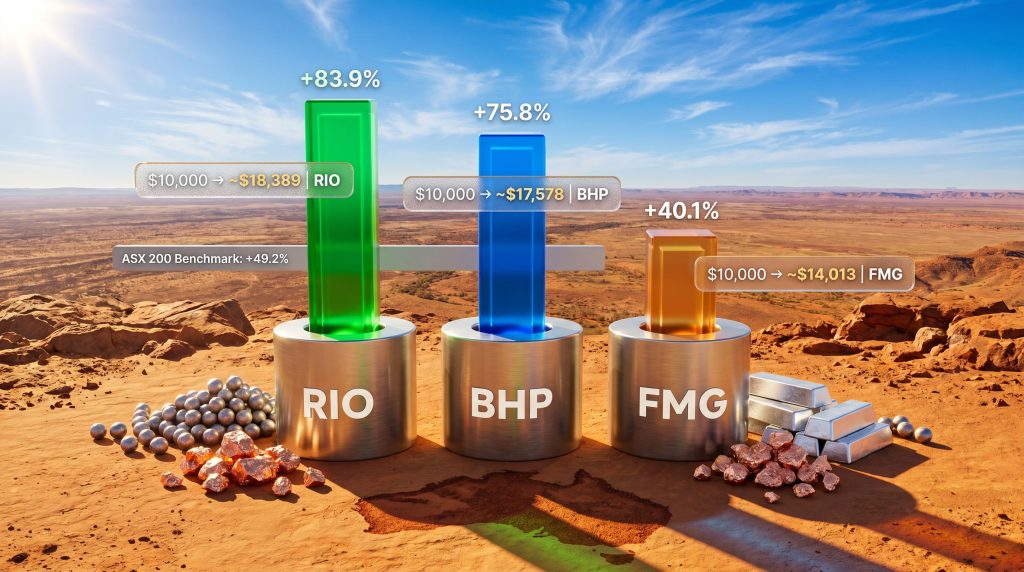
| Total Return (%) | +83.9% | +75.8% | +40.1% |
| $10,000 Grown To | ~$18,389 | ~$17,578 | ~$14,013 |
| Dividend Franking | Fully Franked | Fully Franked | Fully Franked |
Note: Price data as at 22 May 2026. Calculations assume a full $10,000 invested at each entry point. Past performance does not guarantee future results.
Rio Tinto delivered the strongest result, with a total return of approximately 83.9%, turning a $10,000 starting position into roughly $18,389 after five years. BHP followed closely at 75.8% total return, growing the same investment to approximately $17,578. Fortescue, despite posting a capital loss of around 3% on share price alone, recovered to a 40.1% total return once dividends of $9.62 per share were factored in, delivering a final value of approximately $14,013.
Furthermore, for a broader snapshot of how these companies stacked up in FY25 specifically, recent analysis comparing FY25 returns across all three miners highlights just how variable annual performance can be within the longer-term trend.
The Dividend Rescue Effect: Income as a Return Stabiliser
Fortescue's result is perhaps the most instructive of the three. Without its cumulative dividend payments, the stock would have registered a net loss over five years. The $9.62 per share in distributed income essentially converted a negative capital return into a meaningful positive outcome.
This phenomenon, sometimes described in portfolio management literature as the dividend rescue effect, illustrates a critical principle: in cyclical commodity businesses, income distributions frequently compensate for share price compression during downturns. For investors who focus exclusively on price action, this dynamic is routinely underestimated.
Benchmark Context: The S&P/ASX 200 Gross Total Return Index (ASX: XJT), which reinvests all dividends at the ex-dividend date, returned approximately 49.2% over the five years to May 2026. Rio Tinto outperformed this benchmark by roughly 34.7 percentage points, BHP by approximately 26.6 percentage points, while Fortescue underperformed the benchmark by approximately 9.1 percentage points on a total return basis.
How Short-Term Windows Shift the Rankings
Momentum, Volatility, and Time-Frame Dependency
Five-year data points toward a clear winner, but shorter measurement windows produce a very different hierarchy. In one 2025 year-to-date period, all three miners were in negative territory simultaneously, with BHP declining approximately 4%, Rio Tinto falling roughly 8%, and Fortescue retreating around 12%. In a separate measurement window, the order reversed entirely, with Rio Tinto leading at approximately +24%, followed by Fortescue at roughly +16% and BHP at approximately +13.75%.
During October 2025 specifically, Fortescue surged approximately 14.0%, Rio Tinto gained around 8.9%, and BHP rose approximately 2.2%, with all three outperforming the broader ASX 200 during that month.
These shifting rankings reflect a well-understood but frequently ignored dynamic in resources investing: Fortescue carries meaningfully higher beta than its two peers. Beta, in investment terminology, measures a stock's price sensitivity relative to the broader market or a reference commodity. Because Fortescue's revenue base is so concentrated in iron ore, its share price amplifies both upswings and corrections more dramatically than the more diversified BHP or Rio Tinto.
For investors assessing which miner suits their portfolio, relying on any single short-term window is analytically hazardous. Rolling three-year and five-year total returns provide a far more reliable basis for comparison.
What Structurally Drives Returns for Each Company
Iron Ore: The Common Thread and Systemic Risk Factor
All three companies derive a substantial portion of revenue from iron ore operations, making the Chinese steel demand outlook the single most influential external variable across the entire group. Iron ore price trends compress or expand margins, dividend capacity, and share price multiples with near-mechanical regularity.
One underappreciated dimension of this dependency is the ore grade discount problem, which affects Fortescue more acutely than its peers. Iron ore is not a homogeneous commodity. High-grade ore, typically classified above 62% iron content, commands a significant premium over lower-grade material on Chinese spot markets. Fortescue's Pilbara operations have historically produced ore with iron content closer to the 56% to 58% range, which attracts a price discount relative to the benchmark index price most commonly cited in financial media.
This discount is not static. During periods of strong Chinese steel demand, the grade penalty narrows as mills accept lower-quality feedstocks. During downturns or when Chinese mills face profitability pressure, the discount widens sharply, compressing Fortescue's realised price per tonne relative to what Rio Tinto achieves from its higher-grade Pilbara operations. This structural dynamic partially explains Fortescue's weaker margin profile compared to its peers.
BHP: Commodity Diversification as Earnings Insurance
BHP's distinguishing characteristic is the breadth of its commodity portfolio. Its revenue streams span iron ore, copper, metallurgical (coking) coal, and potash development, providing meaningful insulation when iron ore markets soften. BHP's strategic pivot toward copper and other future-facing commodities reflects a deliberate effort to reduce earnings concentration risk over the medium term.
Copper exposure is increasingly valued by the investment community. The metal sits at the intersection of electrification, renewable energy infrastructure, electric vehicles, and grid modernisation, giving BHP a structural demand tailwind that its earnings model will increasingly benefit from over the medium term. BHP's copper assets in South America, particularly the Escondida mine in Chile, represent one of the world's largest and lowest-cost copper operations.
Potash development via the Jansen project in Canada introduces an entirely different commodity dynamic, one tied to global agricultural demand and food security trends rather than steel production. While this project remains in development and will require significant capital for years before generating material returns, it represents a long-duration call option on global food demand.
Rio Tinto: Energy Transition Metals Positioning
Rio Tinto's commodity mix includes iron ore, aluminium, copper, and growing exposure to lithium. Consequently, Rio's lithium strategy is attracting considerable investor attention, particularly given the Rincon brine project in Argentina and the contested Jadar lithium-boron deposit in Serbia. The Jadar project, if developed, would rank among the largest lithium deposits in Europe, though it has faced significant community and regulatory opposition that has delayed its timeline considerably.
The aluminium business, operated primarily through the Rio Tinto Alcan division, provides a revenue stream that responds to different demand drivers than iron ore, including aerospace, packaging, and increasingly, the lightweight components market for electric vehicles. Aluminium smelting is extremely energy-intensive, meaning Rio Tinto's aluminium margins are partially a function of energy input costs, which adds a layer of complexity to earnings analysis.
Rio Tinto's capital return track record over the five-year measurement period has been notably strong, with 10 fully franked dividend payments totalling $40.09 per share, representing one of the most substantial income streams among large-cap ASX stocks over that period.
Fortescue: High Yield, High Concentration, Strategic Diversification Ambition
Fortescue has pursued an ambitious diversification strategy centred on green hydrogen, renewable energy technology, and decarbonisation infrastructure through its Fortescue Energy division. The company committed significant capital to this strategy over several years, including expenditure on green hydrogen feasibility work, electrolyser technology development, and renewable energy projects across multiple jurisdictions.
However, the financial contribution of this diversification effort to overall group earnings remains limited at present. The core iron ore business continues to represent the overwhelming majority of Fortescue's earnings and cash flow generation. Until Fortescue Energy or related divisions achieve commercial scale, the company's financial performance will continue to track iron ore prices closely.
Dividend Yield Comparison and Income Sustainability
Current Yield Snapshot Across All Three Miners
| Company | Approx. Dividend Yield | Franking | Income Risk Profile |
|---|---|---|---|
| BHP Group (BHP) | ~5.7% | Fully Franked | Moderate |
| Rio Tinto (RIO) | ~6.3% | Fully Franked | Moderate |
| Fortescue (FMG) | ~7.9% | Fully Franked | Higher |
Note: Yields are approximate and reflect a specific market period. Yield figures fluctuate with share price movements and dividend policy changes.
During periods of pronounced iron ore price weakness, yields across all three have been observed at significantly elevated levels, with analysis from various market periods noting BHP yields reaching approximately 9.9%, Rio Tinto approximately 14.1%, and Fortescue approximately 15.4%. These headline figures can appear superficially attractive but typically signal elevated dividend sustainability risk rather than income opportunity.
Franking Credit Value Illustration: For an Australian investor in the 32.5% marginal tax rate bracket, a fully franked dividend effectively delivers a gross yield approximately 43% higher than the stated cash yield, due to the 30% corporate tax credit attached to each payment. Within a superannuation fund taxed at 15%, the benefit is even more pronounced, making the after-tax income from these fully franked dividends materially superior to unfranked alternatives offering nominally similar yields.
This franking advantage is particularly significant for self-managed superannuation funds (SMSFs) and Australian resident investors in retirement phase, where franking credits can generate direct cash refunds from the Australian Tax Office when the credit exceeds the tax liability.
Valuation Framework: Are These Stocks Fairly Priced?
The Cyclical Earnings Problem in Mining Valuation
Standard price-to-earnings (P/E) ratios are notoriously unreliable tools for evaluating mining companies. Because commodity prices can swing violently within a single financial year, reported earnings in a boom period will make a stock appear cheap on a P/E basis, while depressed cycle earnings will make the same stock appear expensive. Neither reading reflects the underlying business value accurately.
A more rigorous approach involves normalised or mid-cycle earnings, which estimate what a company would earn at a long-run average commodity price rather than the prevailing spot price. Comparing current valuations against normalised earnings allows investors to assess whether they are buying a business at a discount to intrinsic value or paying a premium that relies on sustained commodity price strength.
Morningstar's assessment of major ASX-listed miners has indicated that BHP and Rio Tinto have traded above their assessed fair value estimates in certain recent periods. Fortescue has, in the same analytical framework, traded at an even greater premium relative to intrinsic value estimates, despite exhibiting weaker margin characteristics attributable to ore grade and cost positioning. This observation suggests that at elevated iron ore price environments, entry points offering a meaningful margin of safety may be limited across all three names.
The next major ASX story will hit our subscribers first
Risk-Adjusted Return Framework: Matching Investor Profiles to Each Miner
Which Miner Suits Which Type of Investor?
Conservative Income Investor
- Primary objective: Stable, sustainable dividend income with lower drawdown risk
- Best alignment: BHP offers the most diversified earnings base among the three, with copper, coal, and potash exposure providing partial insulation against iron ore weakness
- Yield is lower than peers, but dividend sustainability across a full commodity cycle is generally highest
- Appropriate for superannuation portfolios seeking reliable franked income with reduced volatility exposure
Balanced Growth and Income Investor
- Primary objective: Competitive total return combined with meaningful dividend income
- Best alignment: Rio Tinto delivered the strongest five-year total return in this comparison, and many analysts continue to favour Rio over BHP given its growing exposure to energy transition metals through copper and lithium
- The aluminium and copper diversification adds analytical complexity but also introduces structural demand tailwinds
- Appropriate for investors seeking a blend of current income and longer-term commodity optionality
High-Conviction Cyclical Investor
- Primary objective: Maximum yield expression and willingness to accept iron ore concentration risk
- Best alignment: Fortescue offers the highest stated dividend yield among the three, but earnings and dividend sustainability are the most sensitive to iron ore price movements and ore grade dynamics
- Produced the weakest five-year total return in this comparison, requiring active monitoring of iron ore fundamentals and Chinese demand signals
- Appropriate only for investors who hold a positive view on iron ore pricing and can withstand significant short-term share price volatility
Scenario Analysis: If iron ore prices were to decline 30% from prevailing levels, Fortescue would likely experience the most severe earnings compression given its revenue concentration and lower ore grade realisation. BHP's diversified commodity portfolio would provide the greatest earnings buffer in that scenario, while Rio Tinto would occupy an intermediate position between the two.
Macro Factors Affecting the Entire Sector
Forces That Apply Equally Across All Three Companies
Beyond individual business characteristics, several macro dynamics exert influence across Rio Tinto vs BHP vs Fortescue shares returns simultaneously:
- Chinese steel demand remains the dominant demand driver for iron ore, with property sector health, infrastructure spending velocity, and manufacturing activity all feeding into iron ore consumption volumes
- AUD/USD currency dynamics directly influence reported earnings and dividend capacity, as iron ore is priced in US dollars while a significant proportion of operating costs are denominated in Australian dollars. A weaker AUD benefits all three by widening the AUD-equivalent margin per tonne
- Geopolitical trade relationships between Australia and China represent a systemic risk applicable to the entire group, though iron ore has historically been somewhat insulated from trade disruptions given China's import dependency
- Energy transition commodity demand for copper and aluminium is creating longer-term structural tailwinds for BHP and Rio Tinto specifically, as the global decarbonisation effort is materials-intensive
- Decarbonisation of mining operations is becoming an increasingly important capital allocation consideration for all three, as investors and regulators focus on scope 1, 2, and 3 emissions reporting and reduction commitments
Frequently Asked Questions: Rio Tinto vs BHP vs Fortescue
Which ASX miner has delivered the best five-year total return?
Rio Tinto (ASX: RIO) delivered the strongest five-year total return of approximately 83.9% to May 2026, growing a $10,000 investment to approximately $18,389 when dividends are included. BHP came second at approximately 75.8%, and Fortescue third at approximately 40.1%.
Does Fortescue pay better dividends than BHP and Rio Tinto?
Fortescue currently offers the highest stated dividend yield of the three at approximately 7.9%, compared to Rio Tinto at roughly 6.3% and BHP at approximately 5.7%. However, Fortescue's dividends are the most sensitive to iron ore price cycles, making sustainability the central consideration.
Why does iron ore grade matter so much for Fortescue's profitability?
Iron ore grade refers to the iron content percentage of extracted ore. Fortescue's Pilbara ore typically grades in the 56% to 58% iron range, which attracts a price discount on Chinese spot markets relative to higher-grade ore above 62% iron. This discount widens during periods of steel mill margin pressure, structurally compressing Fortescue's realised price per tonne compared to Rio Tinto's higher-grade output.
How important are franking credits for comparing these mining stocks?
Franking credits are highly significant for Australian resident investors. All three companies pay fully franked dividends, meaning the 30% corporate tax already paid on profits can be used as a tax offset. For SMSF investors in accumulation phase or individuals in lower tax brackets, the effective after-tax yield is materially higher than the stated cash yield, making franking an important variable in any genuine return comparison.
Is BHP more defensively positioned than Fortescue?
Yes. BHP's diversified commodity exposure across iron ore, copper, metallurgical coal, and potash development provides meaningful earnings insulation that Fortescue, as a near-pure iron ore producer, does not possess. This diversification supports more stable normalised earnings across a full commodity price cycle.
Key Takeaways: Comparing Rio Tinto vs BHP vs Fortescue Shares Returns
- Rio Tinto delivered the strongest five-year total return of approximately 83.9%, outperforming both the ASX 200 benchmark and its two major peers by a meaningful margin
- BHP followed with approximately 75.8% total return, underpinned by commodity diversification and consistent fully franked dividend distributions
- Fortescue posted the weakest five-year total return of approximately 40.1%, with dividend income doing the heavy lifting to convert what would otherwise have been a capital loss into a positive outcome
- Short-term return rankings are highly time-frame dependent, with Fortescue leading in monthly momentum during October 2025 and Rio Tinto leading across certain year-to-date windows
- Ore grade is a structurally underappreciated variable in Fortescue's earnings model, with the grade discount to benchmark iron ore prices widening meaningfully during periods of Chinese steel mill margin pressure
- For income-focused investors, all three offer fully franked dividends, but yield sustainability differs materially based on commodity diversification and iron ore price sensitivity
- Investor profile alignment matters critically: BHP suits conservative income investors, Rio Tinto suits balanced growth and income investors, and Fortescue suits those with high conviction on iron ore and explicit tolerance for elevated share price volatility
This article contains general financial information only and does not constitute personal financial advice. Past performance is not indicative of future results. All investment values, yields, and return figures are approximate and subject to change. Investors should consider their personal financial circumstances and consult a licensed financial adviser before making any investment decisions.
Want To Capitalise On The Next Major ASX Mineral Discovery Before The Broader Market?
While the returns from Rio Tinto, BHP, and Fortescue demonstrate the wealth-building power of resources investing, the most transformative gains in the sector have historically come from being positioned early in significant new mineral discoveries — and Discovery Alert's proprietary Discovery IQ model delivers real-time alerts the moment major ASX discoveries are announced, turning complex geological data into actionable opportunities. Explore historic discovery returns that demonstrate just how substantial early positioning can be, and begin a 14-day free trial at Discovery Alert to secure a genuine market-leading edge.