May 18, 2026
The Hidden Mechanics Behind Junior Miners Using Base Metals to Fund Gold Growth
Across the global mining sector, a quiet but consequential strategy has been gaining traction among junior-to-mid-tier producers: acquiring cash-generating base metal operations to finance the capital-intensive ramp-up of precious metal assets. This approach sidesteps the chronic vulnerability of single-asset developers, who must repeatedly return to equity markets for funding, diluting shareholders with each raise. Rio2 first copper income and Fenix gold ramp-up represents one of the clearest live examples of this model being tested in real time.
When executed well, the pairing of a copper supply crunch hedge with a gold growth asset creates a self-reinforcing financial architecture that larger producers have long understood but smaller companies are only now beginning to replicate systematically.
Rio2 Limited, listed on the Toronto Stock Exchange, delivered its first genuine test of this model in the quarter ended March 31, 2026. The results reveal both the promise of the dual-asset structure and the operational complexity that comes with building it from the ground up.
When big ASX news breaks, our subscribers know first
From Single-Asset Developer to Dual-Commodity Producer
For most of its recent history, Rio2 was defined almost entirely by one project: the Fenix gold mine in northern Chile. Fenix represented a substantial development-stage commitment, a high-altitude open-pit operation requiring significant upfront capital before producing a single ounce at commercial scale. That concentration of risk is familiar to investors in the junior mining space, where the fate of a company can hinge on the performance of one asset, one permit, or one processing circuit.
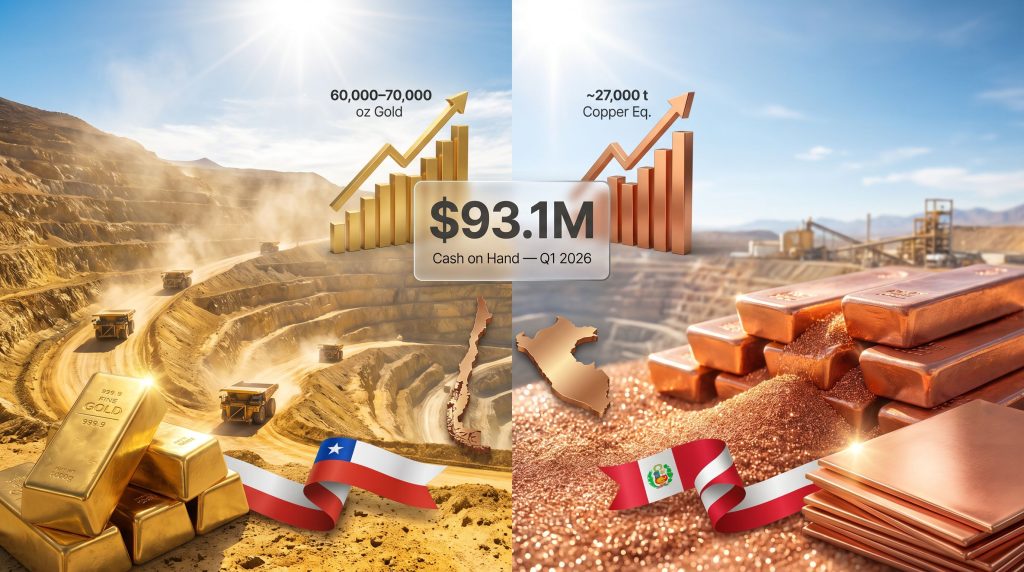
The acquisition of the Condestable copper mine in Peru in January 2026 fundamentally restructured that risk profile. Condestable is an established, operating copper producer with an estimated annual production capacity of approximately 27,000 tonnes of copper equivalent. At consensus copper prices, the asset is projected to generate EBITDA of around US$110 million annually, rising to approximately US$145 million at spot prices — a meaningful spread that reflects just how sensitive copper EBITDA can be to relatively modest price movements.
What makes this pairing strategically coherent is the timing asymmetry. Condestable was already producing when Rio2 acquired it, meaning copper cash flows began flowing immediately, before Fenix had reached commercial production. This sequencing is deliberate and reflects a broader playbook used by more sophisticated operators in the sector: use near-term cash flow to reduce the funding pressure on a longer-duration development asset. Furthermore, the mining industry consolidation trend has made such acquisitions more accessible for ambitious mid-tier companies.
What Rio2's Q1 2026 Numbers Actually Reveal
The headline financials from Rio2's first quarter of 2026 carry more nuance than they appear to at first glance. Income from mine operations reached $24.6 million, while adjusted net income came in at $12.1 million. The gap between those two figures reflects the integration costs and ramp-up drag that accompany any major acquisition alongside a simultaneous greenfield commissioning process, both happening within the same quarter.
Cash and cash equivalents at quarter-end stood at $93.1 million, providing a meaningful operational buffer as Fenix continues its production build. Cash from operating activities reached $22.8 million, up from $19.3 million in the same period of 2025 — a year-on-year improvement that understates the structural change in the business given that the prior period contained no copper revenue at all.
The cash flow statement tells a particularly instructive story when viewed across all three categories:
| Cash Flow Category | Q1 2026 | Q1 2025 |
|---|---|---|
| Cash from Operating Activities | $22.8M | $19.3M |
| Cash Used in Investing Activities | $80.3M | $16.2M |
| Net Cash from Financing Activities | $103.5M | $40,000 |
| Income from Mine Operations | $24.6M | N/A |
| Adjusted Net Income | $12.1M | N/A |
The sharp increase in investing outflows, from $16.2 million to $80.3 million, reflects the capital deployed to complete the Condestable acquisition. The financing inflow of $103.5 million against a prior-year figure of just $40,000 confirms that a substantial capital raise was conducted to fund the transaction. For investors, this context matters: the balance sheet transformation is a one-time repositioning, not an ongoing structural cash drain. In addition, understanding the various capital raising methods available to junior miners helps contextualise the scale of Rio2's financing activity.
Fenix Gold Mine: Understanding the Ramp-Up Trajectory
Why High-Altitude Mining Creates Unique Commissioning Risk
Fenix is not a straightforward open-pit operation. Located at high altitude in the Atacama region of northern Chile, the mine faces a combination of logistical, mechanical, and regulatory challenges that are specific to Andean operating environments. At elevation, equipment behaves differently. Combustion engines lose power, hydraulic systems require recalibration for temperature extremes, and supply chains for replacement parts are considerably longer than they would be at sea level.
These conditions contributed directly to the slower-than-anticipated ramp-up that characterised Q1 2026. Three separate failures of the elution solution pump in the processing plant introduced meaningful production interruptions during the commissioning phase. In gold heap leach and carbon-in-pulp circuits, the elution process is the stage at which gold is stripped from activated carbon using a hot caustic solution.
Pump failures at this stage prevent gold from progressing through to electrowinning and final refining, meaning the upstream mining and crushing operations can be functioning normally while the plant is effectively bottlenecked at a single mechanical component.
Delayed blasting permit approvals added a further constraint. In Chile's regulatory environment, blasting activities at mining operations require specific permits from national authorities, and timing misalignment between permit issuance and operational schedules can cause significant throughput disruptions. This is a less-discussed but practically significant dimension of operating in the Chilean regulatory framework.
Tight labour availability for Rio2's mining contractor, Stracon, compounded the picture. Remote high-altitude sites in Chile compete for skilled workforce with the large-scale copper operations that dominate the country's mining industry, and attracting and retaining qualified personnel at Fenix represents an ongoing management priority.
Fenix Production Metrics and 2026 Targets
Despite the startup challenges, Rio2 achieved its first gold pour at the Fenix site, producing 7,849 oz of gold and 49,198 oz of silver from Fenix in Q1 2026. A small quantity of approximately 358 oz was produced during late commissioning activity in 2025 before formal quarterly reporting began.
The full-year 2026 gold production guidance sits at 60,000 to 70,000 oz, implying a substantial production acceleration through the remaining three quarters of the year. Fenix is targeting a throughput rate of 20,000 tonnes per day at steady state — a figure that represents the operational ceiling the processing infrastructure was designed to handle. Commercial production is anticipated in Q4 2026.
The Q1 production figure of 7,849 oz against a full-year target of 60,000 to 70,000 oz means the mine needs to produce in the range of 52,000 to 62,000 oz across the final nine months of 2026. That is achievable if throughput scales as planned, but leaves limited margin for further mechanical or permitting disruptions.
However, the broader gold price outlook for 2025 and beyond remains constructive, which provides a favourable backdrop for Fenix as it ramps toward full commercial production.
Condestable's Role as Rio2's Cash Flow Anchor
The Copper Mine Peru Investors Should Understand
Condestable is a long-established copper producer in Peru with an operational history that predates Rio2's ownership by decades. This is not a development asset or a resource being brought into production for the first time. It is a functioning mine with existing infrastructure, trained workforce, and established offtake relationships — all of which transferred to Rio2 as part of the January 2026 acquisition.
In Q1 2026, Condestable produced 6.4 million pounds of copper, performing in line with acquisition expectations according to Rio2's management. For investors assessing the credibility of the EBITDA projections attached to the asset, that in-line performance is an important early data point. It suggests the due diligence conducted ahead of the acquisition accurately reflected operational reality on the ground.
The EBITDA sensitivity range of $110 million to $145 million at consensus versus spot copper prices underscores a dimension of Rio2's investment thesis that was not present before the acquisition: meaningful leverage to the copper price cycle. In an environment where copper demand is structurally supported by electrification trends, grid expansion, and the broader energy transition, this exposure introduces a commodity tailwind into Rio2's revenue base that gold alone cannot provide. Consequently, Rio2's positioning shares certain characteristics with operators pursuing a major copper system strategy in Latin America.
Integration Risk: Running Two Operations Simultaneously
Absorbing a newly acquired operating mine while simultaneously managing the Rio2 first copper income and Fenix gold ramp-up is a genuine management challenge. The organisational demands are distinct: Condestable requires stable operating management focused on throughput optimisation and cost control, while Fenix demands the kind of flexible, problem-solving focus that characterises commissioning environments. Running both in parallel stretches leadership bandwidth in ways that are difficult to quantify but are real in their operational impact.
Peru's mining regulatory landscape introduces its own set of considerations. Community relations, environmental monitoring requirements, and government royalty frameworks in Peru have historically created operating uncertainty for mining companies, particularly at the community consultation level. Rio2 will need to demonstrate consistent engagement with local stakeholders at Condestable to protect operational continuity over the medium term.
Key Performance Indicators to Track Through the Rest of 2026
For investors monitoring Rio2's dual-asset transformation, the following metrics will define the narrative through Q2 to Q4:
| KPI | Current Status | 2026 Target |
|---|---|---|
| Fenix Gold Production | Early ramp-up | 60,000 to 70,000 oz |
| Fenix Throughput Rate | Scaling toward target | 20,000 t/d |
| Commercial Production Declaration | Expected Q4 2026 | Q4 2026 |
| Condestable Copper Output | In line with guidance | ~27,000 t copper equivalent |
| Cash and Equivalents | $93.1M at Q1 end | Operational buffer maintained |
The commercial production declaration at Fenix carries particular financial reporting significance. Under International Financial Reporting Standards, mining companies typically capitalise certain costs during the pre-commercial production phase. Once commercial production is declared, those costs shift to the income statement, which can affect reported earnings in the declaration quarter even when underlying operational performance is improving. Investors should be prepared for this accounting transition when it occurs in Q4 2026.
The next major ASX story will hit our subscribers first
What Rio2's Model Means for Junior Mining Investors
Reduced Dilution Risk Through Self-Funding Capacity
One of the most persistent criticisms of junior mining investment is the equity dilution cycle. Developers raise capital, spend it on construction, miss a milestone, and return to market for more funding — each round eroding per-share value. A company with a cash-generating asset running alongside its development project can, in principle, partially self-fund capital requirements, reducing the frequency and scale of equity raises.
Condestable's projected EBITDA of $110 million to $145 million annually, if achieved consistently, provides Rio2 with internal cash flow capacity that most junior gold developers simply do not possess. This changes the risk calculus for equity investors materially.
The Broader Industry Template
Rio2's approach reflects an emerging pattern among ambitious junior miners: rather than waiting for a single precious metal asset to reach production before generating any cash flow, companies are acquiring operating base metal mines to bridge the funding gap. This template reduces dependence on debt markets and equity dilution while simultaneously building the operational track record that institutional investors require before committing larger capital allocations.
The dual-commodity production platform structure that Rio2 is building is increasingly being recognised as a more resilient configuration than pure-play gold exposure, particularly in commodity cycles where base metal demand is driven by structural industrial forces rather than sentiment alone. Furthermore, the Rio2 first copper income and Fenix gold ramp-up story will serve as a meaningful case study for how junior miners can engineer financial resilience through thoughtful asset pairing.
This article is intended for informational purposes only and does not constitute financial advice. Mining investment involves significant risks, including commodity price volatility, operational uncertainty, and regulatory variability. Readers should conduct their own due diligence or consult a licensed financial adviser before making any investment decisions. Production guidance, EBITDA projections, and financial targets referenced in this article represent forward-looking statements subject to material risks and uncertainties.
For ongoing sector reporting across gold, copper, and broader base metals markets, readers can explore related coverage at miningweekly.com.
Want To Identify the Next Major Mineral Discovery Before the Broader Market Does?
Discovery Alert's proprietary Discovery IQ model delivers real-time alerts on significant ASX mineral discoveries, instantly translating complex geological and commodity data into actionable investment insights for both short-term traders and long-term investors. Explore historic discoveries and the substantial returns they generated, then begin your 14-day free trial at Discovery Alert to position yourself ahead of the market.