June 9, 2026
How Rising Fuel Costs Reshape Global Maritime Energy Infrastructure
The marine energy sector stands at a crossroads where decades of established supply patterns face fundamental disruption. Traditional fuel procurement strategies, built around predictable regional pricing differentials and established shipping corridors, are being challenged by unprecedented market volatility and geopolitical uncertainties. Furthermore, soaring asia bunker prices spur panama demand patterns that demonstrate how regional constraints create global market rebalancing effects. This transformation extends beyond temporary price fluctuations to encompass structural changes in how maritime fuel markets operate, creating both significant challenges and strategic opportunities for industry participants.
When big ASX news breaks, our subscribers know first
Understanding the Maritime Fuel Supply Chain Crisis
Modern bunker fuel markets operate through intricate networks where supply disruptions in key regions create cascading effects across global maritime operations. The recent closure of the Strait of Hormuz, which typically sees approximately 138 ships transit daily, has fallen to fewer than 5 ships per day since late February 2026. This represents a shutdown of roughly 25% of seaborne oil trade in the Middle East Gulf region.
The International Energy Agency's coordinated response illustrates the severity of current market conditions. The 400 million barrel emergency release from strategic reserves across 32 member countries represents the largest such intervention in the agency's history, dwarfing the previous record of 182 million barrels released during 2022's geopolitical tensions.
Critical Supply Chain Metrics:
- Daily transit reduction: From 138 to under 5 ships through Hormuz
- Global oil flow impact: Approximately 20% of worldwide petroleum movements
- Emergency reserve deployment: 400 million barrels across IEA members
- Strategic reserve levels: US SPR at 58% capacity (415.4 million barrels)
Regional fuel suppliers have responded to these constraints by implementing unprecedented pricing adjustments. Singapore, historically a primary Asian bunker hub, now faces supply tightening from both Middle Eastern disruptions and reduced output from major regional producers including China and South Korea. However, the complex dynamics of oil price movements continue to influence global supply patterns. This multi-layered constraint has prompted suppliers to raise offers across all conventional bunker grades to record levels.
The current crisis differs from previous supply disruptions due to its systemic nature. Unlike isolated regional events, the combination of chokepoint closures, production facility targeting, and coordinated military actions has created what industry analysts characterize as oil market challenges unprecedented in scale and scope. Consequently, global bunker prices are surging across all major trading hubs worldwide.
What Drives Bunker Fuel Price Volatility in Regional Hubs?
Regional Price Premium Analysis
The transformation of traditional pricing relationships demonstrates the extreme nature of current market conditions. Singapore's Very Low Sulphur Fuel Oil (VLSFO) has shifted from its historical discount to Panama to commanding substantial premiums, reaching $313.25 per tonne on March 9, 2026 before moderating to $214.25 per tonne the following day.
Current Regional Price Differentials (March 10, 2026):
| Fuel Grade | Singapore Premium to Panama | Market Significance |
|---|---|---|
| VLSFO | $214.25/tonne | Reversed historical discount relationship |
| MGO | $474.50/tonne | Highest quality grade premium |
| HSFO | $145.00/tonne | Scrubber-equipped vessel opportunity |
These price differentials have triggered fundamental changes in vessel fuel procurement strategies. Ship operators traveling between Asia and the Americas now deliberately minimise fuel purchases in high-priced Asian ports while maximising volumes in Western Hemisphere locations. This behavioural shift demonstrates rational cost optimisation but creates secondary supply constraints in destination markets.
Supply Chain Adaptation Mechanisms
Panama's emergence as a critical arbitrage point reflects broader changes in global shipping economics. As a natural transshipment location for cargo moving from Asia to the Americas, Panama offers vessel operators the opportunity to capture significant fuel cost savings during periods of extreme price volatility. Additionally, soaring Asia bunker prices have led to increased demand in alternative regional hubs.
The supply response in Panama illustrates market stress indicators:
- Lead time requirements: Minimum 5 days for all conventional bunker grades
- Availability constraints: Tight supply across HSFO, VLSFO, and MGO
- Demand acceleration: HSFO purchases growing faster than premium grades
Scrubber-equipped vessels demonstrate sophisticated fuel grade optimisation during high-price environments. These vessels can utilise High Sulphur Fuel Oil (HSFO) while maintaining regulatory compliance, providing cost advantages when premium fuel grades experience extreme pricing. This technology-driven arbitrage opportunity highlights how vessel infrastructure investments create operational flexibility during market disruptions.
Economic Threshold Analysis
Current price spreads exceed historical norms that typically trigger operational changes in shipping strategies. For a typical large container vessel with fuel capacity of 3,500-4,500 tonnes, the VLSFO price differential between Singapore and Panama represents potential savings of $750,000 to $965,000 per bunkering event.
These substantial cost differentials justify route modifications and extended transit times, fundamentally altering traditional shipping economics. Vessel operators must balance fuel cost savings against additional time costs, port fees, and operational complexities associated with modified bunkering strategies.
Critical Chokepoint Analysis: Impact on Global Energy Flows
Strategic Waterway Assessment
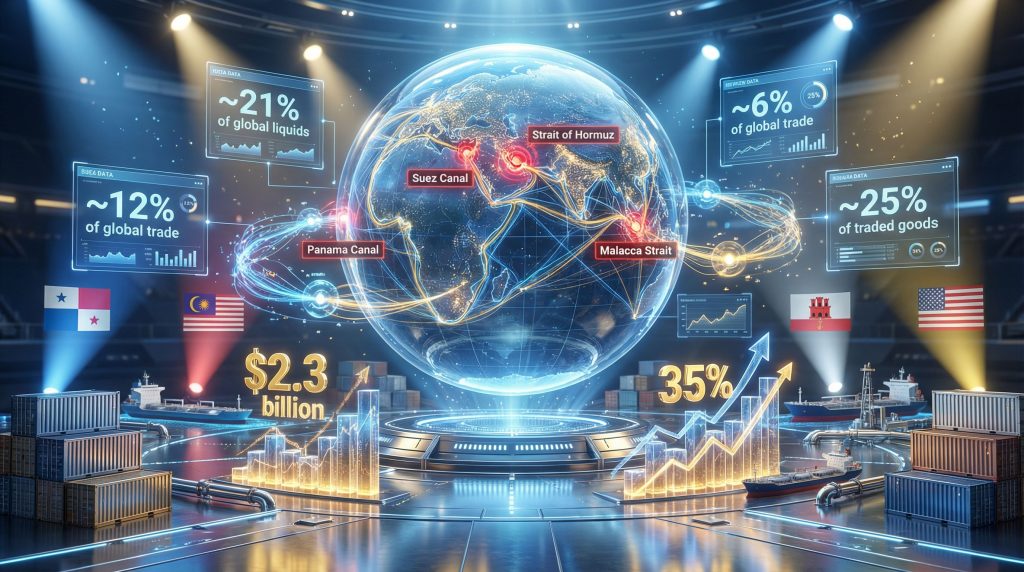
Global energy flows depend on a limited number of critical maritime passages, with the Strait of Hormuz representing the most significant single chokepoint. The current transit reduction from normal operations affects approximately 21% of global liquid petroleum movements, creating immediate supply constraints in key consuming regions.
Major Chokepoint Vulnerability Analysis:
| Chokepoint | Normal Daily Volume | Current Status | Alternative Routes |
|---|---|---|---|
| Strait of Hormuz | ~21% global liquids | Severely restricted | Cape of Good Hope |
| Suez Canal | ~12% global trade | Potentially affected | Around Africa |
| Panama Canal | ~6% global trade | Operating normally | US land bridge |
| Malacca Strait | ~25% traded goods | Monitoring required | Lombok/Sunda Straits |
The economic implications extend beyond immediate fuel availability to encompass broader energy infrastructure resilience. Refineries in Europe and Asia face acute supply constraints, while storage facilities and distribution networks must adapt to altered delivery patterns and timing. In addition, understanding energy security insights becomes crucial for strategic planning.
Alternative Route Economics
When primary shipping routes become unavailable or economically prohibitive, alternative passages create different cost structures and delivery timeframes. The Cape of Good Hope route, while avoiding Middle Eastern chokepoints, adds approximately 3,400 nautical miles and 10-14 additional transit days compared to Suez Canal routing.
These extended transit times create inventory management challenges throughout the supply chain. Refineries must maintain higher working inventories, while fuel distributors face longer lead times and increased working capital requirements. The cumulative effect transforms fuel procurement from just-in-time operations to strategic inventory management.
How Do Regional Price Differentials Create Arbitrage Opportunities?
Cross-Regional Arbitrage Mechanics
Marine fuel arbitrage operates on geographic price differentials that reflect transportation costs, local supply conditions, and regulatory variations. When these differentials exceed historical norms, vessel operators can justify significant operational changes to capture cost savings.
Current market conditions have amplified traditional arbitrage opportunities to exceptional levels. The $474.50 per tonne premium for Marine Gas Oil (MGO) in Singapore versus Panama represents approximately twice the historical range that typically triggers arbitrage activities.
Arbitrage Decision Matrix:
- Route flexibility: Vessel scheduling adaptability for fuel optimisation
- Storage capacity: Onboard fuel inventory management capabilities
- Contract structures: Balance between fixed-price and spot market exposure
- Operational constraints: Port availability and service scheduling requirements
Strategic Fuel Procurement During Market Volatility
Advanced vessel operators employ sophisticated fuel management systems integrating real-time pricing data, route optimisation algorithms, and inventory management protocols. During extreme volatility periods, these systems become critical for maintaining profitability and competitive positioning.
The current environment rewards operational flexibility and strategic thinking over traditional procurement approaches. Vessels with greater fuel storage capacity and flexible scheduling can optimise purchasing timing and location selection to maximise cost advantages. Moreover, understanding oil price stagnation patterns helps inform long-term procurement strategies.
Technology-Enhanced Procurement Benefits:
- 8-12% cost reduction through improved timing and supplier selection
- Real-time pricing integration for dynamic decision-making
- Predictive analytics for market trend identification
- Automated procurement systems reducing manual intervention requirements
Long-term Implications for Global Shipping Economics
Structural Market Evolution
Current disruptions accelerate existing trends toward more resilient and diversified fuel supply chains. The traditional model of minimal fuel inventory and just-in-time purchasing faces pressure from increased geopolitical risk premiums and supply chain uncertainty.
Investment patterns reflect these changing dynamics, with infrastructure development focusing on alternative supply locations and enhanced storage capabilities. Emerging bunker hubs in strategic locations gain importance as vessel operators seek supply chain diversification and risk mitigation. Furthermore, the impact of US tariffs and inflation on maritime costs requires careful consideration.
Regional Hub Investment Priorities:
- Americas expansion: Panama, Houston, and Caribbean infrastructure development
- Alternative Asian centres: Colombo, Port Klang capacity enhancement
- European diversification: Rotterdam, Gibraltar facility expansion
- Emerging markets: West African and South American port development
Investment Infrastructure Requirements
Modern bunker hub development requires substantial capital investment and strategic positioning. Typical viable operations require minimum storage capacity of 150,000 tonnes with average development lead times of 18 months from project initiation to operational capacity.
Annual global investment in bunker infrastructure approaches $2.3 billion, with alternative hub development projects growing at approximately 35% annually. This investment acceleration reflects industry recognition of supply chain vulnerability and the need for geographic diversification.
The next major ASX story will hit our subscribers first
Technology Integration in Modern Bunker Fuel Markets
Digital Transformation Impact
Technology integration revolutionises bunker fuel operations across vessel operators, suppliers, and port authorities. Real-time pricing platforms, automated procurement systems, and predictive analytics become standard tools for managing fuel cost exposure and operational efficiency.
Digital bunker fuel management systems demonstrate measurable benefits through improved timing, supplier selection, and inventory optimisation. These systems can reduce procurement costs by 8-12% while enhancing operational transparency and reducing counterparty risks.
Blockchain and Smart Contract Applications
Emerging technologies address traditional pain points in bunker fuel transactions, including quality disputes, delivery verification, and payment processing. Smart contract implementations streamline these processes while reducing counterparty risks and transaction costs.
Technology Integration Benefits:
- Automated quality verification through digital documentation
- Real-time delivery tracking and inventory management
- Reduced transaction costs through process automation
- Enhanced transparency in pricing and contract execution
Environmental Regulations and Demand Pattern Evolution
IMO 2020 Regulatory Impact Analysis
Environmental regulations continue reshaping bunker fuel demand patterns, with low-sulphur requirements driving premium pricing for compliant fuels. The International Maritime Organisation's sulphur regulations fundamentally altered fuel grade demand, creating lasting market structure changes.
Regulatory Timeline and Market Impact:
- 2020: IMO sulphur regulations reshape fuel grade demand
- 2023: Enhanced emissions monitoring requirements implementation
- 2025: Proposed carbon intensity regulation development
- 2030: Projected alternative fuel mandate discussions
Future regulations targeting carbon emissions will likely create additional demand shifts toward alternative fuel types and more efficient vessel operations. These regulatory pressures compound current supply chain disruptions, creating multiple layers of market transformation pressure.
Fuel Grade Performance Hierarchy
During volatility periods, different bunker fuel grades demonstrate varying performance characteristics:
- VLSFO (Very Low Sulphur Fuel Oil): Primary compliant fuel post-IMO 2020; premium pricing reflects regulatory requirements and limited refinery production capacity
- HSFO (High Sulphur Fuel Oil): Economical alternative for scrubber-equipped vessels; attracts increased demand during price spikes as operators optimise for cost
- MGO (Marine Gas Oil): Highest-quality, most expensive grade; used for specialised applications with typical premiums of $200-300 per tonne above VLSFO
Investment Implications for Energy Market Participants
Strategic Positioning in Evolving Markets
Current market disruptions create both challenges and opportunities for various energy market participants. Refiners, fuel suppliers, shipping companies, and infrastructure investors must reassess strategic positioning based on evolving supply chain dynamics and regional demand shifts.
Portfolio Diversification Strategies:
- Geographic diversification: Reducing concentration risk in single regions
- Infrastructure resilience: Investing in supply chain redundancy capabilities
- Technology integration: Digital transformation and automation capabilities
- Regulatory compliance: Staying ahead of environmental requirement evolution
Successful market participants recognise structural shifts and position accordingly to capitalise on emerging opportunities while managing inherent risks of an increasingly complex global energy system. The current transformation represents more than temporary disruption but signals fundamental changes in maritime fuel market operations.
Market Psychology and Risk Management
Current conditions demonstrate how geopolitical events can rapidly transform established market relationships and pricing structures. Vessel operators, suppliers, and investors must develop more sophisticated risk management approaches accounting for extreme scenario planning and operational flexibility requirements. Additionally, analysing oil price rally factors helps identify market opportunities.
The soaring asia bunker prices spur panama demand phenomenon illustrates how regional supply constraints create global market rebalancing effects. Understanding these interconnected relationships becomes critical for strategic decision-making and investment planning.
Future Market Navigation Strategies
The evolving maritime fuel landscape requires sophisticated risk management approaches, strategic geographic diversification, and proactive adaptation to regulatory and technological changes. Market participants who recognise these structural shifts and position themselves accordingly will be best positioned to capitalise on emerging opportunities.
Current market conditions, where soaring asia bunker prices spur panama demand, demonstrate the dynamic nature of global energy flows and the importance of operational flexibility in managing cost exposure. These patterns will likely persist as geopolitical uncertainties continue affecting traditional supply chain relationships.
Key Success Factors:
- Operational flexibility in fuel procurement and vessel routing
- Technology integration for real-time market analysis and decision-making
- Strategic partnerships with reliable fuel suppliers and service providers
- Risk management sophistication accounting for extreme scenario planning
The transformation of global bunker fuel markets represents a fundamental shift toward more resilient, diversified, and technologically integrated supply chains. Understanding and adapting to these changes will determine competitive positioning in an increasingly complex global maritime energy landscape.
Considering Opportunities in Energy and Maritime Infrastructure Investments?
Discovery Alert's proprietary Discovery IQ model delivers real-time alerts on significant ASX mineral discoveries, including critical resources powering maritime infrastructure and energy transitions. Begin your 14-day free trial today to identify actionable investment opportunities ahead of the broader market, positioning yourself to capitalise on discoveries that could reshape global energy supply chains.