June 22, 2026
Northwestern Ontario's Lithium Belt: Why the Kenora Region Is Attracting Serious Exploration Capital
Hard-rock lithium exploration in Canada is undergoing a quiet but consequential transformation. While attention has long gravitated toward brine deposits in South America's Lithium Triangle, a growing body of geological evidence and shifting supply chain priorities are redirecting capital toward spodumene-bearing pegmatite systems in the Canadian Shield. Northwestern Ontario sits at the centre of this reorientation, and the Rock Tech Victory project Ontario lithium property near Kenora is one of the more strategically interesting land packages to emerge from this trend.
Understanding why requires looking beyond the acquisition itself and examining the structural forces reshaping how lithium gets from the ground to a battery cell.
When big ASX news breaks, our subscribers know first
The Geological Case for Spodumene Pegmatites in Northwestern Ontario
Not all lithium mineralisation is created equal. The pathway from ore to battery-grade lithium hydroxide depends heavily on the host mineralogy, and spodumene-bearing lithium-cesium-tantalum (LCT) pegmatites represent the dominant hard-rock feedstock type feeding North American converter infrastructure today.
Spodumene is a lithium-bearing pyroxene mineral that crystallises within evolved granitic pegmatites under specific pressure-temperature conditions. The LCT classification signals a magmatic differentiation signature associated with highly fractionated granites, and it is this fractionation process that concentrates lithium to economically interesting grades. Critically, spodumene extraction from these systems produces the preferred feedstock for lithium hydroxide refineries, which manufacture the battery-grade chemical input required for high-nickel cathode chemistries used in modern EV batteries.
Technical Note: Spodumene concentrates typically grade between 5% and 7.5% Li₂O before shipment to converters. At this specification, they represent a chemically stable, transport-efficient feedstock. Furthermore, when considering hard-rock vs brine lithium processing requirements, brine sources require evaporation and multi-stage processing before conversion. For a refinery operator seeking feedstock consistency, hard-rock spodumene concentrate offers meaningful process predictability.
Northwestern Ontario's Archean geology hosts a family of terranes structurally analogous to lithium-productive belts documented in Manitoba and Quebec. The Kenora region specifically sits within a geological corridor where pegmatite-forming events associated with late-stage granite intrusions have produced documented spodumene occurrences. The Ontario Geological Survey has contributed publicly available geoscience data that has materially de-risked early-stage targeting across this corridor, reducing the blind exploration risk that historically burdened grassroots programmes.
What the Rock Tech Victory Project Ontario Lithium Property Actually Encompasses
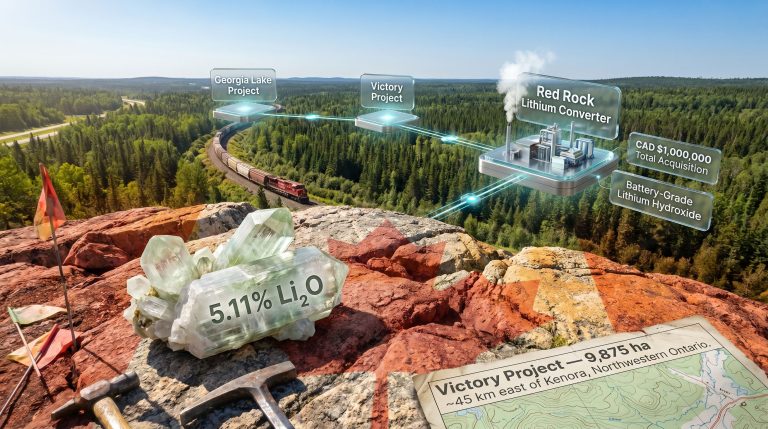
The Victory project covers 9,875 hectares (98.75 km²) of contiguous exploration tenure positioned approximately 45 km east of Kenora in Northwestern Ontario. The land package is not a speculative staking play on peripheral geology. It hosts two surface-confirmed spodumene-bearing LCT pegmatite occurrences, designated the Last Resort and Bounty targets, whose names correspond directly to the vendors from whom Rock Tech Lithium is acquiring the property: Last Resort Resources Ltd. and Bounty Gold Corp.
Surface grab sampling at the Last Resort target has returned results grading up to 5.11% Li₂O. To contextualise that figure properly, the global hard-rock lithium deposit average typically falls between 0.5% and 2.5% Li₂O on a resource-wide basis. Grab samples are selective and non-systematic by nature, meaning they capture the richest exposed material rather than representing deposit-average grades.
Under NI 43-101 standards, they cannot be used to define a mineral resource. What they do provide, however, is a powerful exploration vector, indicating that high-grade spodumene mineralisation is present at surface and justifying systematic follow-up targeting.
Important Context for Investors: Surface grab samples serve as directional tools in early-stage exploration. A result of 5.11% Li₂O is geologically significant, but the critical question is whether that grade persists at depth and across strike. Answering that question requires drilling, not surface sampling alone. Interpreting drill results correctly is consequently an essential skill for evaluating the next phase of this project.
The feature drawing the most exploration attention is the approximately 6 km structural corridor between the Last Resort and Bounty pegmatite occurrences. In pegmatite geology, individual dykes rarely exist in isolation. They tend to cluster within fertile zones defined by structural controls, often appearing as swarms of sub-parallel or en-echelon bodies. The inter-pegmatite corridor at Victory remains essentially untested, representing the highest near-term exploration upside on the property.
Infrastructure Profile: A Competitive Advantage That Compounds Over Time
One of the more underappreciated aspects of the Victory project is its infrastructure endowment. In junior mining, a technically impressive geological target can still fail commercially if the cost of building access infrastructure consumes project economics before a single tonne of ore is processed.
| Infrastructure Asset | Development Relevance | Availability |
|---|---|---|
| Trans-Canada Highway | Year-round road access for equipment and personnel | Direct access |
| CPKC Rail Network | Bulk spodumene concentrate transport to converters | Nearby |
| Electrical Transmission | Processing and camp power supply | On or near property |
| Natural Gas Pipeline | On-site operational energy supply | On or near property |
This infrastructure profile is genuinely unusual for a grassroots exploration property. Direct Trans-Canada Highway access eliminates the need for remote access road construction, which can cost tens of millions of dollars and introduce years of permitting delay. Proximity to the CPKC rail network positions the project for cost-efficient bulk transport of spodumene concentrate to downstream processing facilities, a consideration that becomes increasingly material once tonnages scale up.
How the Option Agreement Is Structured: Terms, Payments, and Royalty Mechanics
Rock Tech Lithium is acquiring the Victory project through a staged option agreement rather than an outright purchase. This distinction matters from both a capital management and risk-allocation perspective.
Under the agreement's terms, Rock Tech can earn a 100% interest in the property through total consideration of up to C$1 million over a 24-month option period, structured as:
- C$600,000 delivered through staged cash payments across the option term
- C$400,000 in Rock Tech Lithium common shares
- Transaction completion remains subject to TSX Venture Exchange (TSXV) approval
The staged structure is deliberate. It limits upfront capital exposure while preserving full optionality over a nearly 10,000-hectare exploration package. If early exploration results underperform, Rock Tech retains the flexibility to discontinue payments without having committed the full consideration. This asymmetric risk profile is a standard feature of junior mining option agreements and is particularly well-suited to grassroots assets where the commercial case has not yet been established by systematic drilling.
NSR Royalty: What It Means and Why the Buyback Matters
The vendors retain a 2% net smelter return (NSR) royalty on future production. An NSR royalty entitles the holder to a fixed percentage of revenue from mineral sales, calculated after smelting and refining charges but before operating cost deductions. Unlike a net profit interest, an NSR royalty is payable regardless of whether the mining operation is profitable, which makes it a low-risk but potentially valuable instrument for the vendor.
Rock Tech holds an option to repurchase 1% of that NSR for C$1 million prior to any construction decision. This buyback mechanism is structurally important. At the exploration stage, royalty commitments have minimal cash flow implications. However, as a project approaches development, a 2% NSR on annual revenues from a significant lithium operation can represent tens of millions of dollars in cumulative payments over a mine's life. Reducing that obligation to 1% before committing construction capital is a standard and prudent form of economic leverage management.
Where Victory Fits Within Rock Tech's Three-Node Ontario Supply Chain
The Victory project cannot be fully understood in isolation. Its strategic logic is inseparable from Rock Tech's broader ambition to construct a vertically integrated, Ontario-based lithium supply chain connecting exploration-stage assets through resource-defined mines to a downstream hydroxide converter.
| Asset | Strategic Role | Development Stage | Key Metrics |
|---|---|---|---|
| Victory Project | Early-stage feedstock exploration option | Grassroots / Exploration | 9,875 ha; up to 5.11% Li₂O grab samples |
| Georgia Lake Project | Primary resource-defined mine (near Beardmore) | Advanced Exploration | 10.6 Mt indicated @ 0.88% Li₂O |
| Red Rock Converter | Ontario's first purpose-built lithium hydroxide refinery | Development / Pre-Production | ~C$200M BMI Group investment; ~2029 projected output |
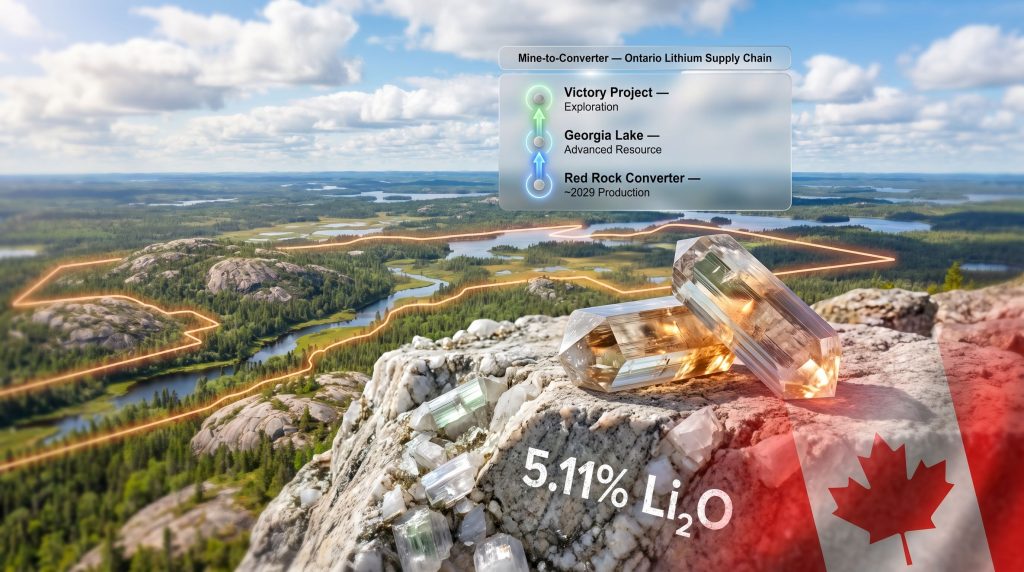
The Georgia Lake project serves as the primary resource base for the Red Rock converter, with an indicated mineral resource of 10.6 million tonnes grading 0.88% Li₂O. The Red Rock converter, located approximately 100 km east of Thunder Bay, serves as the downstream anchor for this supply chain. With approximately C$200 million in committed investment from BMI Group and projected production commencement around 2029, Red Rock represents a fixed demand point for Ontario-sourced spodumene concentrate.
Victory is positioned approximately five hours by road from Red Rock, a logistically viable feedstock corridor if the project advances to production. Victory's role is additive: it extends Rock Tech's spodumene optionality beyond a single deposit, hedging the single-asset dependency risk that has undermined numerous junior mining strategies when unexpected geological or permitting complications arise.
Strategic Insight: Vertical integration from mine to converter reduces exposure to spot lithium price volatility because the operator captures margin across multiple points in the value chain. In addition, understanding lithium market dynamics is increasingly being evaluated as a structural advantage in lithium project valuations, as this model allows operators to benefit whether lithium prices rise or stabilise.
The Technical Roadmap: From Surface Sampling to NI 43-101 Resource
Converting the Victory project's surface-level promise into an investable resource definition requires disciplined execution across a multi-stage exploration programme. The following sequence reflects standard NI 43-101 practice for advancing a pegmatite-hosted lithium target:
- Desktop and geophysical review — Compile historical exploration data and conduct airborne or ground geophysics to map the lateral extent of known pegmatites and identify blind targets within the 6 km inter-pegmatite corridor.
- Systematic channel and trench sampling — Replace selective grab sampling with statistically representative surface data across the Last Resort and Bounty occurrences to establish grade continuity at surface.
- Drill programme design and permitting — Develop a drill collar plan targeting both known occurrences and geophysically defined anomalies within the structural corridor, and obtain required provincial exploration permits.
- Core logging and assay programme — Generate subsurface lithological profiles and grade data to test the vertical persistence of spodumene mineralisation beneath confirmed surface outcrops.
- NI 43-101 resource estimate — Engage a Qualified Person to compile drill results into an inferred mineral resource estimate compliant with Canadian securities standards.
- Preliminary Economic Assessment (PEA) — Evaluate project economics across a range of production scenarios to establish whether development warrants further feasibility investment.
One geological risk worth monitoring is pegmatite structural complexity. LCT pegmatite dykes are not always tabular or geometrically predictable. They can exhibit significant thickness variability, bifurcation, and pinch-and-swell geometry at depth, which complicates resource estimation and can introduce meaningful dilution during mining. The presence of two distinct occurrences separated by a 6 km corridor suggests a broadly fertile pegmatite-forming environment, but structural complexity within individual dykes remains an open question until systematic drilling provides subsurface data.
Furthermore, innovations such as direct lithium extraction may influence downstream processing economics in the medium term, though hard-rock spodumene projects like Victory remain insulated from those shifts given their reliance on conventional concentration and conversion pathways.
The next major ASX story will hit our subscribers first
Benchmarking Victory Against Ontario's Broader Lithium Exploration Landscape
Northwestern Ontario is not short of lithium exploration activity. Active programmes are underway across the Separation Lake, Wisa Lake, Root Lake, and Paterson Lake districts, all of which host documented pegmatite-bearing Archean terranes. The competitive differentiator for Victory is not geology alone.
Most grassroots Ontario lithium properties face a common challenge: compelling geology without the infrastructure to make development economics work. Victory sidesteps this problem through its Trans-Canada Highway frontage, rail proximity, and on-property utility access. Infrastructure readiness reduces the capital intensity of early exploration and compresses the timeline to production if resources are defined, a material advantage when junior company balance sheets are under constant pressure.
The 24-month option window imposes a discipline that will test Rock Tech's capital allocation priorities. The company must advance meaningful exploration within that window to justify exercising the option, which means drilling decisions will likely need to be made within the first year to generate NI 43-101-relevant data before the option term expires.
Key Risks and Parameters Investors Should Track
Disclaimer: The following analysis involves forward-looking assumptions and exploration-stage projections. The Victory project has no defined mineral resource under NI 43-101 standards, and commercial viability has not been established. Investors should conduct independent due diligence and consider their own risk tolerance before making any investment decisions.
Key risk factors and parameters worth monitoring include:
- Resource definition risk: No NI 43-101 resource has been defined at Victory. Grab samples are not resource data.
- Regulatory milestone: TSXV approval is required to complete the transaction. This is a binary near-term catalyst.
- Lithium market price sensitivity: Junior exploration economics are materially affected by spot lithium prices, which have experienced significant volatility since 2022.
- Option execution timeline: The 24-month window requires disciplined programme execution. Delays in permitting or capital raises could compromise the option before meaningful drilling results are generated.
- Grade continuity at depth: The critical unknown for Last Resort and Bounty is whether surface-level high-grade grab sample results reflect genuine deposit-scale mineralisation or isolated high-grade pods.
Victory Project: Key Parameters at a Glance
| Parameter | Detail |
|---|---|
| Property Size | 9,875 hectares (98.75 km²) |
| Location | ~45 km east of Kenora, Northwestern Ontario |
| Mineralisation Type | Spodumene-bearing LCT pegmatites |
| Known Targets | Last Resort and Bounty pegmatite occurrences |
| Best Surface Grade | Up to 5.11% Li₂O (grab sample, Last Resort target) |
| Acquisition Structure | Option agreement |
| Total Consideration | Up to C$1M (C$600K cash + C$400K shares) |
| Option Period | 24 months |
| NSR Royalty | 2% (1% buyback option for C$1M pre-construction) |
| Vendors | Bounty Gold Corp. and Last Resort Resources Ltd. |
| Regulatory Condition | TSXV approval required |
| Strategic Context | Part of Rock Tech's Ontario mine-to-converter supply chain |
The Rock Tech Victory project Ontario lithium property represents a low-cost, high-optionality entry into a geologically credible and infrastructure-advantaged exploration corridor. Its value at this stage lies not in resources that have been defined, but in the structural possibility of resources that may be discovered through disciplined systematic exploration across nearly 10,000 hectares of underexplored pegmatite-bearing terrain.
Want to Be Among the First to Know When the Next Major ASX Mineral Discovery Is Announced?
Discovery Alert's proprietary Discovery IQ model scans ASX announcements in real time, instantly identifying significant mineral discoveries across more than 30 commodities and translating complex data into clear, actionable insights — so subscribers can act ahead of the broader market. Explore historic discoveries and the returns they generated, then begin a 14-day free trial to secure your market-leading advantage.