July 30, 2026
The current European energy landscape presents significant challenges for fertilizer manufacturers, with Romania Azomures mothballing fertilizer production serving as a prime example of how volatile natural gas price trends force strategic operational decisions. Energy-intensive manufacturing sectors across Europe face unprecedented challenges as natural gas price volatility reshapes operational economics. The fertilizer industry, particularly dependent on stable energy costs due to ammonia production requirements, exemplifies how industrial facilities navigate between temporary shutdowns and permanent closures when feedstock prices exceed profitability thresholds.
Understanding these strategic decisions requires examining the complex interplay between energy infrastructure dependencies, production economics, and market dynamics that determine whether facilities maintain ready-to-restart capabilities or cease operations entirely.
Strategic Production Suspension Economics in Chemical Manufacturing
Modern ammonia synthesis operations represent some of the most energy-intensive industrial processes, with natural gas serving dual roles as both primary energy source and chemical feedstock. The Haber-Bosch process, fundamental to nitrogen fertilizer production, cannot escape its thermodynamic requirements: producing one tonne of ammonia demands breaking nitrogen triple bonds at temperatures of 400-500°C and pressures of 150-300 atm.
Energy Intensity and Cost Structure Analysis
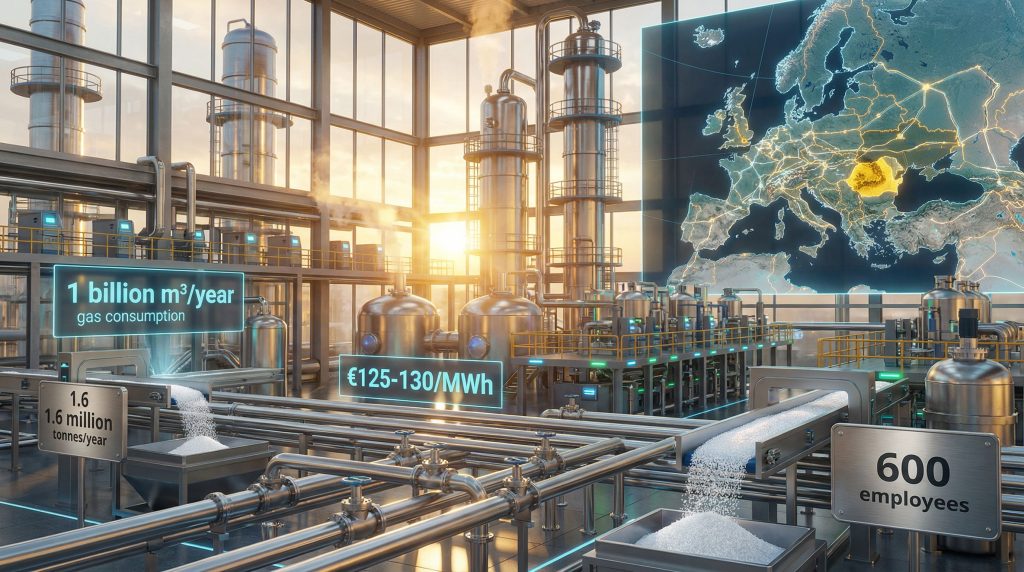
Large-scale fertilizer facilities typically consume 1 billion cubic meters of natural gas annually when operating at full capacity, as demonstrated by Romania's Azomures facility. This massive energy requirement translates to 40-50 gigajoules per tonne of ammonia produced, with natural gas comprising 70-80% of total production costs in European operations.
The economic viability threshold becomes critical when natural gas prices approach €125-130 per megawatt-hour. Above this level, most Eastern European nitrogen fertilizer producers face negative operating margins, as global market pricing prevents full cost pass-through to end consumers. Furthermore, the US natural gas forecast suggests continued volatility may persist throughout 2025, affecting global pricing mechanisms.
Conversely, gas prices below €50/MWh support profitable operations with competitive export positioning. The Romania's largest fertiliser producer halts production demonstrates how these economic pressures translate into operational decisions.
Key Operating Thresholds:
• Breakeven threshold: €125-130/MWh natural gas pricing
• Optimal profitability: Below €50/MWh gas costs
• Crisis suspension: Above €150/MWh triggers widespread capacity mothballing
• Energy intensity: 40-50 GJ per tonne ammonia production
Mothballing vs. Permanent Closure Decision Framework
Chemical manufacturers must evaluate multiple factors when suspending operations. Maintaining ready-to-restart infrastructure requires continuous capital expenditure for equipment preservation, skilled workforce retention, and safety compliance, yet these costs often prove lower than permanent closure followed by new construction.
Preservation Requirements During Mothballing:
• Equipment maintenance: Ammonia synthesis reactors require specific preservation protocols to prevent corrosion damage
• Catalyst protection: Complete catalyst replacement costs €500,000-2 million for large-scale reactors if degradation occurs
• Workforce management: Temporary termination of 600+ employees while maintaining core technical teams
• Restart timeline: 2-4 weeks commissioning period required for production resumption
The decision matrix weighs preservation costs against uncertain restart timing. Romania Azomures mothballing fertilizer production demonstrates this calculation: temporary workforce suspension affects 600 employees while maintaining infrastructure readiness for economic recovery scenarios.
When big ASX news breaks, our subscribers know first
Regional Energy Infrastructure Dependencies and Supply Security
Eastern European fertilizer producers face unique vulnerabilities due to historical reliance on pipeline gas transit systems and limited supply diversification. Romania's natural gas landscape illustrates these dependencies and emerging alternatives that reshape production viability.
Romania's Natural Gas Supply Evolution
Romania produced approximately 11.2 billion cubic meters of natural gas in 2024, though conventional onshore production continues declining as reserves mature. This domestic production covers roughly 50-60% of national consumption, creating import dependency for industrial users like fertilizer manufacturers.
The Black Sea offshore development trajectory offers medium-term supply diversification. The Neptun Deep project and similar developments project adding 1-2 billion cubic meters annually of production capacity through 2026-2027, potentially reducing import dependency and price volatility exposure.
Romania's Gas Infrastructure Elements:
• Domestic production: 11.2 billion m³ annually (declining trend)
• Import dependency: 40-50% of total consumption
• Black Sea potential: 1-2 billion m³/year additional capacity by 2027
• LNG capacity: Constanța terminal handles 5 billion m³/year maximum
• Pipeline vulnerabilities: Aging Soviet-era infrastructure with limited redundancy
Import Alternatives and Cost Implications
Romania's Constanța LNG terminal provides supply diversification but at higher delivered costs than pipeline gas. The facility's 5 billion cubic meter annual regasification capacity expands available supply options while creating cost premiums that impact energy-intensive manufacturers.
Transport infrastructure constraints compound supply challenges. Romanian gas imports rely heavily on pipeline transit through potentially vulnerable corridors, while LNG deliveries face port congestion and seasonal demand fluctuations that affect pricing stability. Additionally, green hydrogen initiatives across Europe signal long-term shifts towards alternative energy sources for industrial applications.
Agricultural Market Impact Assessment
Fertilizer production suspensions create immediate supply chain disruptions for agricultural markets, particularly when domestic producers hold significant market shares. Romania's situation demonstrates how industrial capacity decisions transmit through food production systems.
Domestic Market Concentration Risks
Romania Azomures' 1.6 million tonnes annual capacity represents substantial domestic market exposure, with 75% of production traditionally sold locally. This concentration means approximately 1.2 million tonnes of annual fertilizer demand previously met by a single producer must now source alternatives through:
• Import substitution: Higher-cost foreign supplies subject to transport premiums
• Alternative domestic producers: Limited remaining capacity operating at higher costs
• Inventory drawdown: Unsustainable strategy for extended suspension periods
• Application rate reduction: Yield impact risks for farmers facing supply constraints
Romania's total mineral fertilizer consumption reaches 1.4-1.6 million tonnes annually, with nitrogen and NPK products constituting 60-70% of demand. The Romania Azomures mothballing fertilizer production directly reduces regional supply by an estimated 15-20% depending on competitor utilisation rates.
Market Concentration Analysis:
| Metric | Value | Market Impact |
|---|---|---|
| Azomures Annual Capacity | 1.6 million tonnes | 15-20% of regional supply |
| Domestic Sales Share | 75% (1.2 million tonnes) | Direct local market exposure |
| Romania Total Demand | 1.4-1.6 million tonnes/year | High dependency on single producer |
| Seasonal Concentration | 60% in spring/autumn | Acute supply gaps during planting |
Price Transmission and Farmer Adaptation
Historical analysis reveals 85-95% price transmission from natural gas costs to end-user fertilizer prices within 2-4 weeks during supply disruptions. Romanian grain farmers, primary consumers of nitrogen fertilizers for wheat, corn, and barley production, faced elevated costs throughout the August 2024 onwards production suspension period.
Import substitution proves economically inefficient, typically costing 15-40% premiums over domestic production due to transportation, potential tariffs, and limited alternative supplier availability. Farmers unable to source locally must either accept higher fertilizer costs or reduce application rates with consequent yield penalties.
Regulatory Environment and Policy Implications
The European Union's Carbon Border Adjustment Mechanism (CBAM), effective January 1, 2026, fundamentally alters fertilizer trade economics. The carbon levy on ammonia and nitrogen fertilizer imports from non-EU countries creates additional cost barriers for import substitution while potentially improving EU producers' competitive positioning.
CBAM Impact on Fertilizer Trade
CBAM imposes carbon costs estimated at 5-15% premiums on non-EU fertilizer imports, based on the European Commission's methodology and default carbon intensity values. Consequently, the mechanism mirrors costs European industry has faced under the EU emissions trading system, as reported by Argusmedia regarding Romania's fertiliser production challenges.
CBAM Implementation Effects:
• Import cost increase: 5-15% carbon levy on non-EU ammonia/fertilizer imports
• EU producer advantage: Domestic manufacturers gain competitive positioning
• Supply chain shifts: Increased incentive for EU-based production capacity
• Investment implications: Return requirements for non-EU production projects affected
The mechanism's design coincides with phasing out free allowances for domestic EU industry emitters, creating cost parity between domestic production and imports while encouraging low-carbon production investments.
Strategic Asset Protection Mechanisms
Romania's state-owned Romgaz expressed acquisition interest in Azomures beginning February 2025, viewing fertilizer production capacity as strategically important for national food security. However, negotiations stalled by January 2026 when Romgaz failed to submit formal offers and acquisition timelines.
This government interest reflects broader European recognition of the energy-fertilizer nexus for agricultural stability. State intervention models for critical agricultural input industries demonstrate policy priorities for maintaining domestic production capabilities despite energy market volatility.
Production Restart Viability Assessment
Technical readiness maintenance during extended production suspensions requires careful balance between preservation costs and uncertain restart economics. Chemical processing facilities face unique challenges in maintaining operational capability without active production.
Equipment Preservation During Suspension
Ammonia synthesis reactors and associated high-pressure equipment demand specific preservation protocols during mothballing periods. Inadequate maintenance during 6-12 month suspensions can incur corrosion damage requiring €2-5 million in repair costs, while complete catalyst replacement may cost €500,000-2 million depending on reactor specifications.
The Romania Azomures mothballing fertilizer production case illustrates workforce management challenges, with 600 employees temporarily terminated while maintaining core technical teams for equipment monitoring and restart preparation. This balance reduces labour costs during suspension while preserving institutional knowledge essential for safe production resumption.
Restart Feasibility Factors:
• Equipment integrity: Continuous monitoring prevents costly corrosion damage
• Catalyst preservation: Temperature and atmosphere control maintains synthesis capability
• Skilled workforce: Core technical teams retained for restart operations
• Safety compliance: Regulatory inspections and certifications maintained during suspension
Market Signal Interpretation
Production restart decisions depend on multiple converging indicators beyond simple gas price thresholds. Natural gas futures markets, regional supply diversification progress, and agricultural demand patterns provide signals for economic viability assessment.
European natural gas prices fluctuated between €50-180/MWh during 2021-2024, creating operational uncertainty for facilities exposed to spot market pricing versus those with long-term fixed contracts. Black Sea gas development timelines and LNG import capacity expansion affect medium-term supply stability projections.
However, commodity market volatility continues to challenge traditional planning approaches across energy-intensive industries.
Recovery Indicators:
• Gas price stabilisation: Below €100/MWh sustained pricing improves restart economics
• Supply diversification: Reduced single-source dependencies lower volatility risk
• Agricultural demand: Seasonal fertilizer requirements drive restart timing decisions
• Competitive positioning: Import cost structures versus domestic production economics
The next major ASX story will hit our subscribers first
Future Outlook and Industry Transformation
The Romania Azomures mothballing fertilizer production reflects broader European fertilizer industry restructuring driven by energy transition policies, supply chain diversification, and changing competitive dynamics. Long-term viability depends on adapting production systems to volatile energy markets while maintaining agricultural supply security.
Furthermore, these industry transformation trends demonstrate how traditional manufacturing sectors must evolve to remain competitive in changing energy landscapes.
Energy-intensive chemical manufacturing must navigate between maintaining essential production capabilities and economic sustainability during prolonged commodity price volatility. Strategic mothballing preserves future production optionality while minimising losses during unfavourable market conditions.
"The fertiliser industry's evolution demonstrates how energy infrastructure, regulatory frameworks, and agricultural needs intersect to shape industrial policy and investment decisions across Europe."
The fertilizer industry's evolution demonstrates how energy infrastructure, regulatory frameworks, and agricultural needs intersect to shape industrial policy and investment decisions across Europe. Understanding these dynamics provides insight into broader energy-intensive manufacturing adaptation strategies during the continent's transition toward energy independence and climate policy implementation.
Disclaimer: This analysis includes forward-looking assessments based on current market conditions and policy frameworks. Energy market volatility, regulatory changes, and geopolitical developments may significantly impact actual outcomes. Investment and operational decisions should incorporate comprehensive risk assessment and professional consultation.
Could Romania's Fertiliser Sector Challenges Signal Wider Commodity Opportunities?
Industrial disruptions like Romania Azomures' production suspension often create ripple effects across commodity markets, revealing emerging investment opportunities before mainstream markets recognise them. Discovery Alert's proprietary Discovery IQ model delivers real-time alerts on significant ASX mineral discoveries, empowering subscribers to identify actionable opportunities in commodities whilst market volatility creates optimal entry points for informed investors.