August 8, 2026
Romania's Strategic Position in European Critical Minerals Independence
The Romania rare earth processing venture capitalises on structural advantages that have remained largely untapped in European critical materials strategy. China's control of approximately 80-90% of global rare earth refining capacity has created supply chain vulnerabilities that European policymakers are actively addressing through the Critical Raw Materials Act and related initiatives. Moreover, the critical minerals demand surge across Europe has intensified the need for domestic processing capabilities.
Romania's competitive positioning stems from several converging factors that distinguish it from other European processing candidates. Furthermore, the country's integration with existing European CRM facility networks provides additional strategic advantages.
Infrastructure Legacy and Technical Capabilities
-
Established Radiological Handling Expertise: Four decades of uranium processing experience through facilities like FPCU provides trained personnel familiar with alpha-emitting materials and thorium byproducts
-
Chemical Processing Infrastructure: Existing solvent extraction equipment and waste neutralisation systems reduce capital requirements for rare earth separation
-
Regulatory Framework: Pre-established environmental permits for radioactive material handling streamline approval processes for rare earth operations
-
Cost Structure Advantages: Operational expenses estimated 40-50% lower than Western European alternatives due to labour costs and facility utilisation
Geopolitical and Economic Drivers
The European Union's Critical Raw Materials Act mandates supply chain diversification targets, requiring member states to reduce import dependence on critical materials by 30% by 2030. Romania's initiative directly addresses these regulatory requirements while providing strategic positioning for feedstock imports from Greenland and African sources.
Additionally, this initiative aligns with broader trends outlined in Greenland's critical minerals outlook and represents a significant component of the energy transition in critical minerals sector.
Romania's Black Sea port infrastructure enables direct shipping routes from Greenland, reducing transportation costs by an estimated 15-25% compared to traditional Asia-to-Europe supply chains.
The country's NATO membership and EU regulatory alignment provide additional security for long-term supply agreements, particularly important for defence and aerospace applications requiring decades-long supply chain stability.
When big ASX news breaks, our subscribers know first
The Critical Metals-FPCU Partnership Structure
The joint venture between Critical Metals Corporation and Romania's Feldioara Uranium Concentrate Processing Plant represents a hybrid model combining Canadian mining expertise with European processing capabilities. This partnership structure addresses key vulnerabilities in traditional rare earth supply chains while distributing operational risks across multiple entities.
According to Mining Technology, the collaboration marks a significant milestone in establishing European rare earth processing independence. Furthermore, the joint venture agreement creates a fully integrated mine-to-processing supply chain.
Financial Architecture and Capital Requirements
The venture requires substantial capital deployment across multiple phases:
| Investment Category | Estimated Range | Funding Sources |
|---|---|---|
| Processing Facility Construction | $200-300 million | Private equity, EU co-funding |
| Working Capital Requirements | $50-75 million | PIPE transactions, operational cash flow |
| Technology Integration | $25-40 million | Joint venture contributions |
| Environmental Compliance | $15-25 million | Regulatory compliance reserves |
Critical Metals raised $50 million through a Private Investment in Public Equity (PIPE) transaction to advance both the Tanbreez mining project and processing facility development. However, the allocation between mining operations and processing infrastructure remains unspecified in public documentation.
Operational Framework and Risk Distribution
The partnership allocates 50% of Tanbreez project concentrates to the Romanian facility for the mine's operational lifetime, providing supply chain security that few processing facilities outside China possess. This arrangement represents approximately 2.2 million tonnes of rare earth oxides reserved for FPCU operations over a projected 50-year mine life.
Risk allocation follows a logical distribution model:
-
Mining Risk: Critical Metals assumes geological, permitting, and extraction risks at Tanbreez
-
Processing Risk: FPCU shoulders technology validation, commercial operation, and market delivery risks
-
Shared Market Risk: Both entities face demand fluctuations and pricing volatility in European rare earth markets
Technology Transfer and Integration Challenges
The partnership requires integration of Canadian separation technologies with Romanian processing infrastructure. This presents several technical hurdles that have not been publicly validated at commercial scale.
Critical technical gaps include:
-
Flowsheet Validation: No independent confirmation of commercial-scale heavy rare earth separation processes
-
Reagent Sourcing: Organic extractants required for solvent extraction are primarily manufactured in Asia, creating potential supply chain dependencies
-
Quality Control Systems: Aerospace-grade materials demand 99.99% purity levels requiring sophisticated analytical capabilities
Heavy Rare Earth Separation: Technical Complexity and Commercial Challenges
Heavy rare earth element processing represents one of the most technically challenging aspects of the rare earth value chain. The Romania rare earth processing venture must overcome significant technical hurdles that have limited commercial success outside Chinese facilities.
Process Engineering Requirements
Heavy rare earth separation demands sophisticated solvent extraction systems operating across 50+ sequential stages. Each stage achieves modest separation improvement, requiring precise control of:
-
pH Management: Acidic solutions require continuous monitoring and adjustment
-
Temperature Control: Optimal extraction efficiency occurs within narrow temperature ranges
-
Reagent Ratios: Organic extractant concentrations must be precisely maintained
-
Residence Time: Contact duration between aqueous and organic phases affects separation efficiency
Energy Intensity and Operational Costs
Processing heavy rare earths consumes 40-60 MWh per tonne of separated oxides, representing substantial operational expenses. At current European electricity prices of €100-150/MWh, energy costs alone range from €4,000-9,000 per tonne of finished product.
Energy consumption breakdown:
-
Heating and Temperature Control: 40% of total energy consumption
-
Mixing and Pumping Systems: 25% of total energy consumption
-
Analytical and Quality Control: 15% of total energy consumption
-
Waste Treatment and Neutralisation: 20% of total energy consumption
Radioactive Waste Management Complexity
Rare earth processing generates thorium and uranium-bearing waste streams requiring specialised handling protocols. Thorium-232's 14.05 billion-year half-life creates permanent waste storage obligations that must be factored into long-term operational planning.
Waste management requirements include:
-
Licensed Storage Facilities: Long-term repositories for radioactive solids
-
Environmental Monitoring: Continuous assessment of air, water, and soil contamination
-
Regulatory Compliance: Ongoing reporting to Romanian and EU nuclear authorities
-
Financial Reserves: Decommissioning and remediation cost provisions
Tanbreez: Greenland's Strategic Resource Base
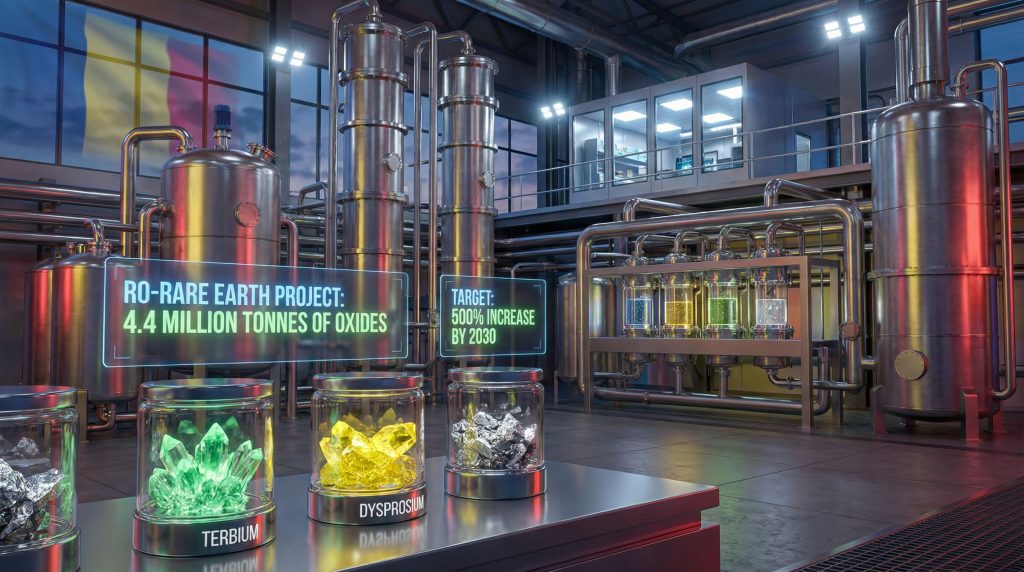
The Tanbreez project in Greenland provides the heavy rare earth feedstock essential for Romania's processing ambitions. With 4.4 million tonnes of rare earth oxides and approximately 25% heavy rare earth content, Tanbreez represents one of the most significant heavy rare earth deposits outside Chinese control.
Resource Characteristics and Processing Advantages
Tanbreez's geological characteristics provide several advantages for downstream processing operations:
| Parameter | Tanbreez Specification | Global Average | Processing Impact |
|---|---|---|---|
| Total REO Resource | 4.4 million tonnes | Varies | 50-year supply security |
| Heavy REE Content | ~25% | 12-15% | Reduced beneficiation requirements |
| Dysprosium Grade | High concentration | Variable | Premium product potential |
| Terbium Content | Significant presence | Limited availability | Defence applications access |
The high heavy rare earth percentage reduces early-stage processing complexity and energy consumption in concentration circuits. Single-source feedstock eliminates blending variability that complicates process control in multi-source operations.
Logistics and Transportation Infrastructure
Greenland's ice-free port access enables year-round shipping to Romanian Black Sea facilities, providing operational advantages over seasonal Arctic operations. Estimated transit time of 3-4 weeks compares favourably to traditional 6-8 week supply chains from Asian sources.
Transportation cost analysis:
-
Greenland to Romania: Approximately 15-25% shipping cost savings versus Asian sources
-
Supply Chain Reliability: Reduced dependency on Suez Canal and Asian port congestion
-
Inventory Management: Shorter lead times enable lower safety stock requirements
Geopolitical Considerations and Risk Factors
Greenland's political status under Danish sovereignty introduces potential policy risks that could affect long-term supply agreements. Independence movements and changing mining policies represent variables that require contingency planning.
Risk mitigation strategies include:
-
Long-term Contracts: 50-year supply agreements provide legal protection
-
Political Risk Insurance: Commercial coverage for sovereign policy changes
-
Alternative Feedstock Sources: Backup supply arrangements from African producers
European Rare Earth Demand Dynamics and Market Drivers
European rare earth consumption is projected to increase dramatically over the next decade, driven primarily by electric vehicle adoption and renewable energy infrastructure deployment. The Romania rare earth processing venture positions itself to capture this expanding demand while reducing European import dependencies.
Sectoral Demand Projections
European rare earth demand analysis reveals significant growth potential across key industrial sectors:
| Industry Sector | 2025 Demand (tonnes REO) | 2030 Projection | Growth Rate |
|---|---|---|---|
| Electric Vehicles | 8,500 | 35,000 | +312% |
| Wind Energy | 12,000 | 45,000 | +275% |
| Industrial Motors | 6,500 | 18,000 | +177% |
| Defence/Aerospace | 2,200 | 4,800 | +118% |
Price Volatility and Supply Chain Vulnerabilities
Dysprosium prices have demonstrated extreme volatility, fluctuating approximately 300% between 2020-2024. This price instability reflects supply chain concentration and limited alternative sources outside Chinese control.
Market dynamics affecting European buyers:
-
Supply Chain Delays: Average 6-8 week lead times from Chinese suppliers
-
Insurance Cost Increases: China-dependent supply chains face 25% annual premium increases
-
Quality Consistency: Blended feedstocks create process control challenges
-
Currency Risk: USD-denominated pricing exposes European buyers to exchange rate fluctuations
Strategic Stockpiling and Regulatory Requirements
The EU Critical Raw Materials Act mandates strategic stockpiling for critical elements, creating additional demand beyond industrial consumption. European manufacturers must maintain minimum inventory levels, increasing total market demand beyond production requirements.
Strategic stockpiling requirements under EU regulations could add 10-15% to total European rare earth demand, creating additional market opportunities for domestic processing facilities.
Competitive Analysis: Romania Versus Alternative European Processing Initiatives
Several European nations are developing rare earth processing capabilities, each with distinct advantages and market positioning. Romania's initiative must compete against established facilities and emerging projects across the continent.
Existing European Processing Landscape
Sweden (REE Platform): Focuses on light rare earth separation from domestic mining operations, primarily serving Scandinavian industrial customers.
Estonia (Silmet): Operates established rare earth metal production from recycled materials and imported concentrates, with proven commercial track record.
France (Solvay, La Rochelle): Targets recycling and urban mining applications, leveraging existing chemical processing expertise.
Germany (H.C. Starck): Specialty metals processing for high-technology applications, emphasising premium market segments.
Romania's Competitive Differentiation
The Romania rare earth processing venture offers several competitive advantages relative to alternative European projects:
| Competitive Factor | Romania Advantage | Competitor Challenge |
|---|---|---|
| Operating Costs | 40-50% lower than Western Europe | High labour and energy costs |
| Feedstock Security | Dedicated 50% Tanbreez allocation | Spot market dependence |
| Scalability Potential | Existing infrastructure expansion | Greenfield development costs |
| Regulatory Efficiency | Streamlined permitting process | Complex approval procedures |
Market Positioning and Customer Segmentation
Romania's facility targets aerospace and military-grade applications, representing higher-margin market segments compared to industrial rare earth applications. This strategic focus requires superior quality control but provides pricing premium opportunities.
Target customer segments:
-
European Aerospace Manufacturers: Airbus, Safran, Rolls-Royce subsidiaries
-
Defence Contractors: Companies requiring security-cleared supply chains
-
Premium Magnet Manufacturers: High-performance permanent magnet producers
-
Specialised Industrial Applications: Medical equipment, precision instrumentation
The next major ASX story will hit our subscribers first
Financial Analysis and Investment Risk Assessment
The Romania rare earth processing venture requires substantial capital investment with returns dependent on successful technology validation, market development, and operational execution. Financial analysis reveals both significant opportunities and considerable risks that potential investors must evaluate carefully.
Capital Expenditure Requirements and Funding Sources
Initial facility construction demands $200-300 million in capital expenditure, representing substantial financial commitment for the joint venture partners. Working capital requirements add an additional $50-75 million for reagents, inventory, and operational startup costs.
Potential funding mechanisms include:
-
EU Strategic Programmes: Up to 40% co-funding through Critical Raw Materials initiatives
-
Romanian Government Incentives: Tax holidays and infrastructure support packages
-
Private Equity Investment: Institutional investors seeking critical minerals exposure
-
Strategic Partner Financing: Automotive and aerospace companies securing supply chains
For investors seeking broader market context, our comprehensive investing guide 2025 provides additional insights into critical minerals investment strategies.
Revenue Projections and Profitability Modelling
Revenue projections depend heavily on product mix, with aerospace-grade materials commanding premium pricing over industrial applications.
Conservative financial scenario modelling:
-
Annual Revenue Potential: $150-200 million at full capacity operations
-
EBITDA Margin Estimates: 25-35% after initial ramp-up period completion
-
Payback Period: 8-12 years depending on funding structure and market conditions
-
Return on Investment: 15-20% internal rate of return under base case assumptions
Market Risk Factors and Mitigation Strategies
Several market dynamics could significantly impact project financial performance:
Chinese Competitive Response: Potential price manipulation or supply flooding to undermine European processing initiatives. Mitigation requires long-term customer contracts and differentiated product positioning.
Technology Disruption: Breakthrough recycling technologies or rare earth-free alternatives could reduce primary demand. Mitigation involves diversified product portfolio and technology monitoring.
Regulatory Changes: Modifications to EU support programmes or environmental regulations could affect project economics. Mitigation requires regulatory risk insurance and policy diversification.
Operational Risk Analysis and Critical Success Factors
The Romania rare earth processing venture faces multiple operational risks that could significantly impact commercial viability and timeline execution. Comprehensive risk assessment reveals both technical challenges and market uncertainties that require proactive management strategies.
Technical and Process Validation Risks
Commercial-Scale Flowsheet Uncertainty: No independent confirmation exists of heavy rare earth separation processes validated at the proposed commercial scale. Pilot-scale success does not guarantee commercial viability, particularly for complex solvent extraction systems requiring 50+ separation stages.
Reagent Supply Chain Dependencies: Organic extractants essential for rare earth separation are primarily manufactured in Asia, creating potential bottlenecks if suppliers impose export restrictions or prioritise Chinese customers during shortage periods.
Quality Control Consistency: Aerospace applications demanding 99.99% purity levels require sophisticated analytical capabilities and process control systems that may exceed current facility specifications.
Environmental and Regulatory Compliance Challenges
Radioactive Waste Management: Thorium and uranium byproducts require long-term storage solutions that may not be fully defined. Waste disposal costs and regulatory compliance could significantly exceed initial estimates.
Environmental Permit Status: Current environmental approvals for rare earth processing operations remain unconfirmed in public documentation, creating potential timeline delays.
Cross-Border Waste Transport: EU hazardous waste regulations may complicate waste disposal arrangements, particularly for radioactive materials requiring specialised facilities.
Market and Competitive Response Risks
Chinese Market Interference: China's control of 80-90% of global rare earth refining provides significant leverage for competitive responses, including strategic price reductions or supply allocations that could undermine European processing economics.
Customer Qualification Timeline: Aerospace and defence applications require extensive qualification processes that may extend 2-3 years, delaying revenue generation and cash flow positive operations.
Alternative Technology Development: Ongoing research into rare earth-free permanent magnets and improved recycling technologies could reduce primary rare earth demand over the project's operational lifetime.
Performance Metrics and Success Measurement Framework
The Romania rare earth processing venture requires comprehensive performance measurement systems tracking both operational milestones and strategic objectives for European supply chain independence. Success criteria must balance commercial viability with broader geopolitical and industrial policy goals.
Operational Performance Indicators
Production Targets and Quality Standards:
-
Design Capacity Achievement: 5,000 tonnes/year concentrate processing within 18 months of commercial startup
-
Heavy REE Output: 500 tonnes/year HREO production meeting aerospace specifications
-
Quality Consistency: 99.99% purity maintenance across magnet-grade product lines
-
Environmental Compliance: Zero regulatory violations or permit suspensions
Cost Competitiveness Metrics:
-
Operating Cost Targets: Maintain costs within 15% of Chinese processing alternatives
-
Energy Efficiency: Achieve design energy consumption of 40-60 MWh per tonne separated oxides
-
Reagent Optimisation: Minimise organic extractant consumption through process optimisation
Strategic Impact Assessment
European Supply Chain Independence:
-
Market Share Capture: Achieve 5-10% of European rare earth demand by 2028
-
Import Dependency Reduction: Contribute to 15-20% reduction in Chinese import reliance
-
Customer Diversification: Supply contracts with minimum 10 European end-users
Economic and Industrial Development:
-
Employment Generation: Create 500+ direct jobs in processing and support functions
-
Technology Advancement: Develop European rare earth separation capabilities
-
Regional Economic Impact: Support ancillary industries and infrastructure development
Long-term Viability Indicators
Technology and Innovation Metrics:
-
Process Improvement: Continuous optimisation reducing energy consumption and reagent usage
-
Product Development: Expansion into specialised high-value applications
-
Research Collaboration: Partnerships with European universities and research institutions
Financial Sustainability:
-
Cash Flow Positive Operations: Achievement within 3-4 years of commercial startup
-
Return on Investment: 15-20% internal rate of return validation
-
Expansion Capital: Self-funding capability for capacity increases or additional product lines
Investment Disclaimer: The analysis presented involves speculative elements regarding future market conditions, technology validation, and operational performance. Rare earth processing investments carry substantial technical, market, and regulatory risks. Potential investors should conduct independent due diligence and consider professional investment advice before making financial commitments to critical minerals ventures.
Looking for Opportunities in European Critical Minerals Processing?
Discovery Alert's proprietary Discovery IQ model delivers real-time alerts on significant critical minerals discoveries across the ASX, empowering subscribers to identify actionable opportunities ahead of the broader market as Europe accelerates its supply chain independence initiatives. Explore why major mineral discoveries can lead to exceptional returns by visiting Discovery Alert's dedicated discoveries page, showcasing historic examples of transformative outcomes, and begin your 30-day free trial today to secure your market-leading advantage.