August 2, 2026
When Energy Dominance Becomes a Liability: The Paradox at the Heart of Russia's Fuel Crisis
There is a deeply counterintuitive scenario unfolding across Russia's vast interior that challenges one of the most enduring assumptions in global energy geopolitics: that crude oil production and domestic fuel security are the same thing. They are not. A country can pump millions of barrels of oil per day and still run dry at the petrol station. The Russia fuel crisis and Kazakhstan gasoline imports dynamic now playing out in Central Asia illustrates this distinction with uncomfortable precision, and its implications extend far beyond the immediate bilateral negotiation between Moscow and Astana.
Understanding why requires separating crude oil from refined products. Crude is the raw material. Gasoline, diesel, and jet fuel are the outputs of a separate industrial process conducted inside refineries. Destroy the refineries, and crude production becomes largely irrelevant to domestic fuel consumers. That is precisely the strategic logic Ukraine has been executing since 2024, and its cumulative effect has now reached a tipping point.
When big ASX news breaks, our subscribers know first
The Architecture of Russia's Refining Crisis
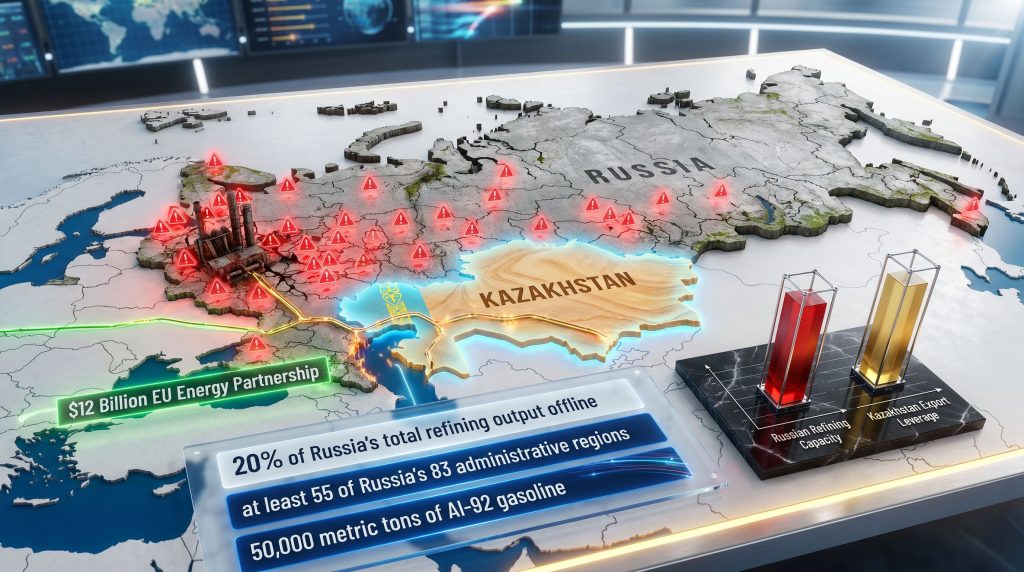
Russia entered the war as one of the world's most self-sufficient fuel producers, capable of supplying its own domestic market whilst simultaneously exporting refined products to Europe and Asia. That position has been systematically eroded. Analysts tracking refinery output capacity estimate that more than 20% of Russia's total refining throughput has been knocked offline as a direct consequence of drone-based infrastructure targeting, according to Reuters.
The Kapotnya refinery in the Moscow metropolitan region offers the starkest illustration of the damage. Struck twice in June 2026, the facility is not expected to return to operational status until at least the end of 2026. A major Moscow-area refinery has separately been reported as potentially remaining offline until 2027. For a country where capital-region fuel supply chains carry enormous political weight, these are not peripheral disruptions. They are blows to the symbolic and logistical core of the Russian state's ability to function normally.
The geographic breadth of the resulting shortages is striking. At least 55 of Russia's 83 administrative regions are currently reporting active gasoline supply constraints, with 17 regions having escalated to mandatory rationing covering both gasoline and diesel. Fuel queues at petrol stations have become one of the few pieces of wartime reality that Russia's state media apparatus cannot filter out of public consciousness, since they are visible, physical, and experienced personally by millions of ordinary citizens.
Why Drone Strikes on Refineries Are Strategically Unique
Precision drone strikes differ fundamentally from conventional bombardment in how they interact with industrial infrastructure. A refinery is not a single target; it is a network of interdependent processing units, heat exchangers, distillation columns, and catalytic converters. Disabling a single critical node, such as a fluid catalytic cracking unit, can suspend output across an entire facility.
Repair timelines stretch into months or years because the components involved are large, specialised, and not readily available on international markets, particularly for a sanctioned economy. Furthermore, the sanctions on Russian oil trade have compounded these equipment access problems considerably, making recovery even more protracted.
This creates a cascading effect that amplifies the actual supply disruption. A single refinery outage reduces regional fuel availability, which triggers precautionary purchasing behaviour, which in turn produces visible queues that signal scarcity to a wider population and generate further demand acceleration. The psychological dimension of the shortage often exceeds its physical reality in the short term.
Shortages are forecast to intensify through summer 2026 and reach a more acute phase by summer 2027 if repair timelines remain extended, according to industry analysts tracking Russian energy infrastructure.
Russia Turns to Kazakhstan: The Strategic Request
Against this backdrop, Russian authorities have approached Kazakhstan seeking approximately 50,000 metric tons of AI-92 grade gasoline. The grade specification is not incidental. AI-92, equivalent to roughly 92 octane by the Russian GOST standard, is the dominant automotive fuel grade across Russia's domestic market, used in the majority of passenger vehicles. It is not a premium product; it is the baseline fuel that keeps ordinary Russian civilian life moving.
The proposed exchange structure is revealing. Russia is not simply asking to purchase fuel outright. The proposal involves supplying Kazakhstan with Russian jet fuel in return, addressing a projected jet fuel deficit that Kazakhstan itself faces in July 2026 due to elevated seasonal aviation demand and constrained supply flows. This barter-adjacent structure reflects the degree to which both economies are experiencing intersecting supply vulnerabilities.
There is also a deeper circular irony embedded in this situation. The Kondensat refinery in Kazakhstan, a potential production source for Russian-bound gasoline, relies on condensate feedstock processed through Russia's own TANECO refinery. After TANECO suspended crude processing on June 12, 2026, following a drone strike, the feedstock supply to Kondensat was directly constrained. Consequently, Russia's own refinery damage is limiting Kazakhstan's capacity to produce the very gasoline Moscow is requesting.
Kazakhstan's Pressure Matrix: Why This Is Not a Simple Decision
Kazakhstan finds itself at the intersection of competing pressures that make either accepting or declining Russia's request genuinely costly. The following table maps the key pressure vectors Astana must navigate:
| Pressure Vector | Source | Nature of Risk | Severity |
|---|---|---|---|
| Transit route dependency | Russia | Economic and diplomatic leverage | High |
| Drone strike retaliation risk | Ukraine | Physical infrastructure threat | Medium-High |
| Domestic fuel supply stability | Internal | Political and consumer risk | Medium |
| Export restriction obligations | Regulatory | Legal and policy constraint | Medium |
| Feedstock supply disruption | Russia (TANECO) | Operational constraint | Medium |
The core of Kazakhstan's dilemma lies in the asymmetry of its infrastructure dependency. An overwhelming proportion of Kazakh crude oil exports reach global markets through Russian-controlled pipeline and port infrastructure. This is not a theoretical vulnerability. In April 2026, the Kremlin demonstrated its willingness to weaponise this dependency by threatening to suspend the flow of Kazakh oil to Germany. Periodic disruptions to the Caspian Pipeline Consortium (CPC) route have already produced measurable damage to Kazakhstan's state revenues.
At the same time, agreeing to supply gasoline to Russia creates a different category of risk. Ukraine's proficiency in targeting energy infrastructure has proven both precise and far-reaching. The Orenburg Gas Processing Plant, a facility critical to Kazakhstan's own energy export chain, sits within potential drone strike range. Ukraine signalled the breadth of its strategic intent on June 19, 2026, when President Zelenskyy issued a direct ultimatum to Belarusian President Lukashenko, warning that continued logistical support for Russian operations, including fuel supply chains, would invite drone retaliation.
As Zelenskyy stated to journalists in Kyiv, the entire country of Belarus risked being drawn into the conflict by Russia if Lukashenko maintained that support. The implication for Kazakhstan is clear: supplying Russian military logistics, even indirectly through civilian fuel provision, could redefine Astana's risk profile in Ukrainian strategic calculations. In this context, Ukraine's strategic resource push reflects a broader pattern of Kyiv leveraging economic and diplomatic pressure across the region.
The Atyrau Maintenance Window: Constraint or Diplomatic Buffer?
The Atyrau refinery, one of Kazakhstan's primary production facilities and a natural candidate for filling a Russian fuel order, is scheduled for planned maintenance running from June 26 to July 20, 2026. This window directly overlaps with Russia's most urgent supply need, providing Astana with a technically credible basis for delayed or reduced delivery without requiring a formal diplomatic refusal.
Whether the timing represents a genuine operational constraint or a conveniently useful buffer is a question energy analysts are actively debating. What it does provide, unambiguously, is room for Kazakhstan to defer a definitive answer whilst the broader geopolitical situation evolves.
In parallel, Kazakhstan is actively exploring zero-tariff gasoline imports from China to reinforce its own domestic supply buffer. This dual-track approach, negotiating with Russia whilst hedging through Chinese supply, reflects Astana's broader strategy of avoiding structural dependence on any single energy relationship. Kazakhstan maintains biannually renewable domestic export restrictions on fuel precisely to protect internal market stability, a policy tool that also provides regulatory cover for limiting external supply commitments.
Rosneft's Proposal and the Limits of Domestic Solutions
Inside Russia, the policy response to the fuel crisis has included a proposal from Rosneft that Russian oil companies be required to process a minimum of 30% of crude output domestically, creating a structural floor for refined fuel production. The logic is straightforward: if mandatory domestic refining quotas existed, export-oriented crude flows could not completely deplete the feedstock available to domestic refineries.
The practical ceiling of this approach is constrained by the very problem it attempts to solve. Damaged refinery capacity limits how much crude can actually be processed domestically regardless of what proportion is mandated. Repairing and rebuilding complex refinery infrastructure under sanctions, with restricted access to specialised components and engineering expertise, is a multi-year undertaking. A 30% refining mandate applied to a damaged refining network does not restore output; it redistributes allocation within a reduced capacity envelope.
However, the oil price geopolitical factors surrounding Russia's predicament extend well beyond domestic refining policy. Global energy markets are already adjusting to the structural uncertainty created by sustained infrastructure targeting in a major producing nation.
Russia's fuel predicament illustrates a structural truth that petroleum economists have long understood: in a modern industrial economy, crude oil reserves and refined fuel availability are separate systems with separate vulnerabilities. Targeting one without the other leaves half the energy chain intact.
The Broader Reordering of Central Asian Energy Geopolitics
The Russia fuel crisis and Kazakhstan gasoline imports situation represents more than a bilateral supply negotiation. It signals a structural inversion in the traditional Russia-Central Asia energy relationship. For decades, Russia functioned as Central Asia's dominant energy patron, supplying refined products, setting regional price benchmarks, and controlling the infrastructure through which Central Asian producers accessed global markets.
The 2026 crisis, however temporarily, reverses that hierarchy. Russia is now approaching Kazakhstan as a supplicant. This inversion has measurable implications for Kazakhstan's long-term strategic positioning, even if Astana is currently too constrained by transit dependencies to fully leverage it.
The country is simultaneously advancing a substantial Western economic anchor: Kazakhstan secured more than $12 billion in EU energy and trade agreements. These investments in Kazakh energy infrastructure reduce, though do not eliminate, long-term transit dependency on Russian routes. Furthermore, the geopolitical risk in mining across Central Asia is being repriced in tandem with these energy developments, as institutional investors reassess regional exposure more broadly. The strategic geometry is one of gradual rebalancing rather than sudden decoupling.
The emergence of drone-based infrastructure targeting as a permanent feature of modern conflict has further altered how energy risk is priced across the post-Soviet space. Insurance underwriters, institutional investors, and sovereign wealth funds are beginning to reprice assets that sit within expanded drone strike radius. This represents a structural shift in energy investment risk assessment that will persist beyond the immediate conflict, regardless of how the Ukraine war concludes.
Additionally, the global trade war impacts reshaping supply chains globally are compounding Russia's difficulty in sourcing replacement refinery components, as sanctions and trade restrictions increasingly converge to limit Moscow's industrial recovery options.
The next major ASX story will hit our subscribers first
Forward Scenarios: What to Watch
| Scenario | Trigger | Probability | Strategic Implication |
|---|---|---|---|
| Kazakhstan supplies partial volumes | Atyrau maintenance completes; jet fuel exchange agreed | Moderate | Short-term bilateral stabilisation; Ukraine escalation risk |
| Kazakhstan declines; Russia escalates transit pressure | Astana refuses; Moscow retaliates via CPC disruption | Moderate | Regional energy market volatility; EU supply chain stress |
| Ukraine strikes Kazakh-adjacent infrastructure | Russia-Kazakhstan deal proceeds; Ukraine responds | Lower | Fundamental reorientation of Central Asian energy risk |
| Russia mandates domestic refining quotas | Rosneft proposal adopted; capacity partially restored | Moderate-High | Reduced import dependency; slower than expected recovery |
| Kazakhstan deepens EU energy ties | $12B EU deals accelerate; Russian leverage diminishes | Moderate-High | Long-term structural shift away from Russian transit dependency |
The scenario that warrants closest attention is the one that appears most mundane: a partial Kazakh supply agreement, quietly executed under the cover of the jet fuel swap arrangement. Reports from TVP World confirm that Russia is actively in talks to buy Kazakh fuel amid the ongoing supply crunch driven by Ukrainian strikes, lending credibility to this trajectory.
If Russia's refinery repair timeline extends into 2027 as current reporting suggests, the 50,000-tonne request may represent the opening position in a series of escalating import demands. That trajectory could gradually draw other Central Asian producers into a new regional fuel trade dynamic, reshaping supply relationships that have been largely static for three decades. The Russia fuel crisis and Kazakhstan gasoline imports episode may consequently be remembered less as an isolated emergency and more as the moment a decades-old energy hierarchy visibly began to shift.
This article is intended for informational and analytical purposes only. It does not constitute financial, investment, or legal advice. Forecasts, scenario projections, and timelines referenced herein reflect publicly available reporting and analysis and are subject to change as the geopolitical situation evolves. Readers seeking investment guidance should consult qualified financial professionals.
Want to Stay Ahead of the Resource Shifts Reshaping Global Markets?
Discovery Alert's proprietary Discovery IQ model scans ASX announcements in real time, instantly identifying significant mineral discoveries tied to the commodities and geopolitical forces driving today's energy and resource reordering — explore historic examples of major discovery returns and begin your 14-day free trial at Discovery Alert to position yourself ahead of the market.