August 20, 2026
When a Major Energy Exporter Cannot Fuel Its Own Capital
There is a deeply counterintuitive scenario playing out in global energy markets that challenges one of the most basic assumptions about resource-rich nations: that they can always supply themselves. Throughout modern history, oil-producing powerhouses have occasionally faced internal distribution problems, but rarely has a top-three crude exporter confronted pump-level rationing in its own capital city. The Russia fuel crisis in Moscow represents exactly that paradox, and understanding how it materialised requires examining the intersection of drone warfare, refinery economics, and the structural vulnerabilities buried inside Russia's downstream energy system.
When big ASX news breaks, our subscribers know first
How Ukraine's Drone Campaign Became an Energy War
The Strategic Logic of Targeting Refineries
Targeting military hardware is the conventional playbook of modern warfare. Targeting the industrial infrastructure that sustains a war economy is something far more consequential. Ukraine's long-range drone campaign has systematically focused on Russian oil refineries since 2024, operating on a straightforward strategic premise: crude oil in the ground generates no battlefield power. It is the refined product, the processed gasoline, diesel, and aviation fuel, that moves armies, fuels logistics chains, and sustains civilian morale.
Refineries are also soft targets relative to hardened military installations. They contain complex processing units, distillation columns, catalytic crackers, and pipeline networks that are expensive to repair, difficult to replace under sanctions, and highly vulnerable to fire and pressure damage. A drone strike does not need to destroy an entire facility to cause lasting throughput reductions. Damaging a single processing unit can take a refinery offline for weeks or months, and, furthermore, securing the specialised parts required for repairs becomes exponentially more difficult in wartime.
The Bashkortostan Strike: Geography as a Signal
The August 2026 drone strike on a refinery in Bashkortostan deserves particular attention because of what it communicates about the evolving reach of Ukrainian drone warfare. Bashkortostan sits north of Kazakhstan, placing it roughly 1,500 to 1,700 kilometres from the Ukrainian border depending on the specific target location. This is not a borderland refinery. It is deep inside the Russian industrial heartland, a region that hosts a significant concentration of petrochemical and refining capacity precisely because it was historically considered safe from external interference.
Regional head Radiy Khabirov confirmed the strike via official channels, characterising the damage in restrained terms, noting that a unit already undergoing maintenance had been hit and that falling debris had caused minor damage to pipes. He expressed confidence that repairs could be completed within days. However, when viewed against the broader pattern of cumulative refinery degradation across Russia throughout 2025 and 2026, even minor and repeatedly occurring damage compounds into a structural supply deficit that no single repair operation can fully reverse.
"The Bashkortostan incident is significant not primarily for the damage it caused in isolation, but for what it signals about the geographic boundary of vulnerability. If refineries this far from the conflict zone are now reachable, Russia's entire downstream energy infrastructure must be considered operationally exposed."
Consequently, the sanctions on Russian oil trading that have been in place since 2022 have made sourcing replacement components substantially harder, amplifying the operational impact of each successive strike.
The Russia Fuel Crisis in Moscow: What Is Actually Happening at the Pump
Rationing Numbers and What They Reveal
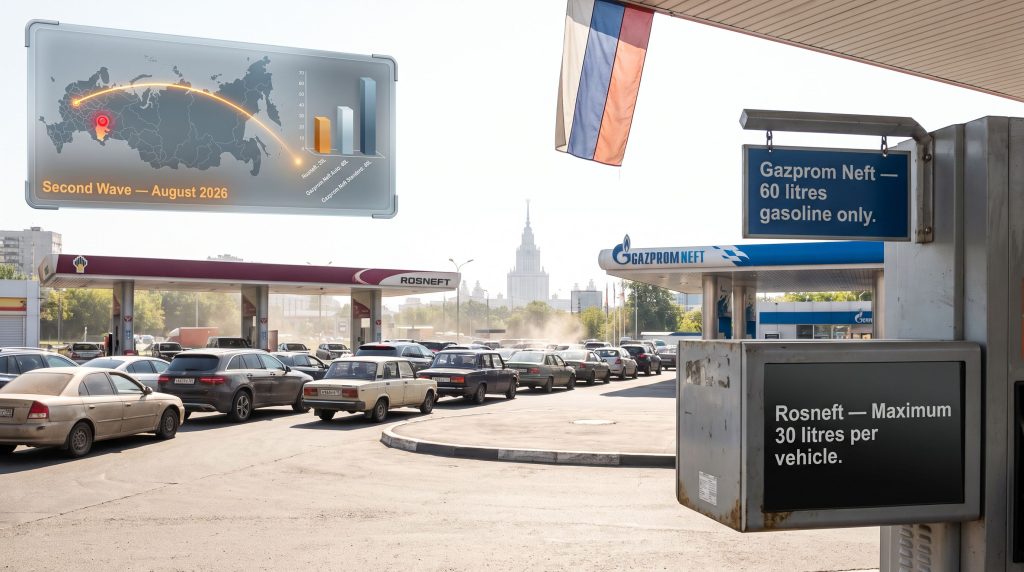
The fuel rationing measures now in effect across Moscow and broader Russia represent a concrete, measurable expression of supply stress. The specific limits imposed by major networks provide a useful window into how severe the constraint actually is.
| Fuel Company | Fuel Type Restricted | Purchase Limit Per Vehicle | Scope of Restriction |
|---|---|---|---|
| Gazprom Neft (Automated Stations) | Gasoline and Diesel | 40 litres (~10 gallons) | All automated Moscow stations |
| Gazprom Neft (Standard Stations) | Gasoline only | 60 litres per vehicle | Gasoline restricted; diesel unrestricted |
| Rosneft (All Stations Nationwide) | Gasoline only | 30 litres (~8 gallons) | All Rosneft stations across Russia |
The decision to apply nationwide restrictions at Rosneft, Russia's largest oil producer, is particularly telling. This is not a localised logistics problem confined to Moscow's distribution network. It reflects a system-wide reduction in available gasoline volumes that cannot be resolved simply by rerouting supply within the city. Both Gazprom Neft and Tatneft have confirmed the restrictions through customer service channels, and both companies have advised customers to expect extended waiting times due to elevated demand pressure.
The Language of Wartime Disruption
One of the more revealing details to emerge from this episode is the official terminology used by Russian energy companies to explain the shortages. The phrase repeatedly offered is "unscheduled refinery maintenance." In peacetime, unscheduled maintenance is an industry-standard term for unexpected mechanical failures or process upsets. In the context of an active drone war targeting refinery infrastructure, however, the phrase functions as deliberate corporate euphemism for strike damage.
This linguistic choice matters for several reasons. It avoids legally or politically sensitive acknowledgment of wartime infrastructure losses. It also obscures the extent of actual damage from public view, making it harder to assess the real throughput reduction Russia's refining sector is experiencing. Analysts and market observers need to read these statements with that translation in mind.
"When Russian energy companies cite unscheduled maintenance as the cause of fuel shortages in August 2026, the underlying cause in the majority of cases is drone strike damage to processing infrastructure, not routine operational disruption."
A Second Wave, Not a Stabilisation: Understanding the Supply Cycle
Why the June 2026 Recovery Was Always Fragile
Reports from mid-July 2026 indicated that Moscow's fuel supply had reached a degree of stability following disruptions earlier in the summer. Russian officials and state media presented this stabilisation as evidence that emergency measures were working. The return of shortages in August 2026, now officially designated by Russian sources as the second wave, exposes the fundamental flaw in that narrative.
Stabilisation in a system where the underlying production infrastructure has been damaged does not mean the problem has been solved. It means the rate of consumption temporarily fell below the rate of available supply. As soon as demand recovered, or as new strike damage reduced throughput further, the deficit re-emerged. The cycle of disruption, partial stabilisation, and renewed shortage is consistent with a system that has lost meaningful refining capacity on a structural rather than temporary basis.
The comparison to historical wartime energy disruptions is instructive. In addition, monitoring current crude oil prices provides essential context for understanding how domestic shortages interact with broader commodity market pressures.
| Country / Conflict | Primary Cause | Government Response | Duration | Market Spillover |
|---|---|---|---|---|
| Russia, 2026 | Drone strikes on refineries | Rationing, rerouting, imports | Ongoing (second wave) | Potential refined product tightening |
| Iran, 2019 to 2020 | Sanctions-driven supply pressure | Price hikes and subsidies | 12+ months | Regional LPG and diesel disruption |
| Libya, 2011 | Civil conflict, infrastructure damage | International aid, ceasefire | 6 to 18 months | Brent crude price spike |
What distinguishes Russia's 2026 situation from the Libyan and Iranian precedents is that Russia entered this crisis as one of the world's largest crude exporters, with enormous latent refining capacity. The fact that pump-level shortages are occurring despite that upstream wealth makes the downstream supply failure all the more structurally significant.
Government Response: Emergency Measures and Their Structural Limits
Rerouting and Imports as Stopgaps
Russia's emergency response to the fuel shortage has included two primary mechanisms: rerouting refined product from Siberian facilities toward Moscow and other vulnerable regions, and drawing on imports from Belarus. Both approaches offer partial relief. Neither addresses the core problem.
Siberian rerouting increases logistical strain on rail and pipeline networks that were not originally designed to compensate for losses in European Russia's refining hubs. Belarus imports provide a cross-border buffer but are limited by Belarusian refining capacity and the terms of ongoing energy arrangements between the two countries.
Perhaps the most historically striking development in this supply picture is Russia receiving its first gasoline cargo from India. For decades, Russia has been a net exporter of refined petroleum products to global markets. The arrival of an Indian gasoline cargo represents a reversal that would have been considered implausible before 2022, and it signals that Russia is now competing for refined product supply on international spot markets — the same markets to which it has historically been a major contributor.
What the Kremlin's Acknowledgment Actually Signals
When the Kremlin issued a statement confirming that oil companies were taking steps to increase deliveries to the most affected regions, it marked a notable departure from prior official messaging. Earlier in the summer, Russian authorities had indicated the situation was under control and improving. The decision to publicly acknowledge renewed supply stress in mid-August 2026 suggests that the domestic visibility of the problem had made continued denial politically untenable.
Public acknowledgment of a fuel shortage by a government that has consistently sought to project energy self-sufficiency is itself a data point about severity. It indicates the gap between available supply and consumer demand had grown large enough that no amount of official reassurance could contain public frustration. Furthermore, the global oil price shock reverberating through international markets has compounded the domestic political pressure on Moscow to act decisively.
The Resource Paradox: Crude Wealth and Refined Product Poverty
Why Exporting Crude Does Not Guarantee Domestic Fuel Security
One of the least appreciated dynamics of the Russia fuel crisis in Moscow is the structural disconnect between crude oil production and domestic refined product availability. Russia extracts and exports crude oil in vast quantities. Its refining sector, however, operates as a separate system with its own infrastructure, processing capacity, and logistical requirements.
When refineries are damaged or taken offline, crude oil exports can continue through separate pipeline systems to maritime loading terminals. This is precisely why Ukraine's targeting strategy focuses on refinery infrastructure rather than oilfields or export pipelines: disabling a refinery does not stop Russia earning export revenue from crude sales, but it does prevent that crude from being converted into the gasoline and diesel that Russian civilians and military logistics depend on domestically.
The result is a binary pressure that becomes increasingly untenable under sustained infrastructure degradation:
- Maintaining crude exports sustains foreign currency earnings but does not solve domestic fuel deficits
- Diverting crude to domestic processing requires available refinery capacity, which is precisely what has been reduced
- Importing refined products on international markets consumes foreign exchange and signals strategic vulnerability
- Continued drone strikes that further reduce refinery throughput tighten this bind further with each successive wave
This is the paradox at the core of the Russia fuel crisis in Moscow: a nation sitting on vast hydrocarbon wealth that cannot reliably fill the petrol tanks of its own capital city.
The next major ASX story will hit our subscribers first
Global Market Implications
Refined Product Markets and the Russia Supply Variable
Russia has historically been one of the world's major exporters of diesel and other refined petroleum products, particularly to European and Asian markets. As domestic rationing intensifies and refinery throughput contracts, the volume available for export necessarily shrinks. This matters for global refined product markets, particularly diesel, where supply margins were already tightening in mid-2026 amid broader geopolitical disruption.
The intersection of oil prices and geopolitics has rarely been more pronounced than in the current environment, where infrastructure warfare is directly reshaping domestic supply conditions in a major producer nation. In addition, the trade war oil impacts already straining global energy flows have left markets with reduced capacity to absorb further supply-side shocks.
The reduction in Russian refined product export volumes, combined with ongoing disruptions to Hormuz transit routes affecting broader regional energy markets, creates a compounding supply-side pressure on global fuel margins. Commodity analysts tracking crack spreads — the price differential between crude oil and refined products — should watch Russia's domestic fuel crisis as a meaningful variable in their models, not merely as a geopolitical news story. For broader context, the Energy Information Administration provides detailed data on Russia's refining capacity and export volumes that analysts may find valuable.
Frequently Asked Questions: Russia Fuel Crisis in Moscow
Is Moscow Running Out of Petrol?
Moscow is not fully out of fuel, but it is experiencing rationing conditions not seen before in the capital, with purchase limits imposed across major station networks and extended queues at filling stations becoming common.
What Fuel Limits Are in Place at Russian Petrol Stations?
Rosneft has capped gasoline purchases at 30 litres per vehicle at all stations nationwide. Gazprom Neft has applied a 40-litre cap on both gasoline and diesel at automated Moscow stations, and a 60-litre gasoline-only cap at standard stations.
Are Diesel Supplies Also Affected?
Current rationing measures from both Rosneft and Gazprom Neft apply primarily to gasoline. Diesel remains unrestricted at most locations, though overall supply pressure continues to affect both fuel categories.
How Long Has Russia Been Experiencing Fuel Shortages in 2026?
The first wave of significant disruptions emerged in June 2026. After a partial stabilisation period in July, a second wave of shortages began in mid-August 2026, coinciding with continued drone strikes on refinery infrastructure.
Could the Fuel Crisis Spread Beyond Moscow?
Rosneft's nationwide rationing measures indicate the supply constraint is already operating beyond Moscow. Regional disparities suggest areas further from refining hubs and with less logistical priority than the capital are likely facing more severe conditions.
Disclaimer: This article is for informational purposes only and does not constitute financial or investment advice. Forecasts and scenario projections involve inherent uncertainty and should not be relied upon as predictions of future events.
Want to Stay Ahead of the Commodity Shifts Reshaping Global Markets?
When geopolitical disruptions ripple through energy and mineral markets at speed, Discovery Alert's proprietary Discovery IQ model scans the ASX daily to deliver real-time alerts on significant mineral discoveries — turning complex market signals into actionable investment opportunities before the broader market catches on. Explore how historic discoveries have generated substantial returns on Discovery Alert's dedicated discoveries page, and begin your 14-day free trial today to secure a market-leading edge.