August 1, 2026
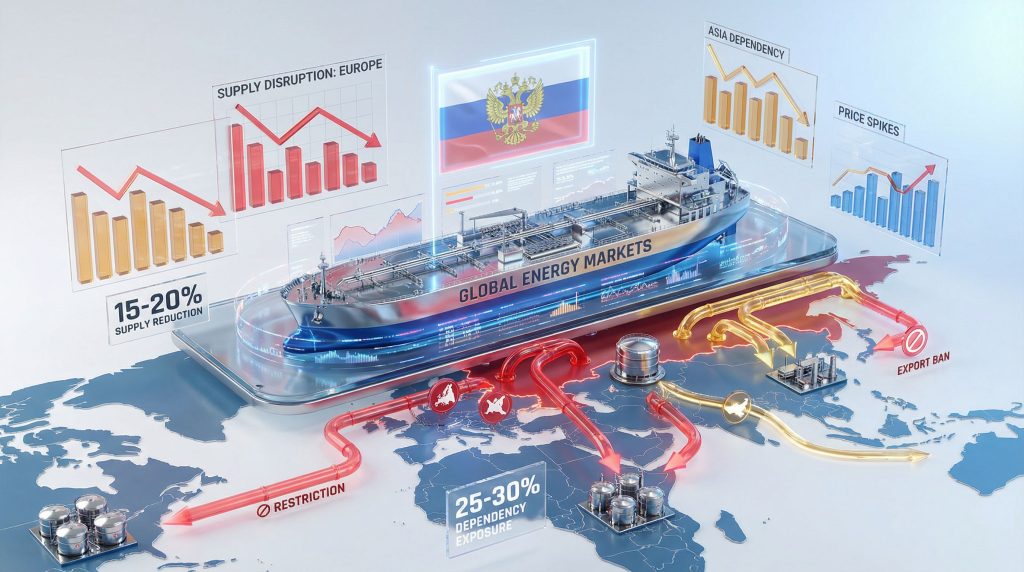
The current global energy crisis, marked by a Russia gasoline export ban and simultaneous supply chain disruptions, is fundamentally reshaping international fuel markets. Furthermore, the intersection of geopolitical tensions, infrastructure vulnerabilities, and strategic resource allocation decisions is creating unprecedented challenges for energy security worldwide. Understanding these complex dynamics requires examining how oil price rally trends interact with export policy decisions during periods of extreme market volatility.
Understanding the Strategic Context Behind Export Controls
What Economic Factors Drive National Fuel Export Policies?
Energy-dependent economies frequently employ export controls as sophisticated economic instruments to manage domestic market stability. These mechanisms typically emerge from four primary drivers that influence government decision-making processes.
Domestic price stabilisation mechanisms represent the most immediate concern for resource-rich nations facing internal supply-demand imbalances. When global commodity prices experience significant volatility, export restrictions can prevent domestic fuel costs from reaching politically unsustainable levels. Consequently, this approach prioritises internal economic stability over short-term export revenues.
Supply security frameworks become critical during periods of geopolitical uncertainty. Nations must balance their role as international suppliers with their responsibility to ensure adequate domestic energy availability. This calculation becomes particularly complex when infrastructure faces potential threats or disruption.
Revenue optimisation strategies for state-controlled energy sectors involve sophisticated timing decisions. Export restrictions can paradoxically increase long-term revenues by maintaining domestic economic stability, which supports broader economic activity and tax generation across multiple sectors.
Regional demand management during seasonal consumption peaks requires careful coordination between production capacity and distribution networks. Spring agricultural seasons and summer transportation demands create predictable consumption surges that influence export allocation decisions.
Why Do Export Bans Emerge During Global Market Volatility?
The current global energy crisis provides compelling evidence for how multiple disruptions can trigger defensive policy responses from major suppliers. The simultaneous closure of the Strait of Hormuz and implementation of the Russia gasoline export ban demonstrates how interconnected supply chain vulnerabilities create cascading market pressures, while tariffs and market volatility further complicate global trading relationships.
The Strait of Hormuz disruption, affecting approximately 20% of global oil supplies, has generated unprecedented price volatility. Brent crude prices surged from approximately $85 per barrel to $126 per barrel within days, representing a nearly 50% increase. This dramatic price movement creates both opportunities and risks for alternative suppliers.
Key Market Disruption Indicators:
- Dubai crude reached $166.80 per barrel, reflecting severe Asian market vulnerability
- Approximately 21 million barrels of oil typically transit the Strait daily
- Global LNG trade experiencing 20% disruption as supply routes become unviable
- Nearly 700,000 people displaced due to broader regional conflicts affecting infrastructure
During such extreme volatility, export restrictions serve multiple strategic purposes. They provide governments with policy flexibility to respond to rapidly changing domestic conditions while maintaining optionality for future market participation. The timing of Russia's export ban from April 1 to July 31, 2026 suggests careful consideration of both seasonal demand patterns and global market conditions.
Energy market analysts have identified three distinct scenarios for continued price trajectories: a swift and intense scenario (>60% probability) where prices spike but ease before summer, an enduring and chaotic scenario (up to 30% probability) with serious infrastructure damage lasting until May, and an oil crisis scenario (<5% probability) where prices exceed $130 and persist through summer with recession implications.
When big ASX news breaks, our subscribers know first
Analysing Russia's Energy Export Strategy Framework
How Do Temporary Export Restrictions Function as Economic Tools?
Russia's four-month gasoline export ban represents a sophisticated approach to market intervention during periods of global uncertainty. The policy framework demonstrates how temporary restrictions can achieve multiple strategic objectives simultaneously, particularly when considering trade war impacts on global energy markets.
Market intervention mechanisms for domestic price controls operate by redirecting export-designated production to internal consumption. Russia's pre-ban export volume of approximately 117,000 barrels per day or 5 million metric tons annually represents significant supply that can be reallocated to domestic markets during the restriction period.
Russian Deputy Prime Minister Alexander Novak's implementation rationale centred on global market turmoil caused by Middle Eastern crises leading to significant price fluctuations. His statements indicated that while "global market turmoil has led to significant price fluctuations," the government maintains that "high international demand for Russian energy resources remains a positive factor." This statement reveals the delicate balance between capitalising on favourable export conditions and ensuring domestic stability.
Production reallocation strategies become particularly effective when refinery infrastructure operates at consistent capacity levels. Russian government statements indicate that crude oil processing volumes remain at previous year levels, ensuring stable oil product supply. This suggests the export ban represents strategic allocation rather than production increases.
The seasonal timing from April through July aligns with historical patterns of fuel demand increases during spring agricultural activities and summer transportation peaks. Several Russian regions and parts of Ukraine under Russian control reported gasoline shortages in the previous year following increased attacks on Russian oil refineries and seasonal demand surges.
What Role Does Refinery Infrastructure Play in Export Decisions?
Refinery infrastructure capacity and geographic distribution create fundamental constraints that influence export policy effectiveness. The vulnerability of processing facilities to external threats has become a material consideration in Russian energy planning.
Processing capacity utilisation rates directly impact the feasibility of export restrictions. When refineries operate at optimal levels, reallocating production from export to domestic markets becomes economically viable. However, if capacity utilisation is constrained by maintenance requirements or infrastructure damage, export restrictions may exacerbate rather than resolve supply shortages.
Geographic distribution challenges across Russia's vast territory create complex logistics considerations. The transportation infrastructure connecting refineries to both domestic distribution networks and export terminals influences the practical implementation of allocation changes. Pipeline capacity, rail transport availability, and truck logistics all factor into the speed and effectiveness of supply reallocation.
The previous year's attacks on Russian oil refineries highlighted infrastructure vulnerability as a critical factor in export decision-making. When processing capacity faces potential disruption, maintaining flexibility between domestic and export allocation becomes essential for overall supply security.
Global Market Implications and Supply Chain Analysis
How Will International Gasoline Markets Respond to Russian Supply Gaps?
The removal of 117,000 barrels per day from global gasoline markets occurs within a broader context of supply chain disruptions affecting multiple regions simultaneously. The compound effect of Russian export restrictions and Middle Eastern supply route closures creates unprecedented pressure on alternative suppliers, while natural gas forecasts suggest broader energy market volatility.
Regional Impact Assessment:
| Market Segment | Supply Disruption | Primary Alternatives | Price Pressure Level |
|---|---|---|---|
| European Markets | Moderate reduction | US Gulf Coast, North Africa | Significant increase |
| Asian Markets | Limited direct impact | Singapore, South Korea | Moderate increase |
| African Markets | High dependency exposure | Algeria, Nigeria | Severe pressure |
European markets face particular challenges due to their historical reliance on both Russian supplies and Middle Eastern crude inputs for domestic refining. The simultaneous disruption of both supply sources forces European importers to compete for alternative supplies from more distant sources, increasing transportation costs and delivery timelines.
Asian markets, while bearing the brunt of direct Strait of Hormuz impacts with many countries importing over 80% of oil and gas shipments that typically pass through the strait, may benefit from redirected supplies as other global buyers seek alternative sources. However, increased competition for available supplies will likely drive regional price premiums.
African markets demonstrate the highest vulnerability due to limited alternative supplier options and infrastructure constraints that prevent rapid supply source diversification. Countries with significant Russian gasoline import dependency face the prospect of severe shortages unless alternative arrangements can be rapidly implemented.
What Are the Cascading Effects on Global Energy Security?
The interconnected nature of global energy markets means that supply disruptions in one region create cascading effects across multiple sectors and geographic areas. Current disruptions demonstrate how energy security concerns extend far beyond immediate fuel availability, particularly as nations work toward energy security transition strategies.
Secondary commodity impacts are already materialising through fertiliser supply chain disruptions. A significant share of global fertiliser supply typically transits through the Strait of Hormuz, and any disruption risks reduced agricultural input availability, lower crop yields, and higher global food prices. The UN World Food Programme has warned of potential food security impacts extending to countries including Afghanistan and Pakistan where needs were already substantial.
Strategic reserve management becomes critical as nations face potential supply interruptions. Countries with significant strategic petroleum reserves may need to consider drawdowns to maintain market stability, but such actions provide only temporary relief while permanent supply diversification arrangements are developed.
Regional cooperation mechanisms are experiencing increased importance as individual nations lack sufficient resources to address supply disruptions independently. Emergency allocation protocols and cross-border sharing arrangements may become necessary to prevent severe shortages in the most vulnerable markets.
The humanitarian implications extend beyond energy markets themselves. Approximately 1.3 million people in Gaza face potential reduced food rations to just 25% of daily requirements without reliable humanitarian corridors, while shipping disruptions have stranded approximately 20,000 seafarers in the Persian Gulf region.
Economic Modelling of Export Ban Consequences
How Do Domestic Market Dynamics Influence Export Policy Timing?
The precise timing of Russia's gasoline export ban from April 1 to July 31 reflects sophisticated analysis of domestic consumption patterns and seasonal demand variations. This four-month restriction period aligns with predictable increases in fuel consumption across multiple economic sectors.
Spring agricultural demand represents a critical factor in seasonal consumption modelling. Agricultural machinery operations, fertiliser application, and crop transportation requirements create substantial fuel demand increases during planting and early growing seasons. The April initiation of export restrictions ensures maximum domestic fuel availability during this critical period.
Summer transportation peaks further justify the July 31 termination date. Personal vehicle usage, commercial transportation, and tourism-related fuel consumption typically reach annual maximums during summer months. Maintaining export restrictions through this period prevents domestic shortages during peak demand.
Regional consumption patterns vary significantly across Russia's extensive territory, with several regions and parts of Ukraine under Russian control having reported gasoline shortages in the previous year. The export ban provides policymakers with tools to address regional imbalances through centralised allocation mechanisms.
Industrial consumption forecasting during periods of economic uncertainty requires careful analysis of manufacturing activity levels, transportation sector requirements, and energy-intensive industry operational schedules. Export restrictions provide flexibility to respond to unexpected demand variations without triggering domestic shortages.
What Are the Revenue Trade-offs for State Energy Companies?
Russian state energy companies face substantial revenue implications from the four-month export restriction. At current market prices of approximately $100-126 per barrel, the foregone export revenue from 117,000 barrels per day could exceed $5 billion over the restriction period.
Immediate revenue calculations suggest significant short-term costs. However, these calculations must be balanced against the economic benefits of domestic price stability, reduced social unrest, and maintained industrial productivity. Domestic economic stability supports broader tax generation and economic activity that may partially offset direct export revenue losses.
Strategic reserve building opportunities during the restriction period allow companies to accumulate inventory for future export when market conditions become more favourable. If global prices remain elevated through the summer period, stored gasoline could be released to export markets at potentially higher prices than currently available.
Market share considerations represent long-term strategic concerns. Extended export restrictions risk allowing competitors to establish relationships with Russian customers, potentially creating permanent market share losses. However, the current global supply crisis suggests that demand for Russian supplies will likely persist beyond the restriction period.
Contract obligations and force majeure clauses may provide legal protection against customer penalties during the restriction period. The combination of Middle Eastern supply disruptions and declared government policy creates force majeure conditions under most international supply agreements.
Geopolitical Risk Assessment Framework
How Do Energy Export Controls Function as Diplomatic Instruments?
Energy export restrictions serve multiple diplomatic functions beyond domestic market management. The timing and duration of Russia's gasoline export ban sends strategic signals to international markets about Russian energy policy flexibility and responsiveness to global conditions.
Economic leverage creation through controlled supply availability demonstrates to importing nations their dependence on Russian energy exports. By temporarily restricting supplies during a period of global shortage, Russia reinforces its position as a critical global energy supplier whose policies significantly impact international markets.
Alliance relationship impacts become particularly relevant during periods of geopolitical tension. European nations relying on Russian gasoline imports must weigh their energy security concerns against broader diplomatic relationships. The export restriction forces these calculations into sharp focus.
Regional influence projection through resource availability extends Russia's soft power capabilities. Countries with limited alternative supply options may need to consider diplomatic concessions or economic arrangements to ensure continued access to Russian energy supplies after the restriction period ends.
What Are the Unintended Consequences of Temporary Export Restrictions?
While export restrictions achieve immediate policy objectives, they can trigger responses that ultimately reduce the implementing country's long-term market influence and revenue potential.
Accelerated energy diversification by importing nations represents the most significant long-term risk. Countries experiencing supply disruptions invest heavily in alternative supplier relationships, domestic production capabilities, and renewable energy infrastructure to reduce future dependency on unreliable suppliers.
Alternative supplier market share expansion occurs when traditional suppliers become unavailable. During Russia's restriction period, suppliers from the Middle East, North Africa, and Asia may establish new customer relationships that persist beyond the restriction timeline.
Technology transfer acceleration for domestic production capabilities becomes a priority for import-dependent nations. Investment in refinery capacity, exploration technology, and alternative energy infrastructure reduces long-term demand for Russian supplies.
Strategic partnership realignments in the energy sector may emerge as countries seek more reliable supply arrangements. Long-term contracts with alternative suppliers, regional energy sharing agreements, and emergency response protocols reduce future vulnerability to Russian policy changes.
Investment and Market Structure Implications
How Will Capital Allocation Shift in Response to Supply Uncertainty?
The combination of Russian export restrictions and broader Middle Eastern supply disruptions is catalysing fundamental changes in global energy infrastructure investment patterns. Capital flows are rapidly shifting toward projects that enhance supply security and reduce dependency on geopolitically sensitive regions.
Refinery capacity expansion in alternative regions has become an immediate investment priority. Countries previously reliant on Russian gasoline imports are accelerating plans for domestic refinery construction and existing facility capacity increases. This infrastructure development requires substantial capital investment but provides long-term energy security benefits.
Strategic petroleum reserve infrastructure development is experiencing renewed focus as governments recognise the critical importance of emergency supply capabilities. Enhanced storage capacity, improved distribution networks, and rapid deployment capabilities are receiving priority funding across multiple regions.
Transportation and storage facility construction acceleration addresses logistics bottlenecks that constrain alternative supply utilisation. Port facilities, pipeline networks, and distribution terminals require expansion to accommodate supply source diversification and increased inventory management requirements.
Alternative energy source development funding is increasing as governments and private investors recognise the long-term risks associated with hydrocarbon import dependency. Solar, wind, and other renewable energy projects are receiving accelerated approval and funding as strategic energy security investments rather than merely environmental initiatives.
What Long-term Market Structure Changes May Emerge?
Current supply disruptions are accelerating structural changes in global energy markets that will persist long after immediate crises resolve. These changes reflect fundamental shifts in how nations approach energy security and supplier relationships.
Regional energy hub development outside traditional suppliers is becoming a strategic priority. Countries and regions are investing in becoming energy processing and distribution centres to reduce dependency on imports from geopolitically unstable areas. This hub model provides supply security through diversified input sources and strategic inventory management.
Bilateral energy agreement proliferation represents a move away from spot market dependence toward long-term contracted supply relationships. These agreements typically include supply guarantee clauses, emergency allocation provisions, and mutual support mechanisms that provide greater supply security than market-based procurement.
Emergency supply mechanism establishment by importing nations creates parallel supply systems designed to activate during crisis periods. These mechanisms include strategic reserves, emergency sharing agreements, and rapid deployment capabilities that provide alternatives when primary suppliers become unavailable.
Technology transfer agreements for domestic production capability development are becoming standard components of international energy relationships. Countries are prioritising partnerships that include technology sharing, training programs, and infrastructure development support to build domestic energy production capabilities.
The next major ASX story will hit our subscribers first
Risk Management Strategies for Energy-Dependent Economies
How Should Nations Prepare for Future Export Disruptions?
The current crisis provides valuable lessons for energy-dependent economies seeking to enhance their resilience against future supply disruptions. Effective preparation requires comprehensive strategies addressing both immediate response capabilities and long-term structural changes.
Diversified supplier portfolio development emerges as the most critical immediate priority. Nations should establish supply relationships with multiple suppliers across different geographic regions to prevent over-dependence on any single source. This diversification strategy requires careful analysis of geopolitical risks, transportation logistics, and pricing mechanisms across potential suppliers.
Strategic reserve capacity optimisation involves determining appropriate inventory levels for different fuel types, establishing efficient storage infrastructure, and developing rapid deployment capabilities. Optimal reserve levels must balance storage costs against supply security benefits while considering seasonal demand variations and potential disruption durations.
Emergency allocation protocol establishment requires pre-negotiated agreements defining priority sectors, allocation mechanisms, and coordination procedures during supply shortages. These protocols should address critical infrastructure needs, economic priority sectors, and humanitarian requirements while maintaining implementation flexibility for different crisis scenarios.
Regional cooperation framework enhancement creates mutual support mechanisms that leverage collective resources during individual nation disruptions. Regional sharing agreements, emergency assistance protocols, and coordinated strategic reserve management provide enhanced security compared to individual nation approaches.
What Early Warning Systems Can Predict Export Policy Changes?
Developing sophisticated early warning capabilities allows energy-dependent nations to anticipate and prepare for potential supply disruptions before they occur. These systems require monitoring multiple indicators across political, economic, and technical domains.
Domestic market monitoring indicators include fuel price movements in supplier countries, regional shortage reports, seasonal demand pattern analysis, and infrastructure damage assessments. Unusual domestic price volatility or shortage reports often precede export policy changes as governments prioritise internal stability over export commitments.
Geopolitical tension assessment frameworks must evaluate multiple risk factors including diplomatic relationship status, military conflict proximity, economic sanctions implementation, and alliance relationship changes. Tensions that threaten supplier nation stability or international relationship quality frequently trigger defensive export policies.
Economic pressure measurement systems analyse supplier nation fiscal conditions, currency stability, inflation rates, and domestic political pressures. Economic stress often motivates export restrictions as governments seek to maintain domestic stability through resource control.
Seasonal demand forecasting improvements enable prediction of periods when supplier nations face internal supply-demand imbalances. Agricultural planting seasons, industrial production cycles, and transportation demand peaks create predictable stress periods that may trigger export policy changes.
Navigating Energy Security in an Uncertain Global Environment
The convergence of Russia's gasoline export ban with broader Middle Eastern supply disruptions represents a watershed moment for global energy security planning. These simultaneous crises demonstrate the interconnected vulnerabilities that characterise modern energy markets and the speed at which supply security can deteriorate.
Key Strategic Considerations for Stakeholders:
- Export ban policies reflect complex calculations balancing domestic stability against international revenue opportunities
- Market diversification investments provide long-term security benefits that justify short-term costs
- Temporary supply restrictions can accelerate permanent market structure changes that persist beyond crisis periods
- Regional cooperation mechanisms become increasingly valuable as individual nation responses prove insufficient
Forward-Looking Market Dynamics:
Global gasoline markets should expect continued volatility through mid-2026 as multiple supply disruptions interact with seasonal demand variations. Alternative supplier capacity expansion will likely accelerate as importing nations seek to reduce dependency on geopolitically sensitive sources. Strategic reserve policies may undergo significant revision globally as governments recognise the critical importance of emergency supply capabilities.
Energy security considerations will increasingly influence long-term investment decisions across multiple sectors. The current crisis demonstrates that energy supply reliability has become as important as cost competitiveness for many economic sectors. This recognition will drive infrastructure investment, technology development, and international relationship priorities for years beyond the immediate crisis resolution.
The global energy market is entering a period of structural transformation driven by security concerns rather than purely economic considerations. Nations and companies that successfully adapt to this new paradigm will gain competitive advantages, while those that fail to address vulnerability exposures may face continued disruption risks.
Disclaimer: This analysis is based on publicly available information and represents assessment of potential market dynamics. Energy markets involve significant volatility and geopolitical risks that can change rapidly. Readers should conduct independent research and consult qualified professionals before making investment or policy decisions based on this analysis.
Ready to Invest in the Next Major Energy Discovery?
Discovery Alert's proprietary Discovery IQ model delivers real-time alerts on significant ASX mineral discoveries, instantly empowering subscribers to identify actionable opportunities ahead of the broader market during volatile energy transitions. Understand why historic discoveries can generate substantial returns by visiting Discovery Alert's dedicated discoveries page, which showcases exceptional market outcomes from major finds.