June 20, 2026
Indian Ocean Energy Security Is Being Quietly Redrawn
When global energy analysts assess geopolitical risk, their attention typically gravitates toward the Persian Gulf, the South China Sea, or the North Sea. Rarely does Madagascar appear on that mental map. Yet the Indian Ocean island nation is emerging as a surprisingly significant piece in a complex puzzle of energy logistics, great power competition, and supply chain resilience that is reshaping how fuel-dependent economies across Africa and beyond think about energy security.
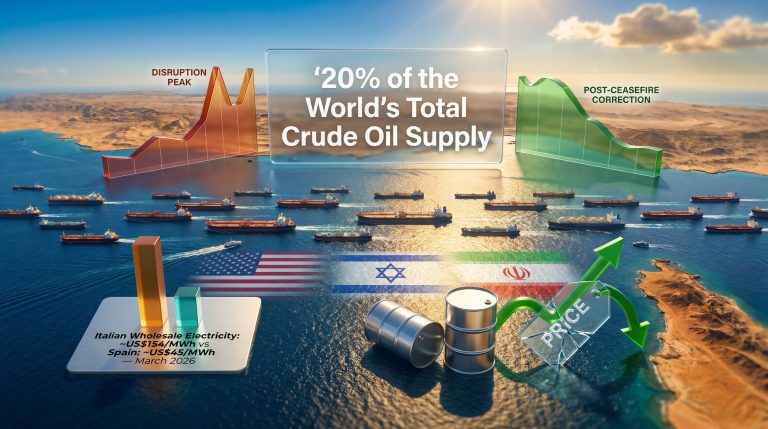
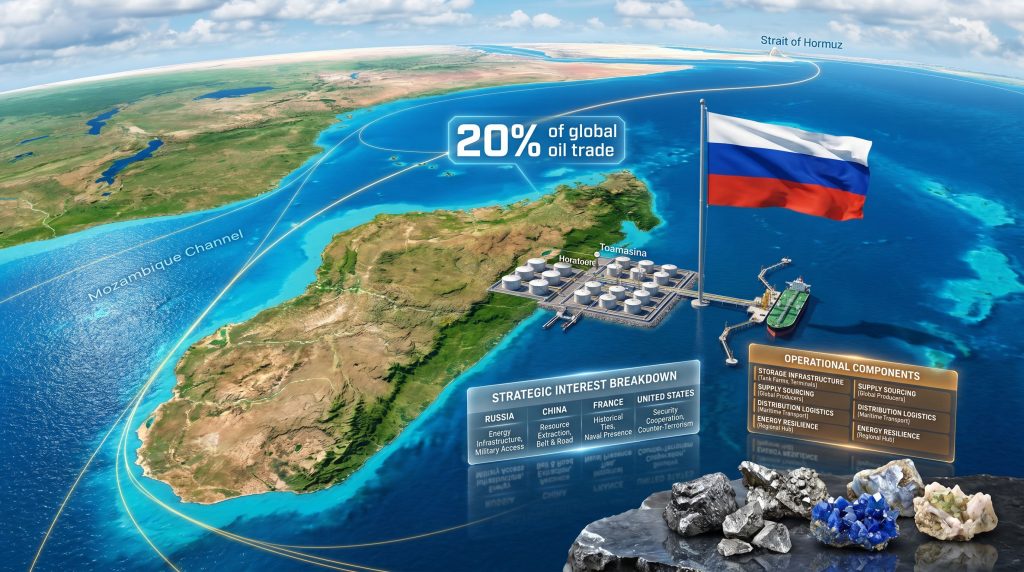
The catalyst is straightforward: roughly one-fifth of all oil traded globally transits through the Strait of Hormuz, a 33-kilometre-wide chokepoint whose vulnerability has become increasingly apparent as Iran-US tensions have intensified through 2025 and into 2026. For African fuel-importing nations, this is not an abstract geopolitical concern. It translates directly into price shocks, foreign exchange strain, and food inflation that cascades rapidly through economies where subsidy buffers are thin. Against this backdrop, the Russia Madagascar fuel storage project has taken on significance far beyond its initial bilateral framing.
When big ASX news breaks, our subscribers know first
Madagascar's Strategic Geography: More Than Just Location
Why the Indian Ocean's Geometry Works in Madagascar's Favour
Geography is destiny in maritime logistics, and Madagascar occupies a genuinely advantageous position within the Indian Ocean's energy transit architecture. The island sits at the intersection of shipping lanes connecting the Middle East, South and Southeast Asia, and the eastern and southern African coastline. Its western flank borders the Mozambique Channel, one of the most heavily trafficked sub-Saharan maritime corridors for energy cargo.
What makes this positioning strategically useful rather than merely incidental is the combination of proximity to major consumer markets and distance from the principal chokepoints that create supply risk. Being approximately 4,500 kilometres from the Strait of Hormuz is not a liability. It is an operational asset: close enough to receive rerouted cargoes efficiently, far enough to operate as a genuinely independent node rather than an extension of Gulf-region logistics.
For countries in eastern and southern Africa, Madagascar offers something that no landlocked neighbour can replicate: the ability to receive, store, and redistribute fuel via sea-based logistics without dependency on any single continental transit corridor. This optionality is precisely what makes the island attractive to external powers seeking to establish forward-positioned energy infrastructure in a region where such capabilities are conspicuously absent.
The Mozambique Channel as a Strategic Artery
The Mozambique Channel's role in African energy logistics is often underappreciated in mainstream analysis. As a natural maritime highway running between Madagascar and the Mozambican coast, the channel functions as the primary sea-based fuel delivery route for eastern and southern African nations from Tanzania down to South Africa. Any infrastructure positioned along this corridor gains immediate relevance to the broadest possible set of regional energy consumers.
As African nations accelerate their reassessment of energy security transition strategies in response to Middle East instability, analysts tracking regional logistics infrastructure have noted that Madagascar's potential to evolve into a fuel storage and redistribution hub extends meaningfully into eastern and southern African markets if investment in port connectivity and pipeline capacity advances alongside tank storage development.
What the Russia-Madagascar Common Economic Zone Actually Establishes
Understanding the Bilateral Framework
The agreement between Russia and Madagascar, confirmed by Madagascar Prime Minister Mamitiana Rajaonarison during a high-level engagement with Russian Security Council Secretary Sergei Shoigu, establishes a common economic zone framework built around several interconnected pillars. Energy cooperation, infrastructure development, agricultural mechanisation, and product processing are all cited as components of the arrangement.
Fuel storage infrastructure is identified as a core deliverable within the energy pillar. Madagascar's Prime Minister stated publicly that a central objective of the arrangement is to address the consequences of Middle East instability by developing facilities to store fuels in Madagascar at competitive prices — a direct acknowledgment that the Hormuz vulnerability problem is driving the project's strategic rationale.
The framework also aligns with Russia's broader pattern of offering preferentially priced fuel arrangements to African partner nations, a model that has featured prominently in Moscow's Africa engagement strategy since 2022. Discounted or competitively priced Russian-origin fuel access forms part of the value proposition Madagascar receives from the partnership.
What Has Been Confirmed Versus What Remains Open
Precision matters when assessing agreements of this nature. The table below distinguishes between confirmed elements of the arrangement and aspects that remain undisclosed or unverified at the time of publication:
| Element | Status |
|---|---|
| Common economic zone framework | Confirmed via Prime Minister's public statement |
| Strategic fuel storage as a project objective | Confirmed |
| Discounted/competitive Russian fuel pricing | Reported and consistent with Russia's Africa model |
| Specific facility location or terminal name | Not publicly disclosed |
| Construction commencement | Not confirmed |
| Financing structure and ownership model | Not publicly disclosed |
| Direct oil and gas import arrangements | Reported as no longer active as of mid-2026 |
This agreement is best understood as a framework commitment with energy storage as a stated objective rather than a project with confirmed construction timelines. The distinction carries significant implications for assessing both the immediacy of the strategic impact and the conditions under which the project could be delayed or restructured.
The Dual Commercial Logic Underpinning the Deal
Energy security agreements rarely operate on a single rationale, and the Russia-Madagascar arrangement is no exception. For Madagascar, the value proposition is straightforward: access to competitively priced fuel from a major supplier, combined with domestic storage infrastructure that buffers the island against the price volatility and supply disruptions that have historically translated into transport and food cost inflation.
For Russia, the calculus is more layered. The arrangement provides a commercially viable entry point into a strategically positioned island nation, bundled with access to a mineral resource profile that aligns with Moscow's growing interest in critical mineral supply chains. Reliable, affordable fuel supply is also a prerequisite for large-scale mining operations, meaning that establishing fuel infrastructure creates enabling conditions for any future resource extraction interests Russian entities may pursue in Madagascar's mineral sector.
The Strait of Hormuz Risk and Africa's Fuel Security Reckoning
The Structural Vulnerability Driving African Energy Recalculations
The Hormuz dependency problem is quantifiable and consequential. Approximately 20% of globally traded oil passes through a 33-kilometre-wide maritime corridor whose stability depends on geopolitical dynamics largely outside the control of consuming nations. Furthermore, for African fuel importers, this creates a specific vulnerability profile: heavy reliance on Middle Eastern crude or refined products, thin subsidy buffers, and limited foreign exchange reserves that constrain the ability to substitute supply sources quickly.
The African Development Bank has flagged rising food and fuel prices as a direct downstream consequence of ongoing Middle East instability, noting that the transmission mechanism operates with particular speed and severity in African markets. When Hormuz disruptions push up global oil price volatility, African consumers face the impact faster and with fewer institutional shock absorbers than most other regions.
How African Economies and Investors Are Responding
Across the continent, a range of strategic responses to the Hormuz vulnerability is taking shape. These vary significantly in approach and scale:
| Strategy | Key Actors | Nature of Response |
|---|---|---|
| Supply source diversification | India (also affecting African trade flows) | Redirecting crude purchasing toward Africa and Latin America amid Hormuz disruption |
| Strategic storage development | Madagascar (via Russian partnership) | Building in-country buffer capacity to insulate against import disruption |
| Regional fuel network consolidation | East Africa (Amsons Group) | Pursuing a $250 million acquisition of regional fuel distribution infrastructure |
| Strategic petroleum reserve expansion | Multiple African governments | Increasing minimum reserve requirements to extend supply security windows |
The Amsons Group transaction is particularly instructive as a market signal. The Tanzania-based conglomerate's move to acquire regional fuel distribution infrastructure at significant capital outlay reflects a private sector reading that physical control of fuel storage and distribution assets is becoming a strategically premium capability in a world where Hormuz disruptions are increasingly treated as a recurring rather than exceptional scenario.
India's supply diversification, while primarily driven by India's own energy security calculus, is creating secondary effects in African markets by increasing competition for African crude outputs and reshaping regional price dynamics. Consequently, for African fuel importers, this adds a further layer of complexity to their supply security challenge.
Madagascar's Pre-Agreement Vulnerability Profile
Before the Russian engagement, Madagascar's energy security position was characterised by significant structural weaknesses. Island geography creates inherent import dependency, with no meaningful domestic petroleum production to offset external supply risk. No substantial strategic petroleum reserve infrastructure existed. Fuel price shocks transmitted directly and rapidly into transport and food costs across an economy where a significant proportion of the population spends a high share of income on basic necessities. This vulnerability profile establishes the genuine need the Russian arrangement addresses, regardless of the broader geopolitical dimensions that accompany it.
Russia's Africa Strategy: Madagascar Within a Broader Architecture
From Opportunistic Deals to Structured Continental Engagement
Russia's intensifying commercial and strategic footprint across Africa should not be read as a series of independent bilateral transactions. Since Western sanctions accelerated following 2022, Moscow has systematically deepened engagement across the continent's energy, mining, and infrastructure sectors with a consistency that reflects structured strategic intent. The metals and mining geopolitics of this shift are increasingly apparent to analysts tracking long-term investment patterns on the continent.
High-level diplomatic activity has included planning for a dedicated Russia-Sahel leaders summit, signalling an ambition to organise engagement with African partners at a regional coalition level. According to Le Monde, military equipment transfers to North African partners, including advanced aircraft systems, demonstrate a multi-domain influence strategy that extends well beyond commercial energy agreements. Madagascar's fuel storage arrangement sits within this broader architecture as the Indian Ocean maritime component of a continental strategy.
Madagascar's Specific Value Within Russia's Indian Ocean Calculus
The Indian Ocean has become an increasingly contested strategic space as competition among major powers for maritime access, logistics positioning, and critical mineral supply chain influence intensifies. For Russia, whose primary maritime access challenges in European waters have been amplified by sanctions and NATO alignment shifts, the Indian Ocean represents an alternative arena for projecting commercial and logistical reach.
Madagascar offers Russia a cost-effective entry point into this strategically valuable maritime zone. A fuel storage presence creates infrastructure with inherent dual-use characteristics: civilian energy logistics capability that simultaneously generates naval logistics optionality for future maritime operations. This dual-use dimension is a consistent feature of port and storage infrastructure investments across the region by multiple competing powers.
Comparing Competing Power Interests in Madagascar
Madagascar is not choosing between Russia and a vacuum. The island nation is navigating simultaneous interest from several major powers, each pursuing distinct strategic objectives:
| Power | Primary Strategic Interest | Principal Engagement Mode |
|---|---|---|
| Russia | Fuel storage, Indian Ocean access, critical minerals | Energy and security framework agreements |
| China | Infrastructure financing, port development, mineral access | Belt and Road-adjacent investment models |
| France | Historical colonial relationship, regional influence retention | Development aid and diplomatic engagement |
| United States | Counter-Russia/China positioning, critical mineral access | Diplomatic and financial engagement channels |
This competitive landscape creates both leverage and exposure for Antananarivo. The simultaneous interest of multiple global powers theoretically provides Madagascar with negotiating optionality to secure better terms across all partnerships. In practice, deepening any single relationship carries the risk of complicating others, particularly as Western nations intensify pressure on African governments over Russian engagement.
Madagascar's Critical Mineral Dimension
Why the Fuel Deal Cannot Be Read in Isolation from Resource Wealth
Any analysis of the Russia Madagascar fuel storage project that treats it purely as an energy security arrangement misses a fundamental dimension of why Madagascar has attracted such concentrated foreign attention. The island holds significant deposits of resources that are central to the global clean energy transition, and critical minerals demand for these specific materials is intensifying rapidly:
- Graphite: A critical anode material for lithium-ion batteries, with Madagascar holding some of the world's highest-quality natural graphite deposits
- Nickel: Used in high-energy-density battery cathodes, with large-scale deposits in the island's laterite geology
- Cobalt: A co-product of nickel extraction in Madagascar's deposit types, and a highly sought battery input
- Rare earth elements: Increasingly critical for permanent magnets in electric motors and wind turbines
Madagascar ranks among Africa's most mineral-rich nations relative to its geographic size. Yet extraction and export infrastructure remains substantially underdeveloped, with foreign exchange earnings from the mineral sector operating well below the theoretical potential suggested by the resource base.
The Operational Link Between Fuel Infrastructure and Mining Economics
This is where the strategic logic of the Russia-Madagascar agreement achieves its most sophisticated dimension. Energy costs represent a substantial share of total operating expenditure for large-scale mining operations, particularly in tropical and island environments where grid power is unreliable and diesel generation is prevalent. Establishing reliable, competitively priced fuel supply through dedicated storage infrastructure directly reduces the operational cost structure for any mining venture operating on the island.
For Russian entities with interests in Madagascar's mineral sector, the fuel storage arrangement functions as enabling infrastructure that improves the economics of extraction operations without requiring visible and politically sensitive direct investment in the mining assets themselves. The fuel storage project provides the energy infrastructure layer upon which a broader resource engagement strategy can be built.
The fuel storage project should be assessed as the energy infrastructure foundation of a multi-sector resource and strategic access agreement rather than as a standalone humanitarian energy security initiative. The commercial logic is mutually reinforcing: Madagascar receives energy resilience, Russia receives resource access optionality packaged within an arrangement framed around energy cooperation.
Global EV Supply Chain Competition and Madagascar's Position
The race to secure battery-grade critical mineral supply chains has intensified dramatically as EV adoption accelerates across major markets. Furthermore, the critical minerals geopolitics of this race are reshaping bilateral relationships across the developing world in ways that extend well beyond conventional trade agreements. Chinese entities currently dominate the processing and refining stages of the battery mineral supply chain, creating significant concentration risk that Western governments and industrial interests are actively working to reduce.
Madagascar's graphite, nickel, and cobalt deposits represent attractive diversification targets for non-Chinese supply chain development. This creates an interesting dynamic: the same mineral assets that attract Russian interest also attract competing interest from Western industrial and government actors pursuing critical mineral supply chain diversification. Madagascar's mineral wealth is therefore simultaneously a source of foreign investment opportunity and a vector through which great power competition is being conducted at the island level.
The next major ASX story will hit our subscribers first
Risks, Limitations, and the Questions Analysts Are Watching
Structural Execution Challenges
The gap between framework agreements and operational infrastructure is often substantial, and Madagascar's specific circumstances create genuine execution risk for the Russia Madagascar fuel storage project. Key structural challenges include:
-
Infrastructure deficit: Madagascar's port capacity, road networks, and grid connectivity present significant logistical constraints for large-scale storage development. Existing port facilities at Toamasina, the island's principal commercial port, have operated under capacity pressure with ageing infrastructure.
-
Financing opacity: The mechanisms through which the storage facilities will be financed have not been publicly disclosed. Russian state-backed financing arrangements typically carry conditionality structures that may create long-term fiscal sovereignty complications for the recipient government.
-
Western multilateral pressure: African nations that deepen engagement with Russia face intensified Western diplomatic pressure that can affect access to multilateral development financing from institutions including the World Bank and the International Monetary Fund.
-
Domestic political risk: Madagascar has experienced recurring episodes of political instability that have historically disrupted foreign investment timelines and created governance uncertainty for long-term infrastructure projects.
The Sovereignty Trade-Off Question
Perhaps the most consequential question for Madagascar's policymakers is the long-term sovereignty implications of the ownership structure for any fuel storage facility that ultimately gets built. Infrastructure built with external financing and potentially operated with significant Russian commercial involvement creates leverage relationships that can outlast the immediate energy security benefits. The distinction between a jointly controlled asset and a facility under Malagasy state control carries profound implications for the island's future strategic autonomy.
Key Analytical Questions Remaining Open
-
Will the common economic zone framework produce binding project commitments with defined timelines, or remain an aspirational framework subject to ongoing negotiation?
-
How will storage facility ownership be structured, and what operational control rights will Russian entities hold?
-
Can Madagascar leverage competing foreign interest from China, France, and the United States to negotiate more balanced terms across all partnerships simultaneously?
-
What environmental compliance framework will govern facility construction and operation in proximity to Madagascar's ecologically sensitive coastal zones?
-
How will Western partners respond if the project advances, and what conditionality might attach to continued multilateral development assistance?
A Logistics Agreement With Layered Strategic Depth
Synthesising the Multi-Dimensional Significance
The Russia Madagascar fuel storage project operates simultaneously across multiple strategic registers that resist simple characterisation. At its most functional level, it addresses a genuine and pressing energy security vulnerability for an island economy with no domestic petroleum production, no strategic reserve infrastructure, and direct exposure to the price volatility generated by Middle East geopolitical instability.
At a deeper level, the project reflects the accelerating reorganisation of Indian Ocean energy logistics driven by Hormuz vulnerability and great power competition for maritime positioning. Madagascar's value is not simply that it sits in a useful location. It is that the island's combination of geographic positioning, mineral resource wealth, and existing openness to Russian diplomatic engagement makes it a multidimensional strategic asset that can simultaneously address several of Moscow's continental and maritime objectives.
Key Takeaways for Analysts Tracking This Space
-
The Strait of Hormuz risk premium is actively reshaping energy infrastructure investment decisions across the Indian Ocean rim, with Madagascar emerging as an unexpected focal point
-
Russia's Africa energy diplomacy has matured from reactive deal-making into a structured, multi-sector engagement model that combines energy, security, and resource dimensions within single bilateral frameworks
-
Madagascar's critical mineral endowment in graphite, nickel, cobalt, and rare earths creates a secondary but strategically significant dimension that gives external powers sustained long-term interest beyond immediate energy infrastructure
-
Fuel storage infrastructure is emerging as a new frontier in geopolitical competition in the Indian Ocean, with dual-use characteristics that distinguish it from conventional port development
-
Madagascar faces a genuine sovereignty navigation challenge: extracting maximum benefit from competing foreign interests while avoiding the structural dependencies that deep single-power engagement can create
Disclaimer: This article is informational in nature and does not constitute financial or investment advice. Statements regarding project timelines, financing arrangements, and geopolitical outcomes involve inherent uncertainty and should not be relied upon as definitive assessments. Readers should conduct independent research and seek professional advice before making any investment or strategic decisions based on information contained herein.
Want To Stay Ahead of Resource Discoveries Reshaping Global Supply Chains?
As great power competition intensifies across the Indian Ocean and critical mineral supply chains become increasingly strategic, Discovery Alert's proprietary Discovery IQ model delivers real-time alerts on significant ASX mineral discoveries — instantly translating complex resource data into actionable investment insights. Explore historic discoveries and the returns they generated, then begin your 14-day free trial at Discovery Alert to position yourself ahead of the next major find.