June 15, 2026
Understanding the Complex Economics Behind Russia Oil Discounts
Global commodity markets operate through intricate pricing mechanisms where geopolitical tensions reshape fundamental supply-demand dynamics. Russia's crude oil pricing strategy has evolved into a sophisticated economic warfare tool that demonstrates how resource-dependent nations can maintain market presence despite unprecedented international pressure. Furthermore, the widespread implementation of russia oil discounts prioritises volume retention over profit maximisation, revealing strategic calculations that extend far beyond traditional commercial optimisation.
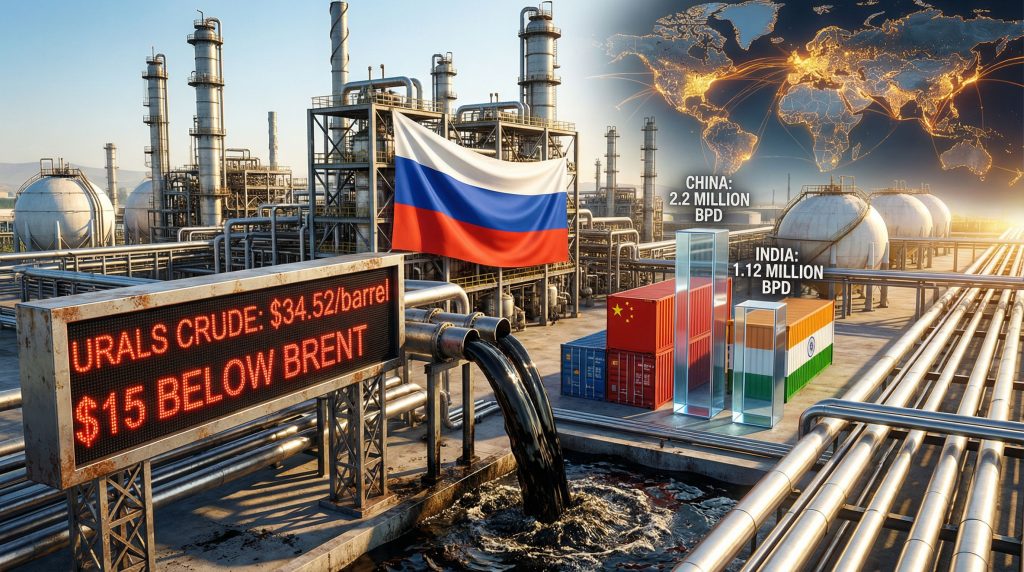
The Urals crude blend, Russia's primary export grade, currently trades at discounts ranging from $15 per barrel below Brent crude as of February 2026, representing a dramatic escalation from approximately $10 per barrel at the beginning of the year. This 50% increase in discount depth within twelve months illustrates how sanctions pressure creates compounding economic constraints that force increasingly desperate pricing strategies.
When big ASX news breaks, our subscribers know first
Strategic Discount Architecture and Market Manipulation
Russia's pricing framework operates through a multi-tiered discount system that varies by destination and crude grade. The mechanism functions as both a market access tool and geopolitical leverage instrument, with different regions receiving differentiated pricing based on risk profiles and strategic importance.
Regional Pricing Differentiation Structure:
• ESPO Blend targeting Chinese markets: $50.54 per barrel
• Urals from Baltic ports: $41.87 per barrel
• Urals from Black Sea ports: $39.40 per barrel
• Delivered prices to Indian refineries: $58.61 per barrel
This geographic segmentation reveals Russia's tactical approach to maintaining export volumes across different buyer categories. In addition, the substantial price variations reflect transportation costs, insurance premiums, and buyer-specific risk assessments that Russian exporters absorb rather than passing to customers.
Production economics indicate Russian operations function near break-even thresholds, with Siberian field extraction costs ranging from $25-40 per barrel. When Urals crude pricing approaches $34.52 per barrel levels observed in December 2025, operators cover variable costs while potentially failing to service fixed infrastructure investments.
Volume-Based Revenue Strategy Under Economic Warfare
Russia's willingness to accept compressed margins demonstrates a fundamental strategic shift from profit optimisation to revenue maximisation. This approach reflects how authoritarian states can weaponise natural resources to sustain military operations despite severe economic sanctions.
Daily fossil fuel revenues generated approximately €489 million ($573 million) in November 2025, despite implementing steep discounts across export markets. This absolute revenue figure illustrates how massive export volumes can compensate for per-unit margin erosion, supporting continued military financing and state operations.
| Revenue Metric | Value | Strategic Implication |
|---|---|---|
| Weekly Export Value | $1.04 billion | Volume-dependent revenue model |
| Daily Revenue Generation | $573 million | Military operation financing capacity |
| Annual Projection | $54 billion | Sustained war financing capability |
The four-week average export volume of 3.33 million barrels per day ending February 8, 2026, demonstrates Russia's commitment to maintaining production levels despite pricing pressures. However, this represents a decrease of approximately 540,000 barrels per day from pre-Christmas 2025 peaks, indicating emerging constraints on Russia's volume-maintenance strategy.
Production Economics Approaching Critical Thresholds
Russian crude output declined for the second consecutive month in January 2026, falling approximately 300,000 barrels per day below OPEC+ permitted levels. This production decline signals that discount-driven margin compression is beginning to impact extraction economics at field level, particularly when considering the broader OPEC production impact on global supply dynamics.
The cost structure analysis reveals heterogeneous production profiles across Russian operations:
• Mature onshore fields: $25-30 per barrel extraction costs
• Siberian operations: $30-35 per barrel operational expenses
• Remote/deepwater projects: $35-40 per barrel full-cycle costs
At current discount levels, higher-cost operations face immediate shut-in decisions, while mature fields continue operating near break-even conditions. Consequently, this creates a production hierarchy where only the most efficient operations remain economically viable under sustained discount pressure.
Asian Market Dynamics and Buyer Substitution Patterns
India's response to russia oil discounts illustrates how geopolitical pressure can override economic incentives in commodity trading relationships. Russian crude shipments to Indian refineries declined 12% in January 2026, dropping to approximately 900,000 barrels per day in the first week of February, compared to peak imports exceeding 2 million barrels per day in mid-2023.
This dramatic reduction reflects multiple convergent pressures:
• US trade agreement conditions requiring Russian oil import cessation
• Sanctions compliance concerns among Indian refining companies
• Alternative supplier availability from Middle Eastern producers
China has emerged as the primary beneficiary of India's withdrawal, with imports running at 2.2 million barrels per day in early February 2026. Furthermore, according to Reuters analysis, this buyer substitution demonstrates Russia's active destination management to maintain total export volumes despite losing major customers.
Comparative Import Analysis:
| Buyer | Current Volume | Peak Historical | Trend Direction |
|---|---|---|---|
| China | 2.2 million bpd | 2.5 million bpd | Stable/Growing |
| India | 0.9 million bpd | 2.0+ million bpd | Declining Rapidly |
| Turkey | 160,000 bpd | 350,000 bpd | Moderate Decline |
Sanctions Architecture and Compliance Cost Transfer
The discount escalation directly correlates with intensifying sanctions pressure on Russian energy exports. US sanctions on major producers including Rosneft and Lukoil created immediate market disruptions, forcing deeper discounts to maintain buyer participation despite enhanced compliance risks.
Sanctions-related complications add an estimated $3-5 per barrel in additional logistics and insurance costs. Rather than passing these expenses to buyers, Russia absorbs them through expanded discounts, indicating that market access preservation takes precedence over cost recovery.
The floating storage strategy reveals Russia's willingness to accept inventory financing costs to maintain production continuity. Moreover, approximately 60 million barrels of Russian crude accumulated on tankers between August 2025 and mid-January 2026, with 9 million barrels discharged in recent weeks as Chinese demand increased.
What Are the Broader Economic Implications?
The implementation of deep russia oil discounts creates ripple effects throughout global commodity markets, influencing everything from oil price trade war dynamics to stagnant oil prices caused by oversupply concerns. These distortions contribute to tariff-induced inflation pressures and exacerbate global trade tensions between major economies.
Geopolitical Fragmentation of Global Oil Markets
The emergence of dual pricing systems reflects broader geopolitical realignment in commodity markets, where political considerations increasingly override pure economic optimisation. This fragmentation creates:
• Sanctions-compliant premium markets serving Western buyers
• Discount-driven alternative systems serving non-aligned purchasers
• Arbitrage opportunities for intermediary trading operations
This structural change may persist beyond current conflict resolution, creating permanent alterations in global energy trade patterns. For instance, Bloomberg reports indicate that these discount patterns are fundamentally reshaping how oil markets absorb supply disruptions.
The next major ASX story will hit our subscribers first
Investment Implications and Capital Allocation Shifts
Deep Russian discounts influence global energy investment by creating pricing distortions that affect project economics across producing regions. Higher-cost extraction operations in North America, offshore developments, and frontier exploration projects face reduced investment attractiveness when competing against subsidised Russian crude.
Investment Impact Categories:
• Renewable energy acceleration: Price volatility encouraging diversification
• Strategic storage expansion: Arbitrage opportunities driving infrastructure investment
• Alternative supply development: Premium for sanctions-compliant sources
Risk premium calculations across energy investments now incorporate geopolitical factors as primary variables rather than secondary considerations. This represents a fundamental shift in how energy markets price political risk and supply reliability.
How Are Competing Producers Responding?
Non-Russian oil exporters face constrained strategic choices when competing against heavily discounted crude:
Price Matching Strategy: Sacrificing margins to maintain market share
Quality Differentiation: Emphasising sanctions-free supply reliability
Service Enhancement: Offering superior payment terms and delivery guarantees
Middle Eastern producers have emphasised supply reliability and established payment mechanisms, while North American shale operations focus on domestic market protection and premium export opportunities to sanctions-compliant buyers.
The competitive landscape increasingly rewards producers who can demonstrate:
• Consistent supply reliability without geopolitical disruption risk
• Transparent payment mechanisms through established financial systems
• Quality specifications meeting international refining standards
Disclaimer: This analysis involves market projections and geopolitical assessments that are inherently speculative. Oil market dynamics can change rapidly based on political developments, sanctions modifications, and economic conditions. Investment decisions should not be based solely on this analysis, and readers should consult qualified financial advisors and conduct independent research before making investment choices. Production cost estimates and revenue projections are based on available public information and may not reflect actual company-specific economics.
Considering Exposure to Commodity Price Volatility?
Discovery Alert's proprietary Discovery IQ model provides real-time alerts on significant ASX mineral discoveries, helping investors capitalise on opportunities while commodity markets face geopolitical disruptions and pricing volatility. Gain immediate market advantage by exploring Discovery Alert's dedicated discoveries page to understand how historic mineral discoveries have generated substantial returns, and begin your 14-day free trial today.