
June 11, 2026
Russia's December Production Crisis Unfolds
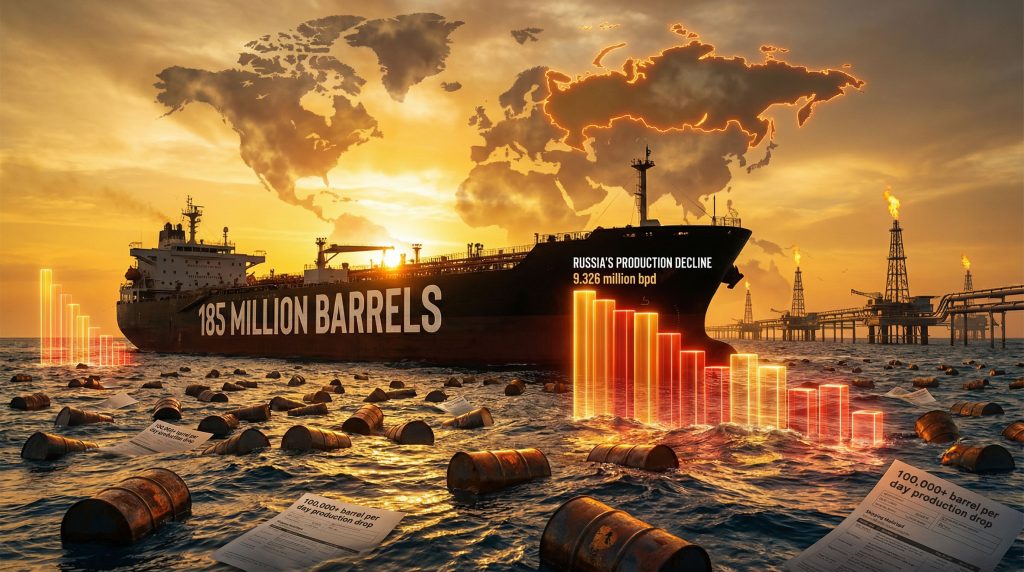
Russia's crude output plunge December has sent shockwaves through global energy markets, marking the most severe production decline in 18 months. The dramatic fall to 9.326 million barrels per day (bpd) represents more than just a statistical anomaly—it signals a fundamental shift in how geopolitical tensions are reshaping energy supply chains. Furthermore, this unprecedented reduction demonstrates the effectiveness of combined sanctions and military targeting strategies in disrupting established production patterns.
When big ASX news breaks, our subscribers know first
The Anatomy of Russia's December 2025 Production Crisis
Russia's crude output plunge December reached its most severe level in 18 months, with production falling to 9.326 million barrels per day (bpd) from November's levels. This represents a decline of more than 100,000 bpd, marking the steepest reduction since June 2024 when Russia was implementing voluntary OPEC+ cuts rather than facing external constraints.
The production shortfall becomes more significant when measured against Russia's OPEC+ quota obligations. The country's allowed production ceiling for December 2025 stood at 9.574 million bpd, meaning actual output fell approximately 248,000 bpd below permitted levels. Consequently, this dramatic underperformance contrasts sharply with Russia's historical tendency to exceed production targets within the OPEC+ framework.
Dual Pressure Points Creating Perfect Storm Conditions
December's production crisis emerged from simultaneous pressures that created unprecedented operational constraints. Western sanctions targeting major Russian producers, including Rosneft and Lukoil, generated significant export bottlenecks as buyers demonstrated increased reluctance to accept Russian cargoes. However, the situation was further complicated by Ukrainian infrastructure attacks reaching monthly record levels, directly impacting both production facilities and refinery operations.
The convergence of these factors created cascading effects throughout Russia's oil value chain. For instance, reduced refinery processing capacity due to operational disruptions lowered domestic crude consumption, while sanctions-driven export difficulties caused supply backlogs. This dual constraint mechanism forced production adjustments at upstream facilities to balance available storage capacity with limited export opportunities.
Additionally, this crisis demonstrates how the OPEC meeting impact on global supply management has become increasingly complex when geopolitical factors override traditional market mechanisms.
| Production Metric | December 2025 | Variance from Target |
|---|---|---|
| Actual Production | 9.326 million bpd | -248,000 bpd |
| OPEC+ Quota | 9.574 million bpd | Baseline |
| Monthly Decline | >100,000 bpd | Steepest since June 2024 |
Market Response and Price Volatility Implications
The significant production shortfall contributed to global supply tightness concerns, particularly given OPEC+'s commitment to maintain steady output through the first quarter of 2026. In addition, market participants responded to the supply disruption with increased volatility in benchmark crude pricing, as the unexpected decline reduced available global supply margins during a period of planned production stability.
Russian condensate production, which typically represents less than 10% of total output according to Russian Academy of National Economy research, would require disproportionate increases to offset the crude production decline. This technical limitation reinforced the significance of December's overall production reduction and its broader implications for oil price rally analysis.
Sanctions-Driven Maritime Storage Crisis and Supply Chain Disruptions
The maritime storage situation reached critical levels by late December 2025, with 185 million barrels of Russian crude accumulated in tankers at sea. This unprecedented volume reflects the compound effects of sanctions targeting Russia's largest producers and the subsequent buyer hesitancy among traditional importing nations.
Indian refineries, historically significant purchasers of Russian crude, began actively seeking alternatives to sanctioned barrels, indicating a strategic shift in procurement patterns. Furthermore, this buyer reticence created immediate logistical challenges as export terminals faced capacity constraints while seaborne inventories continued accumulating.
Geographic Distribution and Transportation Challenges
Tanker routing patterns shifted significantly as vessel operators implemented risk mitigation strategies to avoid infrastructure attack zones. Ships carrying Russian crude adopted roundabout routes along the Turkish coast to minimise exposure to drone strike risks, adding transportation costs and extending delivery timelines.
The floating storage economics became increasingly challenging as carrying costs accumulated for stranded cargoes. Extended storage periods at sea created financial pressures on both producers and vessel operators, while reducing available tanker capacity for global oil transportation needs.
According to Oil Price, the production challenges reflect broader sanctions effectiveness in constraining Russian energy operations.
The accumulation of 185 million barrels at sea represents one of the largest peacetime floating storage events in modern energy history, reflecting the complex intersection of geopolitical sanctions and supply chain logistics.
Impact on Global Tanker Markets
The concentration of Russian crude in floating storage affected global tanker availability and freight rates. Vessels committed to extended storage arrangements reduced the active fleet capacity, creating tightness in tanker markets that affected transportation costs for other crude producers and buyers worldwide.
Ship attacks targeting Russian tankers introduced additional operational complexities, making some tanker owners more cautious about accepting Russian cargo. Consequently, this reduced the available vessel pool for Russian crude transportation, further exacerbating export bottlenecks.
| Storage Metric | December 2025 | Market Impact |
|---|---|---|
| Floating Storage Volume | 185 million barrels | Unprecedented peacetime levels |
| Buyer Hesitancy | Multiple Indian refineries | Seeking alternatives |
| Transportation Risks | Drone attacks on vessels | Routing modifications |
Infrastructure Attacks and Production Capacity Constraints
Ukrainian drone attacks on Russian energy infrastructure reached monthly record levels in December 2025, representing a significant escalation in targeting scope and frequency. For the first time since the conflict began, strikes extended to Russian oil fields in the Caspian Sea, directly affecting production capacity rather than solely targeting transportation and refining assets.
The expanded targeting strategy demonstrated Ukraine's enhanced operational reach and tactical evolution in energy infrastructure warfare. Caspian Sea field strikes indicated capabilities to affect production assets in previously protected geographic regions, fundamentally altering the risk assessment for Russian oil operations.
How Have Refinery Operations Responded to Increased Attacks?
Russian refineries operated below seasonal historical averages throughout most of December as facilities reduced or completely halted operations amid the increased strike frequency. This operational disruption created secondary effects on crude consumption, as reduced refinery throughput decreased domestic demand for Russia's crude production.
The refinery capacity constraints compounded export pressure by eliminating domestic consumption outlets for crude that could not be exported due to sanctions-related buyer hesitancy. In addition, this created additional inventory management challenges at production facilities already facing limited storage capacity.
Supply Chain Vulnerability Assessment
The December attacks revealed critical infrastructure dependencies within Russia's oil production system. The successful targeting of geographically dispersed assets from traditional export terminals to remote Caspian Sea fields demonstrated comprehensive vulnerability across the production value chain.
Transportation infrastructure attacks forced operational modifications including alternative routing strategies and enhanced security protocols. These adjustments increased operational costs while reducing system efficiency, contributing to overall production economics deterioration and affecting broader oil price movements.
- Production facilities: Direct capacity loss from field-level strikes
- Refinery operations: Processing capability reduction affecting domestic consumption
- Transportation networks: Routing modifications and security cost increases
- Storage systems: Capacity constraints from export bottlenecks
Historical OPEC+ Compliance Patterns Versus Current Crisis
Russia's historical relationship with OPEC+ agreements typically involved overproduction relative to assigned quotas, requiring subsequent compensatory cuts to maintain compliance with group production targets. This pattern reflected Russia's tendency to prioritise market share and revenue generation over strict quota adherence.
The December 2025 production decline represents a fundamental departure from this historical behaviour. Rather than voluntary production management, external constraints drove output below quota levels for the first time in recent compliance cycles.
Contextualising the Supply Restart Agreement
OPEC+ had agreed to gradually return barrels to the market between April and December 2025, with commitments to maintain steady output through the first quarter of 2026. Russia's production had been rising throughout the supply restart period until December's decline disrupted this trajectory.
The timing of Russia's production crisis coincided with OPEC+'s transition from supply increases to output stability, creating additional market tightness during a period when spare capacity utilisation was already limited across member nations. However, this development has significant implications for understanding US oil production decline patterns in comparative context.
| Compliance Period | Russia's Behaviour | December 2025 Reality |
|---|---|---|
| Historical Pattern | Overproduction above quotas | 248,000 bpd below quota |
| Typical Response | Compensatory future cuts | External constraint-driven |
| Market Impact | Excess supply management | Involuntary supply reduction |
Alternative Supply Source Implications
The unexpected Russian shortfall placed additional pressure on other OPEC+ members with available spare capacity to consider production adjustments. Saudi Arabia and UAE spare capacity utilisation became increasingly relevant as market participants assessed supply adequacy for early 2026.
The involuntary nature of Russia's production decline differentiated it from coordinated OPEC+ supply management strategies, creating uncertainty about recovery timelines and the need for compensatory production increases from other group members.
Geopolitical Energy Security Transformations
The December production crisis accelerated existing trends toward energy supply diversification among traditional Russian crude importers. European nations, already reducing Russian energy dependencies through policy initiatives, gained additional urgency for alternative supplier relationships and strategic reserve management.
NATO member states reassessed energy security frameworks in light of demonstrated vulnerability to supply disruption through infrastructure attacks. The combination of sanctions effectiveness and military targeting capabilities revealed the fragility of traditional energy trade relationships during geopolitical conflicts.
Emerging Market Procurement Strategy Evolution
Non-aligned nations faced complex decisions regarding continued purchases of discounted Russian crude amid escalating sanctions and supply reliability concerns. Countries previously attracted to Russian crude pricing advantages now weighed potential payment system complications and supply continuity risks.
Payment mechanism innovations became increasingly important as traditional banking channels faced restrictions. Alternative settlement systems, including commodity exchanges and bilateral arrangements, gained prominence as buyers sought sanctions-compliant procurement methods.
Furthermore, market analysis from Bloomberg indicates that Moscow's war chest has been significantly impacted by the plunge in oil exports and prices.
- European Union: Accelerated alternative supplier contracting
- Asian buyers: Risk assessment of Russian crude reliability
- Payment systems: Innovation in sanctions-compliant mechanisms
- Strategic reserves: Enhanced inventory management protocols
The next major ASX story will hit our subscribers first
Global Oil Market Structure Reconfiguration
Russia's December production crisis highlighted the potential for permanent shifts in global oil trade patterns beyond temporary geopolitical disruptions. The demonstrated effectiveness of combined sanctions and infrastructure attacks created precedents for future energy security calculations worldwide.
Investment flows toward non-Russian production capacity gained momentum as market participants reassessed long-term supply reliability assumptions. Enhanced oil recovery projects and capacity expansion initiatives in alternative regions received increased attention from both public and private sector funding sources.
Price Discovery Mechanism Evolution
Regional price differentials between sanctioned and non-sanctioned crude expanded as market participants incorporated additional risk premiums for Russian barrels. This pricing evolution reflected changing perceptions of supply reliability and counterparty risk in energy trading relationships.
Benchmark crude pricing relationships experienced volatility as traditional arbitrage mechanisms faced disruption from sanctions-related trading restrictions. Alternative pricing references gained importance for market participants seeking to establish fair value for various crude grades and geographic origins.
Technology Transfer and Production Enhancement Impacts
The reduced availability of Russian crude accelerated technology transfer initiatives toward alternative production regions. Enhanced oil recovery techniques and production optimisation technologies gained strategic importance as consuming nations sought to maximise output from non-Russian sources.
International collaboration on energy technology development intensified as nations recognised the strategic value of production capacity diversification. Research and development investments focused on improving extraction efficiency and reducing production costs in politically stable regions.
| Market Structure Change | Short-term Impact | Long-term Implications |
|---|---|---|
| Supply Chain Reconfiguration | Immediate disruption | Permanent route changes |
| Investment Flow Redirection | Alternative region focus | Capacity expansion acceleration |
| Price Discovery Evolution | Increased volatility | New benchmark relationships |
Economic Indicators and Market Monitoring Framework
Investors and market participants require enhanced monitoring capabilities to assess ongoing developments in Russian oil production capacity and global supply adequacy. Weekly production data interpretation becomes increasingly complex as traditional reporting mechanisms face limitations due to classified government statistics.
Infrastructure repair timelines and capacity restoration indicators provide critical insights into supply recovery potential. The geographic expansion of targeting capabilities suggests sustained vulnerability requiring continuous assessment of production stability.
Key Performance Metrics for Supply Assessment
Production capacity utilisation rates across major global producers gained enhanced importance as spare capacity margins tightened. Real-time monitoring of refinery operations, transportation bottlenecks, and storage availability became essential for accurate supply-demand balance calculations.
Inventory levels across major consuming regions provided crucial indicators of supply adequacy and strategic reserve utilisation patterns. Regional inventory differentials highlighted the effectiveness of supply chain reconfiguration efforts and alternative sourcing strategies.
- Weekly production tracking: Enhanced data collection methodologies
- Infrastructure assessment: Damage evaluation and repair timeline estimation
- Transportation monitoring: Tanker tracking and route optimisation analysis
- Inventory management: Strategic reserve levels and commercial stock assessment
Investment Opportunity Identification
Alternative supply development projects gained enhanced investment attractiveness as traditional Russian sources faced sustained uncertainty. Capacity expansion initiatives in stable political environments offered strategic value beyond traditional economic returns.
Technology companies specialising in enhanced oil recovery and production optimisation experienced increased interest from both energy sector investors and government strategic programmes. Innovation in supply chain resilience and alternative transportation methods became priority investment themes.
Long-Term Structural Energy Market Evolution
The December 2025 Russian production crisis represents a potential inflection point in global energy market structure, with implications extending far beyond immediate supply disruptions. The demonstrated effectiveness of combined economic sanctions and military infrastructure targeting established new paradigms for energy security planning.
Permanent versus cyclical market shifts require careful analysis as stakeholders assess whether current disruptions represent temporary geopolitical volatility or fundamental changes to global energy trade patterns. The scale and persistence of supply chain reconfiguration efforts suggest structural rather than temporary market evolution, particularly when examining oil price crash dynamics more broadly.
Technology Adoption and Production Innovation
Enhanced oil recovery technology adoption accelerated across non-Russian production regions as operators sought to maximise output from existing assets. Innovation in production efficiency and cost reduction gained strategic importance as alternative suppliers worked to replace Russian crude capacity.
International cooperation on energy technology development intensified as consuming nations recognised the strategic value of production capacity diversification. Research and development investments focused on reducing dependence on geopolitically vulnerable supply sources through technological advancement.
The convergence of sanctions effectiveness, infrastructure vulnerability, and supply chain reconfiguration capabilities suggests lasting changes to global energy security frameworks. Energy-importing nations now possess enhanced tools for managing geopolitical energy dependencies, while producing nations face new vulnerability assessments for infrastructure protection and market access stability.
Disclaimer: This analysis is based on publicly available information and market observations. Energy market conditions remain highly volatile due to geopolitical factors, and actual outcomes may differ significantly from current assessments. Readers should conduct independent research and consider multiple scenarios when making investment or policy decisions related to energy markets.
Want to Stay Ahead of Energy Market Disruptions?
Russia's December production crisis demonstrates how quickly global energy markets can shift, creating significant opportunities for informed investors. Discovery Alert's proprietary Discovery IQ model delivers real-time alerts on major ASX mineral discoveries, helping subscribers identify actionable trading opportunities in the resources sector before market volatility impacts broader investment strategies. Begin your 30-day free trial today to position yourself ahead of rapidly evolving commodity markets.