July 16, 2026
The Hidden Architecture Behind India's Oil Import Strategy
Energy security rarely announces itself until it fails. The quiet machinery of crude import logistics, refinery feedstock scheduling, and supply corridor risk management operates invisibly in the background of national economies, surfacing only when a disruption forces it into public view. For India, the world's third-largest crude importer, this machinery has undergone a structural transformation since 2022 that most casual observers have only partially understood. The shift toward Russian crude is not simply a story of opportunistic discount-seeking. It reflects a sophisticated, multi-layered hedging strategy built around geography, economics, and refinery chemistry simultaneously.
Understanding why Russian crude remains India's key energy security hedge requires unpacking several interlocking dynamics, from the physical constraints of the Strait of Hormuz to the legislative anatomy of proposed US tariffs and the hard arithmetic of replacement barrel availability. Furthermore, the US-China trade war impacts on global energy flows add another layer of complexity to India's procurement calculus.
When big ASX news breaks, our subscribers know first
India's Structural Import Dependency: Why the Numbers Leave Little Room for Idealism
India imports approximately 85 to 90% of its total crude oil requirements from international markets. This is not a policy failure but a geological reality. Domestic production, centred on mature fields in Rajasthan, Gujarat, and offshore basins, covers only a fraction of a consumption base driven by one of the world's fastest-growing industrial economies.
The compounding pressures are significant. Rapid GDP expansion, a refinery capacity build-out that has added tens of millions of tonnes of annual throughput over the past decade, and rising per capita vehicle ownership collectively ensure that import volumes increase structurally each year rather than merely cyclically.
For energy planners, this creates a foundational vulnerability: any single-point failure in supply chains translates almost immediately into fuel shortages, inflationary pressure, and current account deterioration. The strategic response is not to reduce imports, which is not economically feasible in the near term, but to architect a multi-corridor, multi-supplier import system capable of absorbing disruption from any single source.
Russian crude has consequently emerged as the cornerstone of that architecture, and the reasons extend well beyond price alone.
From Near-Zero to Majority Supplier: The Volume Transformation
The speed of Russia's ascent in India's crude import portfolio is, by any historical measure, extraordinary. Before 2022, Russian crude represented roughly 2 to 3% of India's import mix, a marginal presence reflecting logistical friction, pricing structures aligned with European buyers, and limited commercial infrastructure connecting Russian exporters to Indian refiners.
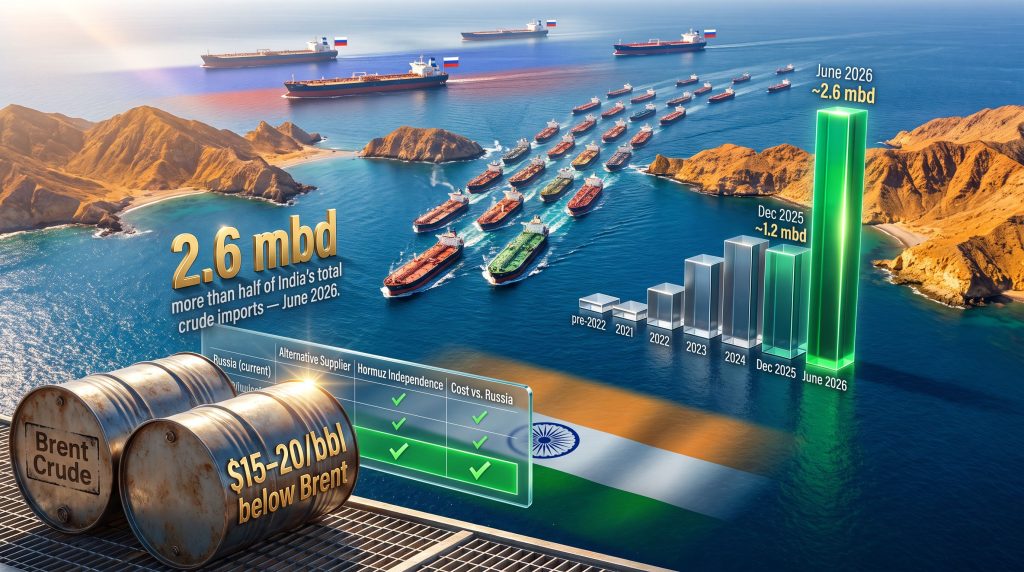
That changed decisively following Western sanctions on Russian energy exports. Within three years, Russia had become India's single largest crude supplier. By June 2026, Kpler data showed Russian crude flows to India reaching approximately 2.6 million barrels per day (mbd), accounting for more than half of India's total crude imports in a single month. Monthly volumes have risen consistently since March 2026, and July 2026 arrivals were tracking at or above June's levels.
The table below maps this structural transition across key periods:
| Period | Russian Crude Share of India's Imports | Approximate Volume |
|---|---|---|
| Pre-2022 (baseline) | ~2-3% | Marginal |
| 2023 (annual average) | ~35-40% | ~1.5-1.8 mbd |
| December 2025 (sanctions impact low) | Reduced | ~1.2 mbd |
| March-June 2026 (rebound) | ~40-50%+ | ~2.4-2.6 mbd |
| July 2026 (projected) | At or above June | ~2.6+ mbd |
The December 2025 dip to approximately 1.2 mbd is analytically important. It demonstrates that sanctions pressure can temporarily compress Indian purchases, but the subsequent rebound to record levels illustrates the structural pull factors that consistently reassert themselves. When the commercial and logistical incentives are strong enough, and the alternatives remain inadequate, volumes recover.
The Price Mechanism: More Than a Discount, a Fiscal Stabiliser
Russian Urals crude has traded at discounts of approximately $15 to $20 per barrel below Brent benchmark pricing since the Western sanctions framework took effect. This discount emerged from market segmentation: Western buyers stepped back, creating a supply overhang that required aggressive pricing to clear into alternative markets.
For India, the arithmetic is straightforward. Across annual import volumes, this differential generates estimated savings of approximately $9 billion per year for the Indian economy. This figure is not abstract. It flows directly into lower refinery input costs, reduced downstream fuel pricing pressure, and an improved current account position — the latter being particularly significant for a current-account-deficit economy sensitive to oil price rally risks.
For state-owned refiners such as Indian Oil Corporation, Bharat Petroleum, and Hindustan Petroleum, which operate under regulated margin structures, the cost differential between Russian and Middle Eastern crude functions as a fiscal stabilisation mechanism rather than simply a commercial advantage.
Refinery Chemistry: The Under-Discussed Technical Lock-In
One factor that receives insufficient attention in mainstream analysis is the technical compatibility dimension of India's Russian crude dependency. Urals crude carries a sulphur content and API gravity profile that aligns well with the existing configuration of India's major refinery complexes.
This matters because crude substitution is not a plug-and-play exercise. Replacing one crude grade with another that has materially different density, sulphur content, or distillation characteristics requires either costly refinery modification or sourcing of a chemically compatible alternative. In practice, many of the crudes available from West African or American sources have lighter API profiles that generate different yield structures, affecting the volume of diesel, petrol, and other products that refiners can extract per barrel processed.
The dual advantage of pricing discount plus processing compatibility creates a combination that competing suppliers cannot easily replicate simultaneously, reinforcing the structural stickiness of Russian crude in India's import mix.
The Hormuz Dimension: Geography as Strategic Value
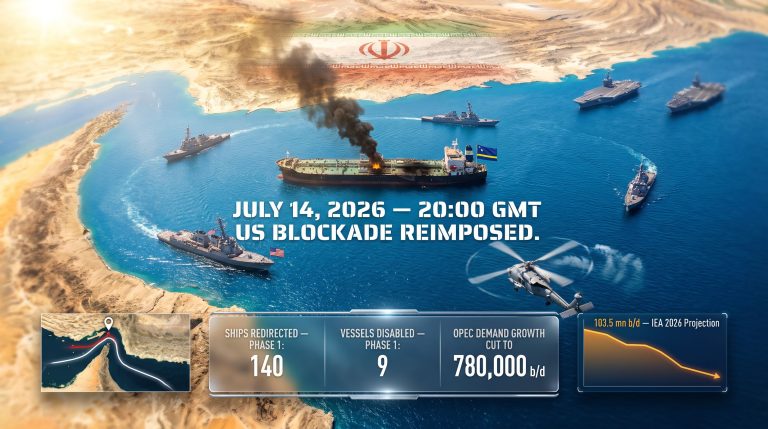
The Strait of Hormuz, the narrow waterway between Iran and the Oman Peninsula, carries approximately 20% of global daily oil supply. Saudi Arabia, Iraq, the UAE, and Kuwait — which collectively form the backbone of India's traditional supply base — route the substantial majority of their crude exports through this chokepoint.
Geopolitical escalation involving Iran, which intensified through 2025 and into 2026 amid US-Iran tensions, has elevated Hormuz disruption risk from a theoretical scenario to an active operational planning assumption for Indian refinery operators. This is a critical psychological and strategic shift: when risk moves from the tail of a probability distribution to its body, procurement strategies must adapt accordingly.
Russian crude exported to India travels via alternative maritime corridors that bypass the Strait of Hormuz entirely. When Hormuz-related disruption events occurred during 2025 and 2026, Russian crude functioned as an active supply gap filler rather than a contingency reserve, enabling Indian refineries to maintain throughput continuity during periods when Middle Eastern volumes were at risk.
A US sanctions waiver extended in early 2026 specifically permitted Indian refiners to continue accessing Russian crude during a period of Hormuz-related supply stress — an intervention that analysts assessed prevented what could have become a serious domestic supply crisis.
The scenario analysis below illustrates the consequence differential:
| Scenario | With Russian Supply Access | Without Russian Supply Access |
|---|---|---|
| Hormuz partial disruption (30 days) | Refineries maintain ~80-90% throughput | Immediate 15-25% throughput reduction |
| Hormuz full closure (60+ days) | Russian volumes absorb ~50% of Middle Eastern shortfall | Severe fuel shortages; emergency reserve drawdown |
| Price impact | Partially insulated by discounted Russian pricing | Full exposure to spot market price spike |
Kpler analyst Sumit Ritolia has noted that Russian crude has become India's strongest energy security hedge, particularly in the context of Strait of Hormuz disruption risk, a characterisation that reflects the operational reality experienced by Indian refiners during the 2025-2026 escalation period.
The Proposed US Tariff Framework: Legislative Anatomy and Market Implications
In mid-2026, US senators advanced a revised bipartisan Russia sanctions bill introducing a restructured tariff mechanism targeting countries that purchase Russian energy. The revised bill modifies a proposal originally introduced in April 2025 in several significant ways. Indeed, the Trump tariff plans have added considerable uncertainty to global energy trade relationships.
| Provision | Original Bill (April 2025) | Revised Bill (July 2026) |
|---|---|---|
| Maximum tariff on top-5 Russian energy buyers | 500% | 100% |
| Sanctions on Russian officials | Included | Included |
| Natural gas exemption threshold | Not specified | Less than 15% of Russian gas exports |
| Exemption condition | None | Active reduction steps required |
The reduction from a maximum 500% tariff to 100% is diplomatically significant, reflecting the recognition that an extreme tariff burden on India and China would generate disproportionate economic disruption and geopolitical blowback. However, even a 100% secondary tariff, if implemented in a form that materially affected Indian purchasing decisions, would restructure global crude trade flows with consequences extending well beyond the bilateral US-India relationship.
The Replacement Barrel Problem: The Market's Unanswered Question
Kpler's analysis frames the core challenge precisely: before any policy materially reducing Russian crude flows can be assessed as viable, the global oil market must first resolve a foundational supply question regarding the origin of replacement barrels.
This is not a rhetorical challenge. It is a structural one. At 2.6 mbd of Russian crude flowing to India alone, any significant volume diversion would require a replacement equivalent to a major new oil province entering production virtually overnight. Global spare production capacity is constrained by both technical depletion of standby fields and internal OPEC+ political dynamics limiting how aggressively spare capacity can be deployed.
The comparative assessment below illustrates why no single alternative supplier resolves this constraint:
| Alternative Supplier | Volume Potential | Cost vs. Russia | Hormuz Independent | Refinery Compatible |
|---|---|---|---|---|
| Saudi Arabia / UAE | High | Lower (Brent-linked) | No | High |
| United States (WTI/shale) | Moderate | Moderate (freight disadvantage) | Yes | Moderate |
| West Africa (Nigeria, Angola) | Moderate | Moderate | Yes | High |
| Iraq | High | Moderate | No (Hormuz-dependent) | High |
| Russia (current) | Very High | Highest (discounted) | Yes | High |
No alternative supplier simultaneously offers Russian crude's combination of volume capacity, pricing, geographic independence from Hormuz, and processing compatibility. This is the core reason why tariff pressure, regardless of its legislative form, faces structural limits on the impact it can practically generate.
India's Sovereign Energy Doctrine: Strategic Autonomy in Practice
India's government has consistently framed its crude procurement decisions through the lens of national interest rather than geopolitical bloc alignment. This reflects a broader foreign policy tradition of non-alignment that has been adapted to the multipolar energy market of the 2020s.
New Delhi's formal position has remained consistent despite diplomatic pressure: Russian crude imports represent a sovereign energy security decision, not a geopolitical signal. India has maintained commercial relationships with Western partners, Middle Eastern suppliers, and sanctioned suppliers simultaneously — a balancing act that requires careful diplomatic management but has so far been sustained.
The practical expression of this doctrine is a diversified supplier base in which Russian crude plays a dominant but not exclusive role, with Middle Eastern, African, and American crudes retained as complementary sources that preserve optionality without replacing Russian volumes at scale.
Systemic Market Risk: Why Disruption Extends Beyond India
Russian crude flows to India function as a pressure valve for the broader global oil market. The original design logic of Western sanctions, including the price cap mechanism, was explicitly calibrated to keep Russian oil moving to non-Western buyers. The rationale was direct: removing millions of barrels per day from global supply circulation would generate a price shock severe enough to harm the sanctioning countries' own economies.
Any tariff or policy mechanism that materially reduces Indian purchases of Russian crude would effectively reverse this design logic. The tariff impact on supply chains extends far beyond simple trade friction, and global benchmark crude prices would face significant upward pressure through multiple transmission channels:
- Spot market tightening as Russian volumes seek new buyers or are stranded
- Freight rate escalation as alternative supply routes compete for tanker capacity
- Refinery margin compression as compatible crude grades become scarcer and more expensive
- Emerging market foreign exchange pressure as import bills rise across current-account-deficit economies
Kpler's assessment is that replacing Russian exports at scale would be difficult without triggering a significant rise in oil prices, given limited spare production capacity, persistent Hormuz risk, and constrained alternative supply infrastructure.
The macroeconomic contagion risk is not confined to India. Economies across Southeast Asia, South Asia, and Sub-Saharan Africa that import crude at market prices would face disproportionate exposure to any tariff-driven oil price spike. Furthermore, the broader relationship between trade war and oil prices suggests that escalating geopolitical tensions consistently amplify commodity market volatility, creating a systemic risk that extends well beyond bilateral dynamics.
The next major ASX story will hit our subscribers first
Frequently Asked Questions: Russian Crude and India's Energy Security
Why does India continue buying Russian crude despite US sanctions pressure?
India imports approximately 85 to 90% of its crude requirements and has determined that Russian crude — offering price discounts of $15 to $20 per barrel, Hormuz-independent supply routes, and refinery-compatible grades — represents the most strategically and economically rational procurement choice under current market conditions.
How much Russian crude does India import?
India imported approximately 2.6 million barrels per day of Russian crude in June 2026, representing more than 50% of total crude imports. This marks a structural transformation from pre-2022 levels when Russian crude accounted for less than 3% of India's import mix.
What would happen if US tariffs forced India to stop buying Russian crude?
Replacing 2.6 mbd of Russian supply would require India to source equivalent volumes from alternative suppliers at higher cost, through Hormuz-dependent routes, and with potential refinery compatibility challenges. Market analysis indicates this scenario would trigger significant domestic fuel price increases and contribute to global oil market tightening.
How does Strait of Hormuz risk affect India's preference for Russian crude?
The Strait of Hormuz carries approximately 20% of global daily oil supply, and India's traditional Middle Eastern suppliers route their exports through this chokepoint. Russian crude arrives via alternative corridors, providing genuine geographic supply diversification that has functioned as an active hedge during Hormuz disruption events in 2025 and 2026.
What are the proposed US tariffs on Russian crude buyers?
A revised US bipartisan bill proposes tariffs of up to 100% on the five largest buyers of Russian energy, including India and China, reduced from the original 500% proposal introduced in April 2025. The bill includes exemptions for countries importing less than 15% of Russia's natural gas exports if they demonstrate active reduction efforts.
Is India's Russian crude dependency likely to decline near-term?
While short-term fluctuations occur — imports dropped to approximately 1.2 mbd in December 2025 amid sanctions pressure before rebounding sharply — analysts expect Russian crude remains India's key energy security hedge through the medium term, given the absence of cost-competitive, Hormuz-independent alternatives at comparable scale.
Key Takeaways: The Strategic Logic Summarised
- Volume dominance: At 2.6 mbd in June 2026, Russian crude accounts for more than half of India's total crude imports, a structural shift from near-zero pre-2022
- Cost advantage: Discounts of $15 to $20 per barrel below Brent generate estimated annual savings of approximately $9 billion for India's economy
- Geographic hedge: Russian supply routes bypass the Strait of Hormuz, providing active insulation against chokepoint risk that threatens India's entire Middle Eastern supply base
- Technical lock-in: Urals crude's sulphur content and API gravity profile are compatible with existing Indian refinery configurations, creating processing advantages that alternative grades do not easily replicate
- Replacement constraint: No alternative supplier combines Russian crude's volume capacity, pricing, Hormuz independence, and refinery compatibility simultaneously
- Tariff uncertainty: Proposed US tariffs of up to 100% on Russian energy buyers introduce geopolitical risk, but face significant structural, implementation, and enforcement barriers
- Systemic market risk: Disrupting Russian flows to India would tighten global oil supply and likely trigger price escalation with consequences extending well beyond the bilateral relationship
This article contains forward-looking assessments and scenario analysis based on available market data and analyst commentary as of July 2026. Energy market conditions, geopolitical developments, and legislative outcomes are subject to rapid change. Nothing in this article constitutes investment advice or a recommendation to take any commercial or financial position. Readers should conduct independent research before making decisions based on the information presented here.
Want to Stay Ahead of the Next Major Commodity Discovery?
While India's crude import strategy reshapes global energy flows, Discovery Alert's proprietary Discovery IQ model scans ASX announcements in real time, instantly identifying significant mineral discoveries across more than 30 commodities — from energy to critical metals — and delivering actionable insights directly to subscribers. Explore historic discoveries and the returns they generated, then begin your 14-day free trial to position yourself ahead of the broader market.